Earth’s Layers and Plates
A free science worksheet ready for your classroom. Open in Kuraplan to grab the print-ready PDF, customize it for your students, or generate a fresh version in seconds.
Earth’s Layers and Plates
Inside Earth: Layers and Moving Plates
Earth may look like a smooth blue and green ball from space, but it is made of several layers. Each layer has different materials and temperatures. These layers work together to shape the planet we live on.
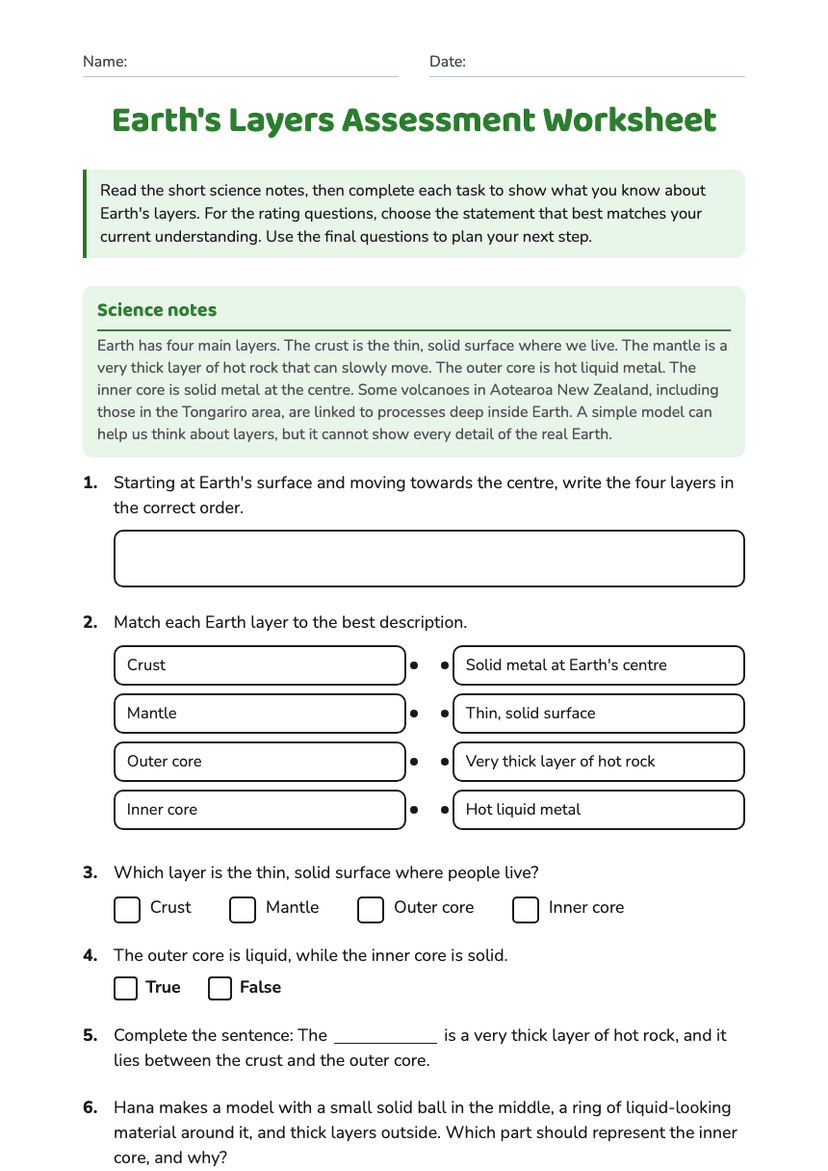
The crust is Earth’s thin, hard outer layer. It is the layer where people, animals and plants live. The crust includes the land under our feet and the rocks beneath the oceans. Although it seems solid, the crust is broken into huge pieces called tectonic plates.
Under the crust is the mantle. The mantle is a very thick layer of hot rock. Most of this rock is solid, but it can slowly bend and flow over a very long time. Heat from deep inside Earth causes gentle movements in the mantle. These movements help the tectonic plates move.
Below the mantle is the outer core. It is made mostly of very hot, melted metals, including iron. The movement of these metals helps create Earth’s magnetic field. This invisible field helps protect our planet from some harmful particles from the Sun.
At the centre of Earth is the inner core. It is also made mostly of iron and is extremely hot. However, the pressure is so great that the inner core is solid. No person has travelled to these deep layers. Scientists learn about them by studying rocks, earthquakes and waves that travel through Earth.
Tectonic plates move very slowly, often only a few centimetres each year. At a plate boundary, two plates may move apart, move towards each other or slide past one another. When plates move apart, melted rock can rise and form new crust. When plates push together, one plate may sink beneath another, or the land may crumple and form mountains.
Plate movement can cause earthquakes. An earthquake happens when rocks suddenly move and release energy. Plate movement can also create volcanoes. A volcano forms when melted rock, called magma, rises through cracks in Earth’s crust.
Aotearoa New Zealand lies near the boundary between the Australian Plate and the Pacific Plate. This is why our country has earthquakes, volcanoes and mountain ranges. The Southern Alps were formed as plates pushed together. Learning about Earth’s layers and plates helps us understand these features and prepare safely for natural hazards.
Glossary
crust: Earth’s thin, hard outer layer.
mantle: A thick layer of hot rock beneath the crust.
outer core: The layer of melted metal beneath the mantle.
inner core: The hot, solid centre of Earth.
tectonic plate: A huge piece of Earth’s crust that moves slowly.
plate boundary: The place where two tectonic plates meet.
Reading Comprehension
_____ Magma rises through cracks in the crust.
_____ Plates move and create cracks or weak places.
_____ A volcano forms at the surface.
_____ Melted rock is pushed upwards.
Teacher Answer Key
1. The crust.
2. Very hot rock; it is mostly solid but can slowly bend and flow over a long time.
3. Iron.
4. The Australian Plate and the Pacific Plate.
5. Move slowly over time.
6. Let out.
7. Dangerous events caused by nature.
8. The pressure at Earth’s centre is so great that the inner core stays solid.
9. The land can crumple and rise when the plates push together.
10. They help scientists learn about Earth’s deep layers.
11. Correct order: 2, 1, 4, 3.
12. Answers should explain that plate movement can cause earthquakes, volcanoes, new crust or mountains. Award credit for two accurate examples supported by the article.
About This Worksheet
Free in Kuraplan
Sign up free, grab the PDF, and customize it for your class.
Print-Ready
Formatted for standard paper. Clean layout, easy to read.
AI-Generated
Created with Kuraplan's AI, designed for real classroom use.
For Teachers & Parents
Use in classrooms, for homework, tutoring, or homeschool.
Need a custom version of this worksheet?
Kuraplan's AI generates custom worksheets in seconds — differentiated for every learner, aligned to your curriculum.
Generate Custom Worksheets — Free