ScienceFreePrintable

Ecosystems and Māori Perspectives

A free science worksheet ready for your classroom. Open in Kuraplan to grab the print-ready PDF, customize it for your students, or generate a fresh version in seconds.
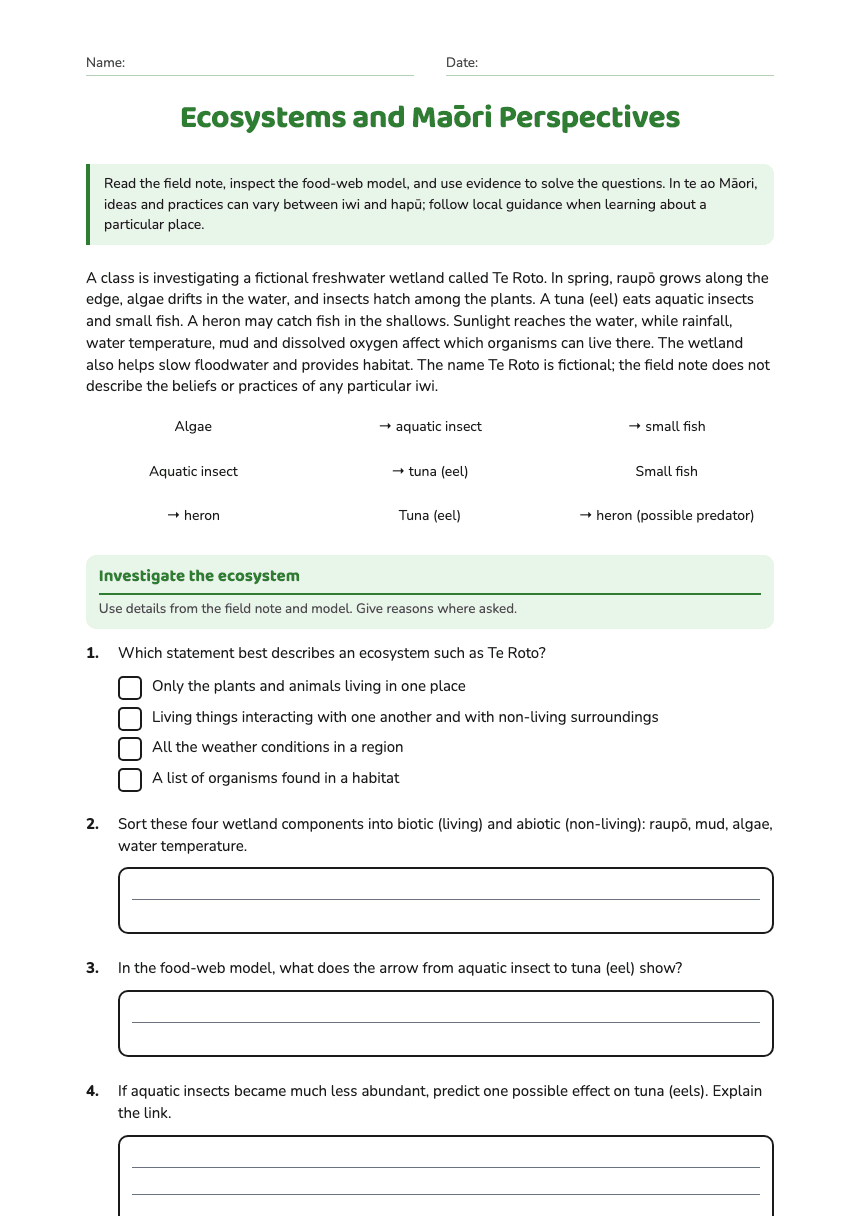
Ecosystems and Māori Perspectives worksheet preview
Name:Date:

Ecosystems and Māori Perspectives

Read the field note, inspect the food-web model, and use evidence to solve the questions. In te ao Māori, ideas and practices can vary between iwi and hapū; follow local guidance when learning about a particular place.
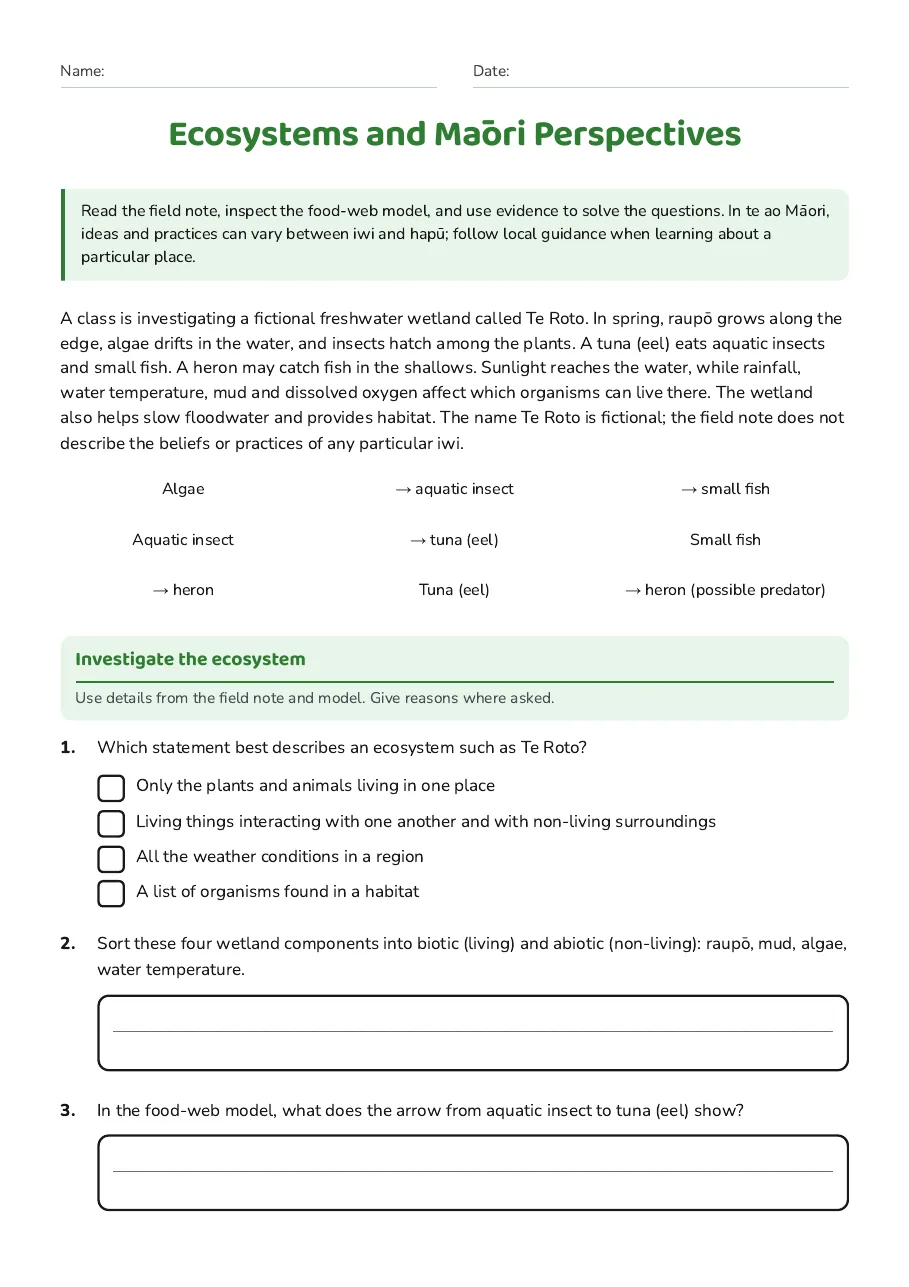
A class is investigating a fictional freshwater wetland called Te Roto. In spring, raupō grows along the edge, algae drifts in the water, and insects hatch among the plants. A tuna (eel) eats aquatic insects and small fish. A heron may catch fish in the shallows. Sunlight reaches the water, while rainfall, water temperature, mud and dissolved oxygen affect which organisms can live there. The wetland also helps slow floodwater and provides habitat. The name Te Roto is fictional; the field note does not describe the beliefs or practices of any particular iwi.

Algae

→ aquatic insect

→ small fish

Aquatic insect

→ tuna (eel)

Small fish

→ heron

Tuna (eel)

→ heron (possible predator)

Investigate the ecosystem

Use details from the field note and model. Give reasons where asked.

1.Which statement best describes an ecosystem such as Te Roto?
  • Only the plants and animals living in one place
  • Living things interacting with one another and with non-living surroundings
  • All the weather conditions in a region
  • A list of organisms found in a habitat
2.Sort these four wetland components into biotic (living) and abiotic (non-living): raupō, mud, algae, water temperature.
3.In the food-web model, what does the arrow from aquatic insect to tuna (eel) show?
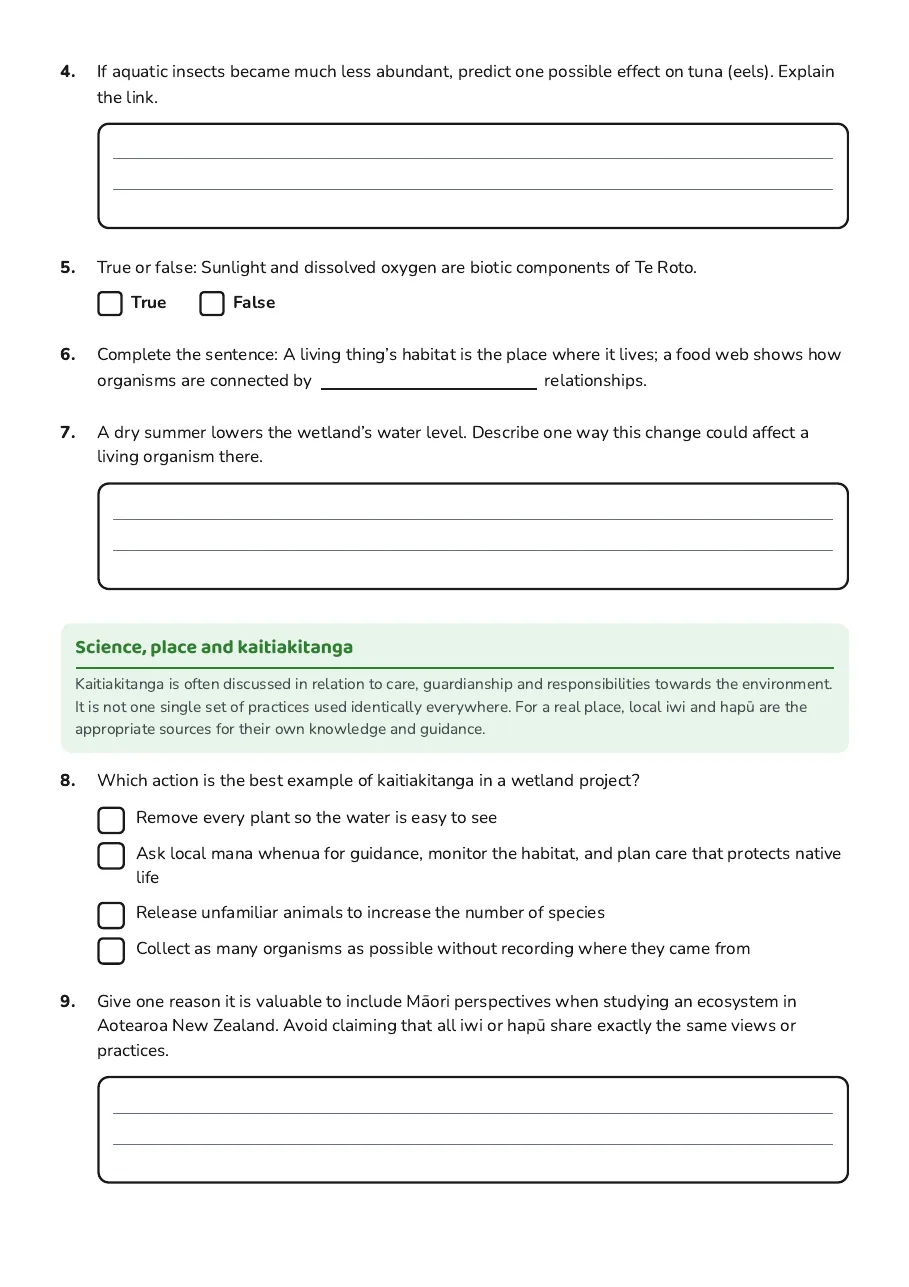
4.If aquatic insects became much less abundant, predict one possible effect on tuna (eels). Explain the link.
5.True or false: Sunlight and dissolved oxygen are biotic components of Te Roto.
TrueFalse
6.Complete the sentence: A living thing’s habitat is the place where it lives; a food web shows how organisms are connected by relationships.
7.A dry summer lowers the wetland’s water level. Describe one way this change could affect a living organism there.

Science, place and kaitiakitanga

Kaitiakitanga is often discussed in relation to care, guardianship and responsibilities towards the environment. It is not one single set of practices used identically everywhere. For a real place, local iwi and hapū are the appropriate sources for their own knowledge and guidance.

8.Which action is the best example of kaitiakitanga in a wetland project?
  • Remove every plant so the water is easy to see
  • Ask local mana whenua for guidance, monitor the habitat, and plan care that protects native life
  • Release unfamiliar animals to increase the number of species
  • Collect as many organisms as possible without recording where they came from
9.Give one reason it is valuable to include Māori perspectives when studying an ecosystem in Aotearoa New Zealand. Avoid claiming that all iwi or hapū share exactly the same views or practices.
10.Propose one practical wetland-care action for the fictional Te Roto. Explain which part of the ecosystem it could help and how you would check whether the action is working.

3 printable pages

  • Ecosystems and Māori Perspectives, page 1 of 3: Investigate the ecosystem

    Page 1

  • Ecosystems and Māori Perspectives, page 2 of 3: Science, place and kaitiakitanga

    Page 2

  • Ecosystems and Māori Perspectives, page 3 of 3: 10. Propose one practical wetland-care action for the fictional Te Roto. Explain which…

    Page 3

About This Worksheet

Free in Kuraplan

Sign up free, grab the PDF, and customize it for your class.

Print-Ready

Formatted for standard paper. Clean layout, easy to read.

AI-Generated

Created with Kuraplan's AI, designed for real classroom use.

For Teachers & Parents

Use in classrooms, for homework, tutoring, or homeschool.

Need a custom version of this worksheet?

Kuraplan's AI generates custom worksheets in seconds — differentiated for every learner, aligned to your curriculum.

Generate Custom Worksheets — Free
No credit card Curriculum-aligned Under 60 seconds