Electrochemical Cell Potentials
A free science worksheet ready for your classroom. Open in Kuraplan to grab the print-ready PDF, customize it for your students, or generate a fresh version in seconds.
Electrochemical Cell Potentials

🎯 WALT & Success Criteria
We Are Learning To: Calculate standard cell potentials and predict the spontaneity of electrochemical reactions
Success Criteria - I can:
✓ Use standard reduction potentials to calculate cell potentials
✓ Predict whether a reaction is spontaneous using E°cell values
✓ Explain how concentration changes affect cell potentials
✓ Connect electrochemical principles to real-world applications
📚 Key Concepts
Remember: E°cell = E°cathode - E°anode
Spontaneous reactions: E°cell > 0
Mātauranga Māori Connection: Traditional Māori understanding of mauri (life force) in materials relates to electron flow and energy transfer in electrochemical cells.
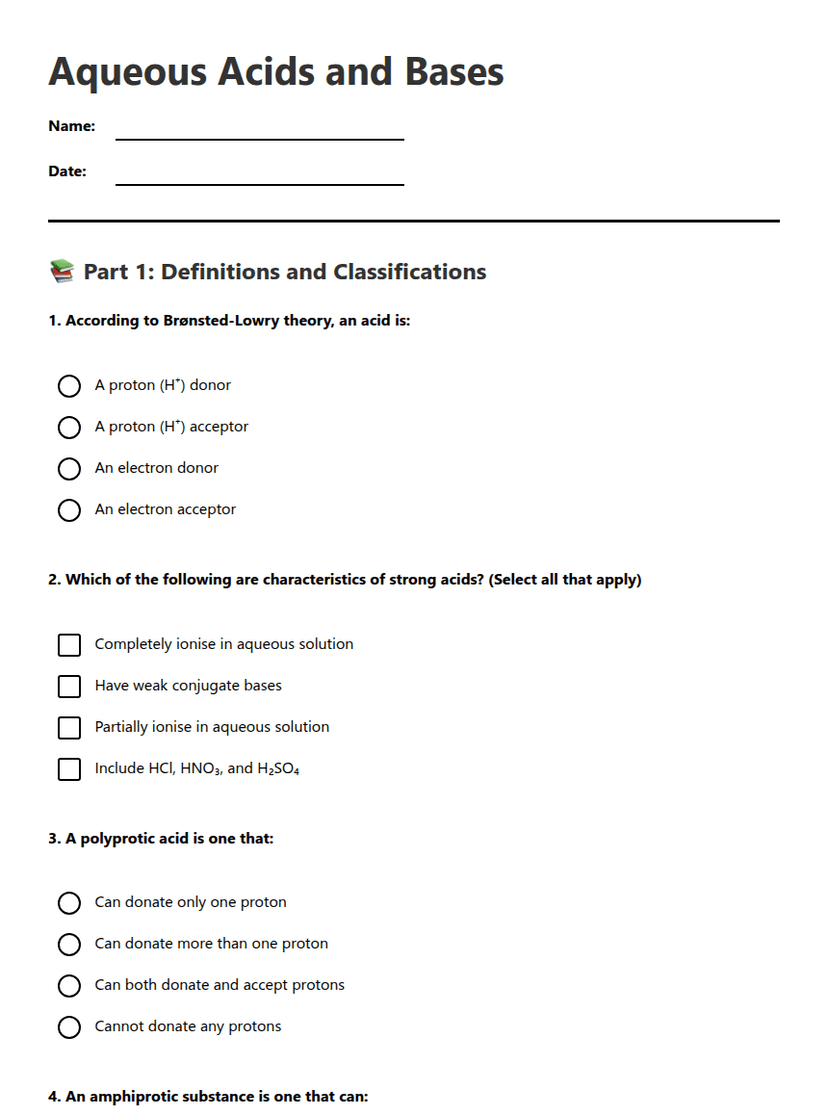
🔋 Part 1: Standard Cell Potential Calculations
Given: Ag⁺ + e⁻ → Ag (E° = +0.80 V), Cu²⁺ + 2e⁻ → Cu (E° = +0.34 V)
Given: Al³⁺ + 3e⁻ → Al (E° = -1.66 V), Mg²⁺ + 2e⁻ → Mg (E° = -2.37 V)
🌊 Part 2: Real-World Applications & Concentration Effects
🎯 Differentiation Support
For dyslexia-friendly reading: Key terms are in bold. Use the formula sheet provided.
Support strategy: Work in pairs to discuss concepts before writing answers.
Extension: Research how fuel cells work and calculate their theoretical efficiency.
About This Worksheet
Free in Kuraplan
Sign up free, grab the PDF, and customize it for your class.
Print-Ready
Formatted for standard paper. Clean layout, easy to read.
AI-Generated
Created with Kuraplan's AI, designed for real classroom use.
For Teachers & Parents
Use in classrooms, for homework, tutoring, or homeschool.
Need a custom version of this worksheet?
Kuraplan's AI generates custom worksheets in seconds — differentiated for every learner, aligned to your curriculum.
Generate Custom Worksheets — Free