Email Writing Scaffolding Guide
A free english worksheet ready for your classroom. Open in Kuraplan to grab the print-ready PDF, customize it for your students, or generate a fresh version in seconds.
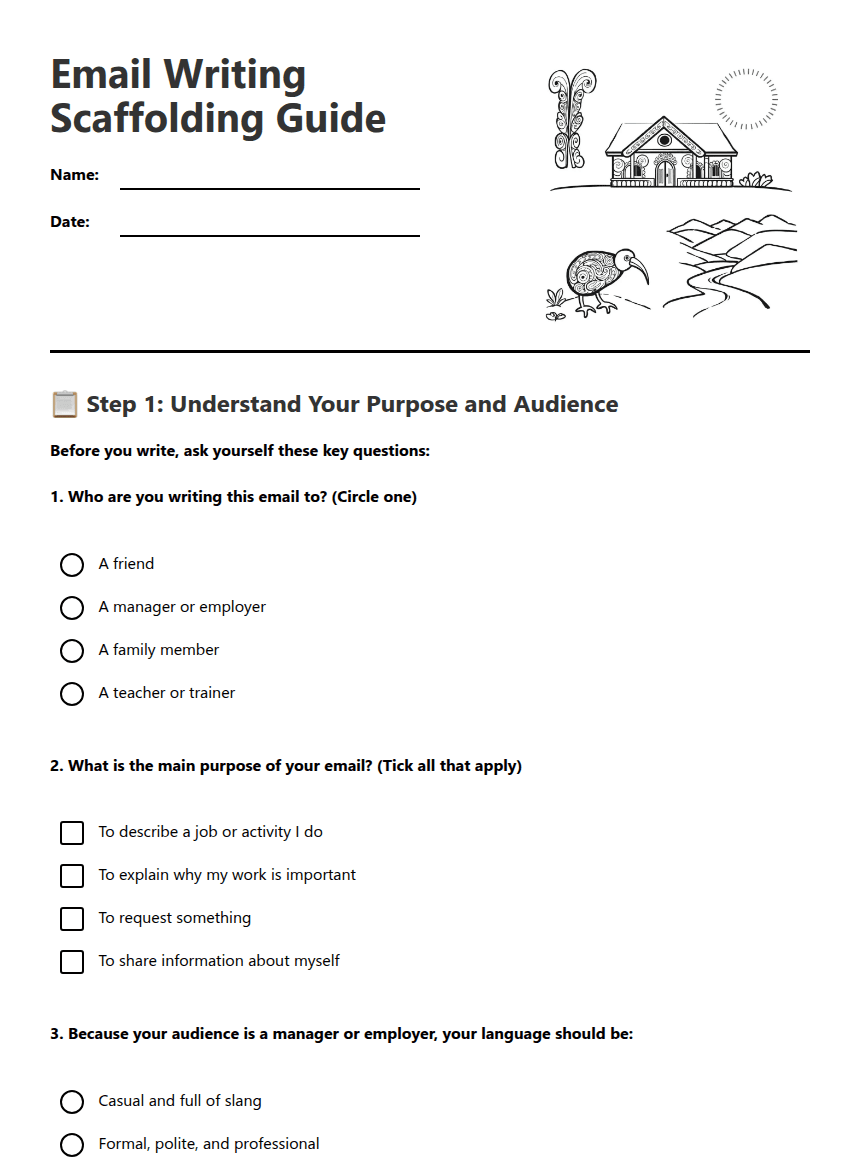
Email Writing Scaffolding Guide

📋 Step 1: Understand Your Purpose and Audience
Before you write, ask yourself these key questions:
🗂️ Step 2: Plan Your Email Structure
A well-written email has three main parts. Use the boxes below to plan what you will write in each section.
📌 Example Email Structure:
Greeting: "Dear [Name],"
Body Paragraph 1 – Describe your activity/job: "I work as a kitchen hand at a local café. My main tasks include..."
Body Paragraph 2 – Explain why it is important: "This role is important because..."
Closing: "Thank you for your time. Kind regards, [Your Name]"
Dear _________________________,
Paragraph 1 – What is your job or activity?
Paragraph 2 – Why is it important?
Closing sentence: _________________________________________
Sign-off (e.g. Kind regards): _________________________________________
Your name: _________________________________________
✏️ Step 3: Write Your Draft Email (150–250 words)
Use your plan from Step 2 and the sentence starters below to help you write your full email draft.
💡 Helpful Sentence Starters:
• "I am writing to tell you about..."
• "My role involves..." | "One of my main responsibilities is..."
• "This is important because..." | "Without this, ..."
• "I enjoy this work because..." | "I have learnt that..."
📝 Useful Vocabulary: responsible, organise, communicate, contribute, ensure, assist, maintain, complete, professional, reliable
Total word count: ___________
Is this between 150–250 words?
Yes No – I need to add/remove some sentences.🔍 Step 4: Revise and Edit Your Email
Read through your draft carefully and use this checklist before writing your final copy.
About This Worksheet
Free in Kuraplan
Sign up free, grab the PDF, and customize it for your class.
Print-Ready
Formatted for standard paper. Clean layout, easy to read.
AI-Generated
Created with Kuraplan's AI, designed for real classroom use.
For Teachers & Parents
Use in classrooms, for homework, tutoring, or homeschool.
Need a custom version of this worksheet?
Kuraplan's AI generates custom worksheets in seconds — differentiated for every learner, aligned to your curriculum.
Generate Custom Worksheets — Free