A free english worksheet ready for your classroom. Open in Kuraplan to grab the print-ready PDF, customize it for your students, or generate a fresh version in seconds.
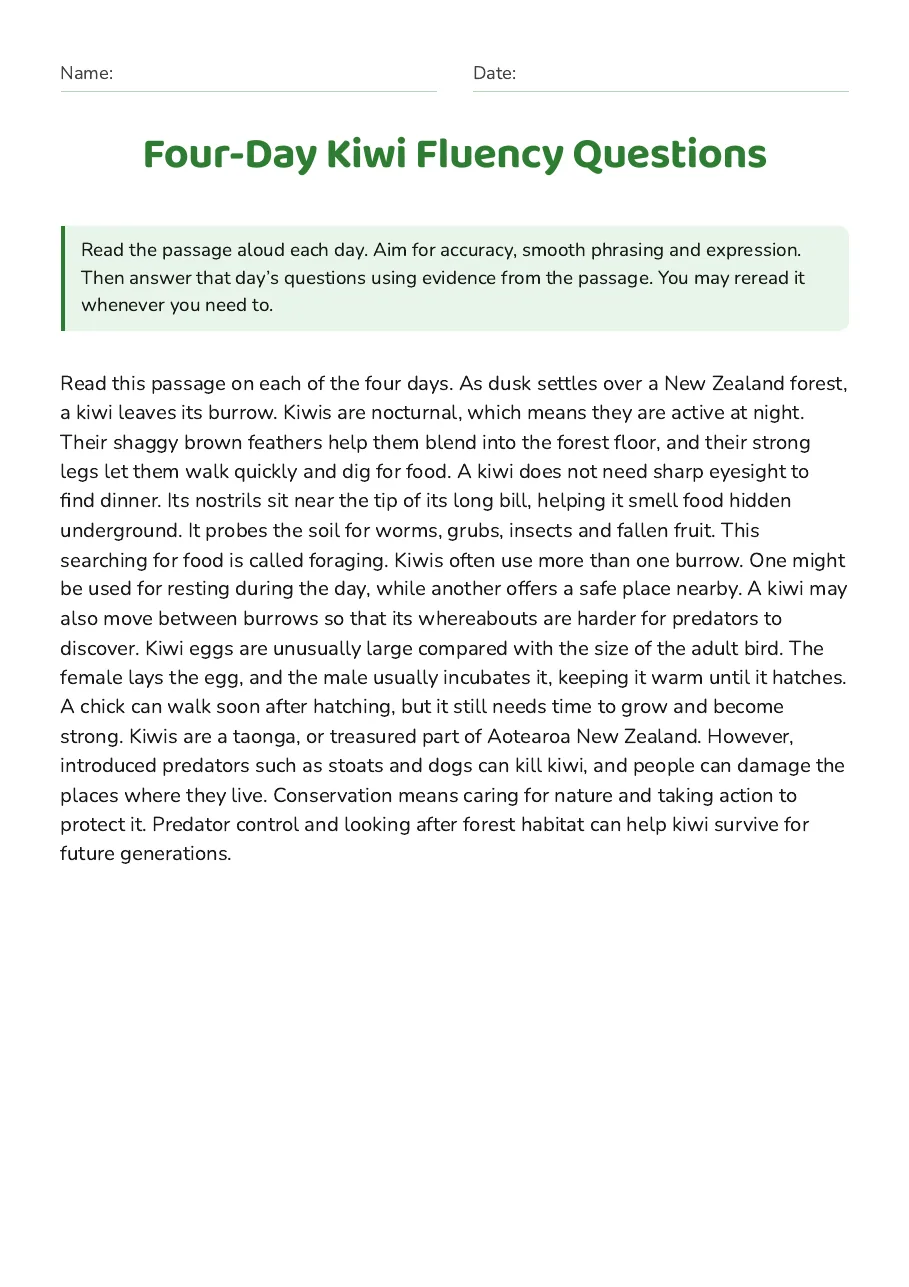
Read the passage aloud each day. Aim for accuracy, smooth phrasing and expression. Then answer that day’s questions using evidence from the passage. You may reread it whenever you need to.
Read this passage on each of the four days.
As dusk settles over a New Zealand forest, a kiwi leaves its burrow. Kiwis are nocturnal, which means they are active at night. Their shaggy brown feathers help them blend into the forest floor, and their strong legs let them walk quickly and dig for food.
A kiwi does not need sharp eyesight to find dinner. Its nostrils sit near the tip of its long bill, helping it smell food hidden underground. It probes the soil for worms, grubs, insects and fallen fruit. This searching for food is called foraging.
Kiwis often use more than one burrow. One might be used for resting during the day, while another offers a safe place nearby. A kiwi may also move between burrows so that its whereabouts are harder for predators to discover.
Kiwi eggs are unusually large compared with the size of the adult bird. The female lays the egg, and the male usually incubates it, keeping it warm until it hatches. A chick can walk soon after hatching, but it still needs time to grow and become strong.
Kiwis are a taonga, or treasured part of Aotearoa New Zealand. However, introduced predators such as stoats and dogs can kill kiwi, and people can damage the places where they live. Conservation means caring for nature and taking action to protect it. Predator control and looking after forest habitat can help kiwi survive for future generations.
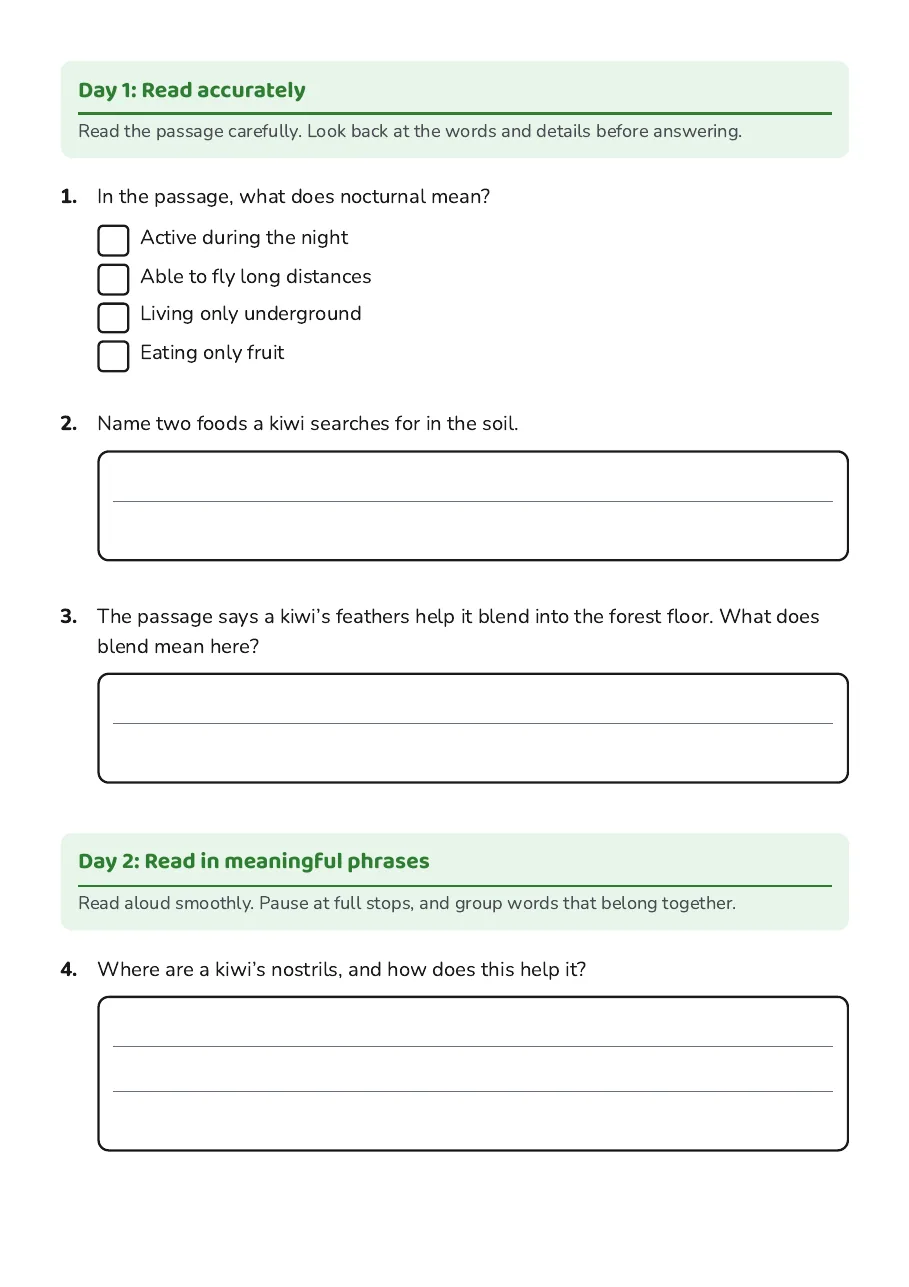
Day 1: Read accurately
Read the passage carefully. Look back at the words and details before answering.
1.In the passage, what does nocturnal mean?
Active during the night
Able to fly long distances
Living only underground
Eating only fruit
2.Name two foods a kiwi searches for in the soil.
3.The passage says a kiwi’s feathers help it blend into the forest floor. What does blend mean here?
Day 2: Read in meaningful phrases
Read aloud smoothly. Pause at full stops, and group words that belong together.
4.Where are a kiwi’s nostrils, and how does this help it?
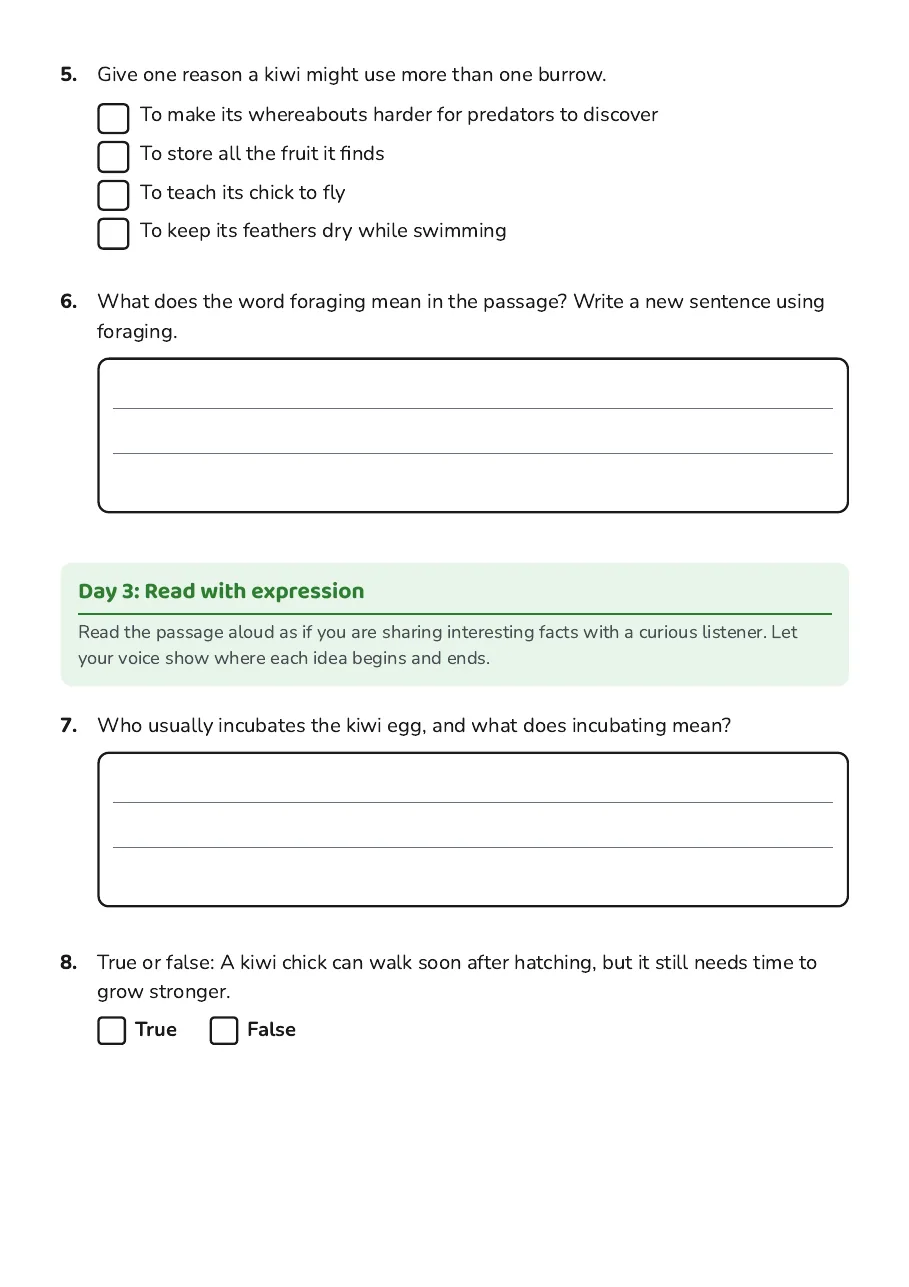
5.Give one reason a kiwi might use more than one burrow.
To make its whereabouts harder for predators to discover
To store all the fruit it finds
To teach its chick to fly
To keep its feathers dry while swimming
6.What does the word foraging mean in the passage? Write a new sentence using foraging.
Day 3: Read with expression
Read the passage aloud as if you are sharing interesting facts with a curious listener. Let your voice show where each idea begins and ends.
7.Who usually incubates the kiwi egg, and what does incubating mean?
8.True or false: A kiwi chick can walk soon after hatching, but it still needs time to grow stronger.
TrueFalse
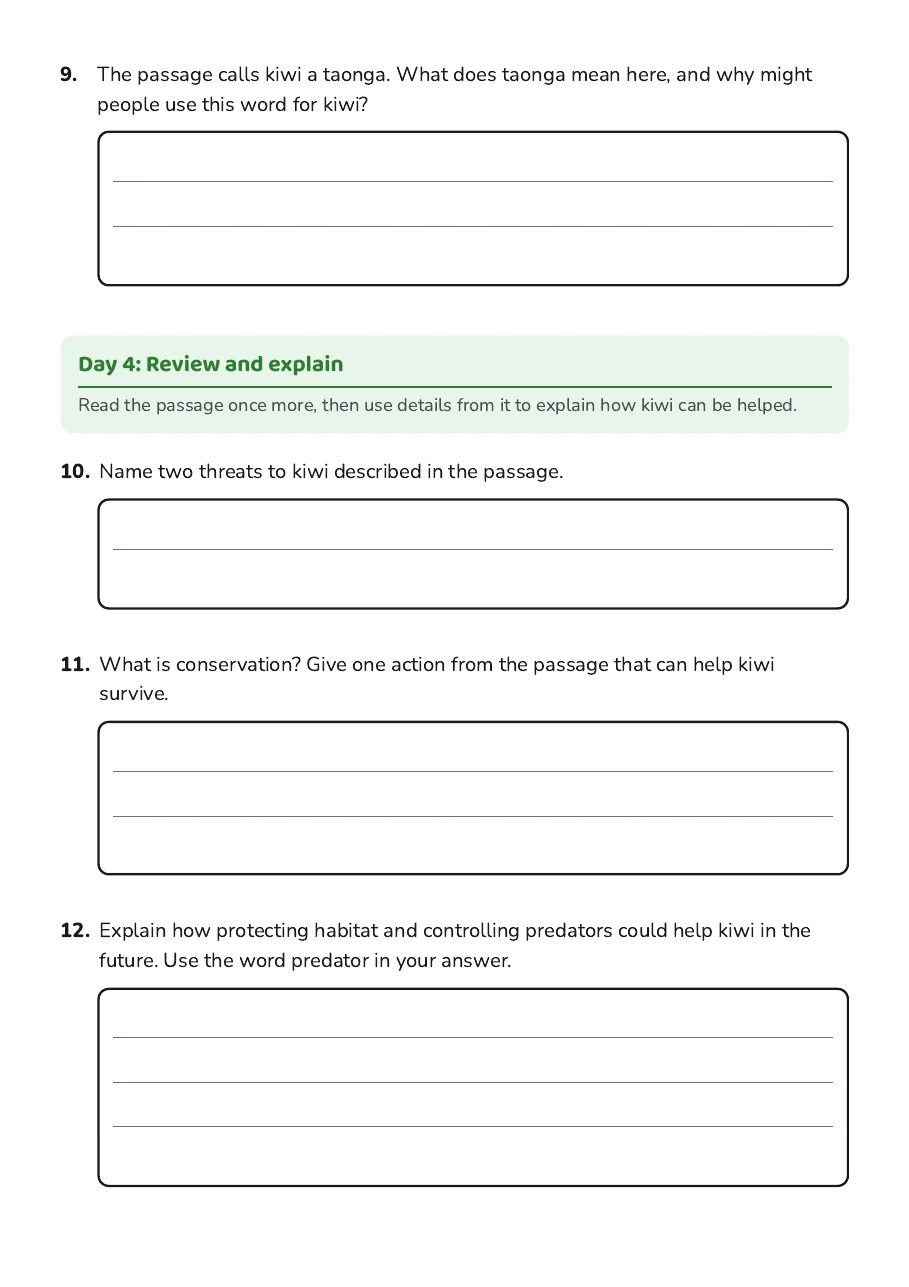
9.The passage calls kiwi a taonga. What does taonga mean here, and why might people use this word for kiwi?
Day 4: Review and explain
Read the passage once more, then use details from it to explain how kiwi can be helped.
10.Name two threats to kiwi described in the passage.
11.What is conservation? Give one action from the passage that can help kiwi survive.
12.Explain how protecting habitat and controlling predators could help kiwi in the future. Use the word predator in your answer.