Geometry and Angles Pre-Test
A free maths worksheet ready for your classroom. Open in Kuraplan to grab the print-ready PDF, customize it for your students, or generate a fresh version in seconds.
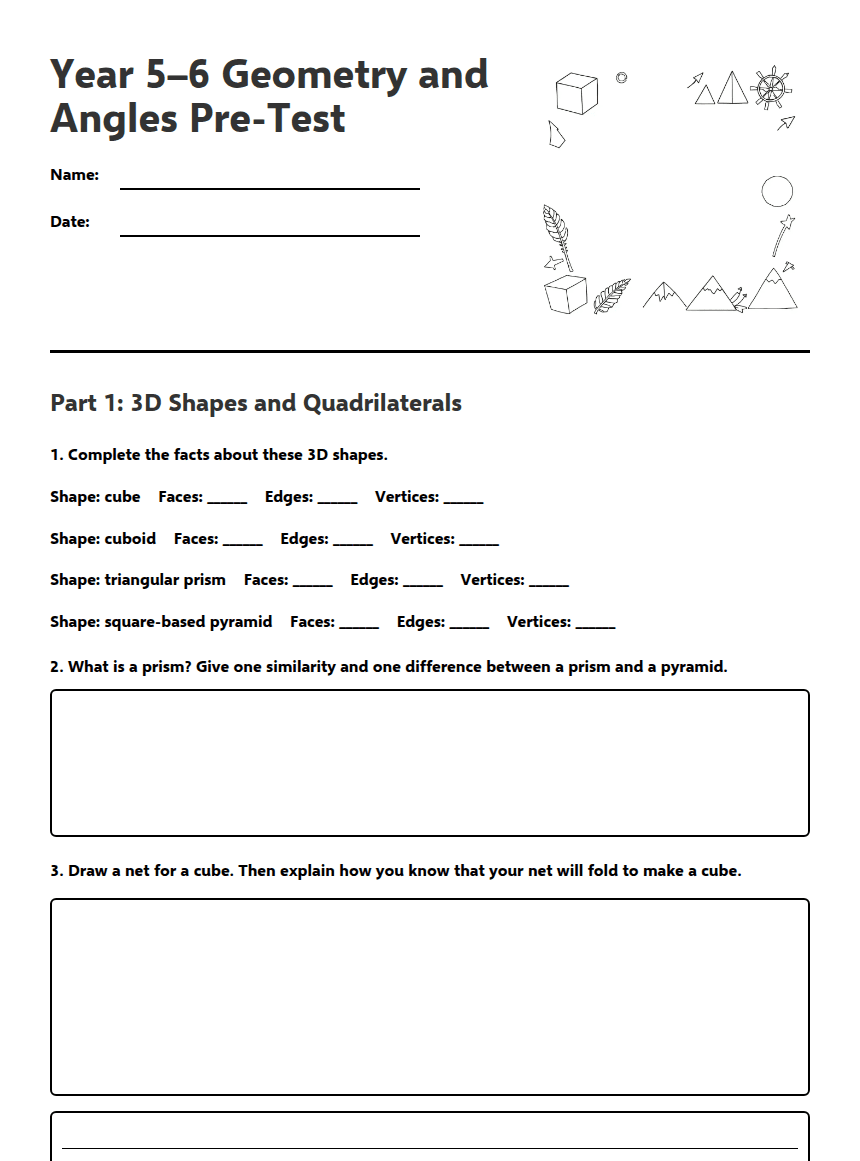
Year 5–6 Geometry and Angles Pre-Test
Part 1: 3D Shapes and Quadrilaterals
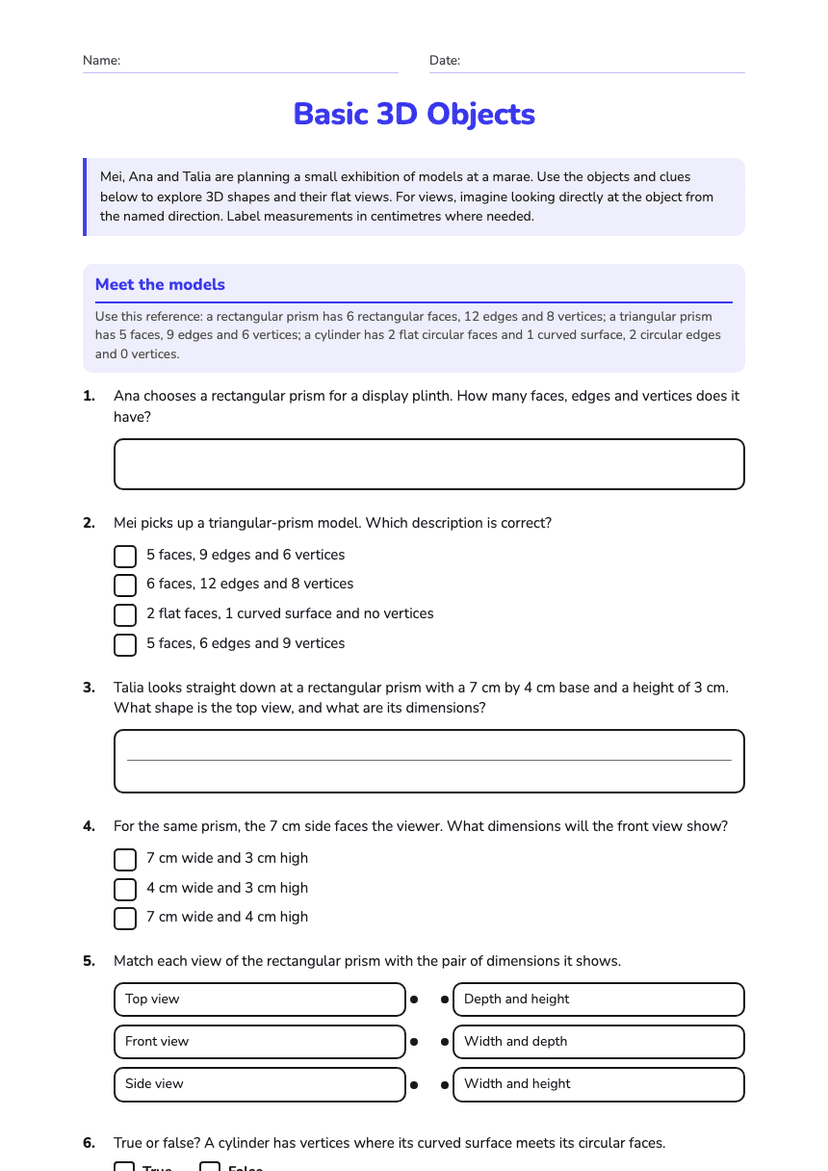
Shape: cube Faces: ______ Edges: ______ Vertices: ______
Shape: cuboid Faces: ______ Edges: ______ Vertices: ______
Shape: triangular prism Faces: ______ Edges: ______ Vertices: ______
Shape: square-based pyramid Faces: ______ Edges: ______ Vertices: ______
a) Four equal sides and four right angles: ____________________
b) Two pairs of parallel sides, but not necessarily right angles: ____________________
c) One pair of parallel sides: ____________________
d) Two pairs of equal adjacent sides: ____________________
e) Four equal sides, but not necessarily right angles: ____________________
Part 2: Lines, Triangles and Transformations
a) What does it mean when two lines are parallel?
b) What does it mean when two lines are perpendicular?
A shape is flipped over a line: ____________________
A shape is slid without being turned: ____________________
A shape is turned around a fixed point: ____________________
Choose from: reflection, translation, rotation.
Part 3: Angles and Reflection
a) A quarter turn is ______° and is a ____________________ angle.
b) A half turn is ______° and is a ____________________ angle.
c) An angle smaller than 90° is called an ____________________ angle.
d) An angle between 90° and 180° is called an ____________________ angle.
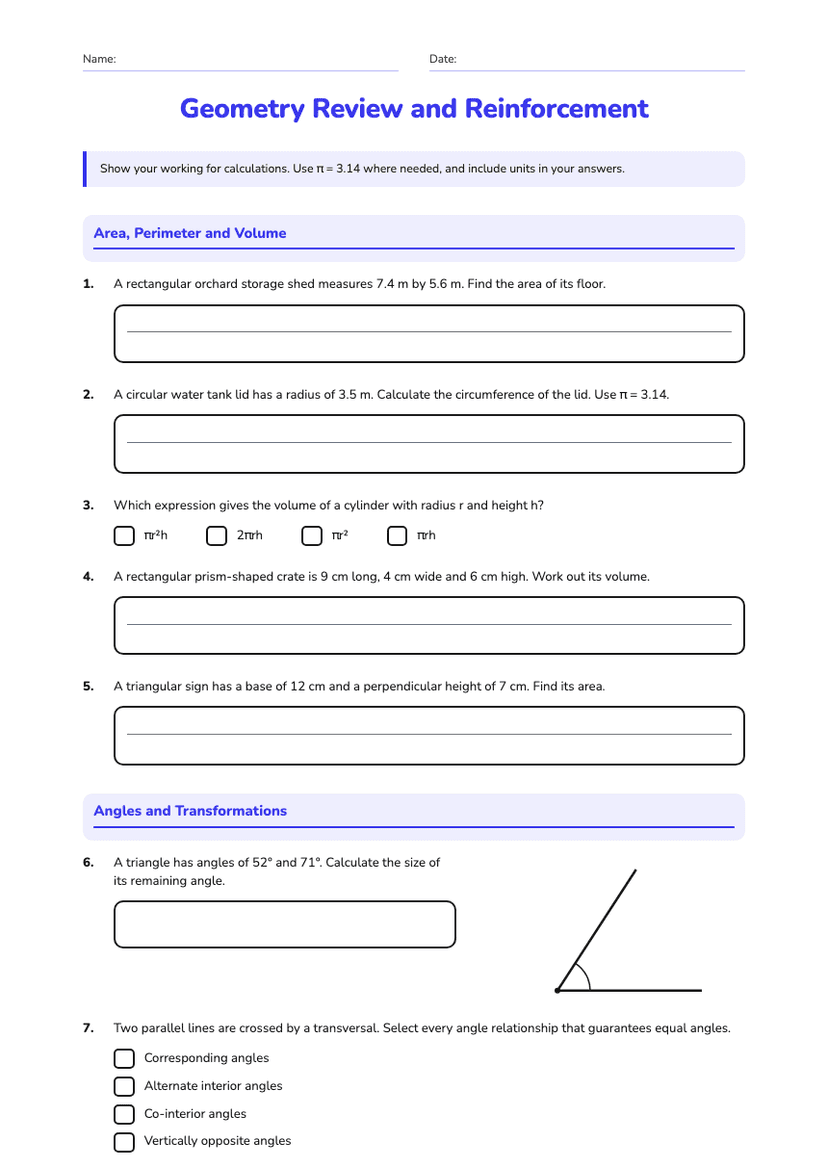
a) Angles on a straight line are 65° and x°. Find x. x = ______°
b) Angles at a point are 90°, 120°, 80° and y°. Find y. y = ______°
c) One vertically opposite angle is 48°. What is the other vertically opposite angle? ______°
a) Two angles in a triangle are 55° and 70°. Find the third angle. ______°
b) Three angles in a quadrilateral are 90°, 85° and 110°. Find the fourth angle. ______°
Student Reflection
Which geometry topic do you feel most confident about? Which topic would you like to practise more?
TEACHER ANSWER KEY — START ON A NEW PAGE
Part 1: 3D Shapes and Quadrilaterals
1. Cube: 6 faces, 12 edges, 8 vertices. Cuboid: 6 faces, 12 edges, 8 vertices. Triangular prism: 5 faces, 9 edges, 6 vertices. Square-based pyramid: 5 faces, 8 edges, 5 vertices.
2. A prism has two identical, parallel ends and faces joining the ends. Acceptable similarity: both are 3D solids/polyhedra with faces, edges and vertices. Acceptable difference: a prism has two matching parallel bases; a pyramid has one base and triangular faces meeting at one point.
3. Accept any valid cube net made from six connected squares that folds into a cube. The explanation should mention six faces joining edge-to-edge with no overlapping faces when folded.
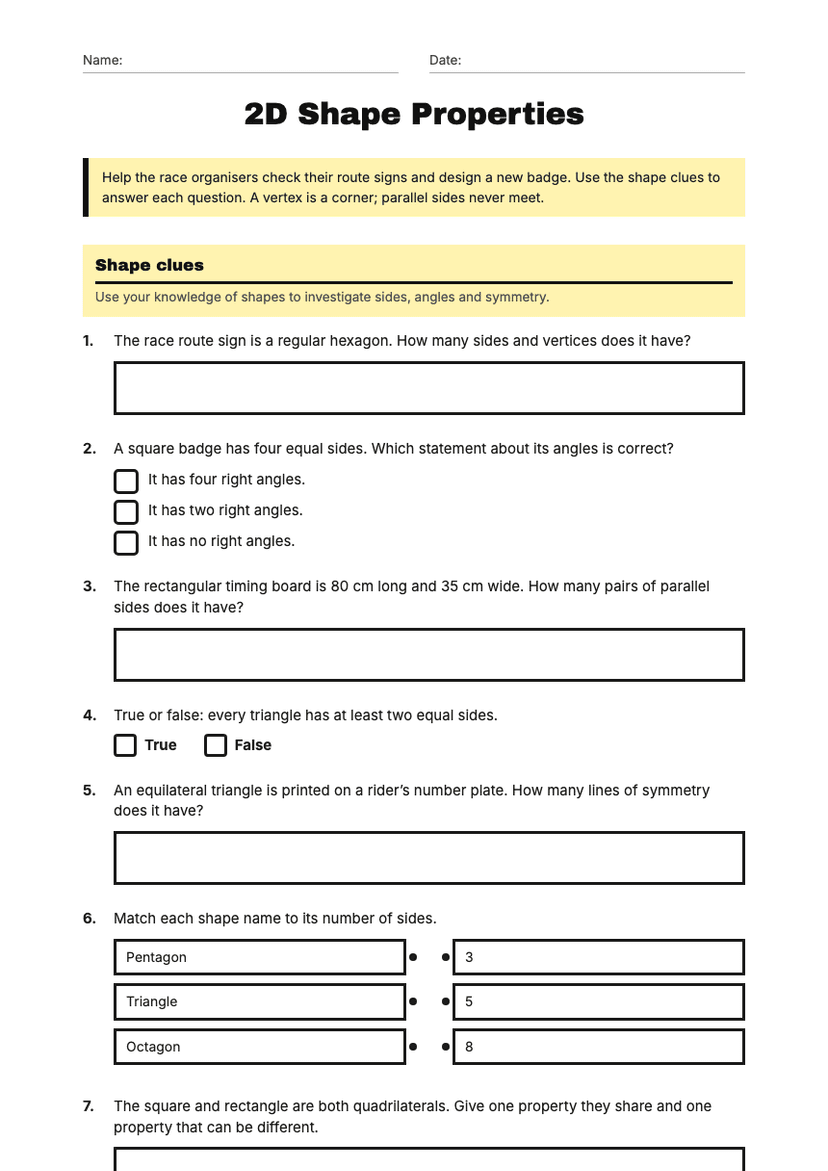
4. a) Square. b) Parallelogram. c) Trapezium. d) Kite. e) Rhombus.
Part 2: Lines, Triangles, Transformations and Angles
5. Parallel lines remain the same distance apart and never meet. Perpendicular lines meet at a right angle of 90°.
6. A square is a rectangle because it has four right angles. It is a rhombus because it has four equal sides. It is a parallelogram because both pairs of opposite sides are parallel.
7. Acceptable triangle types include equilateral, isosceles and scalene by side length, and acute, right-angled and obtuse by angle size. Facts must be accurate. For example: an equilateral triangle has three equal sides; an isosceles triangle has two equal sides; a scalene triangle has no equal sides; a right-angled triangle has one 90° angle.
8. Flipped over a line: reflection. Slid without being turned: translation. Turned around a fixed point: rotation.
9. A tessellation is a repeating pattern of shapes that covers a surface without gaps or overlaps. Accept squares, rectangles, equilateral triangles, regular hexagons and other valid examples.
10. a) 90°, right angle. b) 180°, straight angle. c) acute. d) obtuse.
11. a) 115°. b) 70°. c) 48°.
12. a) 55°. b) 75°. Triangle total: 180°. Quadrilateral total: 360°.
Student Reflection: Answers will vary. Look for a sensible response identifying a strength and a topic for further practice.
About This Worksheet
Free in Kuraplan
Sign up free, grab the PDF, and customize it for your class.
Print-Ready
Formatted for standard paper. Clean layout, easy to read.
AI-Generated
Created with Kuraplan's AI, designed for real classroom use.
For Teachers & Parents
Use in classrooms, for homework, tutoring, or homeschool.
Need a custom version of this worksheet?
Kuraplan's AI generates custom worksheets in seconds — differentiated for every learner, aligned to your curriculum.
Generate Custom Worksheets — Free