MathsFreePrintable
Geometry in Real Life
A free maths worksheet ready for your classroom. Open in Kuraplan to grab the print-ready PDF, customize it for your students, or generate a fresh version in seconds.
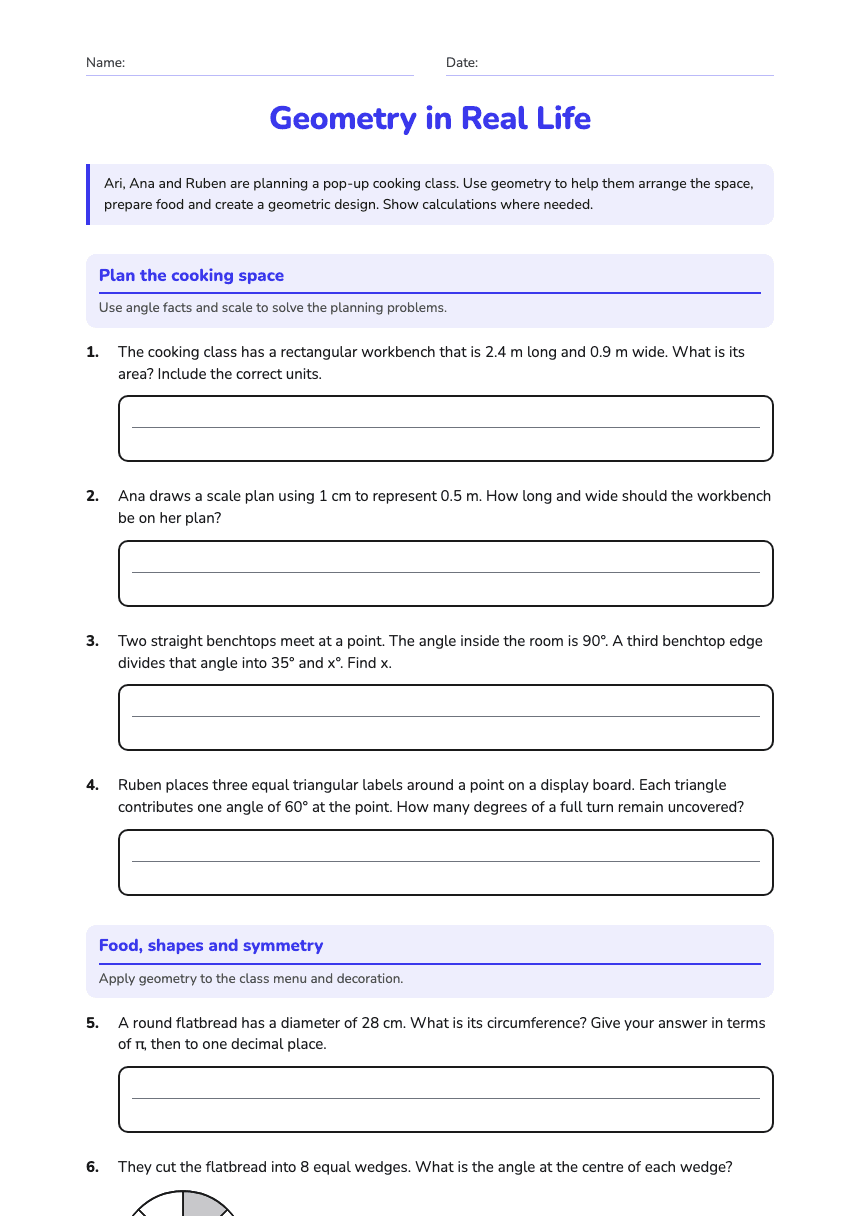
Name:Date:
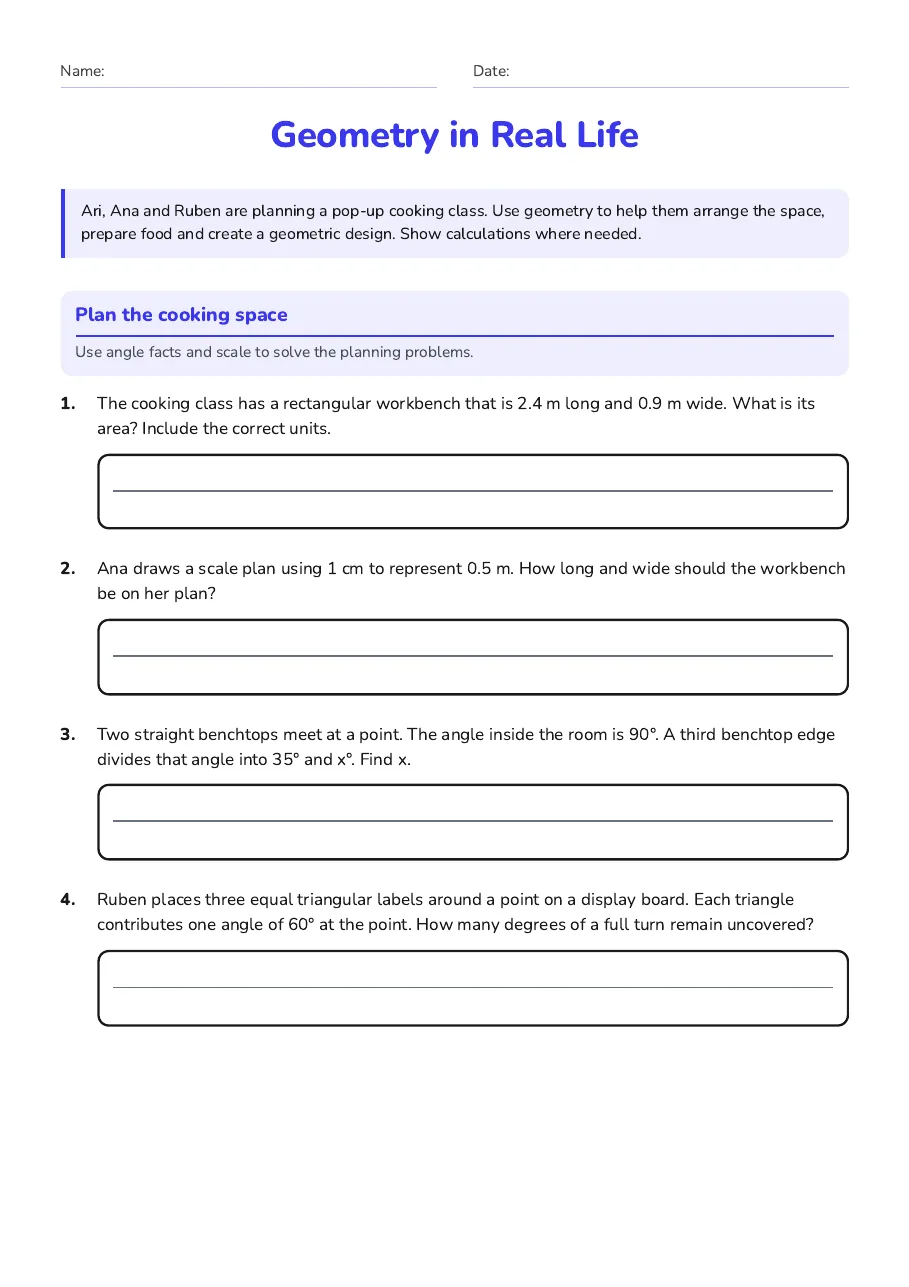
Geometry in Real Life
Ari, Ana and Ruben are planning a pop-up cooking class. Use geometry to help them arrange the space, prepare food and create a geometric design. Show calculations where needed.
Plan the cooking space
Use angle facts and scale to solve the planning problems.
1.The cooking class has a rectangular workbench that is 2.4 m long and 0.9 m wide. What is its area? Include the correct units.
2.Ana draws a scale plan using 1 cm to represent 0.5 m. How long and wide should the workbench be on her plan?
3.Two straight benchtops meet at a point. The angle inside the room is 90°. A third benchtop edge divides that angle into 35° and x°. Find x.
4.Ruben places three equal triangular labels around a point on a display board. Each triangle contributes one angle of 60° at the point. How many degrees of a full turn remain uncovered?
Food, shapes and symmetry
Apply geometry to the class menu and decoration.
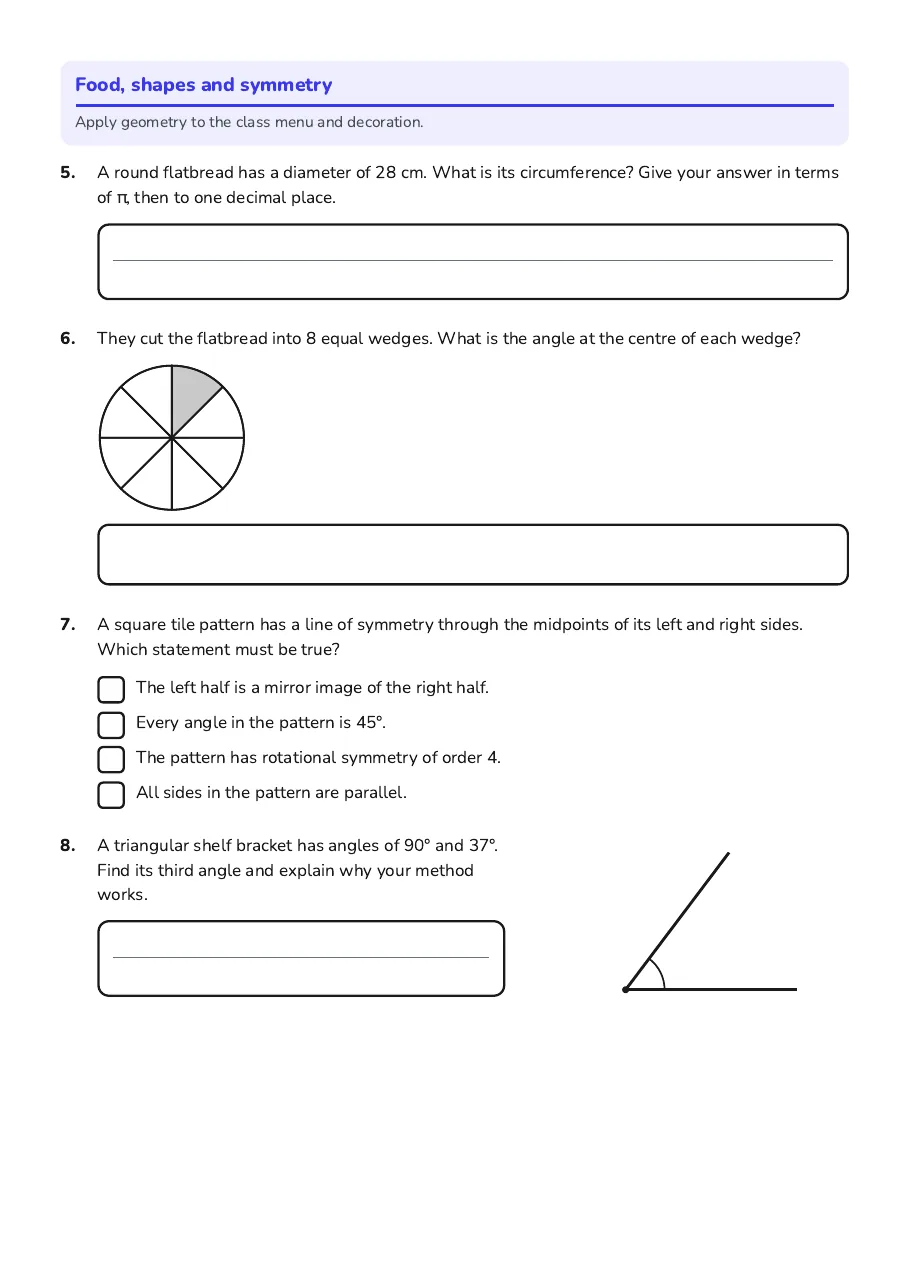
5.A round flatbread has a diameter of 28 cm. What is its circumference? Give your answer in terms of π, then to one decimal place.
6.They cut the flatbread into 8 equal wedges. What is the angle at the centre of each wedge?
7.A square tile pattern has a line of symmetry through the midpoints of its left and right sides. Which statement must be true?
- The left half is a mirror image of the right half.
- Every angle in the pattern is 45°.
- The pattern has rotational symmetry of order 4.
- All sides in the pattern are parallel.
8.A triangular shelf bracket has angles of 90° and 37°. Find its third angle and explain why your method works.
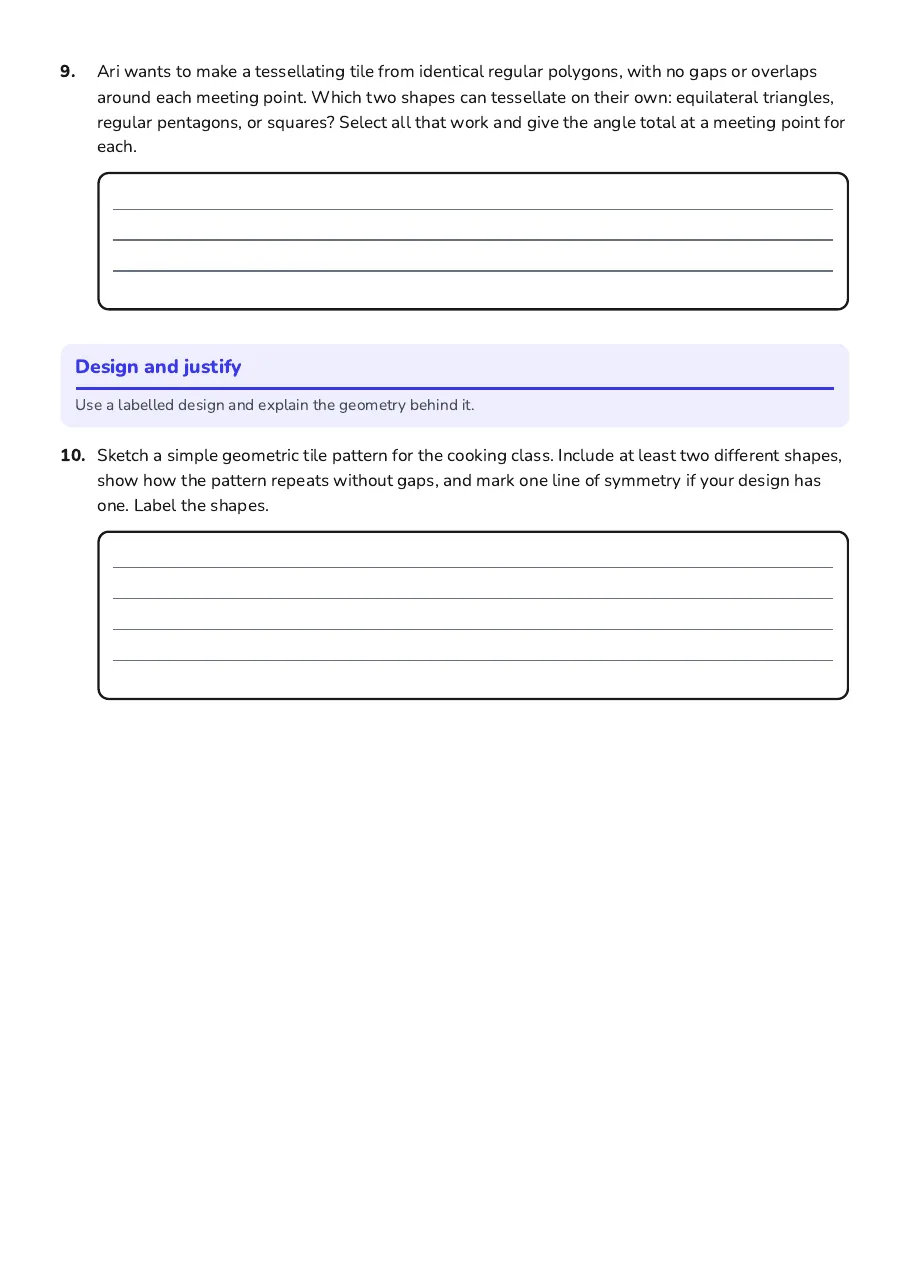
9.Ari wants to make a tessellating tile from identical regular polygons, with no gaps or overlaps around each meeting point. Which two shapes can tessellate on their own: equilateral triangles, regular pentagons, or squares? Select all that work and give the angle total at a meeting point for each.
Design and justify
Use a labelled design and explain the geometry behind it.
10.Sketch a simple geometric tile pattern for the cooking class. Include at least two different shapes, show how the pattern repeats without gaps, and mark one line of symmetry if your design has one. Label the shapes.
3 printable pages
Page 1
Page 2
Page 3
About This Worksheet
Free in Kuraplan
Sign up free, grab the PDF, and customize it for your class.
Print-Ready
Formatted for standard paper. Clean layout, easy to read.
AI-Generated
Created with Kuraplan's AI, designed for real classroom use.
For Teachers & Parents
Use in classrooms, for homework, tutoring, or homeschool.
Need a custom version of this worksheet?
Kuraplan's AI generates custom worksheets in seconds — differentiated for every learner, aligned to your curriculum.
Generate Custom Worksheets — Free No credit card Curriculum-aligned Under 60 seconds