MathsFreePrintable

Geometry Transformations Introduction

A free maths worksheet ready for your classroom. Open in Kuraplan to grab the print-ready PDF, customize it for your students, or generate a fresh version in seconds.
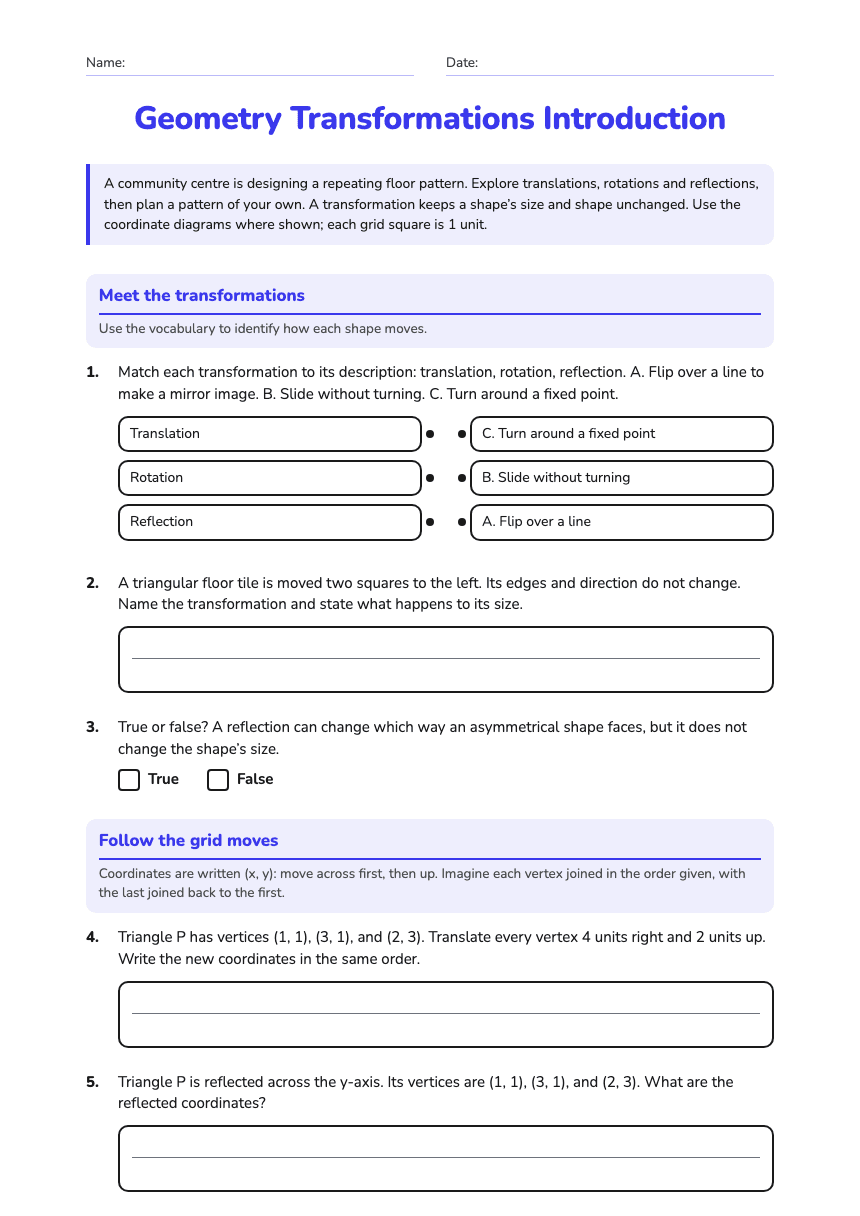
Geometry Transformations Introduction worksheet preview
Name:Date:

Geometry Transformations Introduction

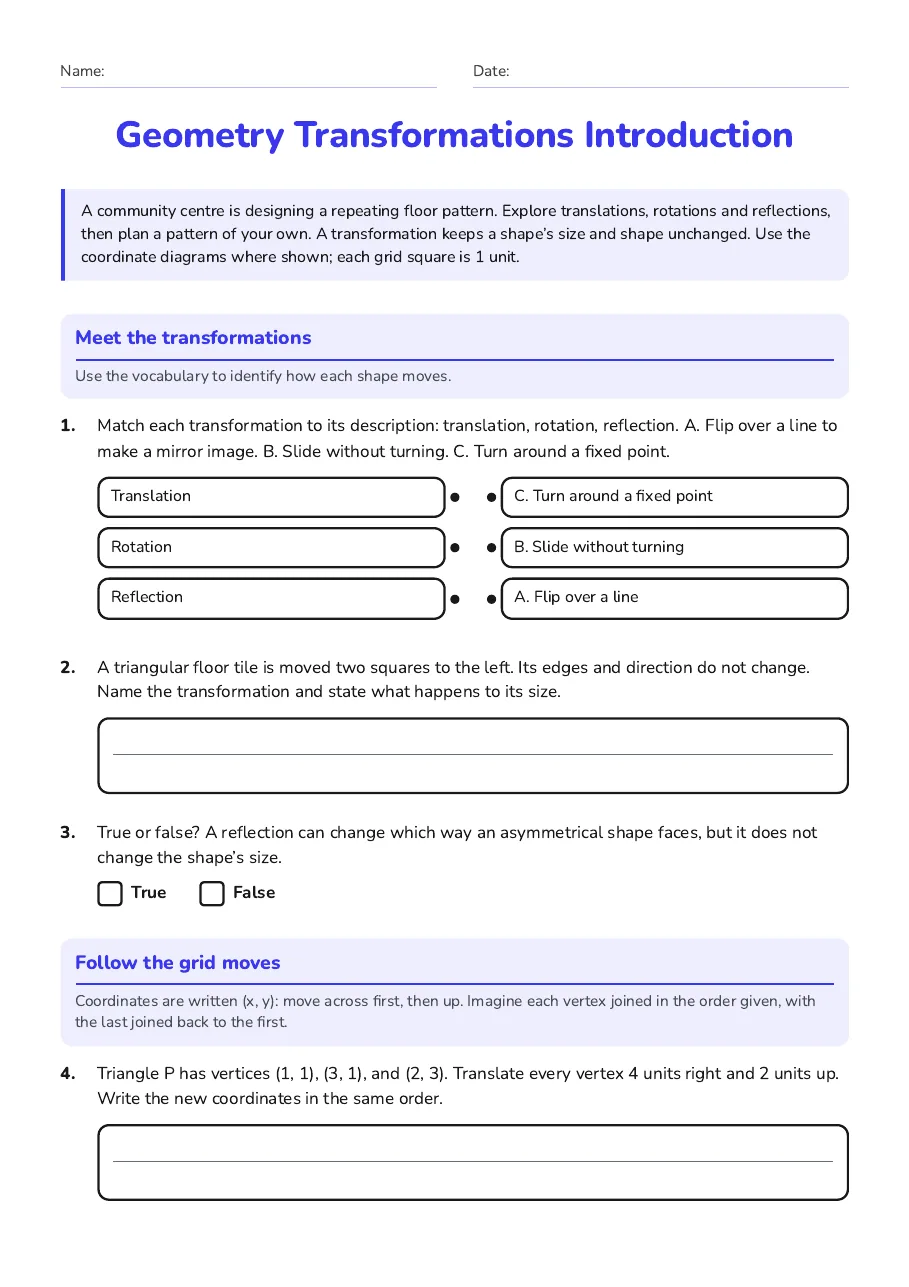
A community centre is designing a repeating floor pattern. Explore translations, rotations and reflections, then plan a pattern of your own. A transformation keeps a shape’s size and shape unchanged. Use the coordinate diagrams where shown; each grid square is 1 unit.

Meet the transformations

Use the vocabulary to identify how each shape moves.

1.Match each transformation to its description: translation, rotation, reflection. A. Flip over a line to make a mirror image. B. Slide without turning. C. Turn around a fixed point.
  • Translation
  • Rotation
  • Reflection
  • C. Turn around a fixed point
  • B. Slide without turning
  • A. Flip over a line
2.A triangular floor tile is moved two squares to the left. Its edges and direction do not change. Name the transformation and state what happens to its size.
3.True or false? A reflection can change which way an asymmetrical shape faces, but it does not change the shape’s size.
TrueFalse

Follow the grid moves

Coordinates are written (x, y): move across first, then up. Imagine each vertex joined in the order given, with the last joined back to the first.

4.Triangle P has vertices (1, 1), (3, 1), and (2, 3). Translate every vertex 4 units right and 2 units up. Write the new coordinates in the same order.
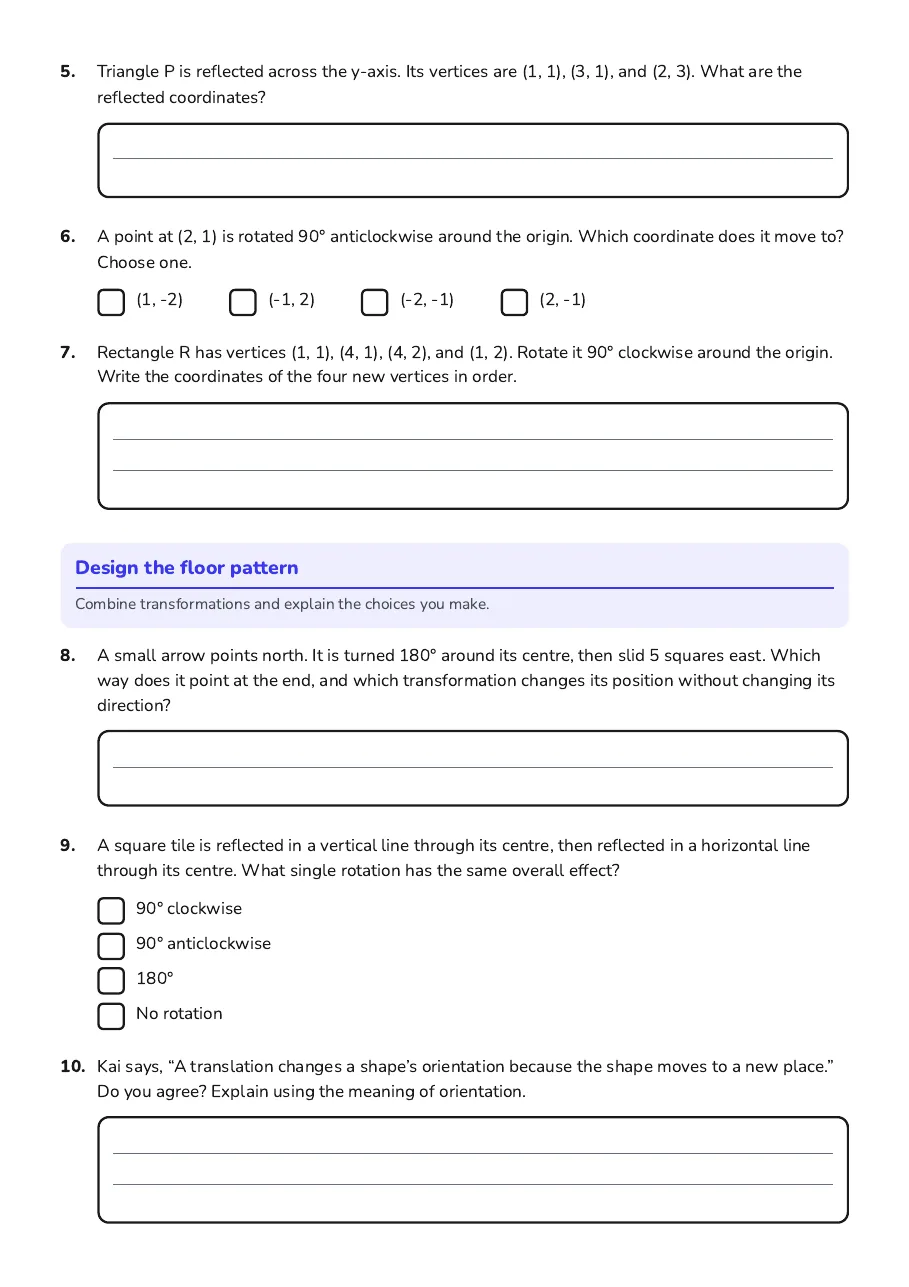
5.Triangle P is reflected across the y-axis. Its vertices are (1, 1), (3, 1), and (2, 3). What are the reflected coordinates?
6.A point at (2, 1) is rotated 90° anticlockwise around the origin. Which coordinate does it move to? Choose one.
  • (1, -2)
  • (-1, 2)
  • (-2, -1)
  • (2, -1)
7.Rectangle R has vertices (1, 1), (4, 1), (4, 2), and (1, 2). Rotate it 90° clockwise around the origin. Write the coordinates of the four new vertices in order.

Design the floor pattern

Combine transformations and explain the choices you make.

8.A small arrow points north. It is turned 180° around its centre, then slid 5 squares east. Which way does it point at the end, and which transformation changes its position without changing its direction?
9.A square tile is reflected in a vertical line through its centre, then reflected in a horizontal line through its centre. What single rotation has the same overall effect?
  • 90° clockwise
  • 90° anticlockwise
  • 180°
  • No rotation
10.Kai says, “A translation changes a shape’s orientation because the shape moves to a new place.” Do you agree? Explain using the meaning of orientation.
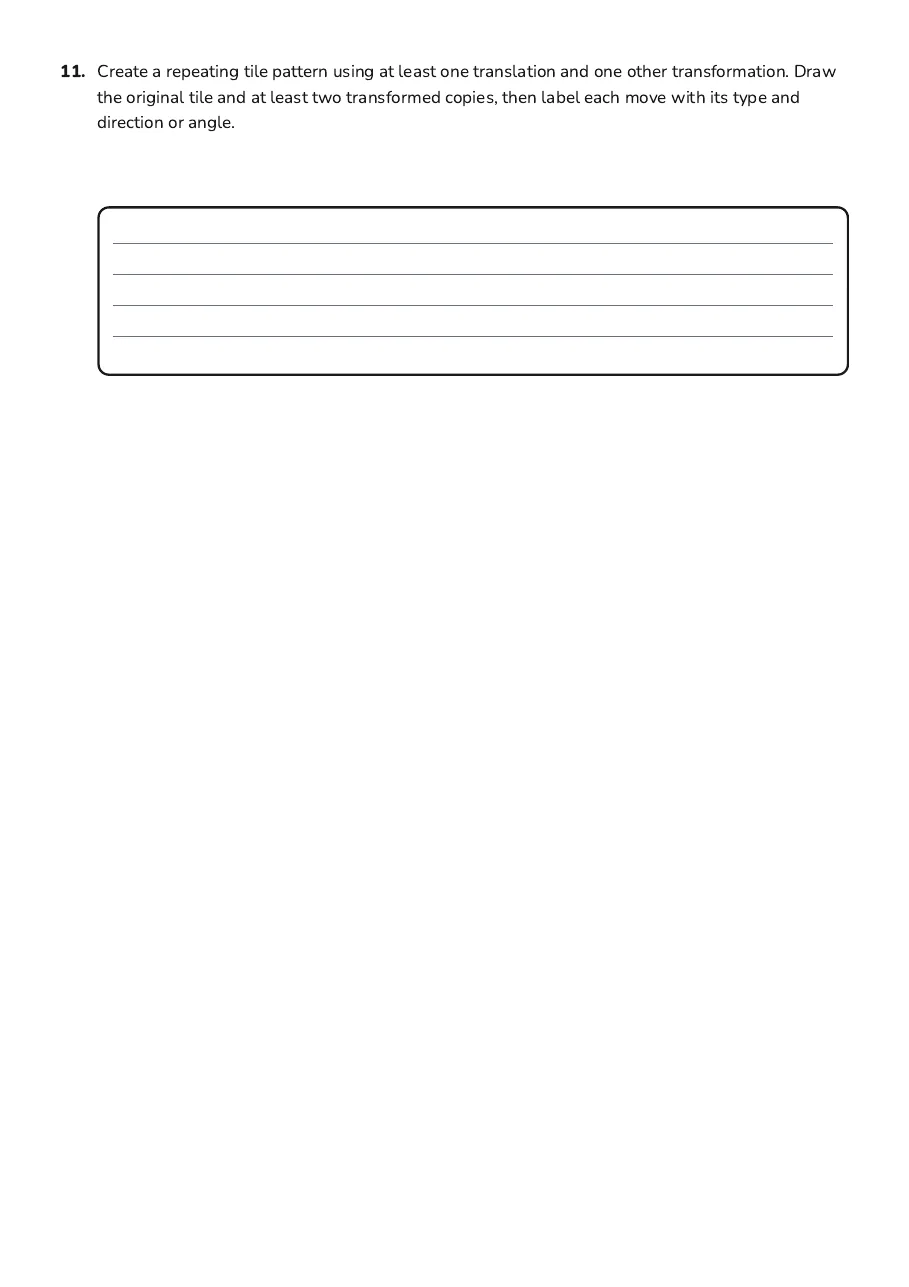
11.Create a repeating tile pattern using at least one translation and one other transformation. Draw the original tile and at least two transformed copies, then label each move with its type and direction or angle.

3 printable pages

  • Geometry Transformations Introduction, page 1 of 3: Meet the transformations, Follow the grid moves

    Page 1

  • Geometry Transformations Introduction, page 2 of 3: Design the floor pattern

    Page 2

  • Geometry Transformations Introduction, page 3 of 3: 11. Create a repeating tile pattern using at least one translation and one other…

    Page 3

About This Worksheet

Free in Kuraplan

Sign up free, grab the PDF, and customize it for your class.

Print-Ready

Formatted for standard paper. Clean layout, easy to read.

AI-Generated

Created with Kuraplan's AI, designed for real classroom use.

For Teachers & Parents

Use in classrooms, for homework, tutoring, or homeschool.

Need a custom version of this worksheet?

Kuraplan's AI generates custom worksheets in seconds — differentiated for every learner, aligned to your curriculum.

Generate Custom Worksheets — Free
No credit card Curriculum-aligned Under 60 seconds