Ideologies and Leaders: Evidence Sorting
A free social sciences worksheet ready for your classroom. Open in Kuraplan to grab the print-ready PDF, customize it for your students, or generate a fresh version in seconds.
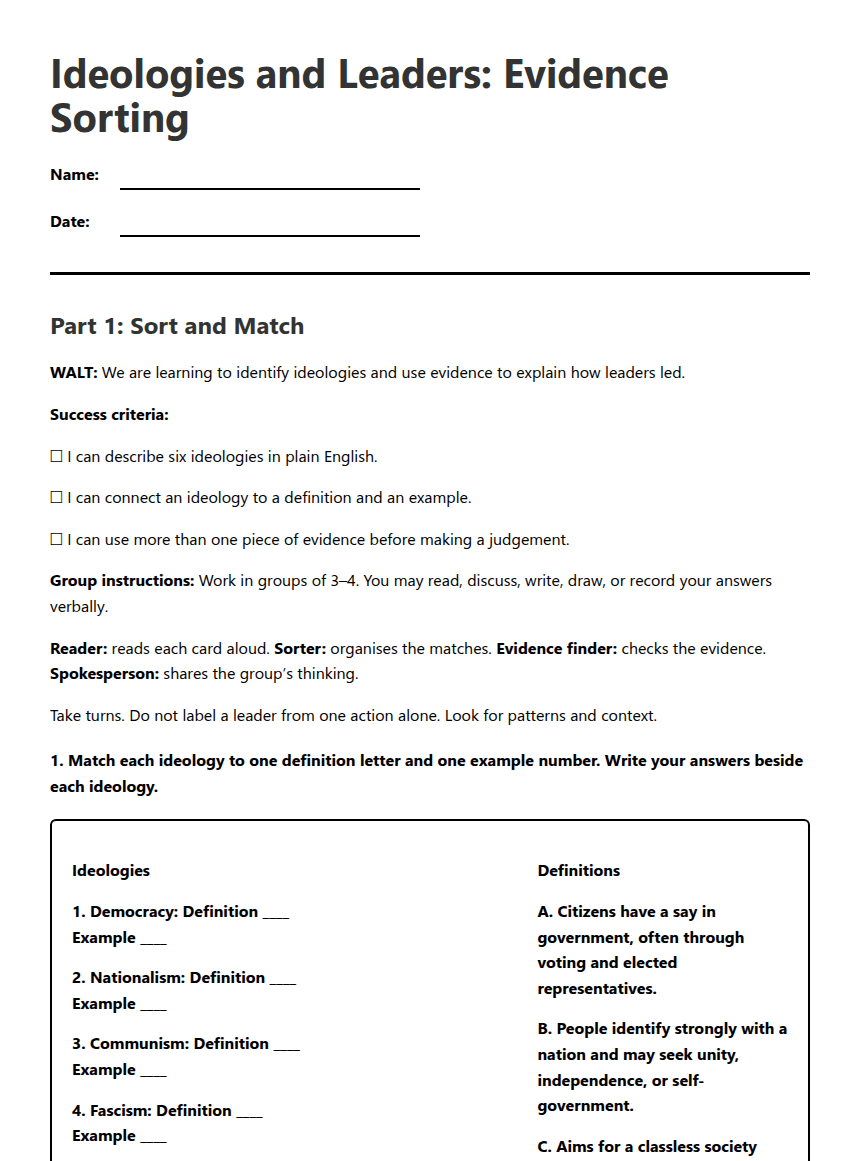
Ideologies and Leaders: Evidence Sorting
Part 1: Sort and Match
WALT: We are learning to identify ideologies and use evidence to explain how leaders led.
Success criteria:
☐ I can describe six ideologies in plain English.
☐ I can connect an ideology to a definition and an example.
☐ I can use more than one piece of evidence before making a judgement.
Group instructions: Work in groups of 3–4. You may read, discuss, write, draw, or record your answers verbally.
Reader: reads each card aloud. Sorter: organises the matches. Evidence finder: checks the evidence. Spokesperson: shares the group’s thinking.
Take turns. Do not label a leader from one action alone. Look for patterns and context.
Ideologies
Definitions
Examples
Dyslexia-friendly option: Ask a group member or teacher to read the definitions aloud. Highlight key words or use a voice recording instead of writing.
Part 2: Leaders and Evidence
Choose one leader: Te Rauparaha, Nelson Mandela, Jacinda Ardern, or another researched leader approved by your teacher.
Chosen leader: ______________________________________________
Time and place: ______________________________________________
Ideology 1: _________________________________________________
What did the leader appear to believe?
Two specific actions, policies, speeches, or events:
Evidence 1:
Evidence 2:
Who benefited, or gained power or rights?
Who may have lost power, rights, or freedom?
Cautious conclusion: How accurately does this ideology describe the leader? Give a reason.
Differentiation options: Use a leader fact sheet, word bank, partner scribing, speech-to-text, or a recorded response. Advanced learners should check at least two reliable sources and compare different viewpoints.
Part 3: Reflect and Extend
Second ideology: _____________________________________________
Counter-example: Describe an action or belief that does not fit your first label.
Final judgement: How accurate is your original label? Explain what evidence supports and challenges it.
Teacher Answer Key — Final Page
Matching answers:
Democracy — A, 1
Nationalism — B, 2
Communism — C, 3
Fascism — D, 4
Liberalism — E, 5
Socialism — F, 6
Discussion guidance: Accept answers that explain that leaders may combine ideologies or use them differently in different situations. For example, a leader may support democratic elections but also promote nationalist policies. A label should be based on several reliable examples, the leader’s context, and the effects on different groups.
Evidence task guidance: Responses will vary. Strong responses name a specific action, connect it to an ideology, identify who benefited and who may have lost power or freedom, and use cautious language. Do not accept a conclusion based on only one action.
Possible evidence: Te Rauparaha may be studied through leadership, iwi relationships, conflict, migration, and changing power in the early nineteenth century. Nelson Mandela may be studied through opposition to apartheid, reconciliation, inclusive elections, and constitutional democracy. Jacinda Ardern may be studied through democratic leadership, social welfare, public health decisions, and responses to the Christchurch attacks. Students must explain the evidence rather than treating any leader as a perfect example of one ideology.
About This Worksheet
Free in Kuraplan
Sign up free, grab the PDF, and customize it for your class.
Print-Ready
Formatted for standard paper. Clean layout, easy to read.
AI-Generated
Created with Kuraplan's AI, designed for real classroom use.
For Teachers & Parents
Use in classrooms, for homework, tutoring, or homeschool.
Need a custom version of this worksheet?
Kuraplan's AI generates custom worksheets in seconds — differentiated for every learner, aligned to your curriculum.
Generate Custom Worksheets — FreeMore Social Sciences Worksheets
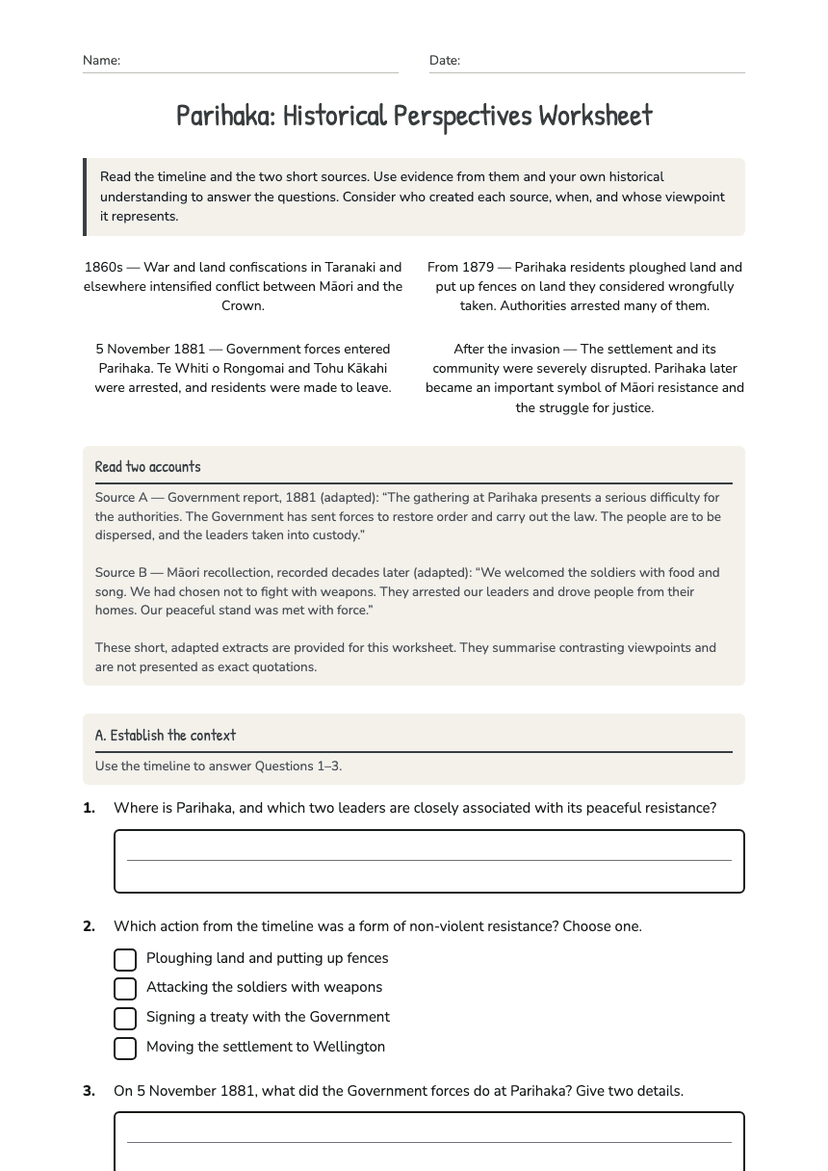
Parihaka: Historical Perspectives Worksheet
Free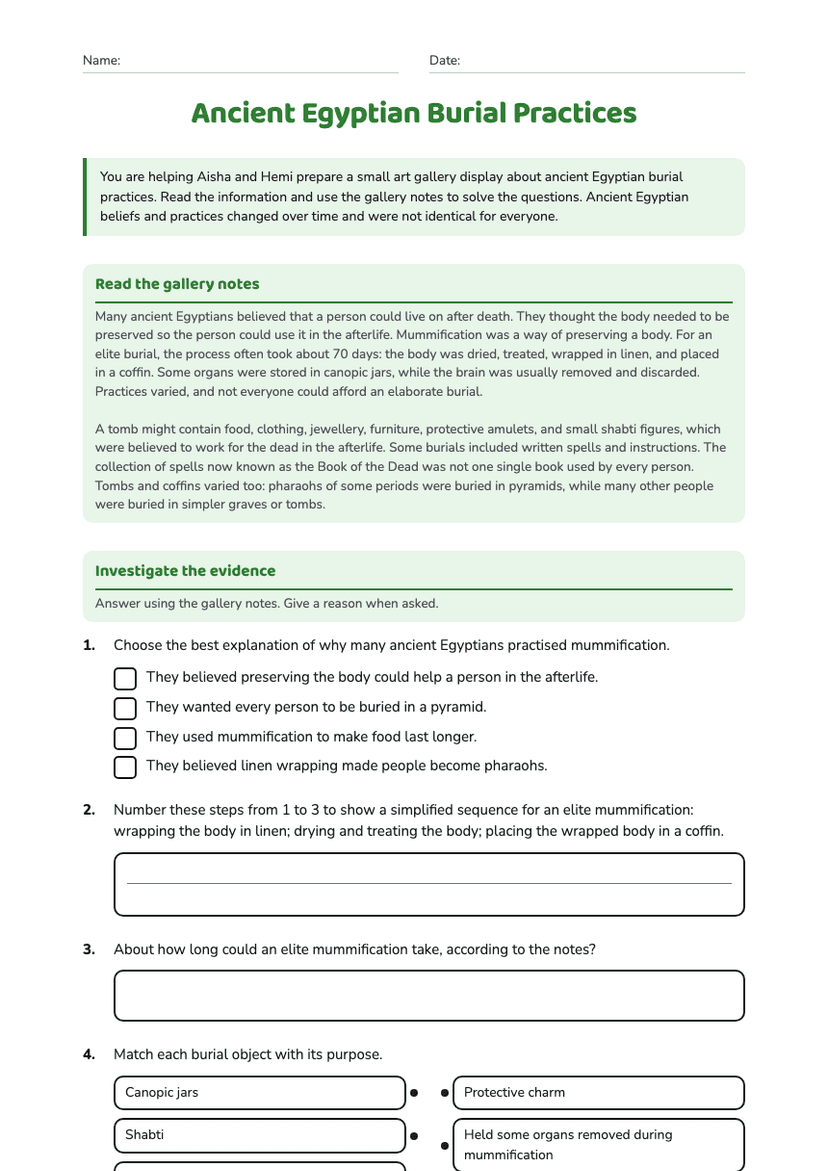
Ancient Egyptian Burial Practices
Free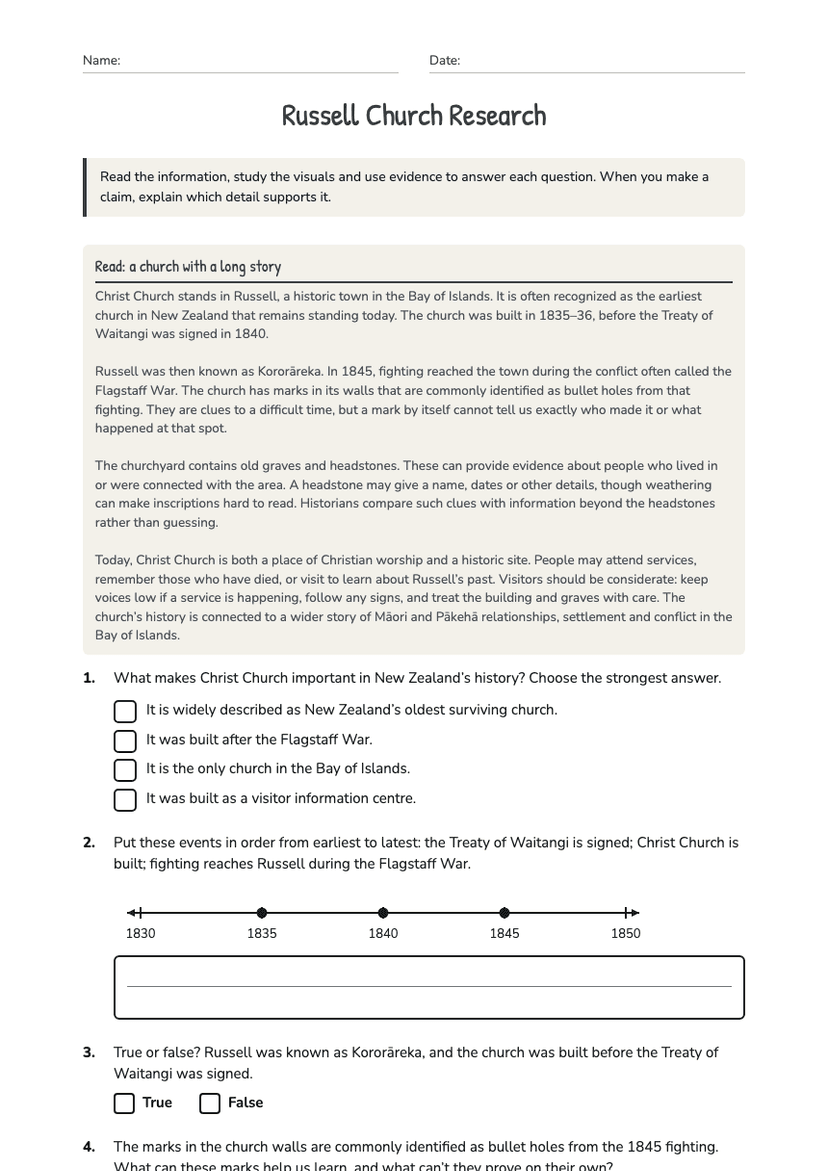
Russell Church Research
Free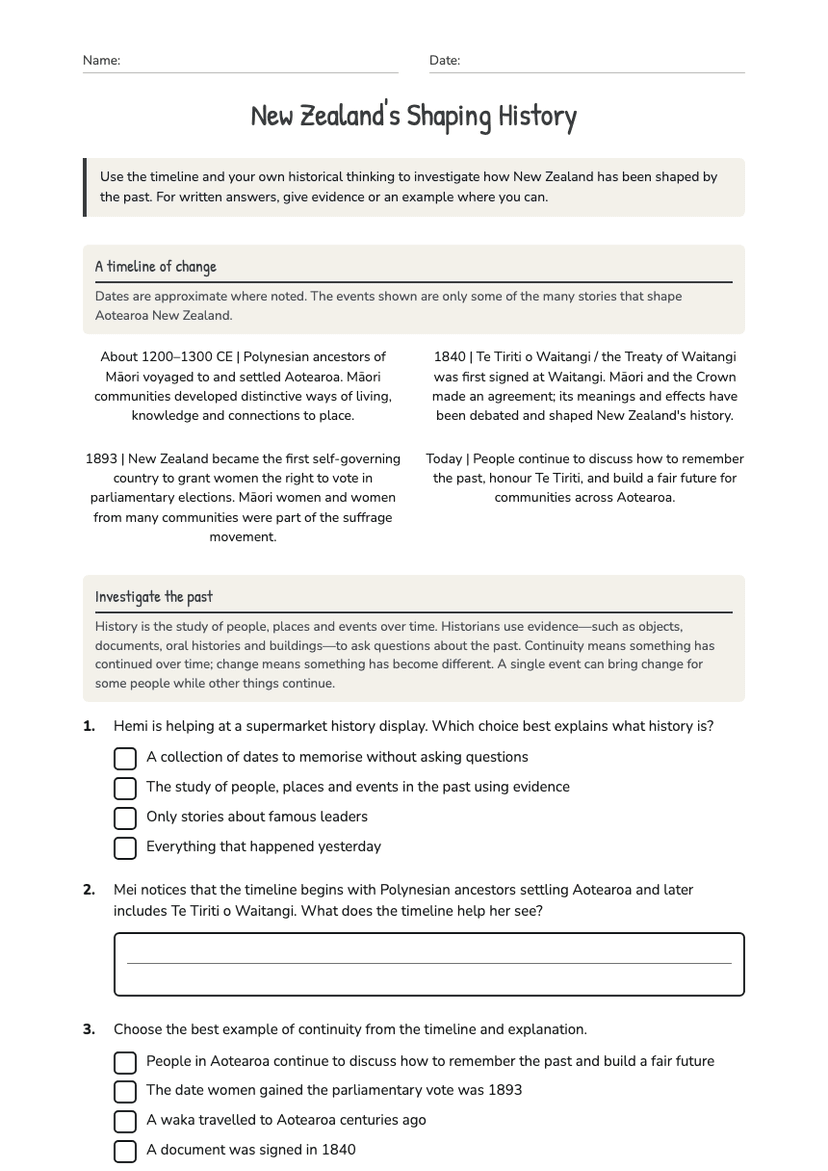
New Zealand's Shaping History
Free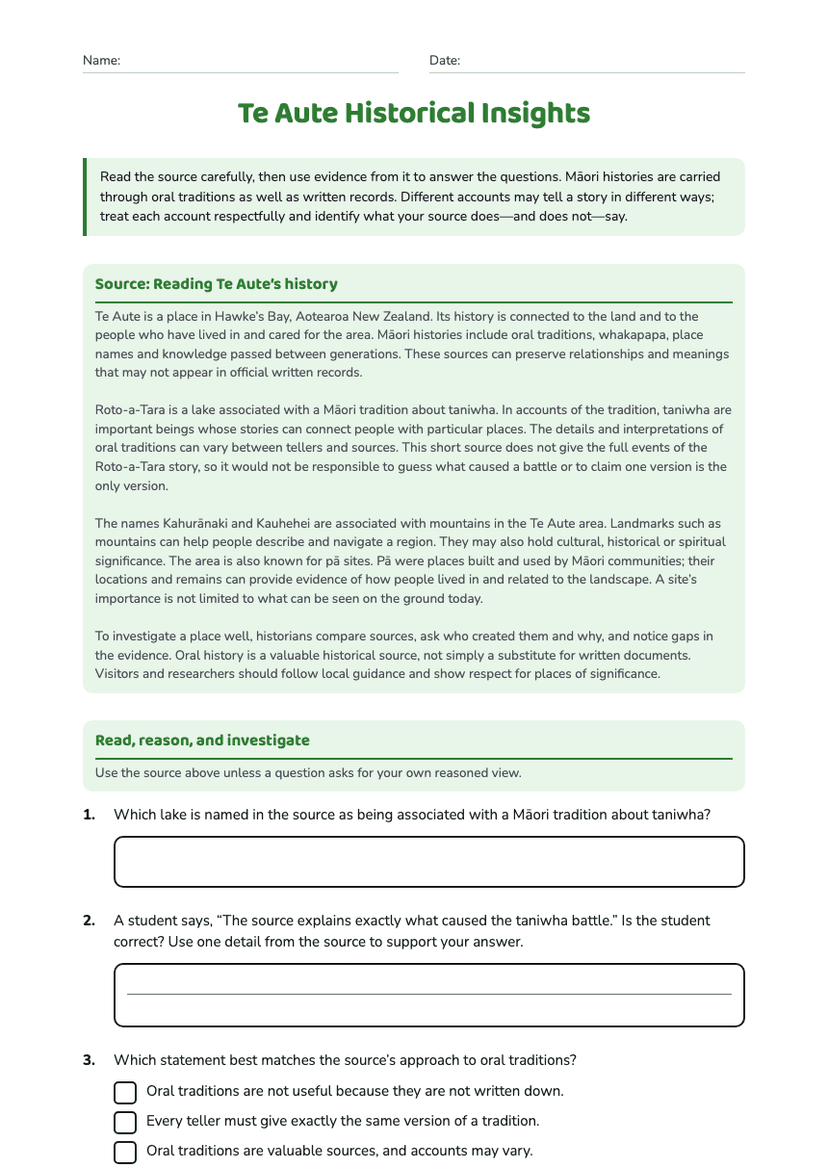
Te Aute Historical Insights
Free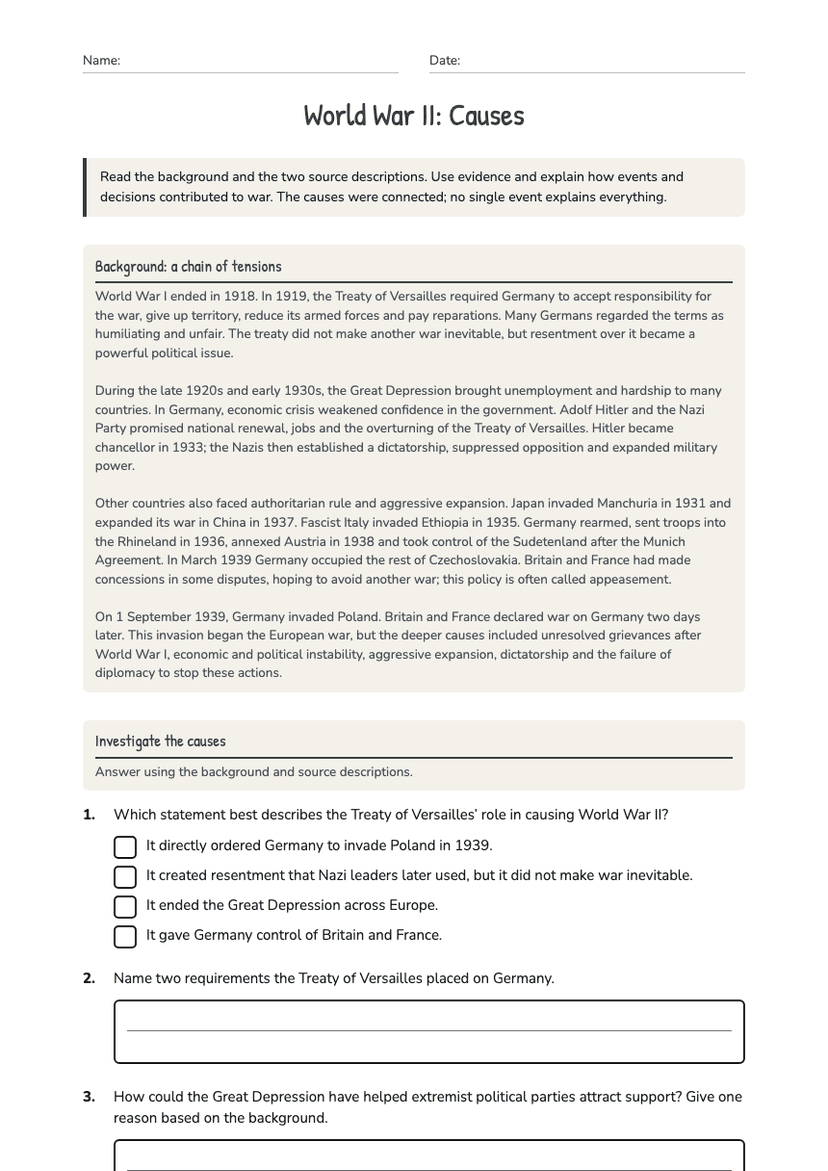
World War II: Causes
Free
Traditional and Modern Voyaging
Free