Irrigation Systems Assessment
A free technology worksheet ready for your classroom. Open in Kuraplan to grab the print-ready PDF, customize it for your students, or generate a fresh version in seconds.
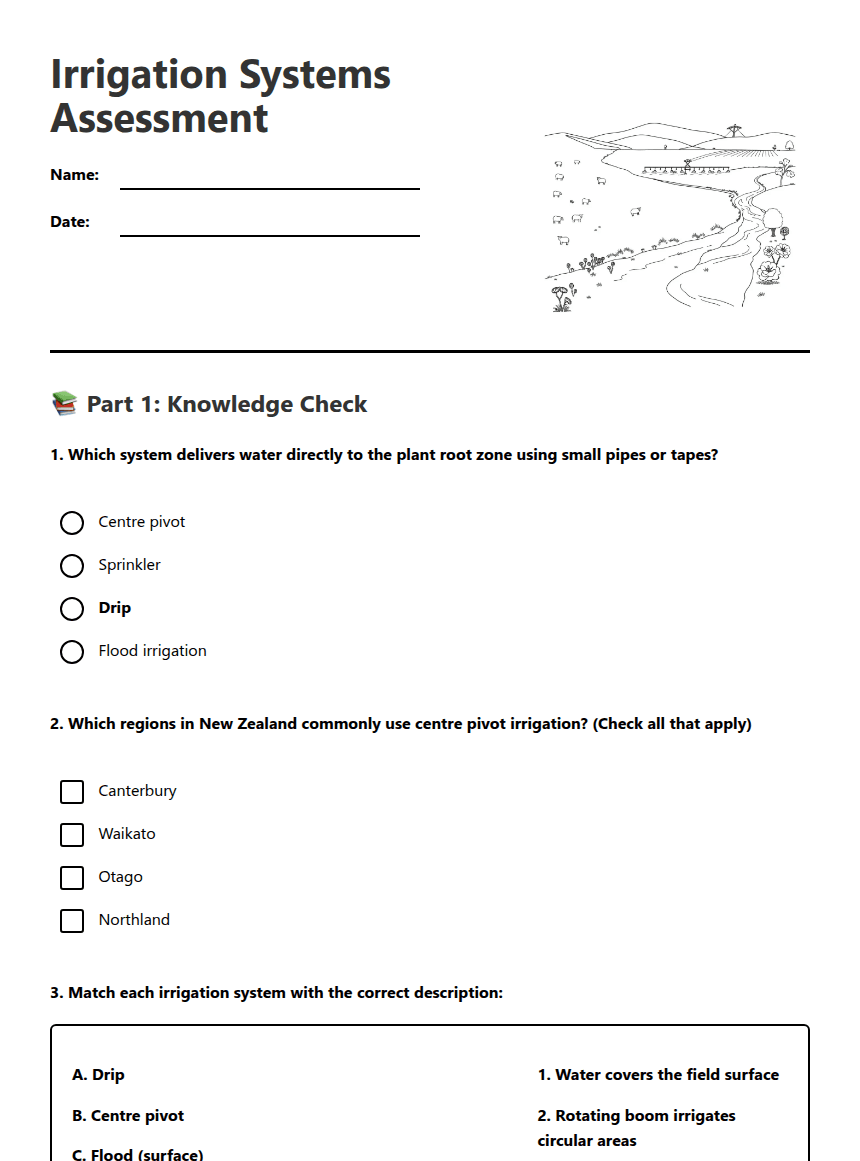
Irrigation Systems Assessment
📚 Part 1: Knowledge Check
✏️ Part 2: Research, Model and Reflection (3 lessons)
Assessment Activity: You have three lessons to design and build a small model replica of your chosen irrigation system. The model can not exceed 50cm x 50cm. You can display your model using the large silver trays in a farm/ paddock set up. Each team member must submit their own
Lesson 1 — WALT: Understand common irrigation systems used in New Zealand.
Success criteria: I can name an irrigation system and describe it in detail.
Lesson 2 — WALT: Research and plan a model of one irrigation system.
Success criteria: I can produce a materials list, and labelled plan.
Lesson 3 — WALT: Build and test a small working model.
Success criteria: My model is a replication of the irrigation system, and I can explain how it meets real-world needs.
About This Worksheet
Free in Kuraplan
Sign up free, grab the PDF, and customize it for your class.
Print-Ready
Formatted for standard paper. Clean layout, easy to read.
AI-Generated
Created with Kuraplan's AI, designed for real classroom use.
For Teachers & Parents
Use in classrooms, for homework, tutoring, or homeschool.
Need a custom version of this worksheet?
Kuraplan's AI generates custom worksheets in seconds — differentiated for every learner, aligned to your curriculum.
Generate Custom Worksheets — FreeMore Technology Worksheets
Energy Systems, Exercise Response, and Nutrition
Free
Respiratory and Circulatory Systems
Free
Space Systems Synthesis Worksheet
Free
Exploring Government Systems
Free
Government Systems Overview
Free
Government Systems Overview
Free
Kaitiakitanga and Ecosystems
Free