Kingitanga Patterns and Algebra
A free maths worksheet ready for your classroom. Open in Kuraplan to grab the print-ready PDF, customize it for your students, or generate a fresh version in seconds.
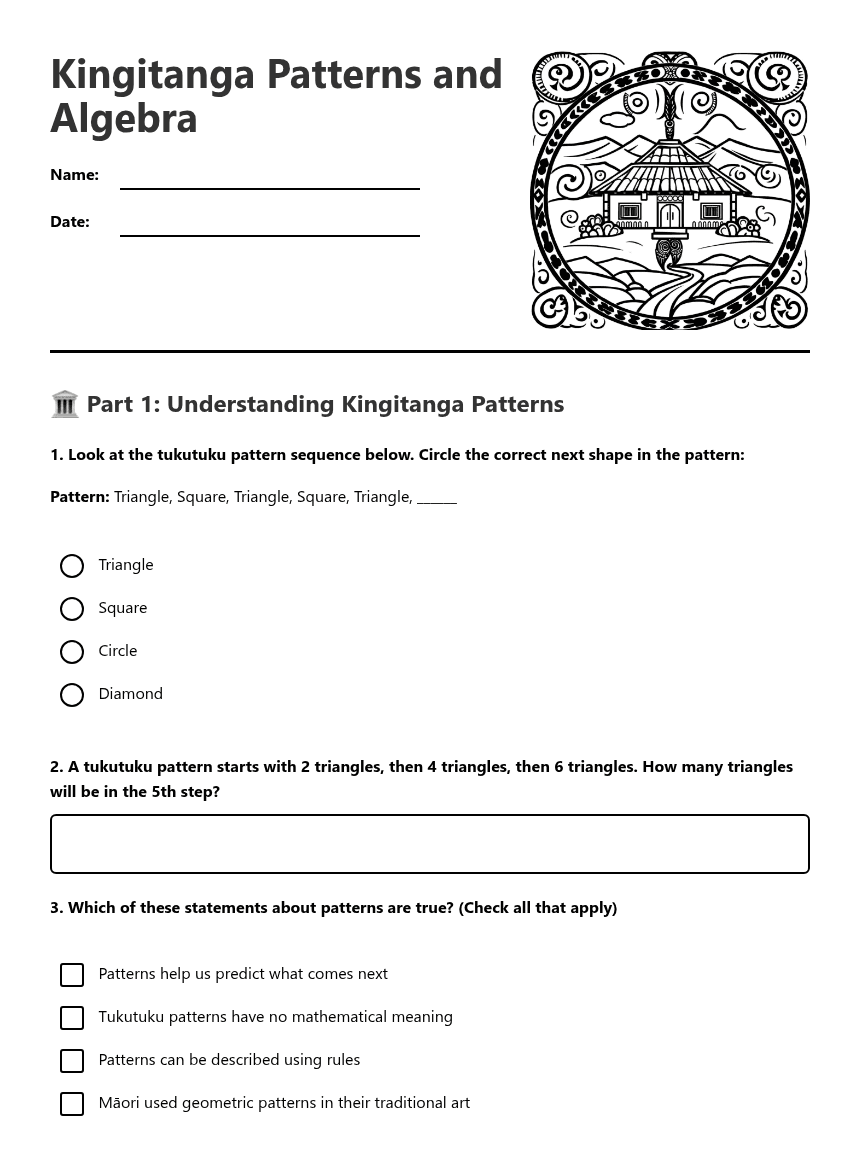
Kingitanga Patterns and Algebra

🏛️ Part 1: Understanding Kingitanga Patterns
Pattern: Triangle, Square, Triangle, Square, Triangle, ______
📊 Part 2: Pattern Tables and Rules
Rule: The number of diamonds increases by 3 each step
| Step Number | Number of Diamonds |
|---|---|
| 1 | 5 |
| 2 | 8 |
| 3 | _____ |
| 4 | _____ |
| 5 | _____ |
d = _______________
🎨 Part 3: Creating Your Own Tukutuku Pattern
| Step Number | Number of Shapes |
|---|---|
| 1 | |
| 2 | |
| 3 | |
| 4 |
🔍 Part 4: Pattern Analysis and Cultural Connections
The _____________ movement was important for Māori unity. Traditional meeting houses often feature _____________ patterns, which are geometric designs that follow mathematical _____________. These patterns can be described using _____________ expressions.
t = _______________
About This Worksheet
Free in Kuraplan
Sign up free, grab the PDF, and customize it for your class.
Print-Ready
Formatted for standard paper. Clean layout, easy to read.
AI-Generated
Created with Kuraplan's AI, designed for real classroom use.
For Teachers & Parents
Use in classrooms, for homework, tutoring, or homeschool.
Need a custom version of this worksheet?
Kuraplan's AI generates custom worksheets in seconds — differentiated for every learner, aligned to your curriculum.
Generate Custom Worksheets — FreeMore Maths Worksheets
Powers, Roots, and Integers
Free
Growing Patterns: Beginning Algebra
Free
Sequence Classification: Differences & Ratios
Free
True or False Equations
Free
Tū Tauā Algebra Attacks
Free
Exponents and Integer Operations
Free
Two-Step Addition Division Equations
Free