Ko Pukuatua Vocabulary Comprehension
A free english worksheet ready for your classroom. Open in Kuraplan to grab the print-ready PDF, customize it for your students, or generate a fresh version in seconds.
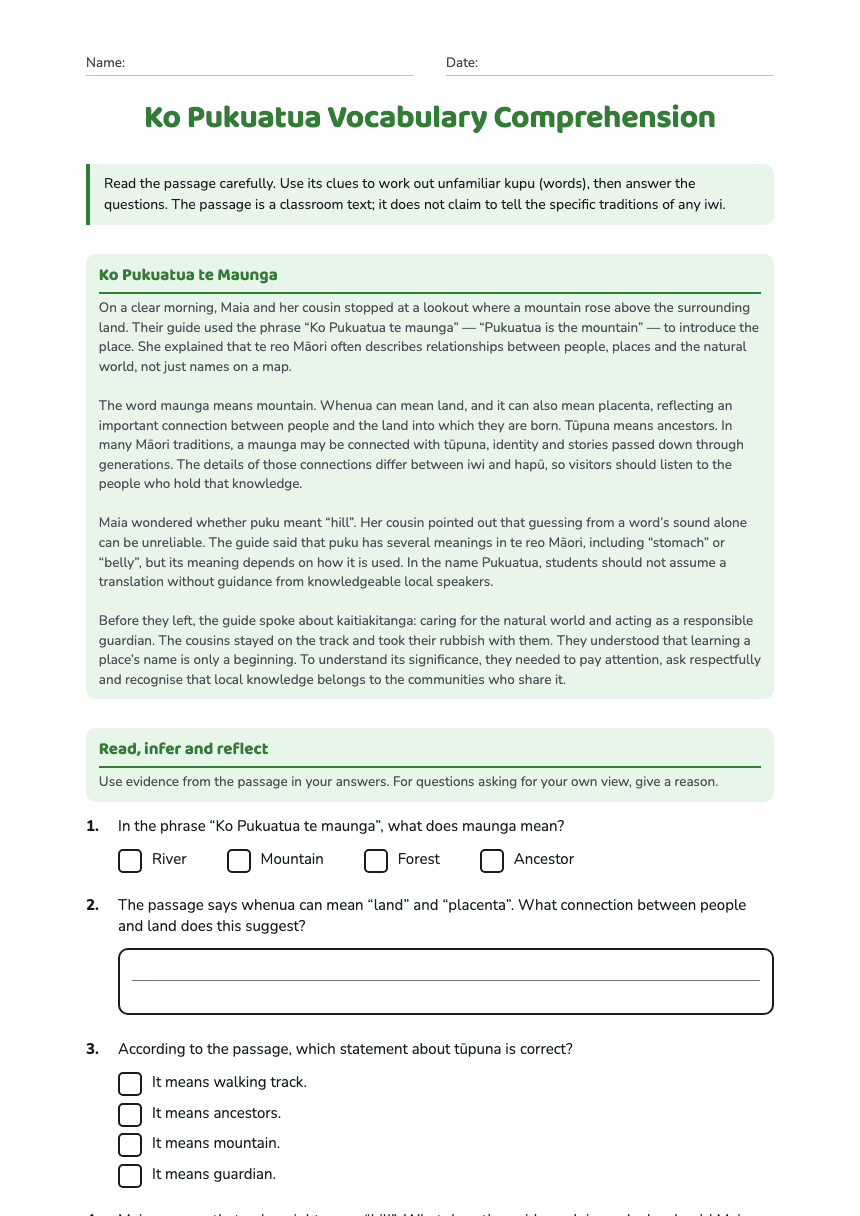
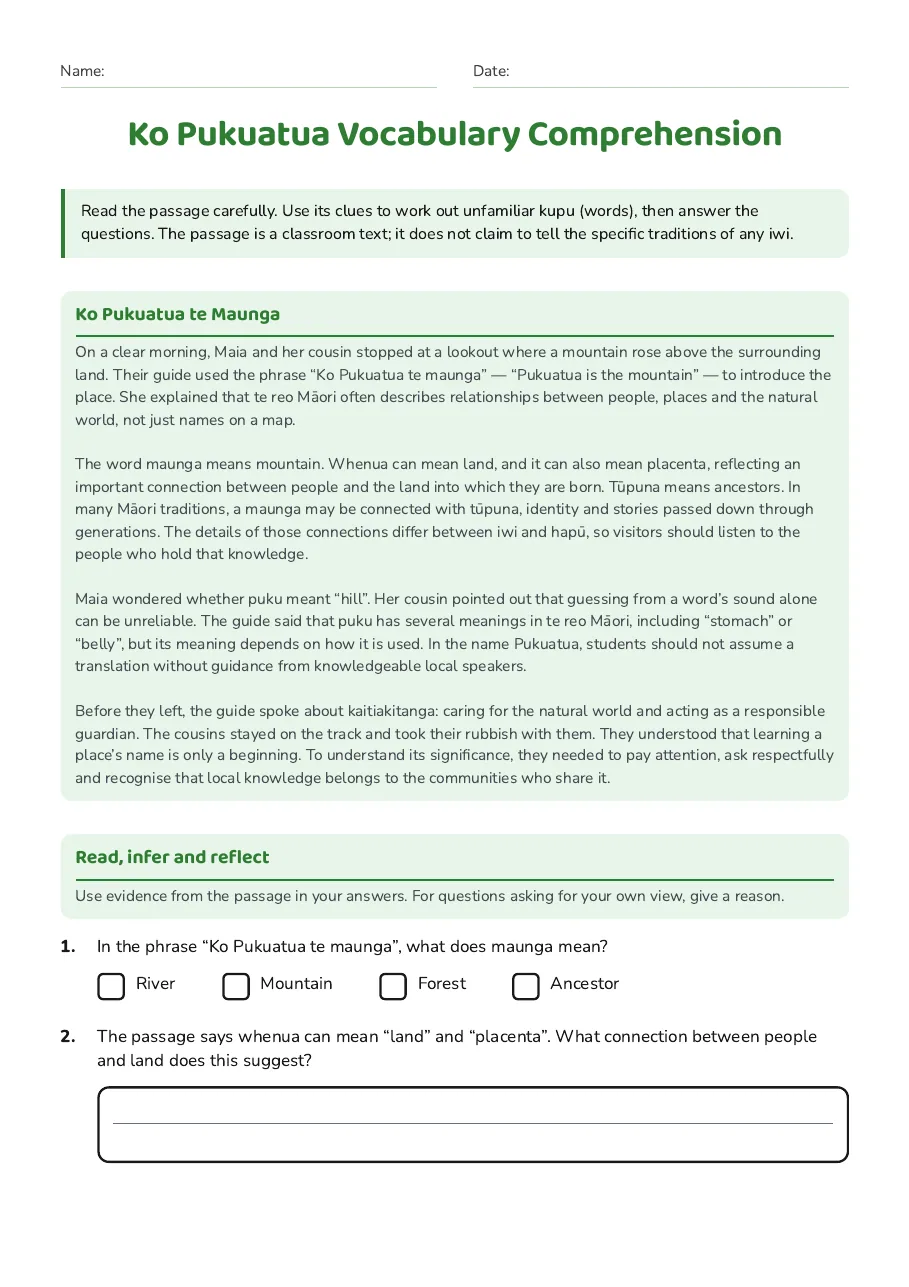
Ko Pukuatua Vocabulary Comprehension
Ko Pukuatua te Maunga
On a clear morning, Maia and her cousin stopped at a lookout where a mountain rose above the surrounding land. Their guide used the phrase “Ko Pukuatua te maunga” — “Pukuatua is the mountain” — to introduce the place. She explained that te reo Māori often describes relationships between people, places and the natural world, not just names on a map. The word maunga means mountain. Whenua can mean land, and it can also mean placenta, reflecting an important connection between people and the land into which they are born. Tūpuna means ancestors. In many Māori traditions, a maunga may be connected with tūpuna, identity and stories passed down through generations. The details of those connections differ between iwi and hapū, so visitors should listen to the people who hold that knowledge. Maia wondered whether puku meant “hill”. Her cousin pointed out that guessing from a word’s sound alone can be unreliable. The guide said that puku has several meanings in te reo Māori, including “stomach” or “belly”, but its meaning depends on how it is used. In the name Pukuatua, students should not assume a translation without guidance from knowledgeable local speakers. Before they left, the guide spoke about kaitiakitanga: caring for the natural world and acting as a responsible guardian. The cousins stayed on the track and took their rubbish with them. They understood that learning a place’s name is only a beginning. To understand its significance, they needed to pay attention, ask respectfully and recognise that local knowledge belongs to the communities who share it.
Read, infer and reflect
Use evidence from the passage in your answers. For questions asking for your own view, give a reason.
- River
- Mountain
- Forest
- Ancestor
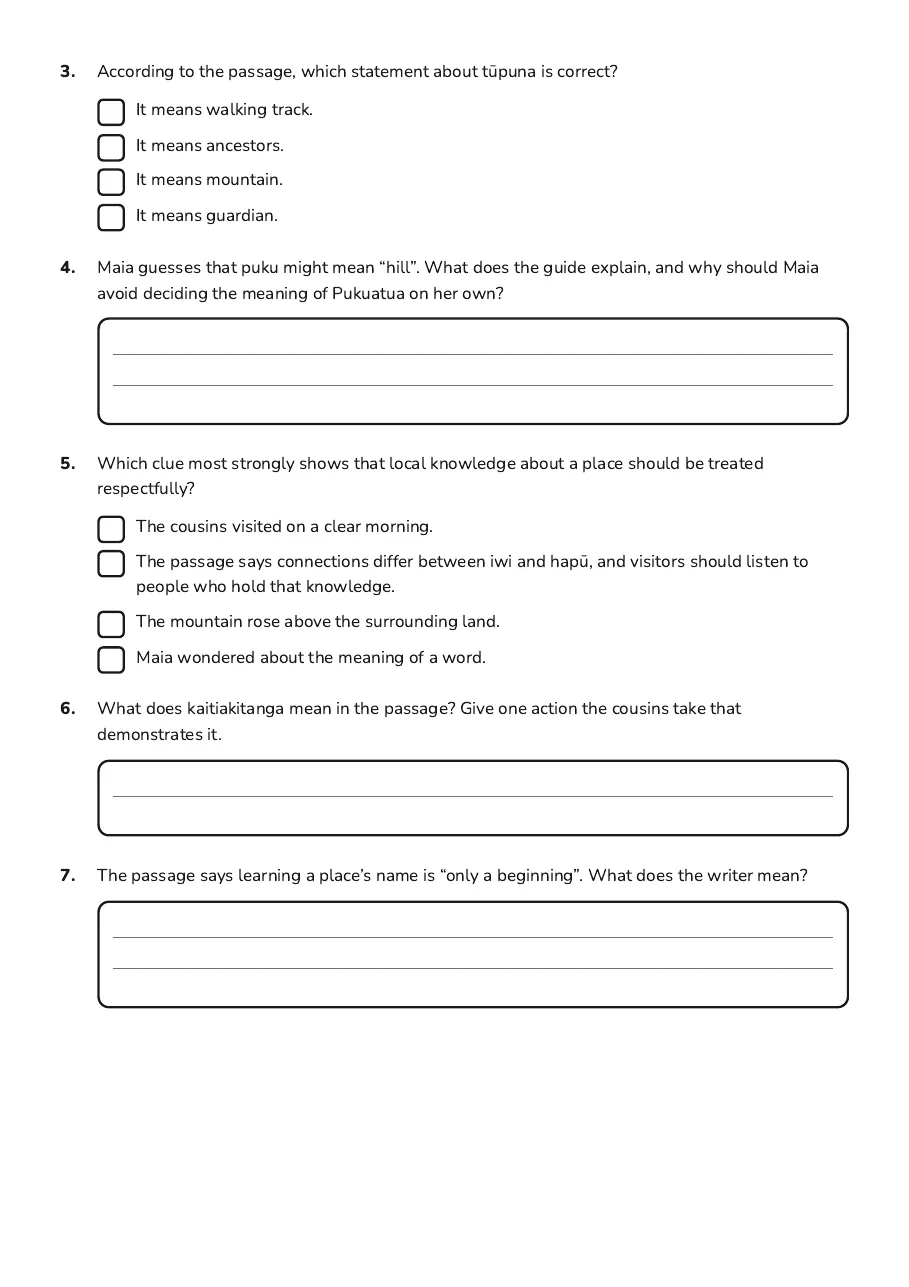
- It means walking track.
- It means ancestors.
- It means mountain.
- It means guardian.
- The cousins visited on a clear morning.
- The passage says connections differ between iwi and hapū, and visitors should listen to people who hold that knowledge.
- The mountain rose above the surrounding land.
- Maia wondered about the meaning of a word.
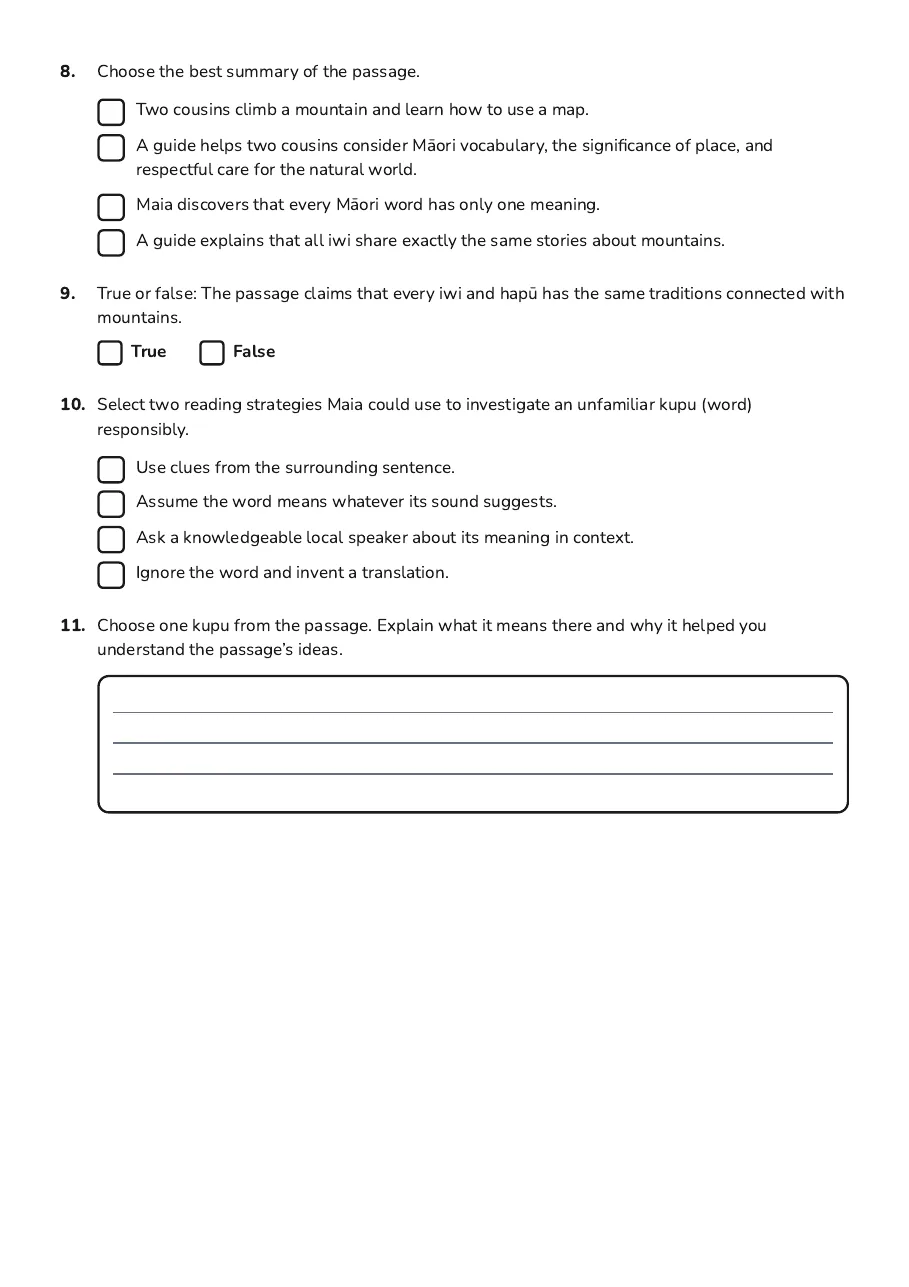
- Two cousins climb a mountain and learn how to use a map.
- A guide helps two cousins consider Māori vocabulary, the significance of place, and respectful care for the natural world.
- Maia discovers that every Māori word has only one meaning.
- A guide explains that all iwi share exactly the same stories about mountains.
- Use clues from the surrounding sentence.
- Assume the word means whatever its sound suggests.
- Ask a knowledgeable local speaker about its meaning in context.
- Ignore the word and invent a translation.
3 printable pages
Page 1
Page 2
Page 3
About This Worksheet
Free in Kuraplan
Sign up free, grab the PDF, and customize it for your class.
Print-Ready
Formatted for standard paper. Clean layout, easy to read.
AI-Generated
Created with Kuraplan's AI, designed for real classroom use.
For Teachers & Parents
Use in classrooms, for homework, tutoring, or homeschool.
Need a custom version of this worksheet?
Kuraplan's AI generates custom worksheets in seconds — differentiated for every learner, aligned to your curriculum.
Generate Custom Worksheets — Free