MathsFreePrintable
Linear Patterns and Equations
A free maths worksheet ready for your classroom. Open in Kuraplan to grab the print-ready PDF, customize it for your students, or generate a fresh version in seconds.
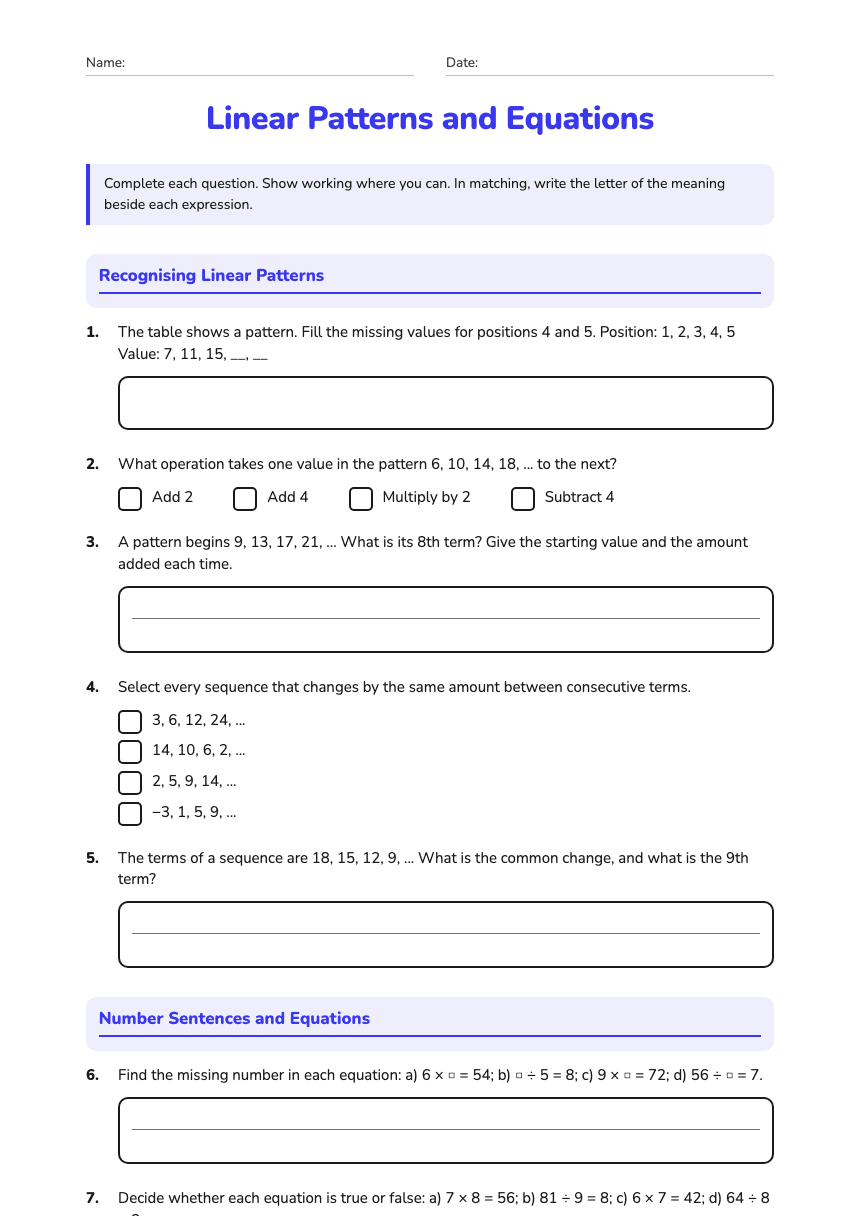
Name:Date:
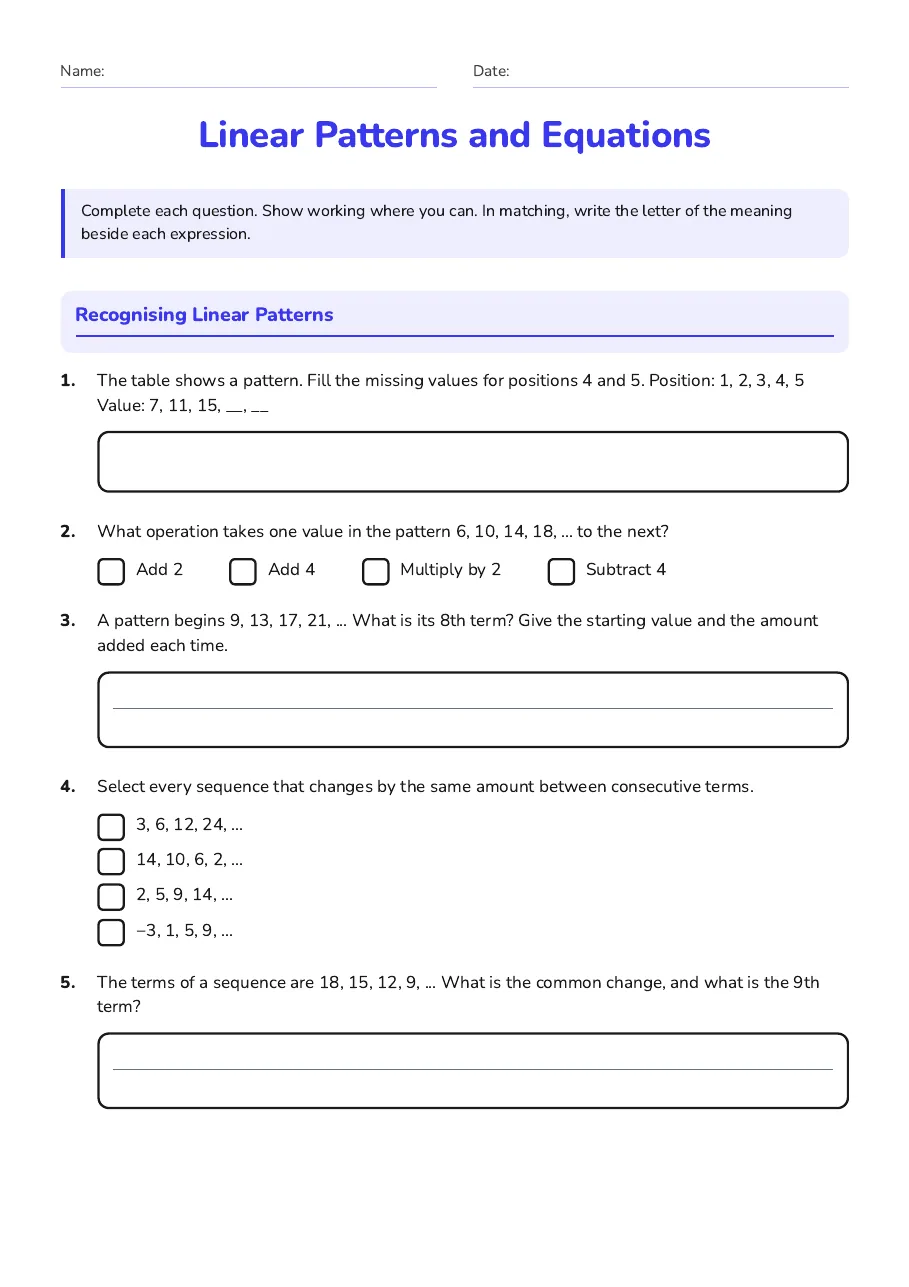
Linear Patterns and Equations
Complete each question. Show working where you can. In matching, write the letter of the meaning beside each expression.
Recognising Linear Patterns
1.The table shows a pattern. Fill the missing values for positions 4 and 5.
Position: 1, 2, 3, 4, 5
Value: 7, 11, 15, __, __
2.What operation takes one value in the pattern 6, 10, 14, 18, ... to the next?
- Add 2
- Add 4
- Multiply by 2
- Subtract 4
3.A pattern begins 9, 13, 17, 21, ... What is its 8th term? Give the starting value and the amount added each time.
4.Select every sequence that changes by the same amount between consecutive terms.
- 3, 6, 12, 24, ...
- 14, 10, 6, 2, ...
- 2, 5, 9, 14, ...
- −3, 1, 5, 9, ...
5.The terms of a sequence are 18, 15, 12, 9, ... What is the common change, and what is the 9th term?
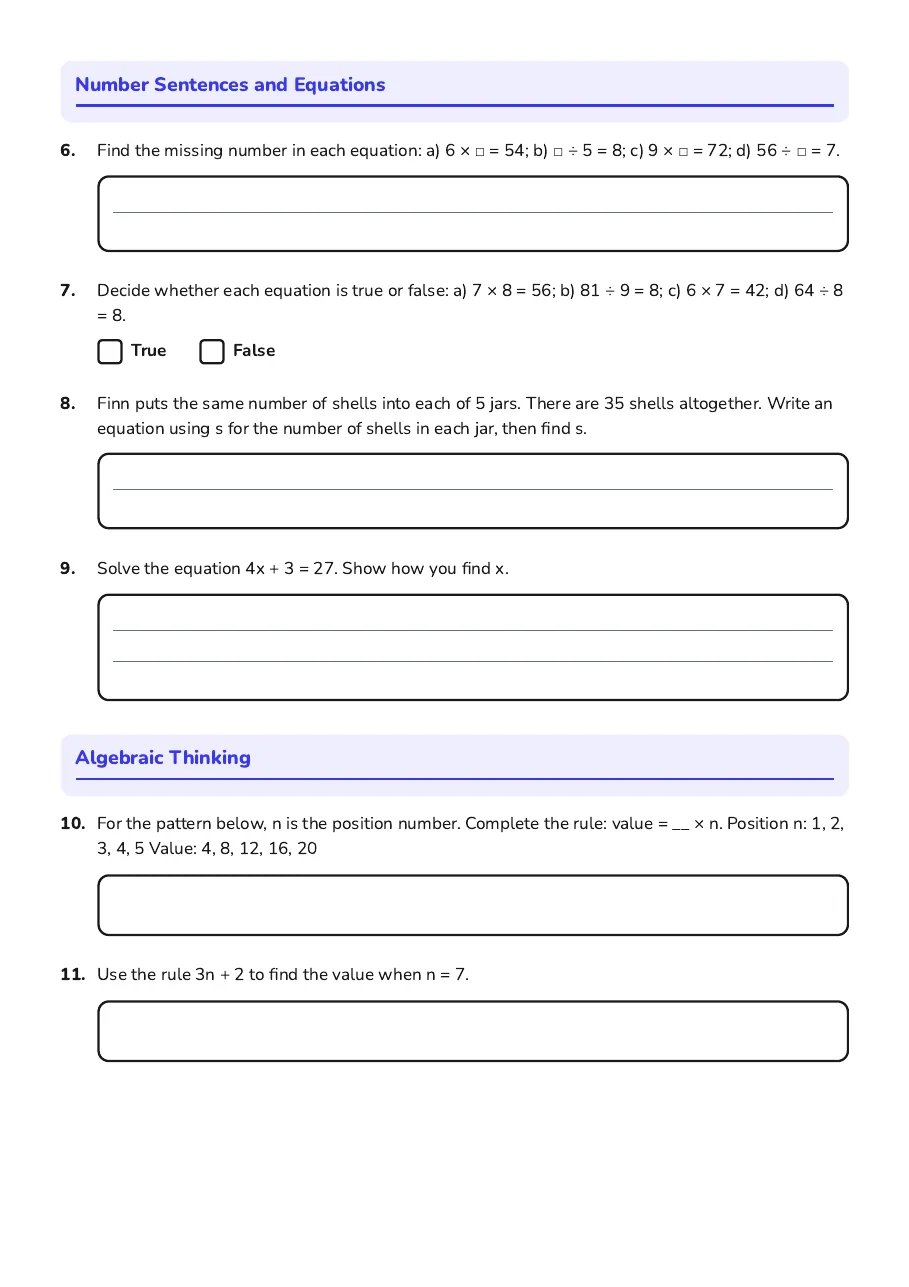
Number Sentences and Equations
6.Find the missing number in each equation: a) 6 × □ = 54; b) □ ÷ 5 = 8; c) 9 × □ = 72; d) 56 ÷ □ = 7.
7.Decide whether each equation is true or false: a) 7 × 8 = 56; b) 81 ÷ 9 = 8; c) 6 × 7 = 42; d) 64 ÷ 8 = 8.
TrueFalse
8.Finn puts the same number of shells into each of 5 jars. There are 35 shells altogether. Write an equation using s for the number of shells in each jar, then find s.
9.Solve the equation 4x + 3 = 27. Show how you find x.
Algebraic Thinking
10.For the pattern below, n is the position number. Complete the rule: value = __ × n.
Position n: 1, 2, 3, 4, 5
Value: 4, 8, 12, 16, 20
11.Use the rule 3n + 2 to find the value when n = 7.
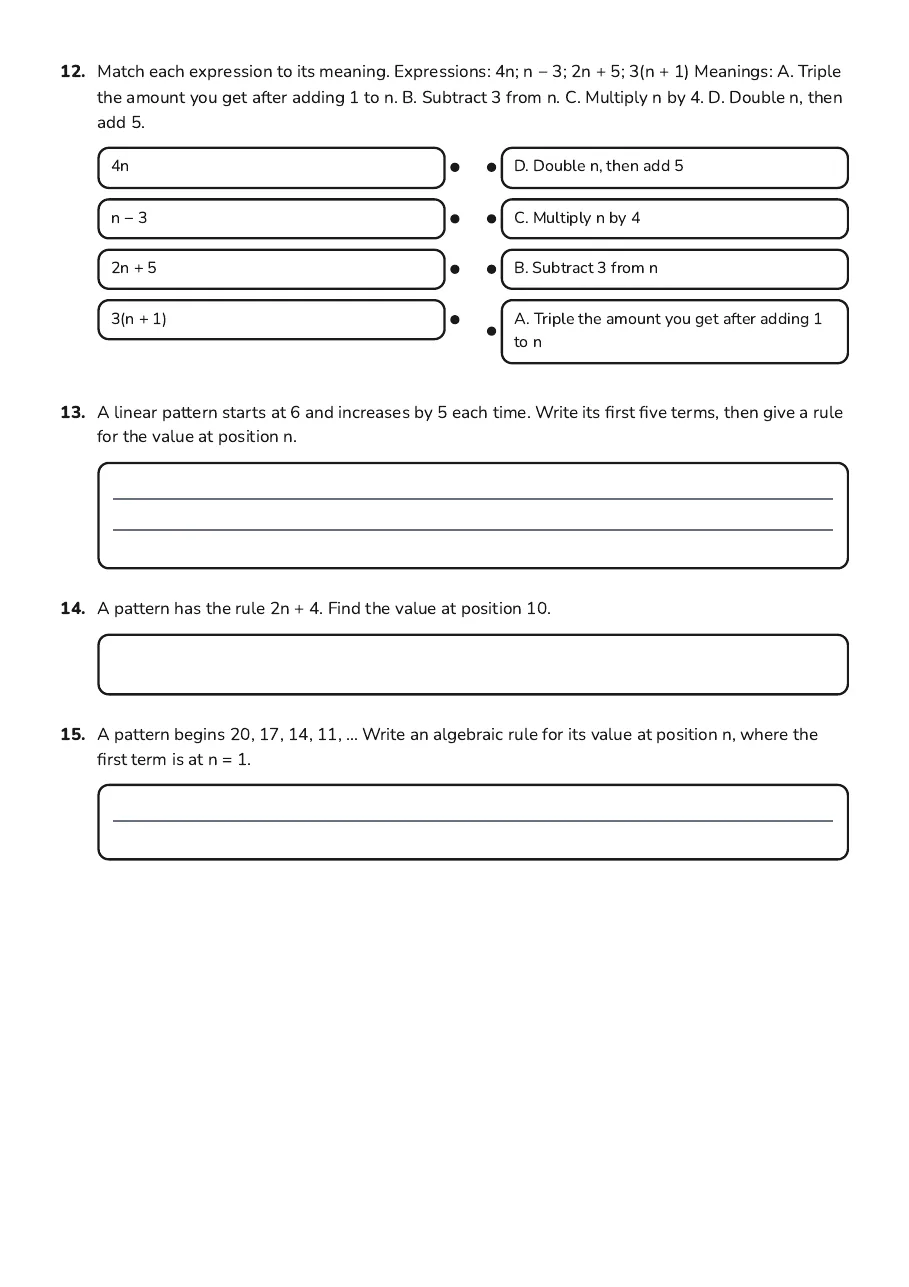
12.Match each expression to its meaning.
Expressions: 4n; n − 3; 2n + 5; 3(n + 1)
Meanings: A. Triple the amount you get after adding 1 to n. B. Subtract 3 from n. C. Multiply n by 4. D. Double n, then add 5.
- 4n
- n − 3
- 2n + 5
- 3(n + 1)
- D. Double n, then add 5
- C. Multiply n by 4
- B. Subtract 3 from n
- A. Triple the amount you get after adding 1 to n
13.A linear pattern starts at 6 and increases by 5 each time. Write its first five terms, then give a rule for the value at position n.
14.A pattern has the rule 2n + 4. Find the value at position 10.
15.A pattern begins 20, 17, 14, 11, ... Write an algebraic rule for its value at position n, where the first term is at n = 1.
3 printable pages
Page 1
Page 2
Page 3
About This Worksheet
Free in Kuraplan
Sign up free, grab the PDF, and customize it for your class.
Print-Ready
Formatted for standard paper. Clean layout, easy to read.
AI-Generated
Created with Kuraplan's AI, designed for real classroom use.
For Teachers & Parents
Use in classrooms, for homework, tutoring, or homeschool.
Need a custom version of this worksheet?
Kuraplan's AI generates custom worksheets in seconds — differentiated for every learner, aligned to your curriculum.
Generate Custom Worksheets — Free No credit card Curriculum-aligned Under 60 seconds
More Maths Worksheets
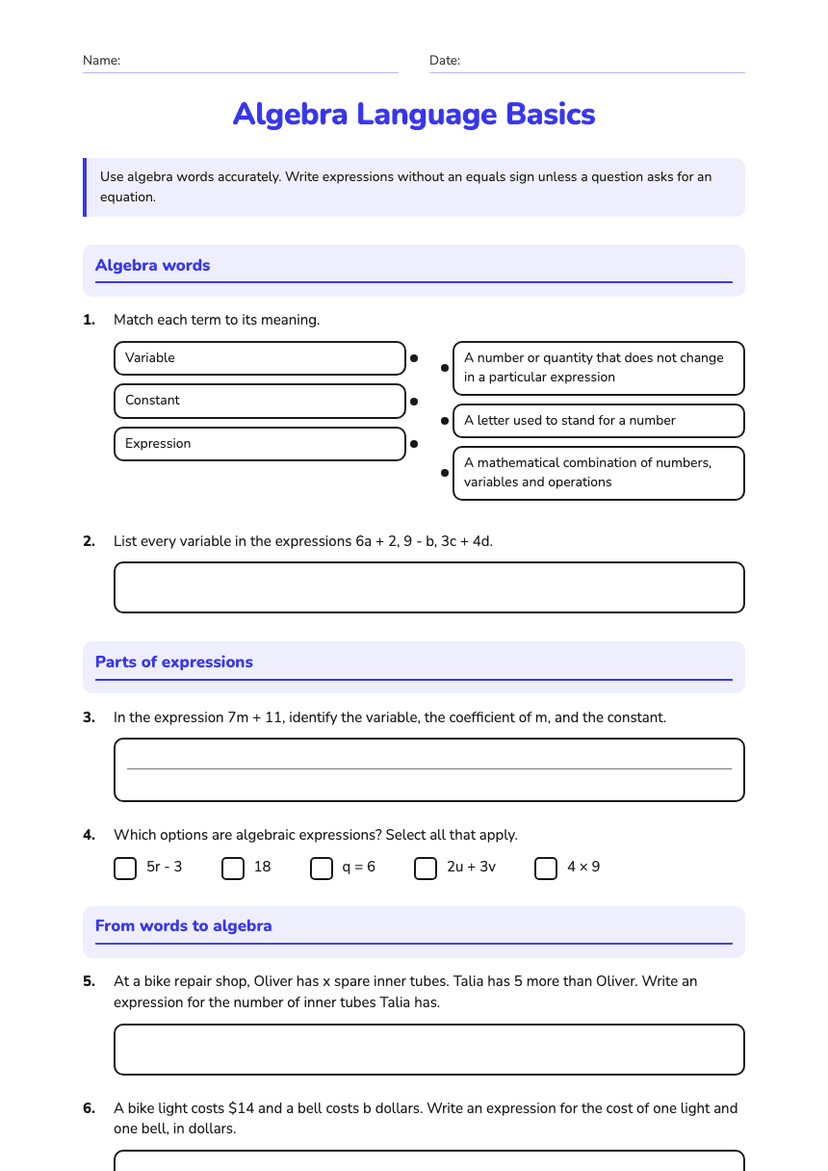
Year 7–8
Algebra Language Basics
Free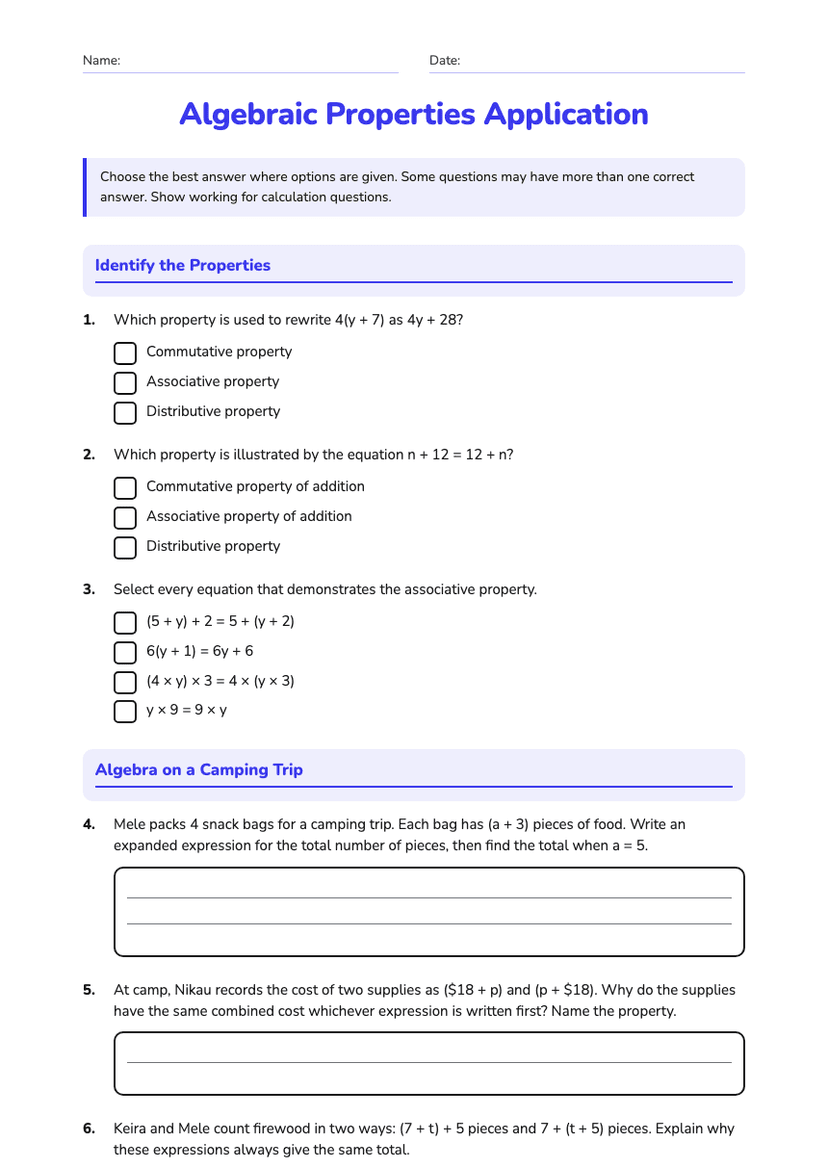
Year 8
Algebraic Properties Application
Free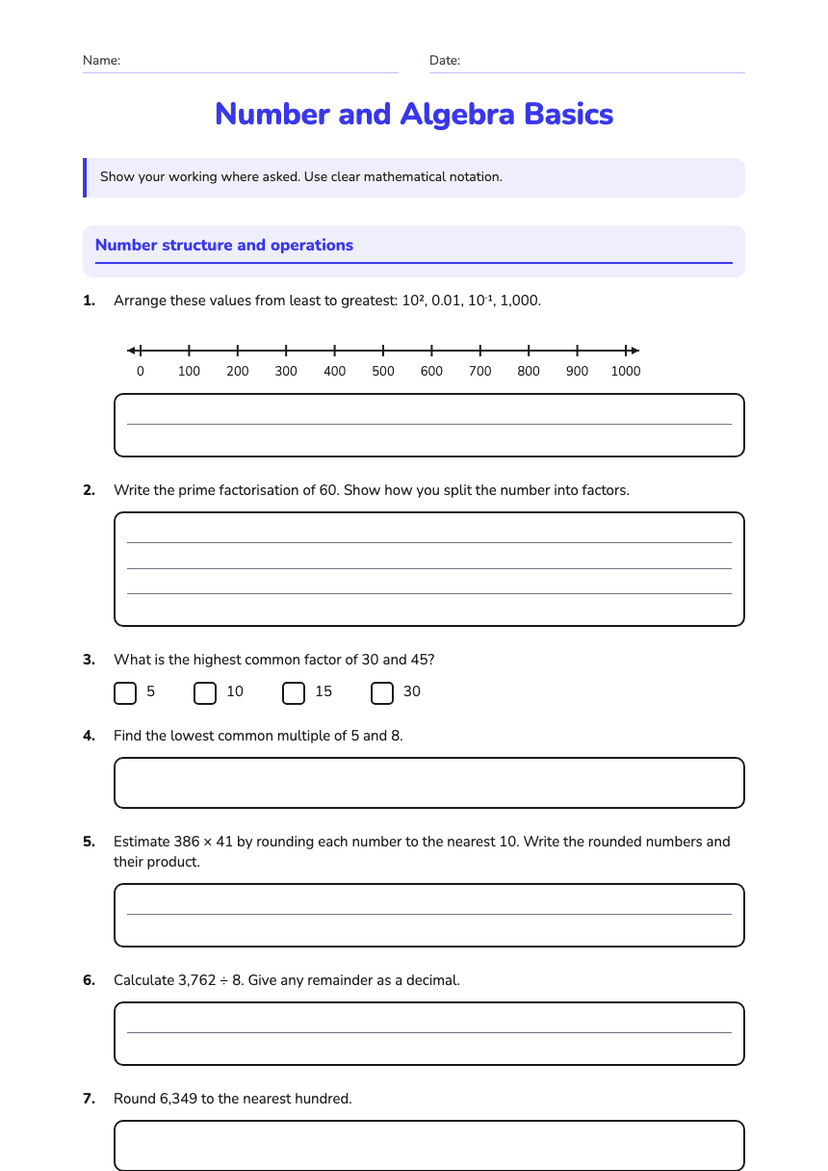
Year 7–8
Number and Algebra Basics
Free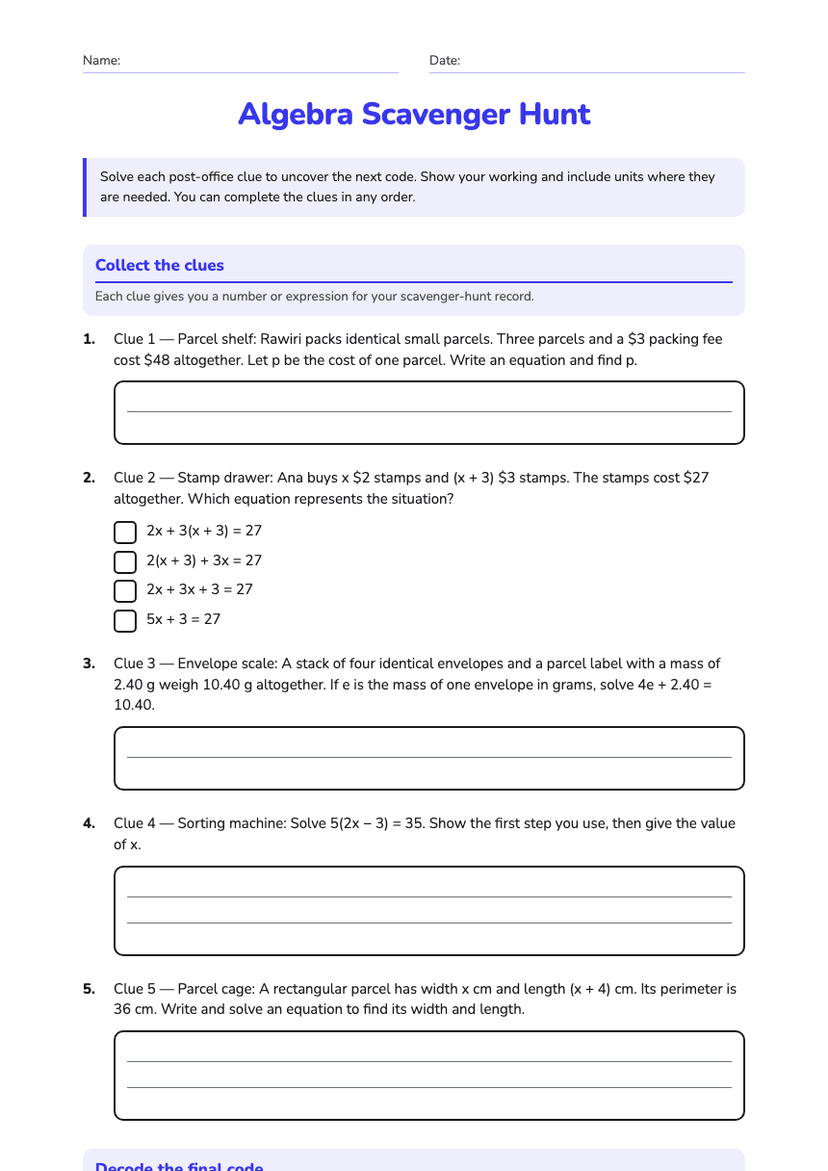
Year 9
Algebra Scavenger Hunt
Free
Year 7–8
Introduction to Algebraic Concepts
Free
Year 7–8
Unknown Angles Equations
Free
Year 7–8
Patterns to Algebra
Free
Year 11