MathsFreePrintable

Measurement Concepts Introduction

A free maths worksheet ready for your classroom. Open in Kuraplan to grab the print-ready PDF, customize it for your students, or generate a fresh version in seconds.
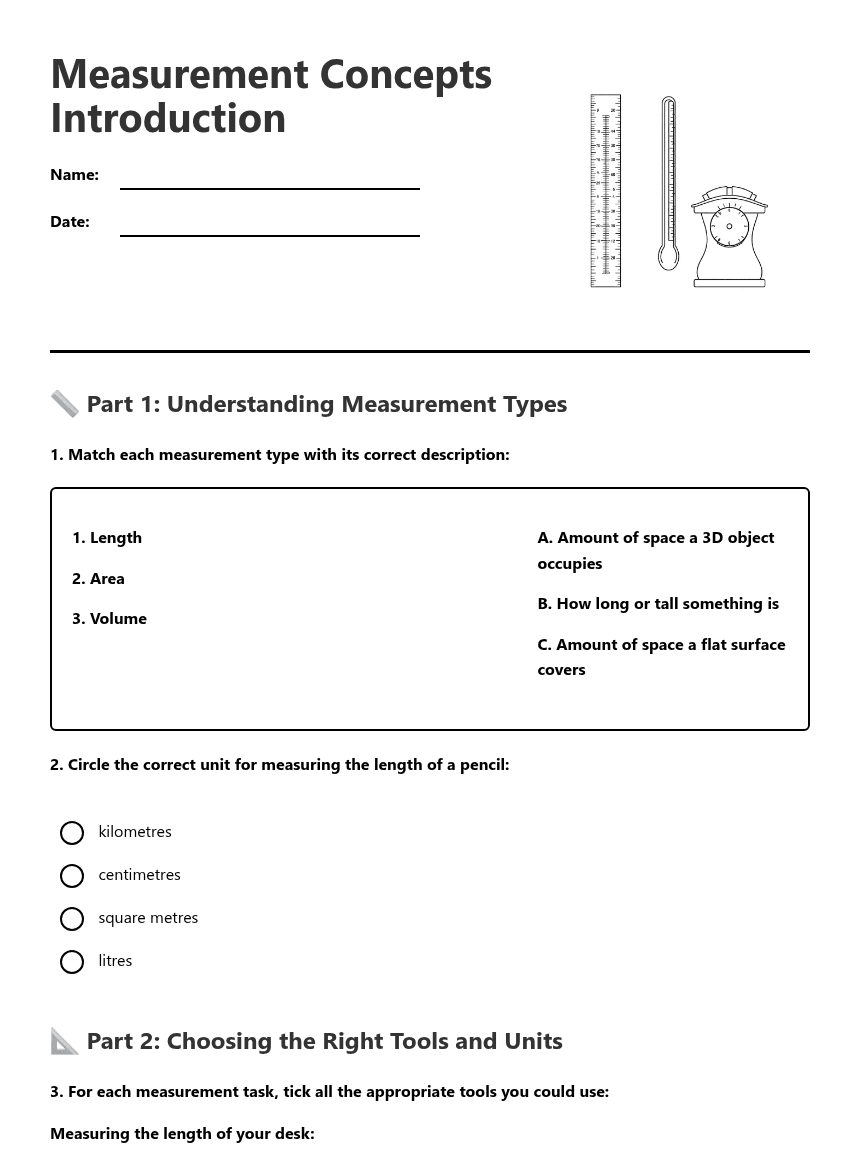
Measurement Concepts Introduction worksheet preview
Measurement Concepts Introduction

Measurement Concepts Introduction

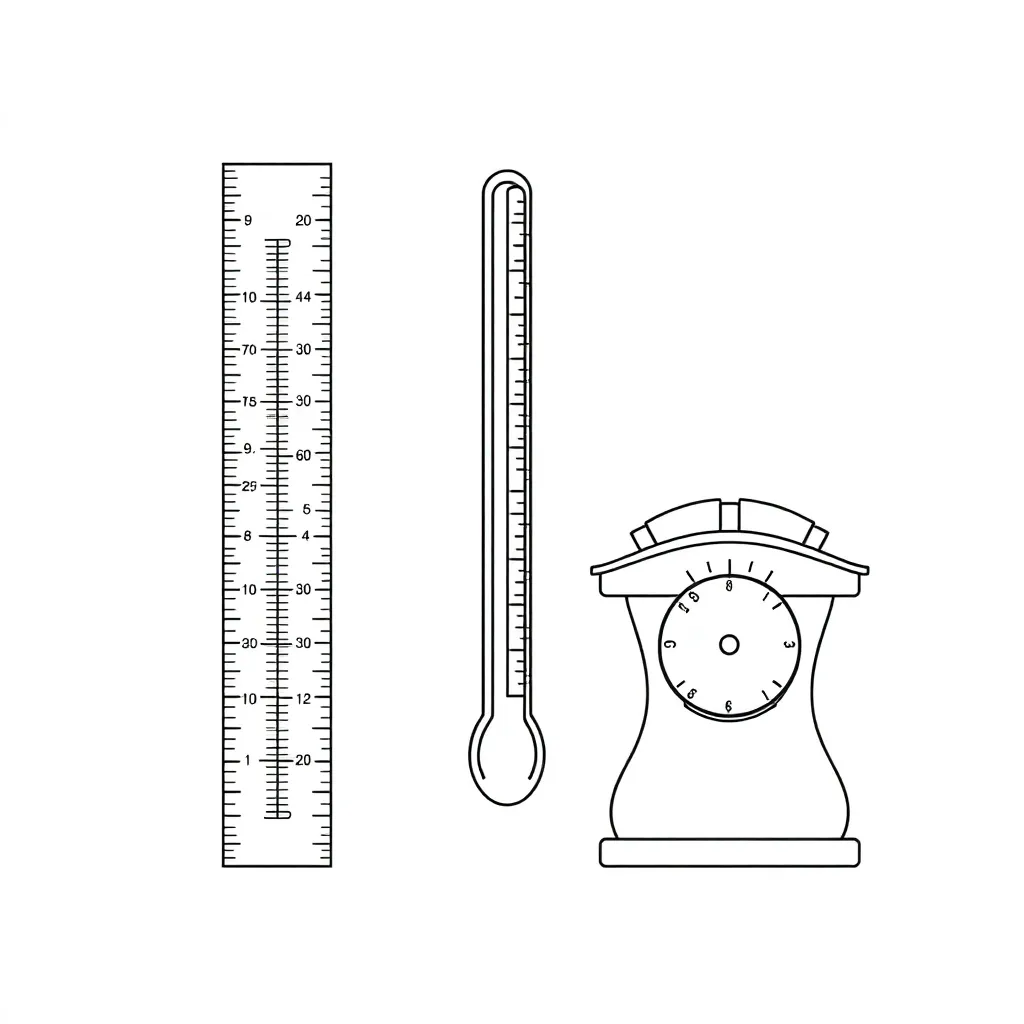
Measurement tools including ruler, measuring jug, and cubes

📏 Part 1: Understanding Measurement Types

1. Match each measurement type with its correct description:
1. Length
2. Area
3. Volume
A. Amount of space a 3D object occupies
B. How long or tall something is
C. Amount of space a flat surface covers
2. Circle the correct unit for measuring the length of a pencil:

kilometres

centimetres

square metres

litres

📐 Part 2: Choosing the Right Tools and Units

3. For each measurement task, tick all the appropriate tools you could use:

Measuring the length of your desk:

Ruler

Measuring tape

Measuring jug

Your hand span

Measuring the volume of water in a bottle:

Measuring jug

Ruler

Graduated cylinder

Measuring cup

4. Fill in the blanks with the correct metric units:

a) The height of a door is about 2 ____________

b) The area of a postage stamp is about 6 ____________

c) A can of soft drink contains 330 ____________

d) The volume of a dice is about 1 ____________

🔢 Part 3: Real-Life Measurement

5. Look at each scenario and write what type of measurement is needed (length, area, or volume):

a) Buying carpet for your bedroom floor: ____________

b) Checking if a sofa will fit through a doorway: ____________

c) Finding how much paint is needed to fill a container: ____________

d) Measuring fabric to make curtains: ____________

e) Calculating how much soil fits in a planter box: ____________

6. Circle the most sensible unit for each measurement:

Distance from Auckland to Wellington:

650 centimetres

650 metres

650 kilometres

Area of a classroom:

60 square centimetres

60 square metres

60 square kilometres

✏️ Part 4: Measurement Practice

7. Draw and label a rectangle that is 4 cm long and 2 cm wide. Then calculate its area:
8. Estimate, then measure three objects in your classroom. Record your findings:
Object 1: ________________________
Estimate: _______ Actual: _______ Unit: _______
Object 2: ________________________
Estimate: _______ Actual: _______ Unit: _______
Object 3: ________________________
Estimate: _______ Actual: _______ Unit: _______
9. Explain why measurement is important in everyday life. Give two specific examples:

🏠 Part 5: Home Connection

10. For homework, find one example of each measurement type at home and describe what tool you would use to measure it:
Length example: ________________________
Tool needed: ________________________
Area example: ________________________
Tool needed: ________________________
Volume example: ________________________
Tool needed: ________________________

About This Worksheet

Free in Kuraplan

Sign up free, grab the PDF, and customize it for your class.

Print-Ready

Formatted for standard paper. Clean layout, easy to read.

AI-Generated

Created with Kuraplan's AI, designed for real classroom use.

For Teachers & Parents

Use in classrooms, for homework, tutoring, or homeschool.

Need a custom version of this worksheet?

Kuraplan's AI generates custom worksheets in seconds — differentiated for every learner, aligned to your curriculum.

Generate Custom Worksheets — Free
No credit card Curriculum-aligned Under 60 seconds