MathsFreePrintable

Measuring Length Accurately

A free maths worksheet ready for your classroom. Open in Kuraplan to grab the print-ready PDF, customize it for your students, or generate a fresh version in seconds.

Measuring Length Accurately worksheet preview
Name:Date:

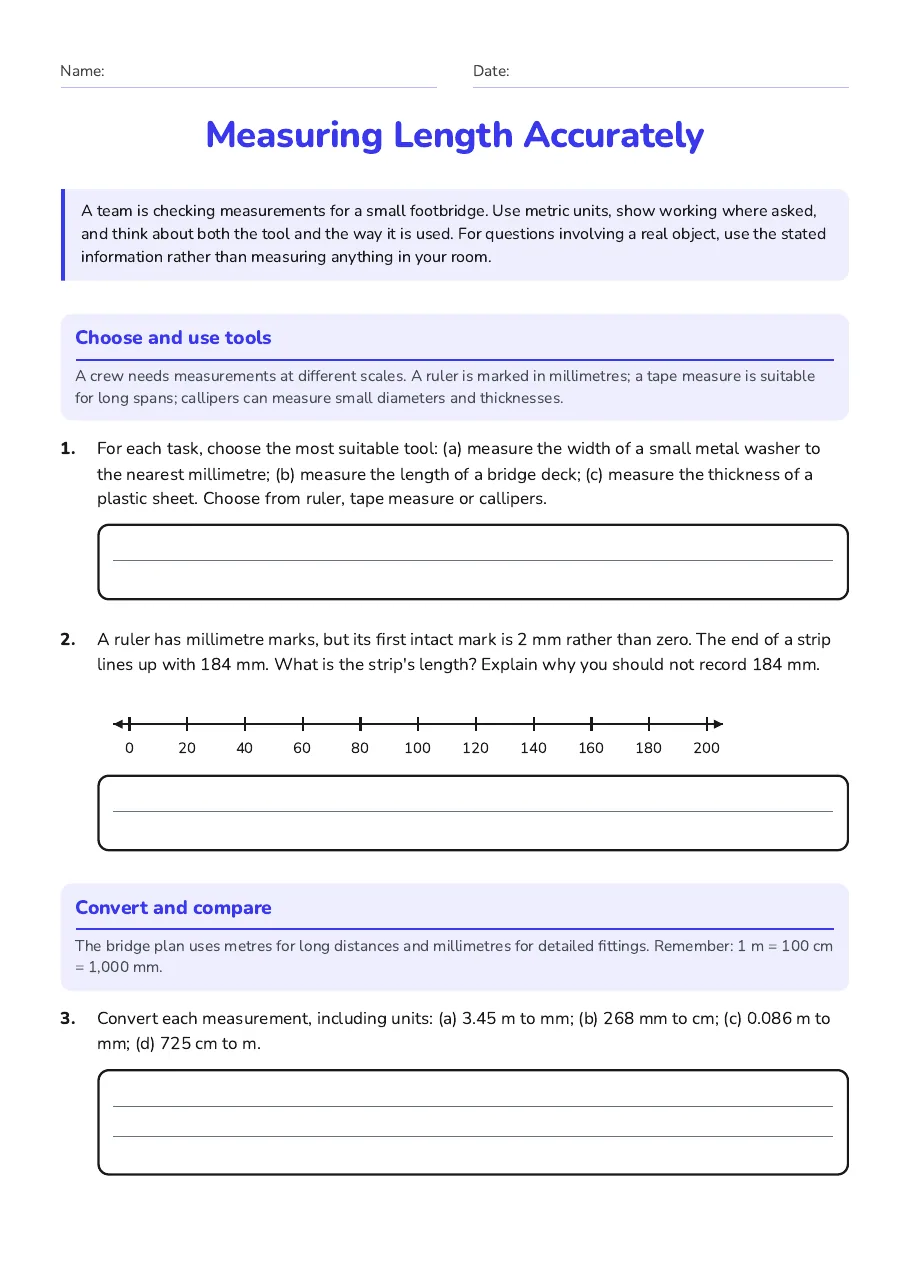
Measuring Length Accurately

A team is checking measurements for a small footbridge. Use metric units, show working where asked, and think about both the tool and the way it is used. For questions involving a real object, use the stated information rather than measuring anything in your room.

Choose and use tools

A crew needs measurements at different scales. A ruler is marked in millimetres; a tape measure is suitable for long spans; callipers can measure small diameters and thicknesses.

1.For each task, choose the most suitable tool: (a) measure the width of a small metal washer to the nearest millimetre; (b) measure the length of a bridge deck; (c) measure the thickness of a plastic sheet. Choose from ruler, tape measure or callipers.
2.A ruler has millimetre marks, but its first intact mark is 2 mm rather than zero. The end of a strip lines up with 184 mm. What is the strip's length? Explain why you should not record 184 mm.
020406080100120140160180200

Convert and compare

The bridge plan uses metres for long distances and millimetres for detailed fittings. Remember: 1 m = 100 cm = 1,000 mm.

3.Convert each measurement, including units: (a) 3.45 m to mm; (b) 268 mm to cm; (c) 0.086 m to mm; (d) 725 cm to m.
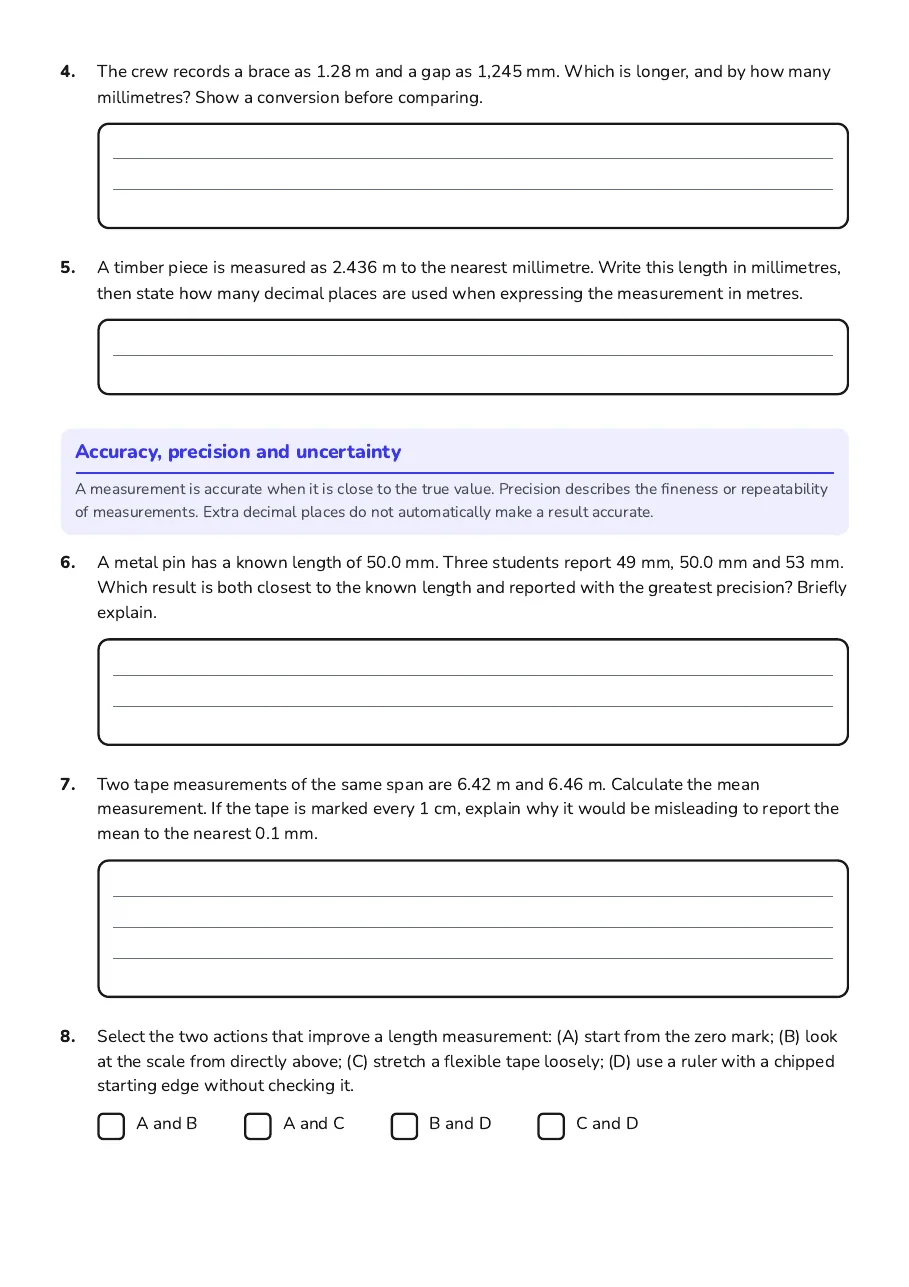
4.The crew records a brace as 1.28 m and a gap as 1,245 mm. Which is longer, and by how many millimetres? Show a conversion before comparing.
5.A timber piece is measured as 2.436 m to the nearest millimetre. Write this length in millimetres, then state how many decimal places are used when expressing the measurement in metres.

Accuracy, precision and uncertainty

A measurement is accurate when it is close to the true value. Precision describes the fineness or repeatability of measurements. Extra decimal places do not automatically make a result accurate.

6.A metal pin has a known length of 50.0 mm. Three students report 49 mm, 50.0 mm and 53 mm. Which result is both closest to the known length and reported with the greatest precision? Briefly explain.
7.Two tape measurements of the same span are 6.42 m and 6.46 m. Calculate the mean measurement. If the tape is marked every 1 cm, explain why it would be misleading to report the mean to the nearest 0.1 mm.
8.Select the two actions that improve a length measurement: (A) start from the zero mark; (B) look at the scale from directly above; (C) stretch a flexible tape loosely; (D) use a ruler with a chipped starting edge without checking it.
  • A and B
  • A and C
  • B and D
  • C and D
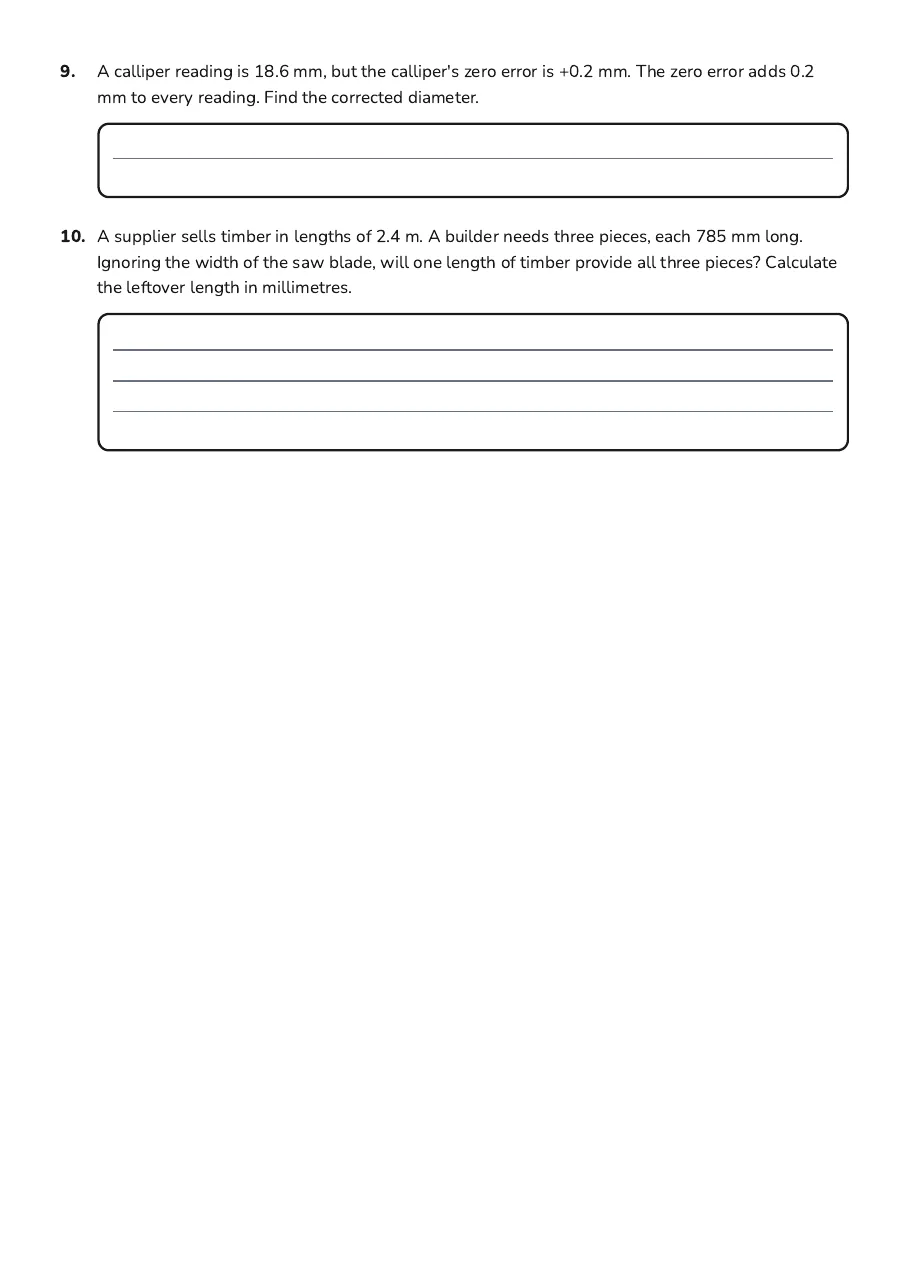
9.A calliper reading is 18.6 mm, but the calliper's zero error is +0.2 mm. The zero error adds 0.2 mm to every reading. Find the corrected diameter.
10.A supplier sells timber in lengths of 2.4 m. A builder needs three pieces, each 785 mm long. Ignoring the width of the saw blade, will one length of timber provide all three pieces? Calculate the leftover length in millimetres.

3 printable pages

  • Measuring Length Accurately, page 1 of 3: Choose and use tools, Convert and compare

    Page 1

  • Measuring Length Accurately, page 2 of 3: Accuracy, precision and uncertainty

    Page 2

  • Measuring Length Accurately, page 3 of 3: 9. A calliper reading is 18.6 mm, but the calliper's zero error is +0.2 mm. The zero…

    Page 3

About This Worksheet

Free in Kuraplan

Sign up free, grab the PDF, and customize it for your class.

Print-Ready

Formatted for standard paper. Clean layout, easy to read.

AI-Generated

Created with Kuraplan's AI, designed for real classroom use.

For Teachers & Parents

Use in classrooms, for homework, tutoring, or homeschool.

Need a custom version of this worksheet?

Kuraplan's AI generates custom worksheets in seconds — differentiated for every learner, aligned to your curriculum.

Generate Custom Worksheets — Free
No credit card Curriculum-aligned Under 60 seconds