ScienceFreePrintable

Moon Phases and Maramataka

A free science worksheet ready for your classroom. Open in Kuraplan to grab the print-ready PDF, customize it for your students, or generate a fresh version in seconds.
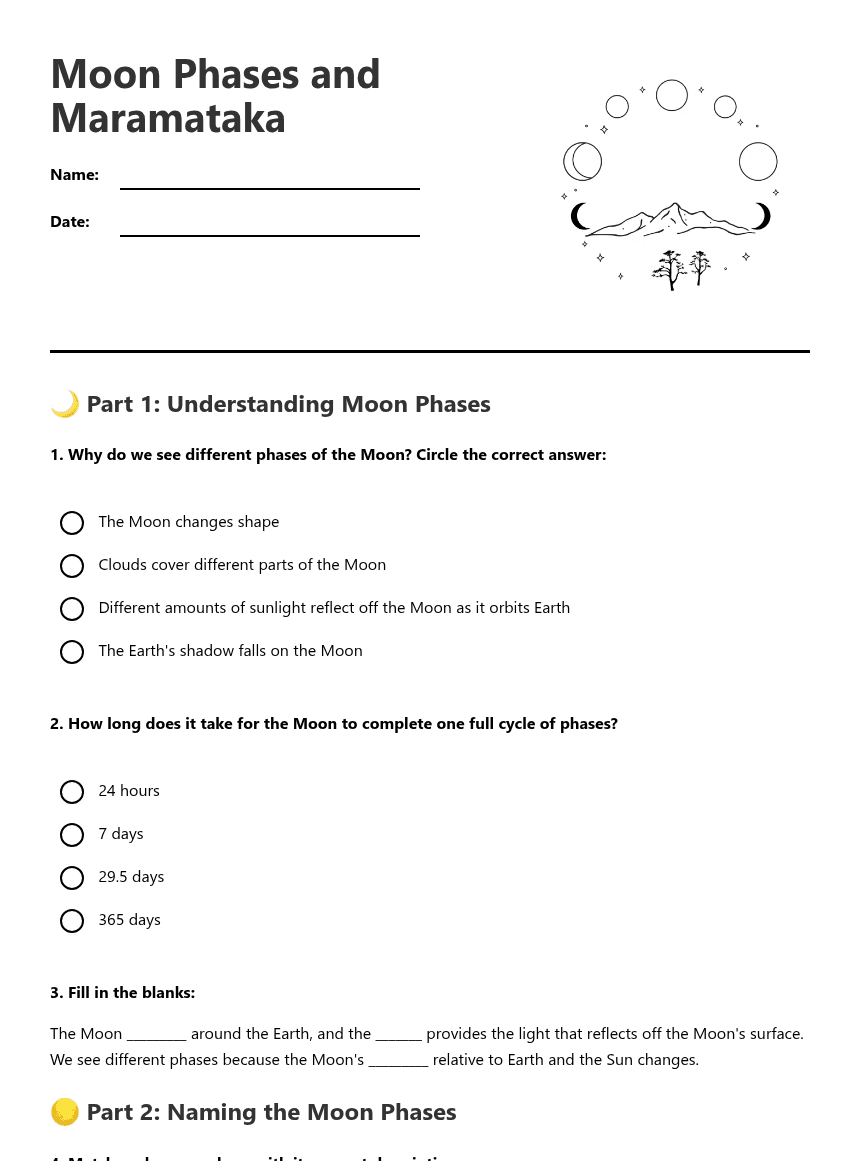
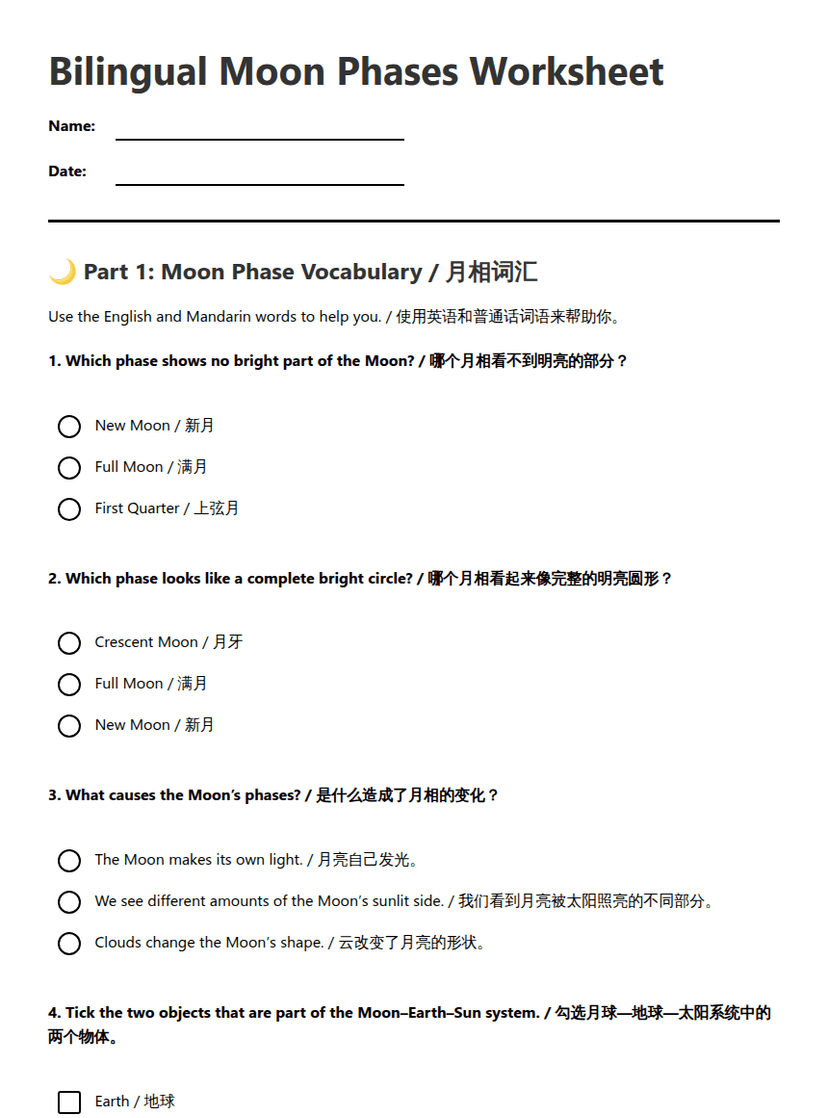
Moon Phases and Maramataka worksheet preview
Moon Phases and Maramataka

Moon Phases and Maramataka

Moon phases diagram showing Earth, Sun and Moon positions

🌙 Part 1: Understanding Moon Phases

1. Why do we see different phases of the Moon? Circle the correct answer:

The Moon changes shape

Clouds cover different parts of the Moon

Different amounts of sunlight reflect off the Moon as it orbits Earth

The Earth's shadow falls on the Moon

2. How long does it take for the Moon to complete one full cycle of phases?

24 hours

7 days

29.5 days

365 days

3. Fill in the blanks:

The Moon _________ around the Earth, and the _______ provides the light that reflects off the Moon's surface. We see different phases because the Moon's _________ relative to Earth and the Sun changes.

🌕 Part 2: Naming the Moon Phases

4. Match each moon phase with its correct description:
1. New Moon
2. First Quarter
3. Full Moon
4. Waxing Crescent
5. Waning Gibbous
A. The entire face of the Moon is visible
B. Half of the Moon is visible (right side)
C. The Moon is not visible from Earth
D. A small crescent is growing larger
E. More than half visible but getting smaller
5. Put the moon phases in the correct order by numbering them 1-8:

___ Waning Crescent

___ First Quarter

___ Full Moon

___ New Moon

___ Waxing Gibbous

___ Last Quarter

___ Waning Gibbous

___ Waxing Crescent

🎨 Part 3: Drawing Moon Phases

6. Draw and label the eight main phases of the Moon in the space below. Show how much of the Moon is visible in each phase:
7. Draw a diagram showing the positions of the Earth, Sun, and Moon during a Full Moon phase. Label each object:

🌿 Part 4: Te Ao Māori and Maramataka

8. What is maramataka?

A Māori fishing net

The Māori lunar calendar

A type of traditional Māori food

A Māori navigation tool

9. Check all the ways that Māori traditionally used moon phases:

For planting crops

For fishing

For navigation

For telling time during the day

For understanding natural rhythms

10. Explain how understanding moon phases connects Māori to their environment:
11. The Māori name for New Moon is Huna-nui. Why do you think this phase might be important in the maramataka?

🔬 Part 5: Scientific Thinking

12. If you were standing on the Moon during a "New Moon" phase (as seen from Earth), what would you see when you looked at Earth?

A "New Earth" (completely dark)

A "Full Earth" (completely lit up)

A "Half Earth"

Earth would not be visible

13. Predict what you would observe if you watched the Moon for one week starting from a New Moon:
14. Home Observation Challenge: Over the next week, observe and sketch the Moon each night. Record the date and time of your observations:

About This Worksheet

Free in Kuraplan

Sign up free, grab the PDF, and customize it for your class.

Print-Ready

Formatted for standard paper. Clean layout, easy to read.

AI-Generated

Created with Kuraplan's AI, designed for real classroom use.

For Teachers & Parents

Use in classrooms, for homework, tutoring, or homeschool.

Need a custom version of this worksheet?

Kuraplan's AI generates custom worksheets in seconds — differentiated for every learner, aligned to your curriculum.

Generate Custom Worksheets — Free
No credit card Curriculum-aligned Under 60 seconds