Moon Phases and Tides
A free science worksheet ready for your classroom. Open in Kuraplan to grab the print-ready PDF, customize it for your students, or generate a fresh version in seconds.
Moon Phases and Tides
Experiment Recording Worksheet — Years 5–8
🌙 Part 1: Hands-on Model Exploration
Use the globe (Earth), styrofoam ball (Moon), and flashlight (Sun) with your group to model the Earth-Moon-Sun system. Record your observations below.
1. New Moon 2. _________________ 3. _________________ 4. _________________
5. _________________ 6. _________________ 7. _________________ 8. _________________
🌊 Part 2: Tides and Gravitational Pull Activity
Using the water tray activity, you explored how the Moon's gravity pulls on Earth's oceans. Answer the questions below based on what you observed.
💭 Part 3: Reflect and Connect
The Moon takes approximately _________ days to orbit Earth. As it moves, we see different moon phases because of how sunlight hits the Moon from different angles. The Moon's _________________ pull on Earth's oceans causes tides to rise and fall. When the Sun, Earth, and Moon are in a straight line (during _________________ Moon or _________________ Moon), we get the strongest tides called spring tides.
About This Worksheet
Free in Kuraplan
Sign up free, grab the PDF, and customize it for your class.
Print-Ready
Formatted for standard paper. Clean layout, easy to read.
AI-Generated
Created with Kuraplan's AI, designed for real classroom use.
For Teachers & Parents
Use in classrooms, for homework, tutoring, or homeschool.
Need a custom version of this worksheet?
Kuraplan's AI generates custom worksheets in seconds — differentiated for every learner, aligned to your curriculum.
Generate Custom Worksheets — FreeMore Science Worksheets
Natural Events and Disasters Sort
Free
Earth, Moon and Sun Patterns
Free
Papatūānuku: Layers and Movement
Free
Planet Earth Synthesis Grid
Free
Space Systems Synthesis Worksheet
Free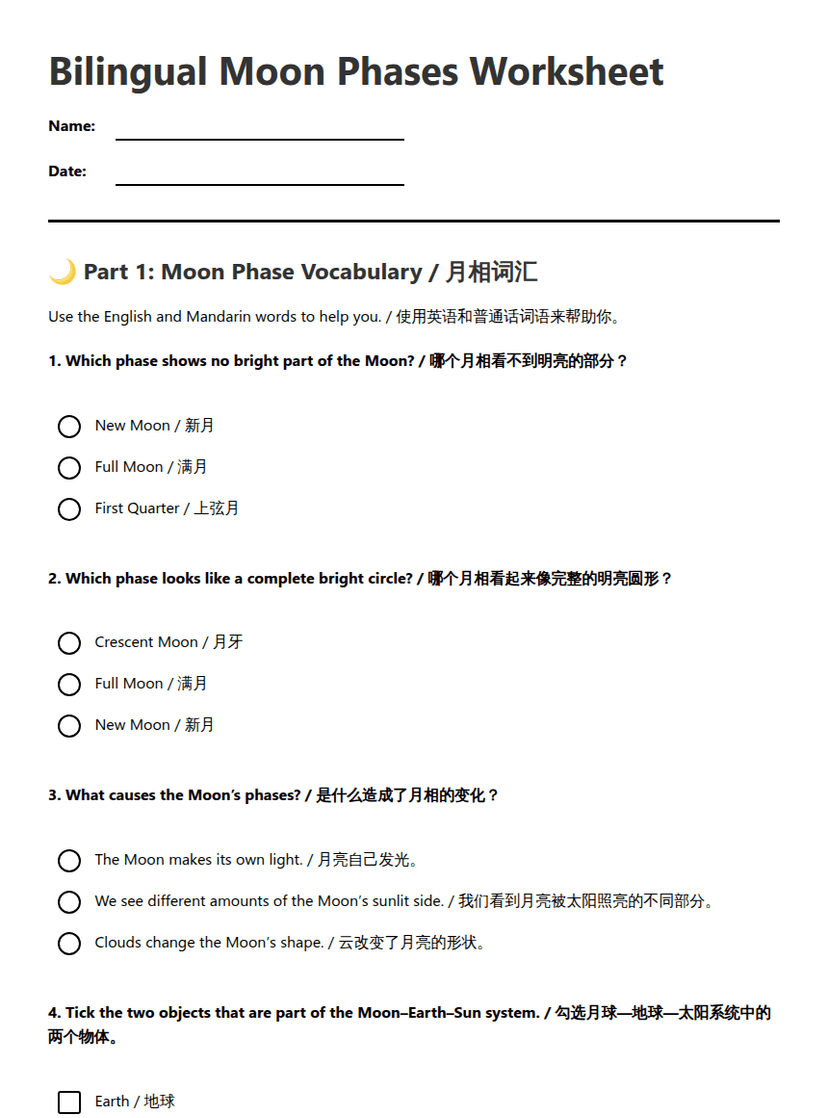
Bilingual Moon Phases Worksheet
Free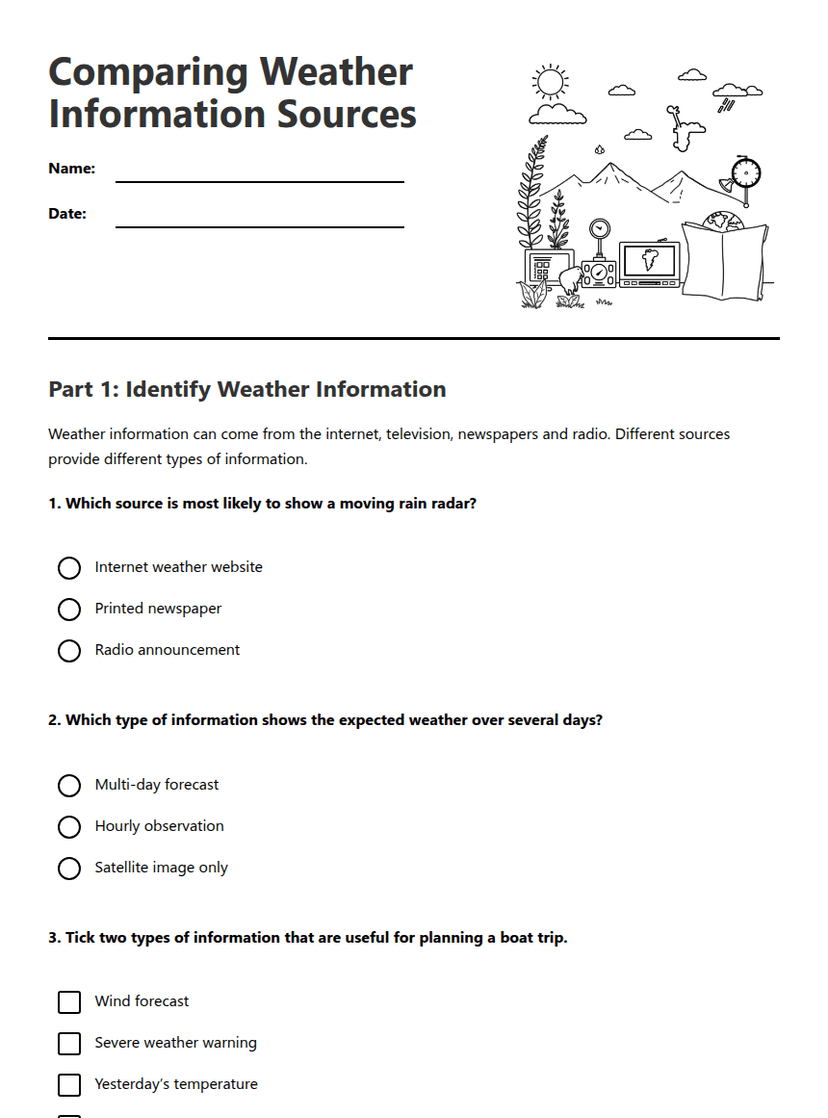
Comparing Weather Information Sources
Free