MathsFreePrintable
Māori Patterns Geometry Shapes
A free maths worksheet ready for your classroom. Open in Kuraplan to grab the print-ready PDF, customize it for your students, or generate a fresh version in seconds.

Māori Patterns Geometry Shapes
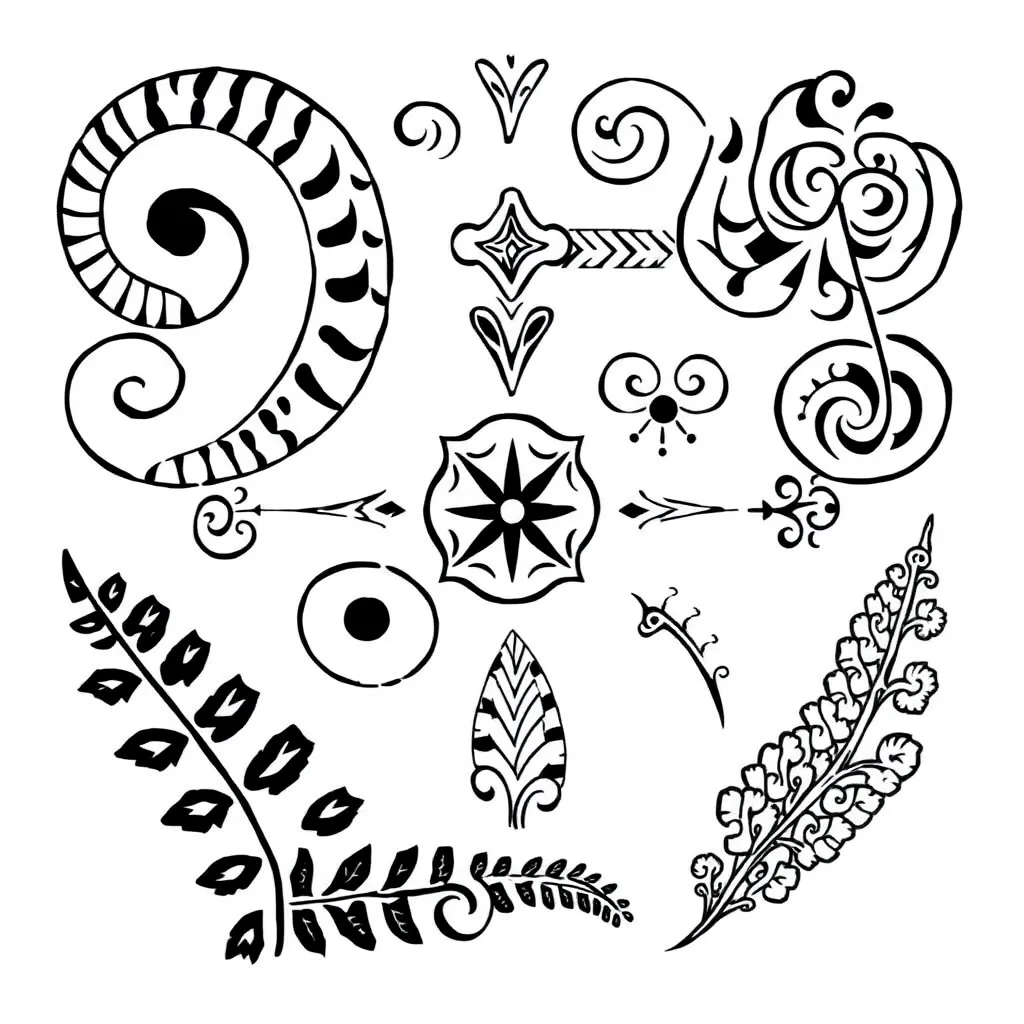
🎨 Part 1: Shape Hunt in Māori Patterns
1. Look at the tukutuku pattern below. Circle all the 2D shapes you can identify:
Tapatoru (Triangle)
Tapawhā rite (Square)
Tapawhā roa (Rectangle)
Ono taha (Hexagon)
Raina (Diamond/Rhombus)
Porowhita (Circle)
2. Which of these 3D shapes might be represented in kowhaiwhai patterns?
Pyramid (Pokapū)
Prism (Mata-ā)
Cone (Kōpere)
Cylinder (Raina-roa)
📝 Part 2: Geometric Vocabulary - Te Reo Māori and English
3. Match the English geometric terms with their te reo Māori equivalents:
1. Side
2. Vertex
3. Angle
4. Triangle
5. Square
A. Tapatoru
B. Koki
C. Pito
D. Taha
E. Tapawhā rite
4. Fill in the blanks using geometric vocabulary:
A tapatoru has _______ taha (sides) and _______ pito (vertices). The sum of all koki (angles) in a tapatoru equals _______ degrees.
A tapawhā rite has _______ equal taha and _______ right koki. Each koki measures _______ degrees.
🔄 Part 3: Transformations in Māori Patterns
5. Which transformations can you identify in traditional tukutuku patterns? Check all that apply:
Reflection (Atahua - mirror image)
Rotation (Takahuriā - turning)
Translation (Kōpekepeke - sliding)
Enlargement (Whakanui - scaling)
6. Describe the symmetry you observe in a typical kowhaiwhai pattern:
7. If you rotate a traditional Māori pattern by 180 degrees, what property remains unchanged?
The colour of the pattern
The shape and size of individual elements
The cultural meaning
All of the above
✏️ Part 4: Design Your Own Pattern
8. In the space below, sketch a simple kowhaiwhai-inspired pattern using at least three different 2D shapes. Include one example each of reflection, rotation, and translation:
9. List the shapes you used in your pattern and describe their properties:
10. Explain how your pattern shows respect for Māori culture while demonstrating geometric concepts:
🧮 Part 5: Mathematical Reasoning
11. Calculate the number of triangles in a tukutuku panel that has 6 rows and 4 columns of diamond shapes, where each diamond contains 4 triangles:
12. If a kowhaiwhai pattern uses regular hexagons, what is the measure of each interior angle?
13. Explain why geometric patterns are important in Māori culture and how they connect to mathematical concepts we use today:
About This Worksheet
Free in Kuraplan
Sign up free, grab the PDF, and customize it for your class.
Print-Ready
Formatted for standard paper. Clean layout, easy to read.
AI-Generated
Created with Kuraplan's AI, designed for real classroom use.
For Teachers & Parents
Use in classrooms, for homework, tutoring, or homeschool.
Need a custom version of this worksheet?
Kuraplan's AI generates custom worksheets in seconds — differentiated for every learner, aligned to your curriculum.
Generate Custom Worksheets — Free No credit card Curriculum-aligned Under 60 seconds
More Maths Worksheets
Year 7
Compass Maps Worksheet
Free
Year 5–6
3D Shape Investigation Mission
Free
Year 5–6
Shape and Transformation Pre-Test
Free
Year 5–6
Geometry and Angles Pre-Test
Free
Year 5–6
Year 5–6 Geometry Diagnostic Pre-Test
Free
Year 5–6
Geometry and Angles Pre-Test
Free
Year 4
Seeing 3D Shapes from Different Views
Free
Year 2