EnglishFreePrintable
Natural Phenomena Reading Comprehension
A free english worksheet ready for your classroom. Open in Kuraplan to grab the print-ready PDF, customize it for your students, or generate a fresh version in seconds.
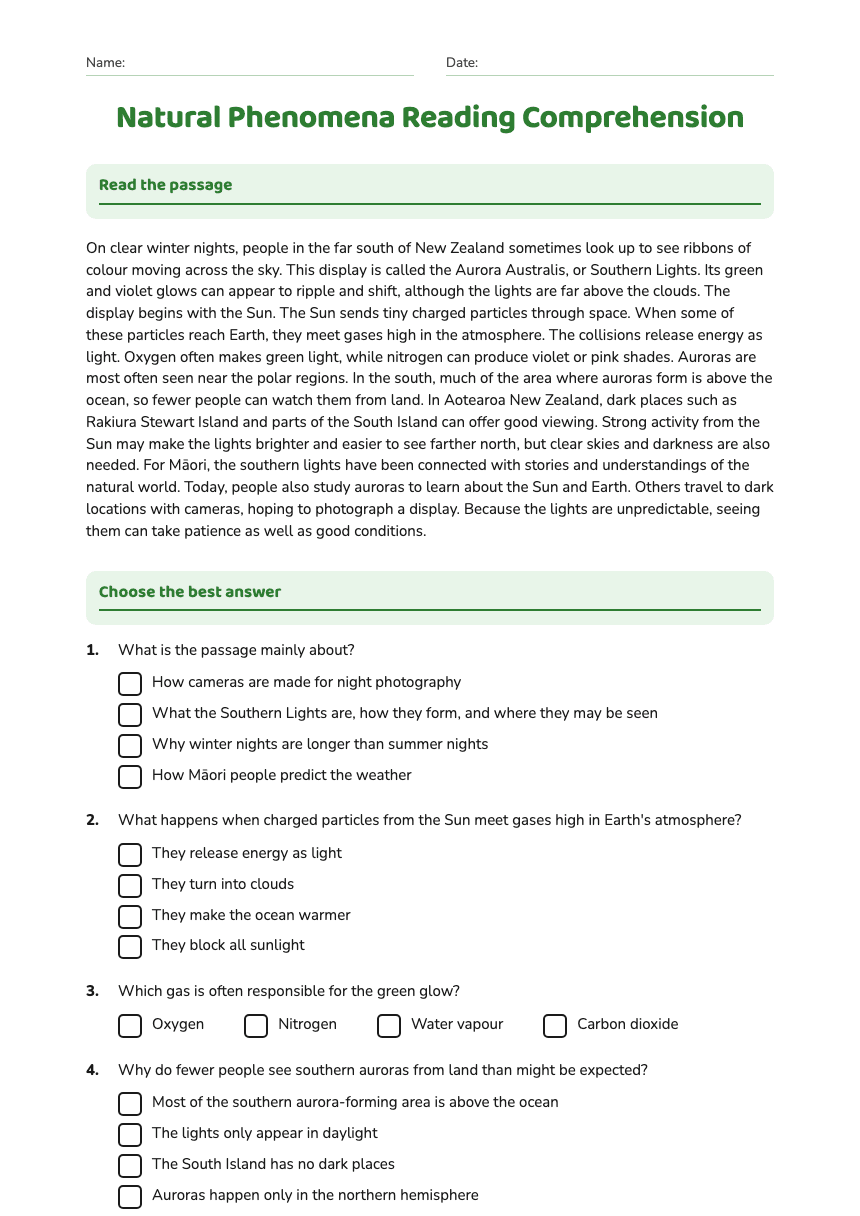
Name:Date:
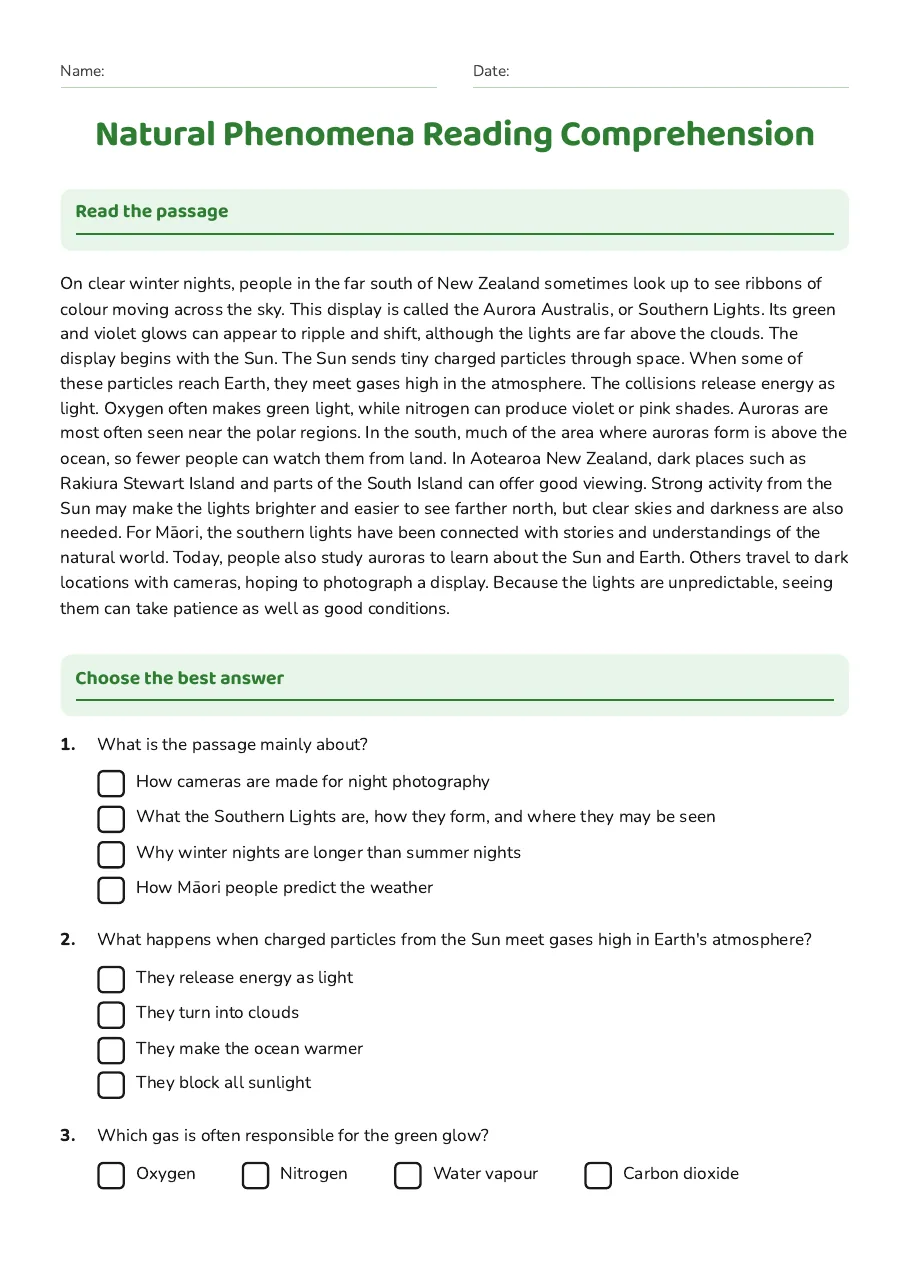
Natural Phenomena Reading Comprehension
Read the passage
On clear winter nights, people in the far south of New Zealand sometimes look up to see ribbons of colour moving across the sky. This display is called the Aurora Australis, or Southern Lights. Its green and violet glows can appear to ripple and shift, although the lights are far above the clouds.
The display begins with the Sun. The Sun sends tiny charged particles through space. When some of these particles reach Earth, they meet gases high in the atmosphere. The collisions release energy as light. Oxygen often makes green light, while nitrogen can produce violet or pink shades.
Auroras are most often seen near the polar regions. In the south, much of the area where auroras form is above the ocean, so fewer people can watch them from land. In Aotearoa New Zealand, dark places such as Rakiura Stewart Island and parts of the South Island can offer good viewing. Strong activity from the Sun may make the lights brighter and easier to see farther north, but clear skies and darkness are also needed.
For Māori, the southern lights have been connected with stories and understandings of the natural world. Today, people also study auroras to learn about the Sun and Earth. Others travel to dark locations with cameras, hoping to photograph a display. Because the lights are unpredictable, seeing them can take patience as well as good conditions.
Choose the best answer
1.What is the passage mainly about?
- How cameras are made for night photography
- What the Southern Lights are, how they form, and where they may be seen
- Why winter nights are longer than summer nights
- How Māori people predict the weather
2.What happens when charged particles from the Sun meet gases high in Earth's atmosphere?
- They release energy as light
- They turn into clouds
- They make the ocean warmer
- They block all sunlight
3.Which gas is often responsible for the green glow?
- Oxygen
- Nitrogen
- Water vapour
- Carbon dioxide
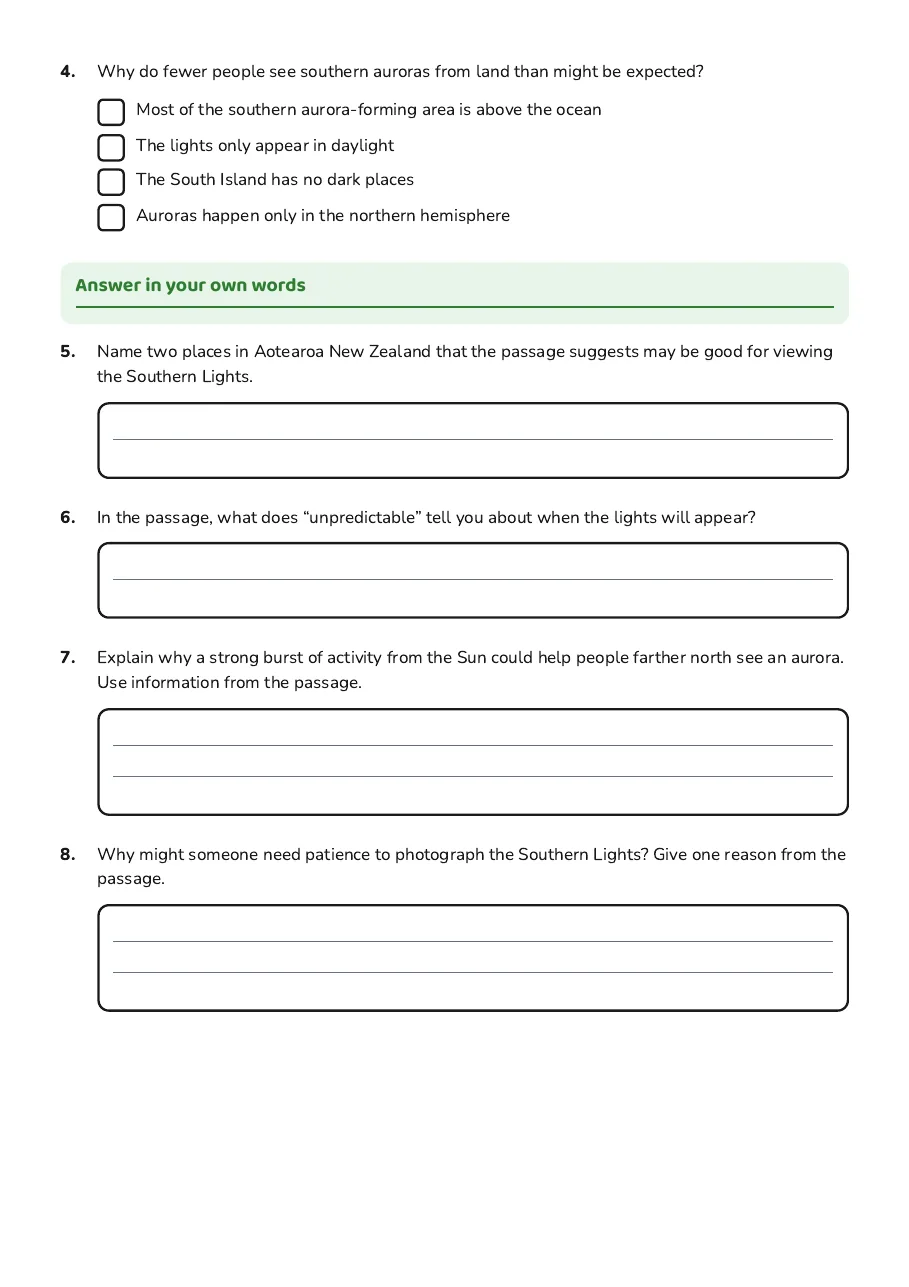
4.Why do fewer people see southern auroras from land than might be expected?
- Most of the southern aurora-forming area is above the ocean
- The lights only appear in daylight
- The South Island has no dark places
- Auroras happen only in the northern hemisphere
Answer in your own words
5.Name two places in Aotearoa New Zealand that the passage suggests may be good for viewing the Southern Lights.
6.In the passage, what does “unpredictable” tell you about when the lights will appear?
7.Explain why a strong burst of activity from the Sun could help people farther north see an aurora. Use information from the passage.
8.Why might someone need patience to photograph the Southern Lights? Give one reason from the passage.
2 printable pages
Page 1
Page 2
About This Worksheet
Free in Kuraplan
Sign up free, grab the PDF, and customize it for your class.
Print-Ready
Formatted for standard paper. Clean layout, easy to read.
AI-Generated
Created with Kuraplan's AI, designed for real classroom use.
For Teachers & Parents
Use in classrooms, for homework, tutoring, or homeschool.
Need a custom version of this worksheet?
Kuraplan's AI generates custom worksheets in seconds — differentiated for every learner, aligned to your curriculum.
Generate Custom Worksheets — Free No credit card Curriculum-aligned Under 60 seconds