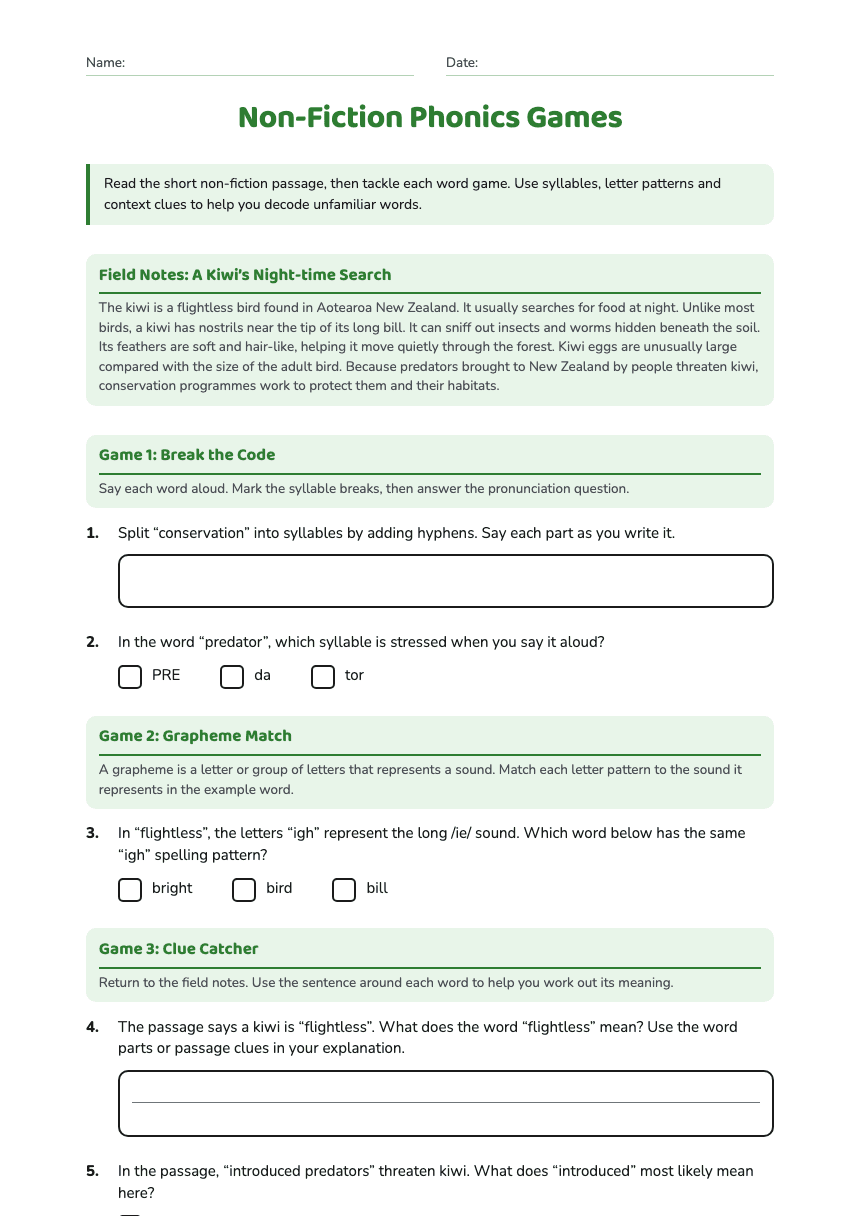
Non-Fiction Phonics Games
A free english worksheet ready for your classroom. Open in Kuraplan to grab the print-ready PDF, customize it for your students, or generate a fresh version in seconds.
Non-Fiction Phonics Games
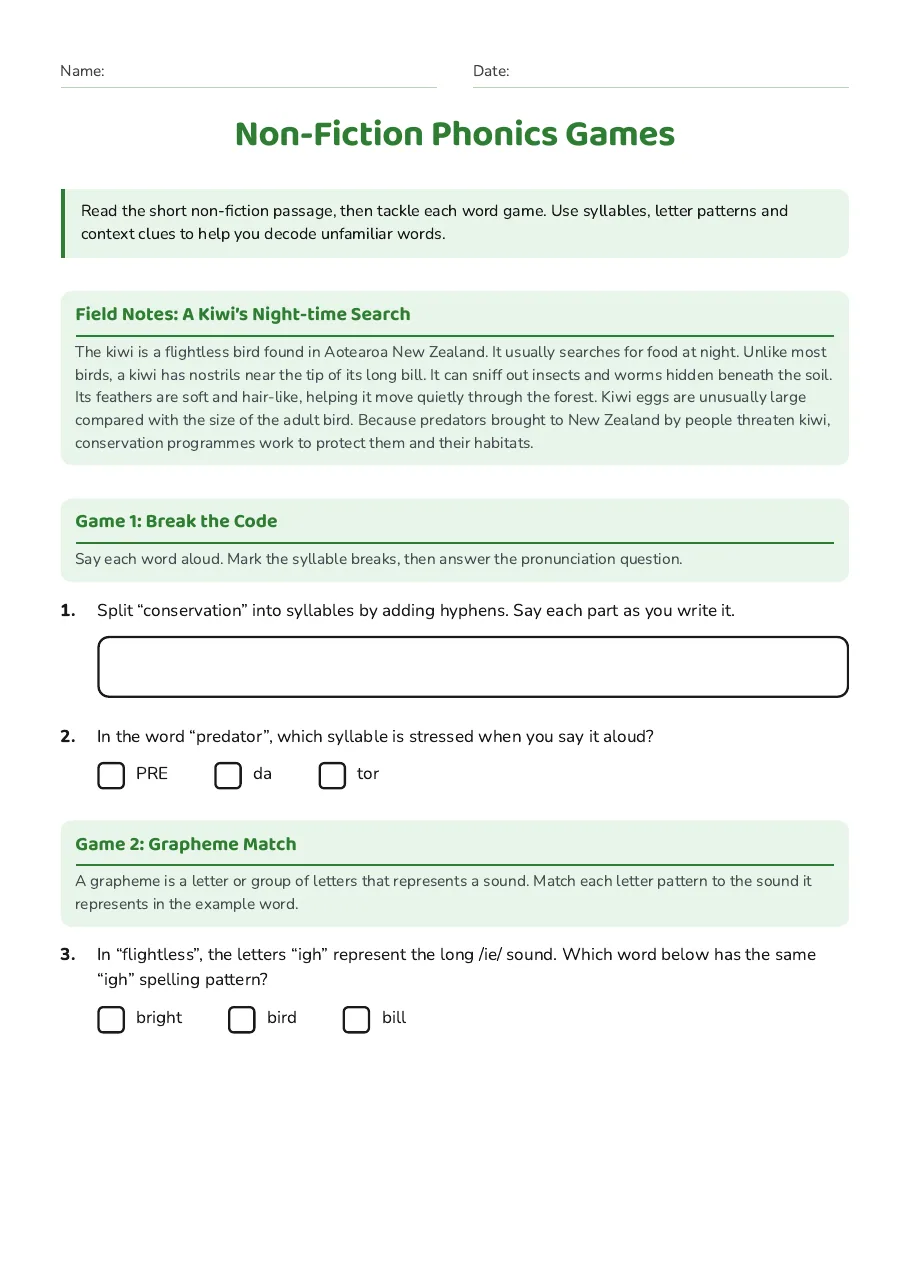
Field Notes: A Kiwi’s Night-time Search
The kiwi is a flightless bird found in Aotearoa New Zealand. It usually searches for food at night. Unlike most birds, a kiwi has nostrils near the tip of its long bill. It can sniff out insects and worms hidden beneath the soil. Its feathers are soft and hair-like, helping it move quietly through the forest. Kiwi eggs are unusually large compared with the size of the adult bird. Because predators brought to New Zealand by people threaten kiwi, conservation programmes work to protect them and their habitats.
Game 1: Break the Code
Say each word aloud. Mark the syllable breaks, then answer the pronunciation question.
- PRE
- da
- tor
Game 2: Grapheme Match
A grapheme is a letter or group of letters that represents a sound. Match each letter pattern to the sound it represents in the example word.
- bright
- bird
- bill
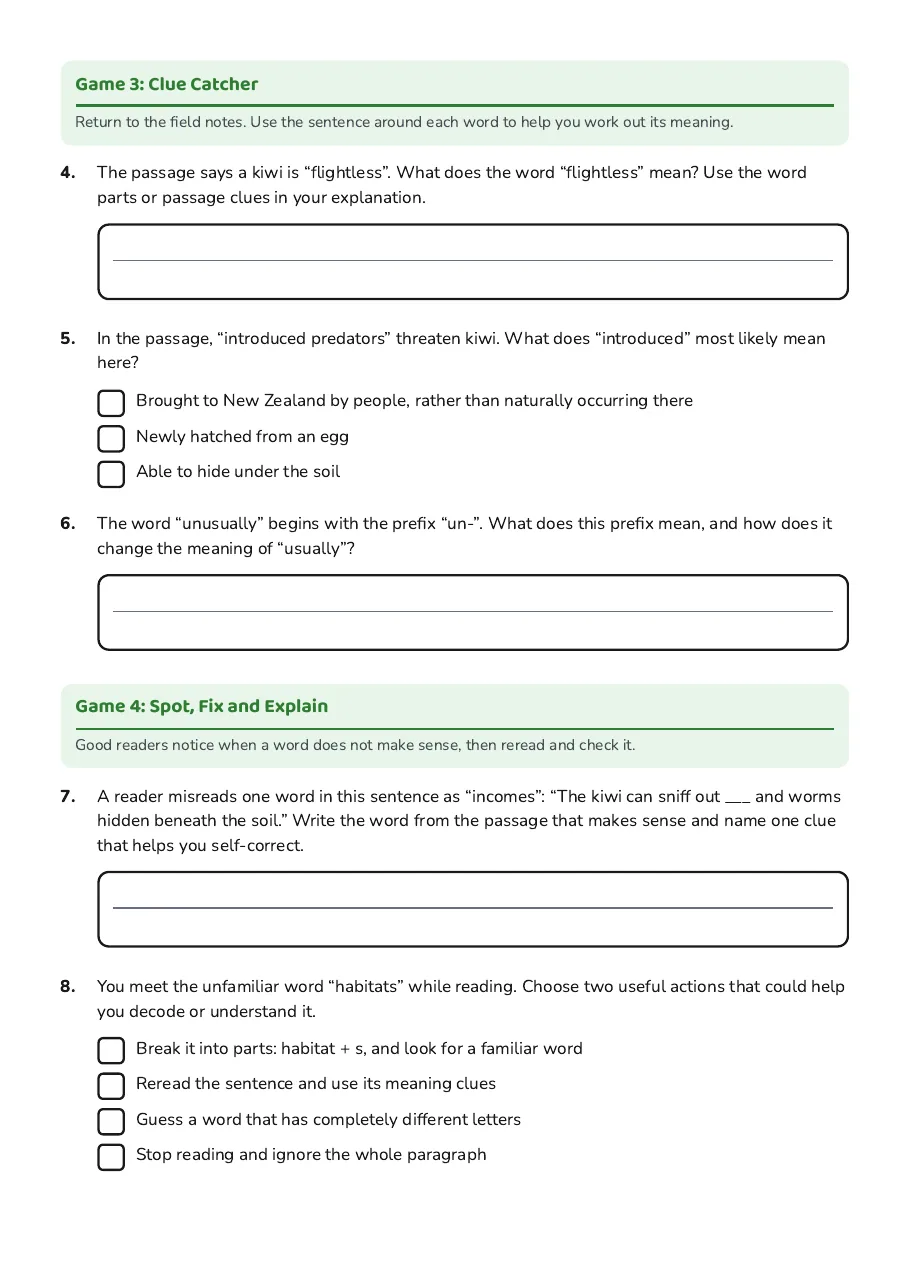
Game 3: Clue Catcher
Return to the field notes. Use the sentence around each word to help you work out its meaning.
- Brought to New Zealand by people, rather than naturally occurring there
- Newly hatched from an egg
- Able to hide under the soil
Game 4: Spot, Fix and Explain
Good readers notice when a word does not make sense, then reread and check it.
- Break it into parts: habitat + s, and look for a familiar word
- Reread the sentence and use its meaning clues
- Guess a word that has completely different letters
- Stop reading and ignore the whole paragraph
3 printable pages
Page 1
Page 2

Page 3
About This Worksheet
Free in Kuraplan
Sign up free, grab the PDF, and customize it for your class.
Print-Ready
Formatted for standard paper. Clean layout, easy to read.
AI-Generated
Created with Kuraplan's AI, designed for real classroom use.
For Teachers & Parents
Use in classrooms, for homework, tutoring, or homeschool.
Need a custom version of this worksheet?
Kuraplan's AI generates custom worksheets in seconds — differentiated for every learner, aligned to your curriculum.
Generate Custom Worksheets — Free