Organic Chemistry Essentials Worksheet
A free science worksheet ready for your classroom. Open in Kuraplan to grab the print-ready PDF, customize it for your students, or generate a fresh version in seconds.
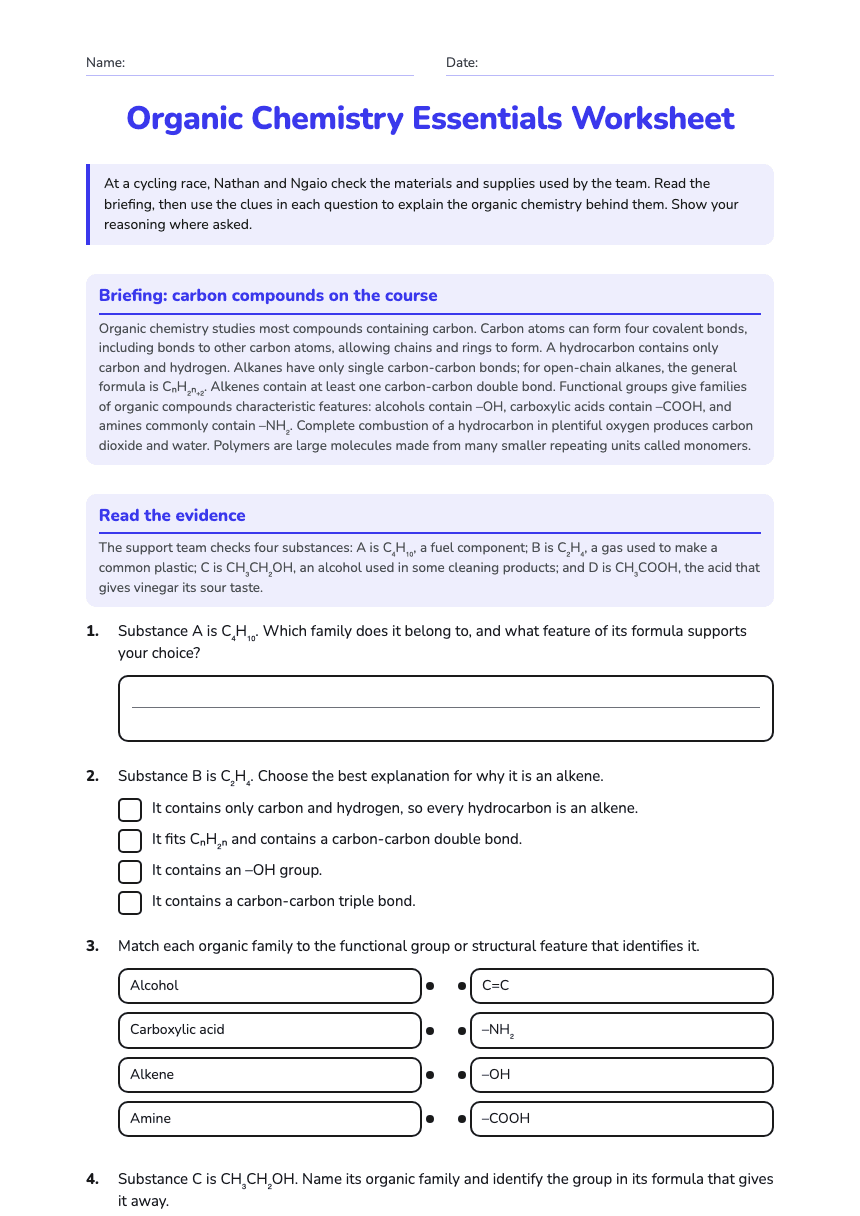
Organic Chemistry Essentials Worksheet
🧪 Introduction: What is Organic Chemistry?
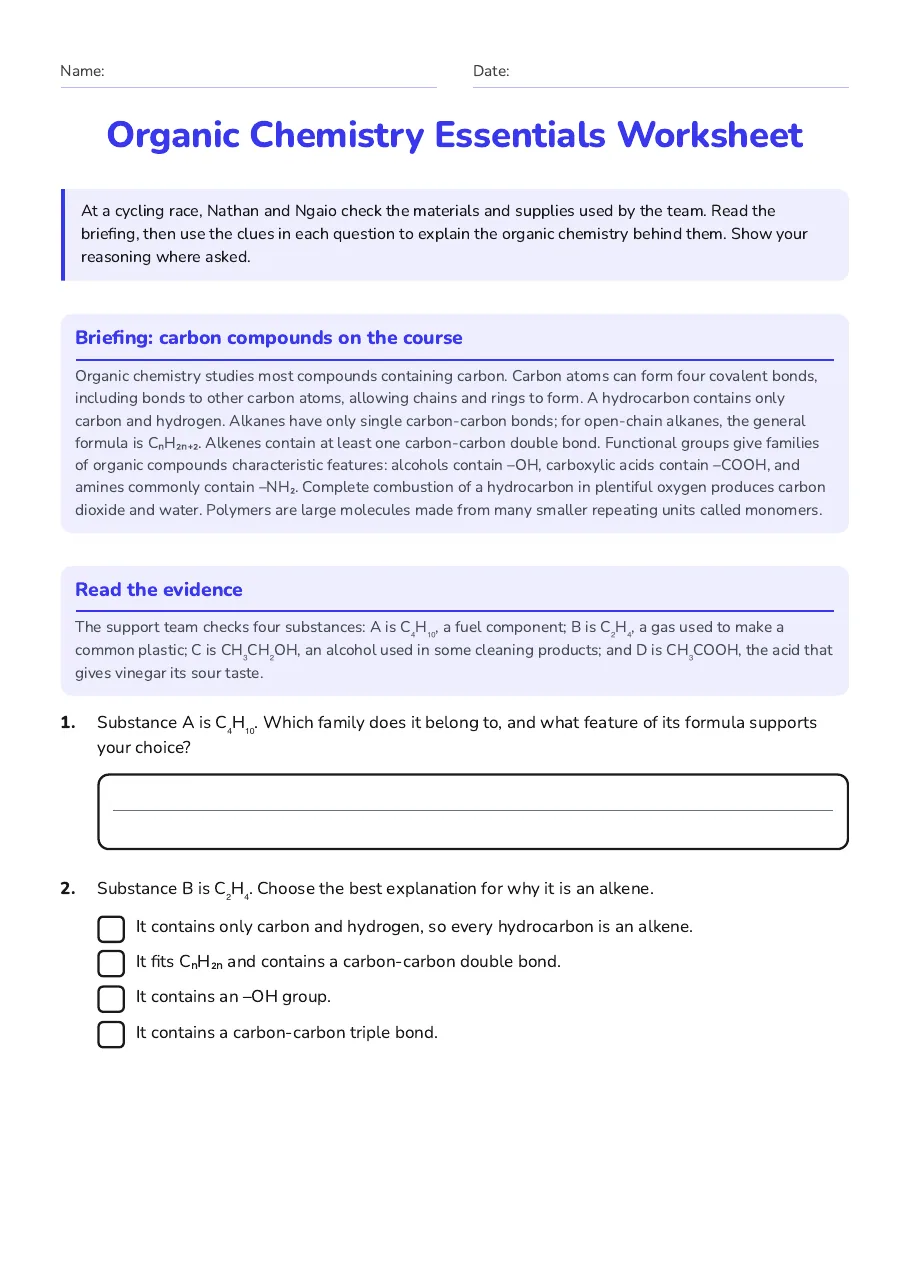
Organic chemistry is the branch of chemistry that studies compounds containing carbon. Carbon is unique because it can form long chains, rings, and complex structures by bonding with other carbon atoms and elements such as hydrogen, oxygen, nitrogen, and more. Organic compounds are found everywhere in everyday life — from the petrol used in New Zealand vehicles, to the plastics in our packaging, to the proteins in our food. Understanding organic chemistry helps us make sense of the materials and fuels that shape our world.
📝 Part 1: Multiple Choice
Circle the letter of the best answer for each question.
🔗 Part 2: Matching — Functional Groups
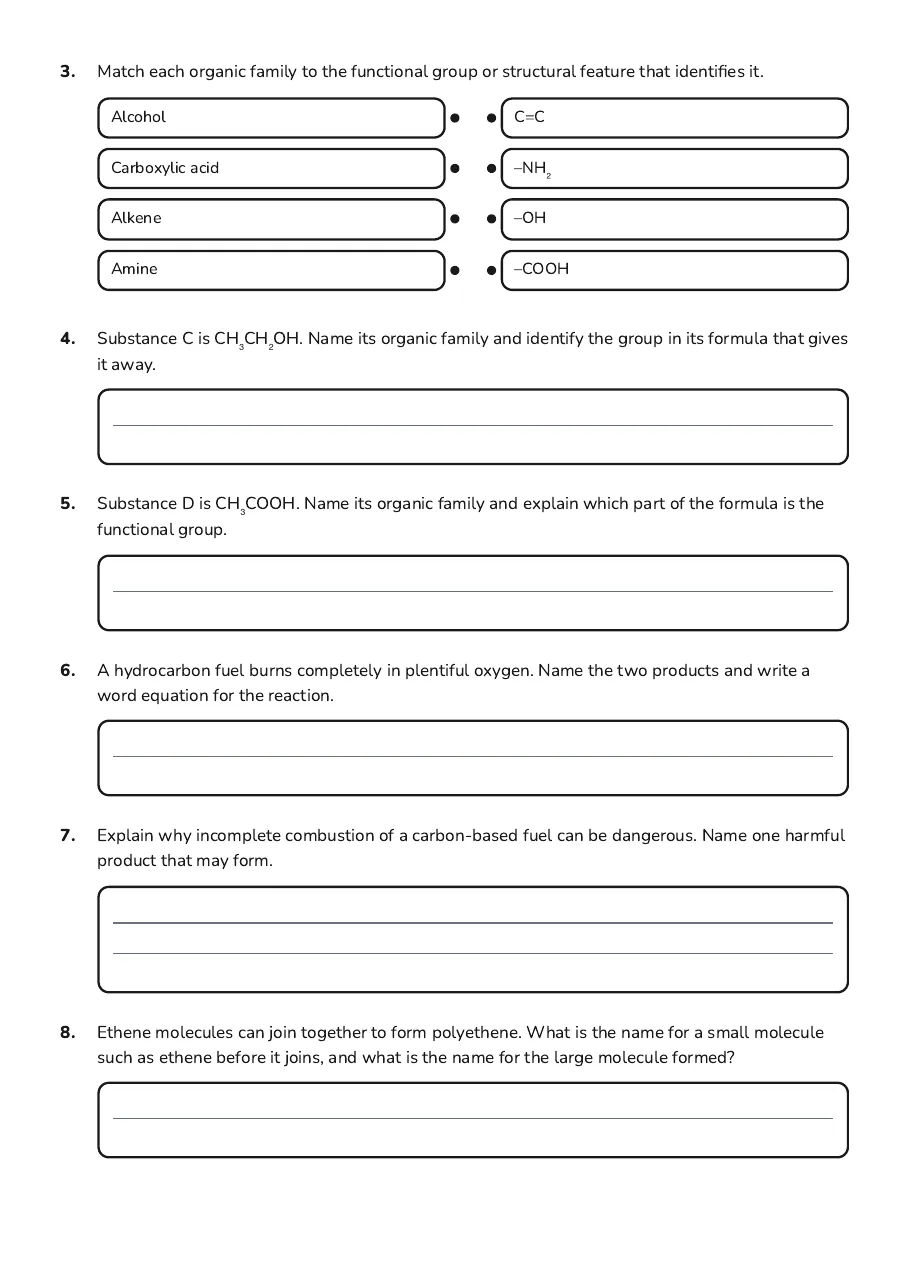
Draw a line from each functional group name on the left to its correct descriptor on the right.
✏️ Part 3: Short Answer Questions
Answer each question in full sentences where possible.
Prefix for carbon count:
1 carbon = meth– | 2 carbons = __________ | 3 carbons = __________ | 4 carbons = __________
Suffix for bond type:
Single bond (alkane) = –ane | Double bond (alkene) = __________ | Triple bond (alkyne) = __________
🔬 Part 4: Identify the Molecule
Look at each molecular formula below. Identify the hydrocarbon family OR the functional group present. Write your answer on the line provided.
a) C5H12 (fits CnH2n+2)
Family/Group: _________________________ Key feature: _________________________
b) C2H4 (fits CnH2n)
Family/Group: _________________________ Key feature: _________________________
c) CH3OH
Family/Group: _________________________ Key feature: _________________________
d) CH3COOH
Family/Group: _________________________ Key feature: _________________________
🌿 Part 5: Creative Task — Polymers in Action
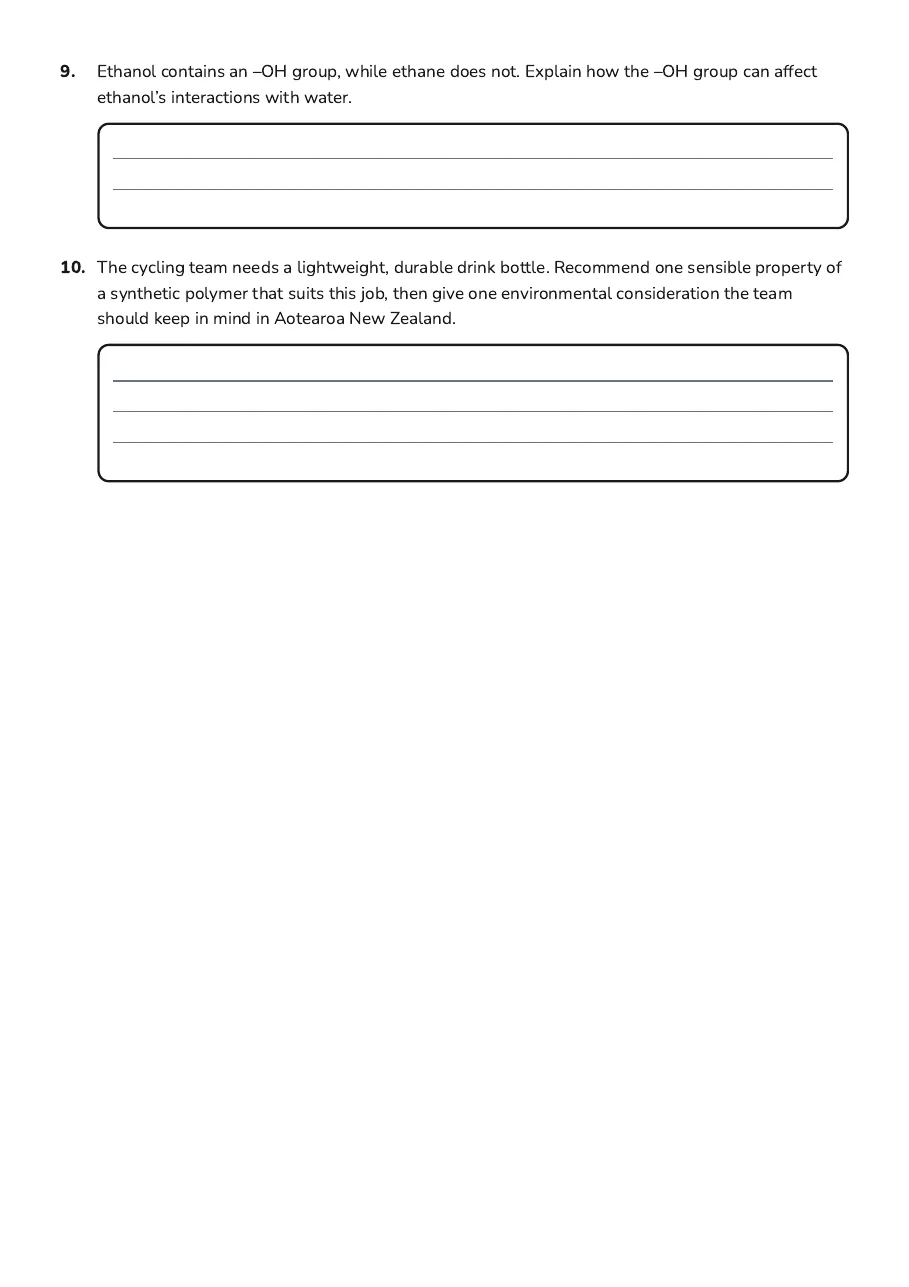
Think about the role of synthetic polymers (plastics) in everyday New Zealand life.
• Name or describe the product and the polymer it is made from (e.g. polyethylene, polypropylene, PET)
• Explain one benefit of using this polymer for this product
• Explain one environmental consideration related to this polymer in a NZ context
My product: _____________________________________________
Polymer used: _____________________________________________
Optional: Sketch your product in the box below.
📋 Answer Guide — Teacher Use Only
For teacher reference. Do not distribute to students.
Part 1: Multiple Choice
1. B | 2. C | 3. B | 4. C | 5. B | 6. C | 7. B | 8. C
Part 2: Matching
Alcohol → Contains –OH; e.g. ethanol in hand sanitiser
Carboxylic Acid → Contains –COOH; acidic, found in vinegar
Aldehyde → Contains –CHO; carbonyl group at end of chain
Ketone → Contains –CO– in the middle of a carbon chain
Amine → Contains –NH2; found in amino acids
Alkene → Contains –C=C–; unsaturated hydrocarbon
Part 3: Short Answers
9. Boiling point increases as carbon chain length increases. Longer chains have greater London dispersion (van der Waals) forces between molecules, requiring more energy to separate them.
10. Accept any two: flammable (release energy when burned), liquid at room temperature (easy to store/transport), relatively stable, reasonable energy density. E.g. petrol (octane) and LPG (propane/butane).
11. Adding –OH increases polarity and the ability to form hydrogen bonds, making the molecule more soluble in water and raising its boiling point compared to the equivalent alkane. Example: ethanol (hand sanitiser, disinfectant) mixes with water easily.
12. Prefixes: 2 = eth–, 3 = prop–, 4 = but–. Suffixes: double bond = –ene, triple bond = –yne.
13. Methane + oxygen → carbon dioxide + water (CH4 + 2O2 → CO2 + 2H2O)
14. Incomplete combustion produces carbon monoxide (CO), a colourless, odourless, toxic gas that can cause poisoning or death. It occurs when there is insufficient oxygen for complete combustion.
Part 4: Identify the Molecule
a) Alkane — fits CnH2n+2; only single bonds, saturated
b) Alkene — fits CnH2n; contains a C=C double bond, unsaturated
c) Alcohol — contains –OH functional group (methanol)
d) Carboxylic acid — contains –COOH functional group (ethanoic acid / acetic acid / vinegar)
Part 5: Creative Task
Accept any reasonable polymer product. Look for: named polymer (e.g. PET, polyethylene, polypropylene, nylon), a clear benefit (durable, lightweight, waterproof, cheap to produce), and a genuine environmental consideration (e.g. slow to biodegrade, contributes to landfill/ocean pollution, recycling challenges in NZ, carbon footprint of production). Award marks for scientific reasoning and NZ context.
About This Worksheet
Free in Kuraplan
Sign up free, grab the PDF, and customize it for your class.
Print-Ready
Formatted for standard paper. Clean layout, easy to read.
AI-Generated
Created with Kuraplan's AI, designed for real classroom use.
For Teachers & Parents
Use in classrooms, for homework, tutoring, or homeschool.
Need a custom version of this worksheet?
Kuraplan's AI generates custom worksheets in seconds — differentiated for every learner, aligned to your curriculum.
Generate Custom Worksheets — FreeMore Science Worksheets
Danforth: Authority and Conscience
Free
Natural Resources Science
Free
Natural Resources Science
Free
Vitamins, Minerals, and Protein Science
Free
Exploring Science Materials
Free
Waka Buoyancy Science Worksheet
Free
Science Skills Made Simple
Free