MathsFreePrintable

Packaging Engineer Design Challenge

A free maths worksheet ready for your classroom. Open in Kuraplan to grab the print-ready PDF, customize it for your students, or generate a fresh version in seconds.
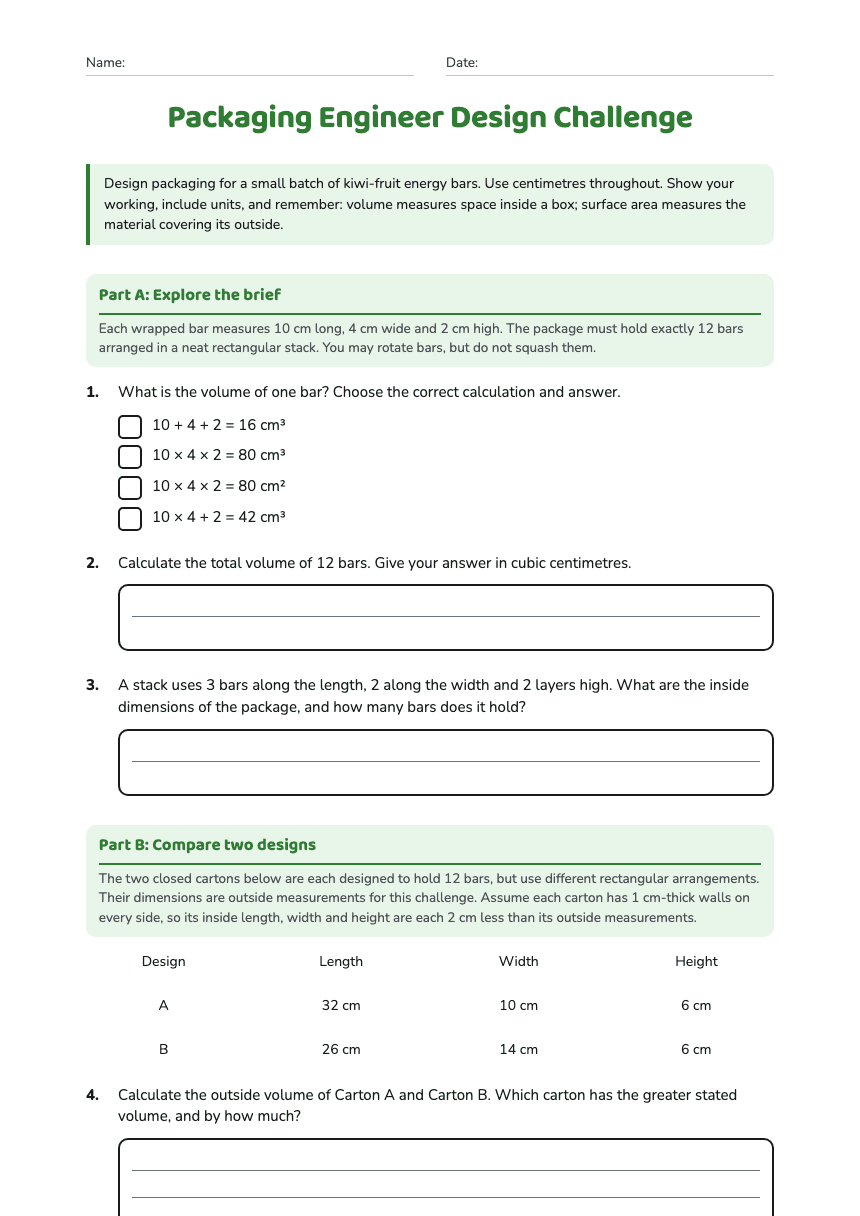
Packaging Engineer Design Challenge worksheet preview
Name:Date:

Packaging Engineer Design Challenge

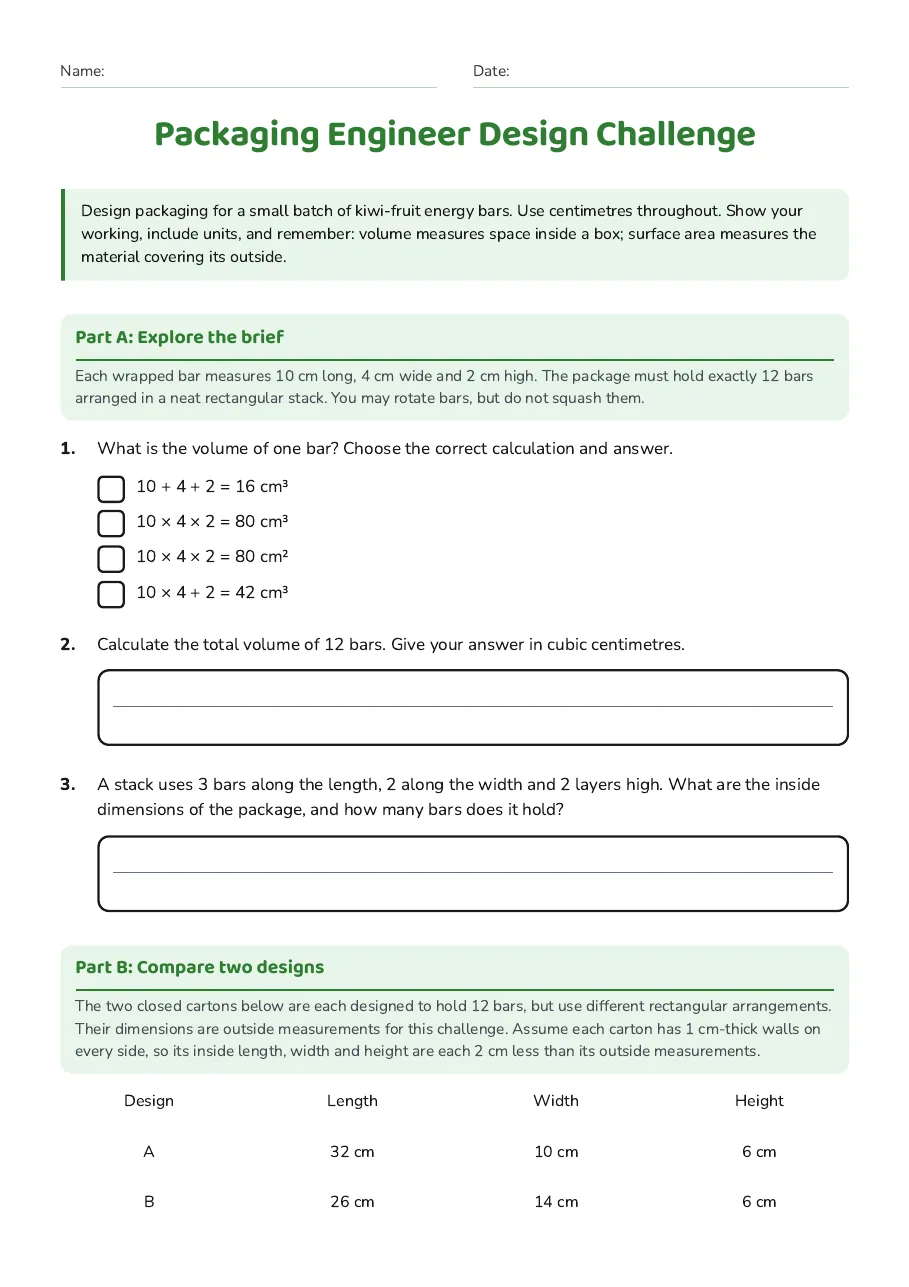
Design packaging for a small batch of kiwi-fruit energy bars. Use centimetres throughout. Show your working, include units, and remember: volume measures space inside a box; surface area measures the material covering its outside.

Part A: Explore the brief

Each wrapped bar measures 10 cm long, 4 cm wide and 2 cm high. The package must hold exactly 12 bars arranged in a neat rectangular stack. You may rotate bars, but do not squash them.

1.What is the volume of one bar? Choose the correct calculation and answer.
  • 10 + 4 + 2 = 16 cm³
  • 10 × 4 × 2 = 80 cm³
  • 10 × 4 × 2 = 80 cm²
  • 10 × 4 + 2 = 42 cm³
2.Calculate the total volume of 12 bars. Give your answer in cubic centimetres.
3.A stack uses 3 bars along the length, 2 along the width and 2 layers high. What are the inside dimensions of the package, and how many bars does it hold?

Part B: Compare two designs

The two closed cartons below are each designed to hold 12 bars, but use different rectangular arrangements. Their dimensions are outside measurements for this challenge. Assume each carton has 1 cm-thick walls on every side, so its inside length, width and height are each 2 cm less than its outside measurements.

Design

Length

Width

Height

A

32 cm

10 cm

6 cm

B

26 cm

14 cm

6 cm

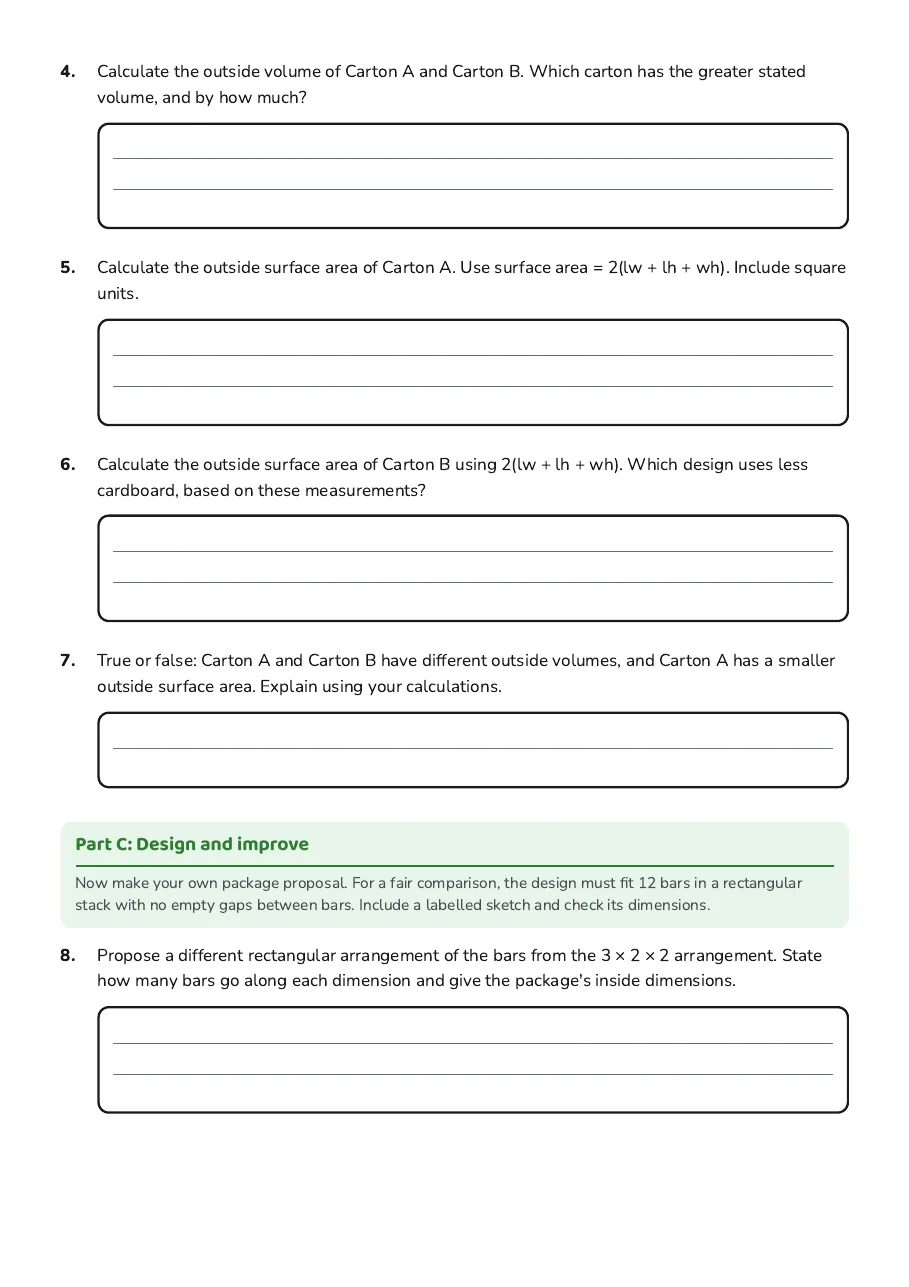
4.Calculate the outside volume of Carton A and Carton B. Which carton has the greater stated volume, and by how much?
5.Calculate the outside surface area of Carton A. Use surface area = 2(lw + lh + wh). Include square units.
6.Calculate the outside surface area of Carton B using 2(lw + lh + wh). Which design uses less cardboard, based on these measurements?
7.True or false: Carton A and Carton B have different outside volumes, and Carton A has a smaller outside surface area. Explain using your calculations.

Part C: Design and improve

Now make your own package proposal. For a fair comparison, the design must fit 12 bars in a rectangular stack with no empty gaps between bars. Include a labelled sketch and check its dimensions.

8.Propose a different rectangular arrangement of the bars from the 3 × 2 × 2 arrangement. State how many bars go along each dimension and give the package's inside dimensions.
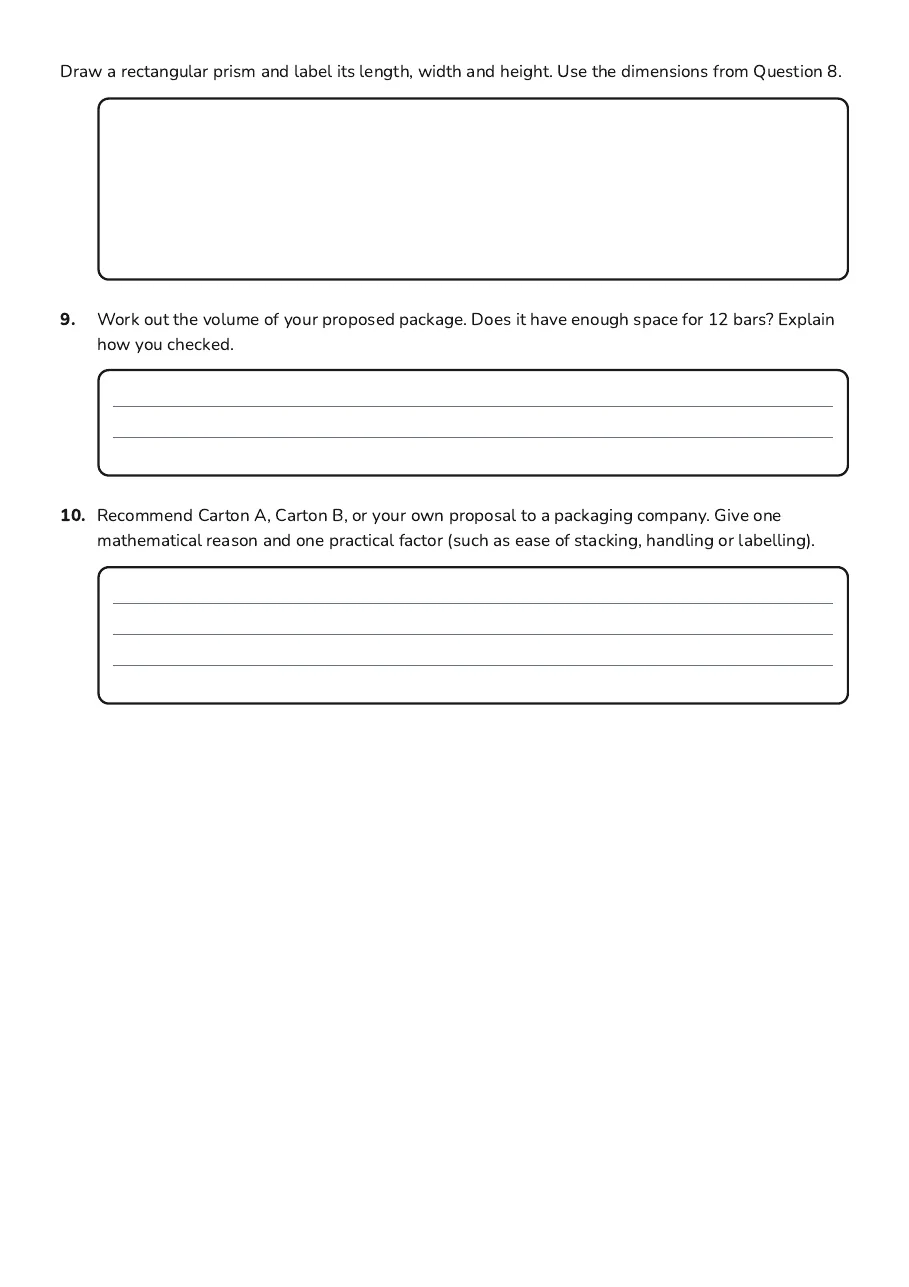
Draw a rectangular prism and label its length, width and height. Use the dimensions from Question 8.
9.Work out the volume of your proposed package. Does it have enough space for 12 bars? Explain how you checked.
10.Recommend Carton A, Carton B, or your own proposal to a packaging company. Give one mathematical reason and one practical factor (such as ease of stacking, handling or labelling).

3 printable pages

  • Packaging Engineer Design Challenge, page 1 of 3: Part A: Explore the brief, Part B: Compare two designs

    Page 1

  • Packaging Engineer Design Challenge, page 2 of 3: Part C: Design and improve

    Page 2

  • Packaging Engineer Design Challenge, page 3 of 3: Draw a rectangular prism and label its length, width and height. Use the dimensions from…

    Page 3

About This Worksheet

Free in Kuraplan

Sign up free, grab the PDF, and customize it for your class.

Print-Ready

Formatted for standard paper. Clean layout, easy to read.

AI-Generated

Created with Kuraplan's AI, designed for real classroom use.

For Teachers & Parents

Use in classrooms, for homework, tutoring, or homeschool.

Need a custom version of this worksheet?

Kuraplan's AI generates custom worksheets in seconds — differentiated for every learner, aligned to your curriculum.

Generate Custom Worksheets — Free
No credit card Curriculum-aligned Under 60 seconds