TechnologyFreePrintable
Pattern Vocabulary and Reflection
A free technology worksheet ready for your classroom. Open in Kuraplan to grab the print-ready PDF, customize it for your students, or generate a fresh version in seconds.
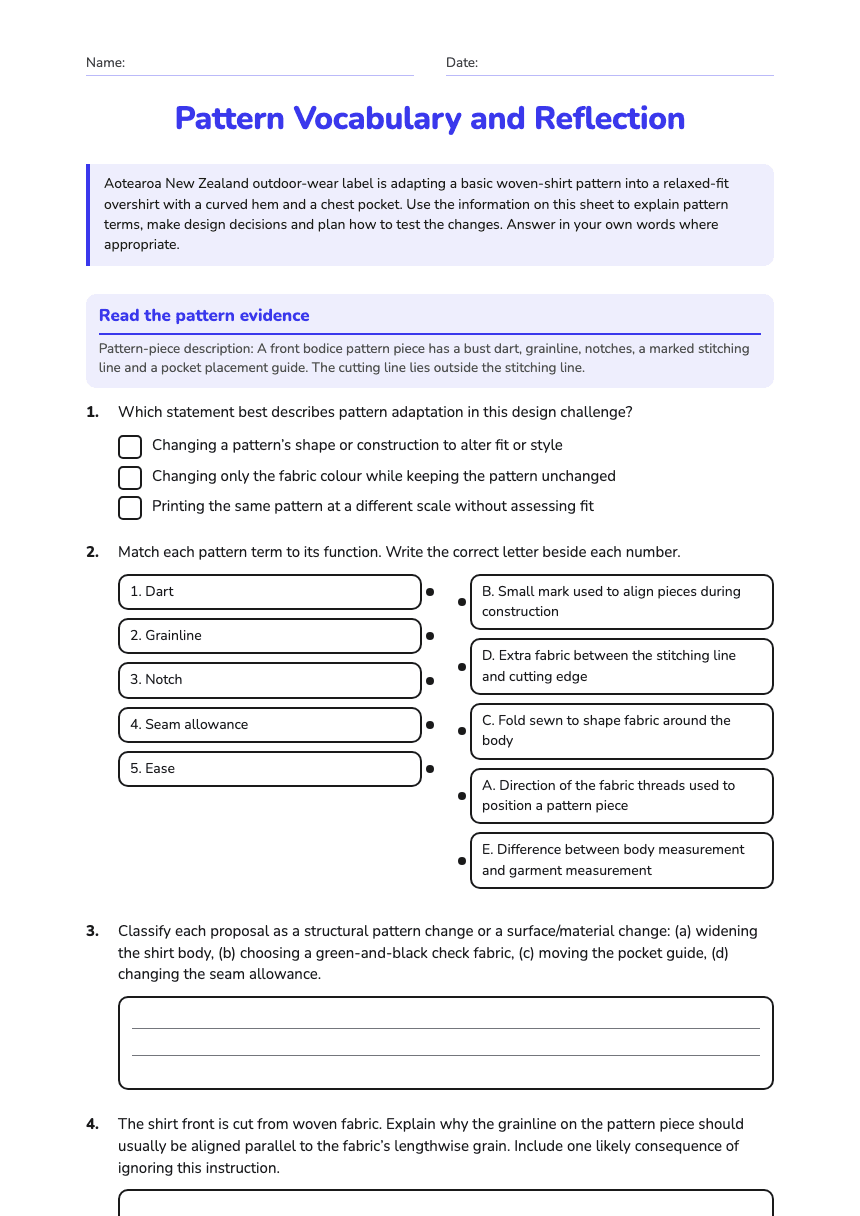
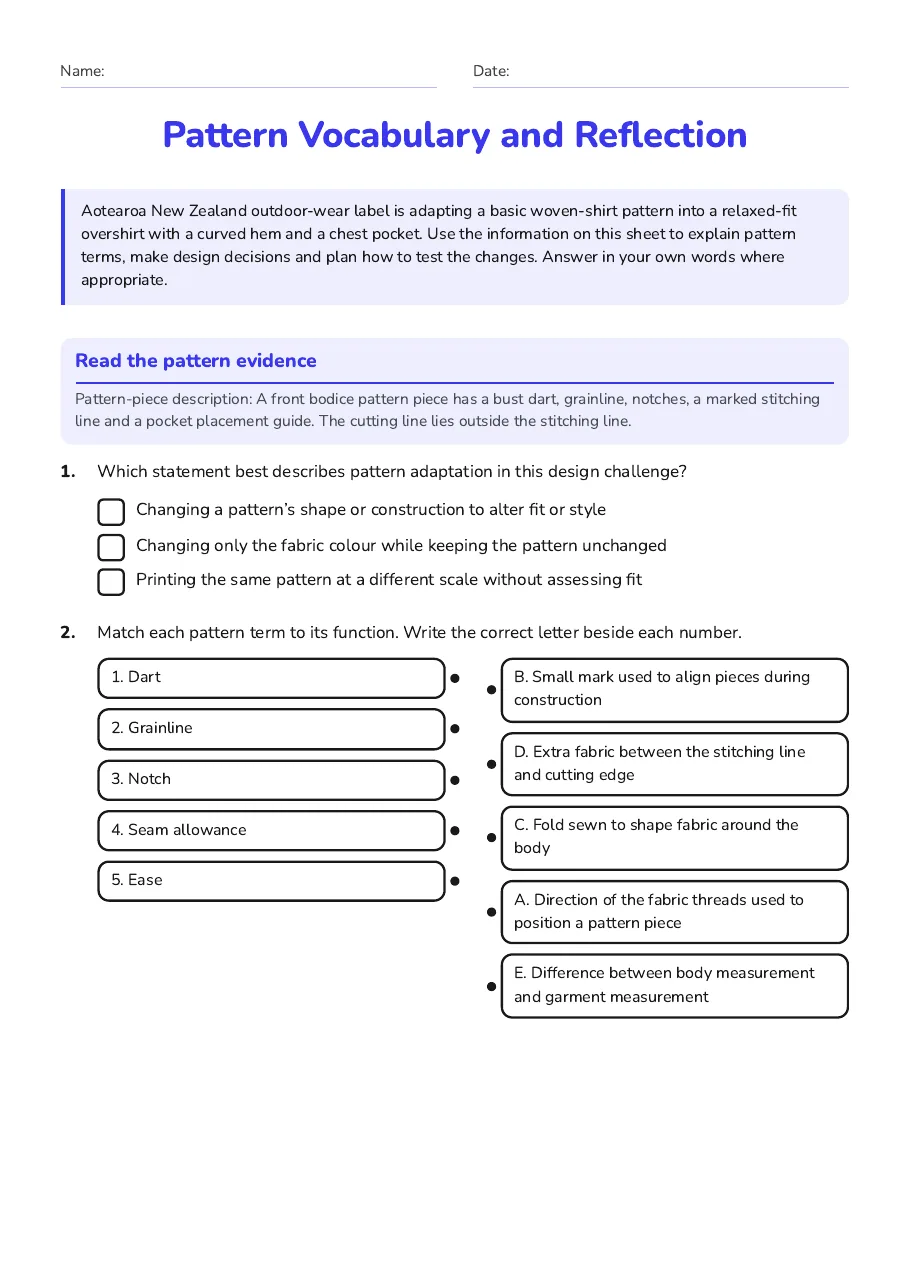
Name:Date:
Pattern Vocabulary and Reflection
Aotearoa New Zealand outdoor-wear label is adapting a basic woven-shirt pattern into a relaxed-fit overshirt with a curved hem and a chest pocket. Use the information on this sheet to explain pattern terms, make design decisions and plan how to test the changes. Answer in your own words where appropriate.
Read the pattern evidence
Pattern-piece description: A front bodice pattern piece has a bust dart, grainline, notches, a marked stitching line and a pocket placement guide. The cutting line lies outside the stitching line.
1.Which statement best describes pattern adaptation in this design challenge?
- Changing a pattern’s shape or construction to alter fit or style
- Changing only the fabric colour while keeping the pattern unchanged
- Printing the same pattern at a different scale without assessing fit
2.Match each pattern term to its function. Write the correct letter beside each number.
- 1. Dart
- 2. Grainline
- 3. Notch
- 4. Seam allowance
- 5. Ease
- B. Small mark used to align pieces during construction
- D. Extra fabric between the stitching line and cutting edge
- C. Fold sewn to shape fabric around the body
- A. Direction of the fabric threads used to position a pattern piece
- E. Difference between body measurement and garment measurement
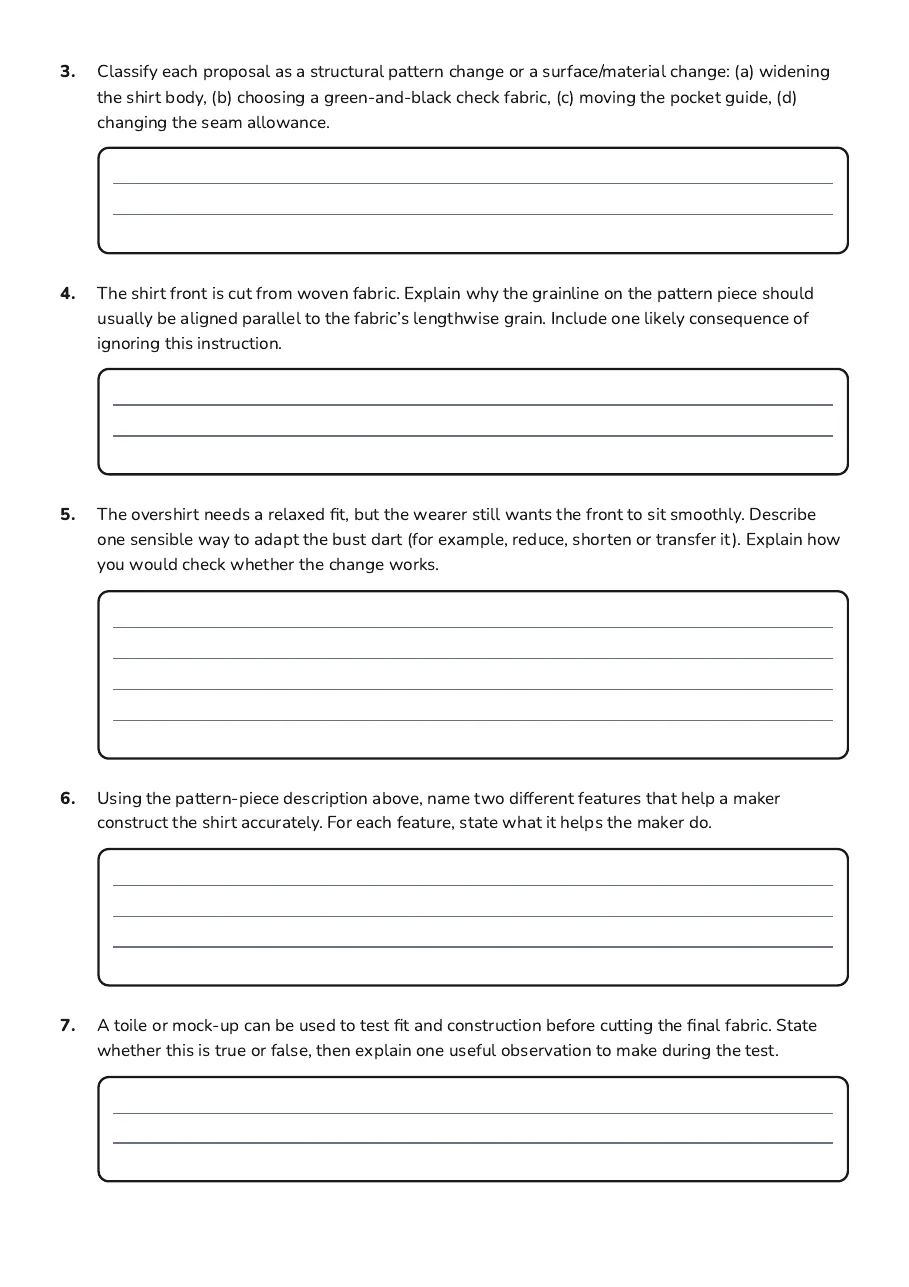
3.Classify each proposal as a structural pattern change or a surface/material change: (a) widening the shirt body, (b) choosing a green-and-black check fabric, (c) moving the pocket guide, (d) changing the seam allowance.
4.The shirt front is cut from woven fabric. Explain why the grainline on the pattern piece should usually be aligned parallel to the fabric’s lengthwise grain. Include one likely consequence of ignoring this instruction.
5.The overshirt needs a relaxed fit, but the wearer still wants the front to sit smoothly. Describe one sensible way to adapt the bust dart (for example, reduce, shorten or transfer it). Explain how you would check whether the change works.
6.Using the pattern-piece description above, name two different features that help a maker construct the shirt accurately. For each feature, state what it helps the maker do.
7.A toile or mock-up can be used to test fit and construction before cutting the final fabric. State whether this is true or false, then explain one useful observation to make during the test.
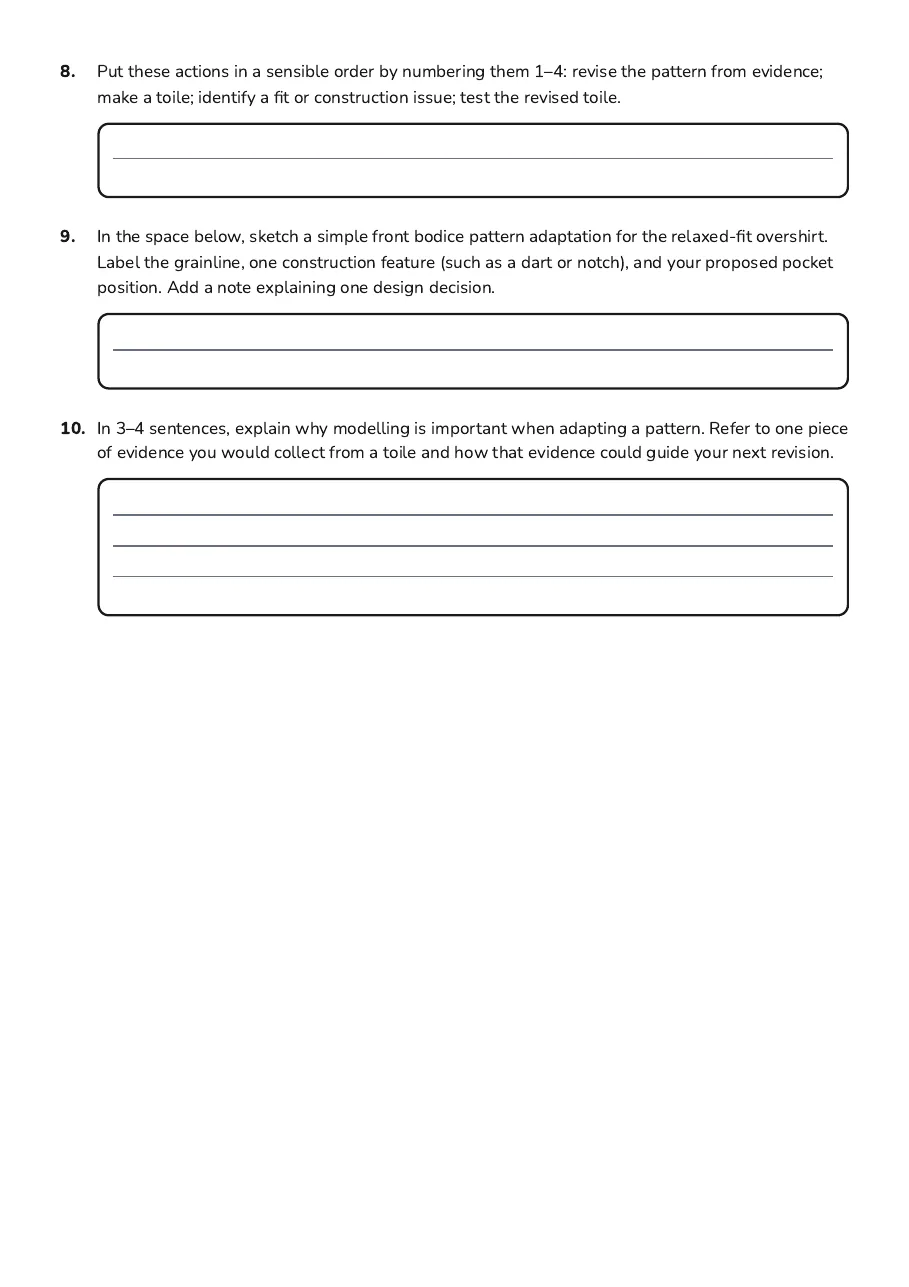
8.Put these actions in a sensible order by numbering them 1–4: revise the pattern from evidence; make a toile; identify a fit or construction issue; test the revised toile.
9.In the space below, sketch a simple front bodice pattern adaptation for the relaxed-fit overshirt. Label the grainline, one construction feature (such as a dart or notch), and your proposed pocket position. Add a note explaining one design decision.
10.In 3–4 sentences, explain why modelling is important when adapting a pattern. Refer to one piece of evidence you would collect from a toile and how that evidence could guide your next revision.
3 printable pages
Page 1
Page 2
Page 3
About This Worksheet
Free in Kuraplan
Sign up free, grab the PDF, and customize it for your class.
Print-Ready
Formatted for standard paper. Clean layout, easy to read.
AI-Generated
Created with Kuraplan's AI, designed for real classroom use.
For Teachers & Parents
Use in classrooms, for homework, tutoring, or homeschool.
Need a custom version of this worksheet?
Kuraplan's AI generates custom worksheets in seconds — differentiated for every learner, aligned to your curriculum.
Generate Custom Worksheets — Free No credit card Curriculum-aligned Under 60 seconds
More Technology Worksheets
Year 5–6
Weather Patterns Worksheet
Free
Year 4–6
Treaty Vocabulary Cards
Free
Vocabulary and Sentences Practice
Free
Year 9
Te Reo Feelings Vocabulary
Free
Year 4
Probability Vocabulary Exploration
Free
Electricity and Atmosphere Vocabulary
Free
Year 5
Māori Vocabulary: Pōhutukawa & Matariki
Free
Year 7–8