Plant Classification Writing Rubric
A free english worksheet ready for your classroom. Open in Kuraplan to grab the print-ready PDF, customize it for your students, or generate a fresh version in seconds.

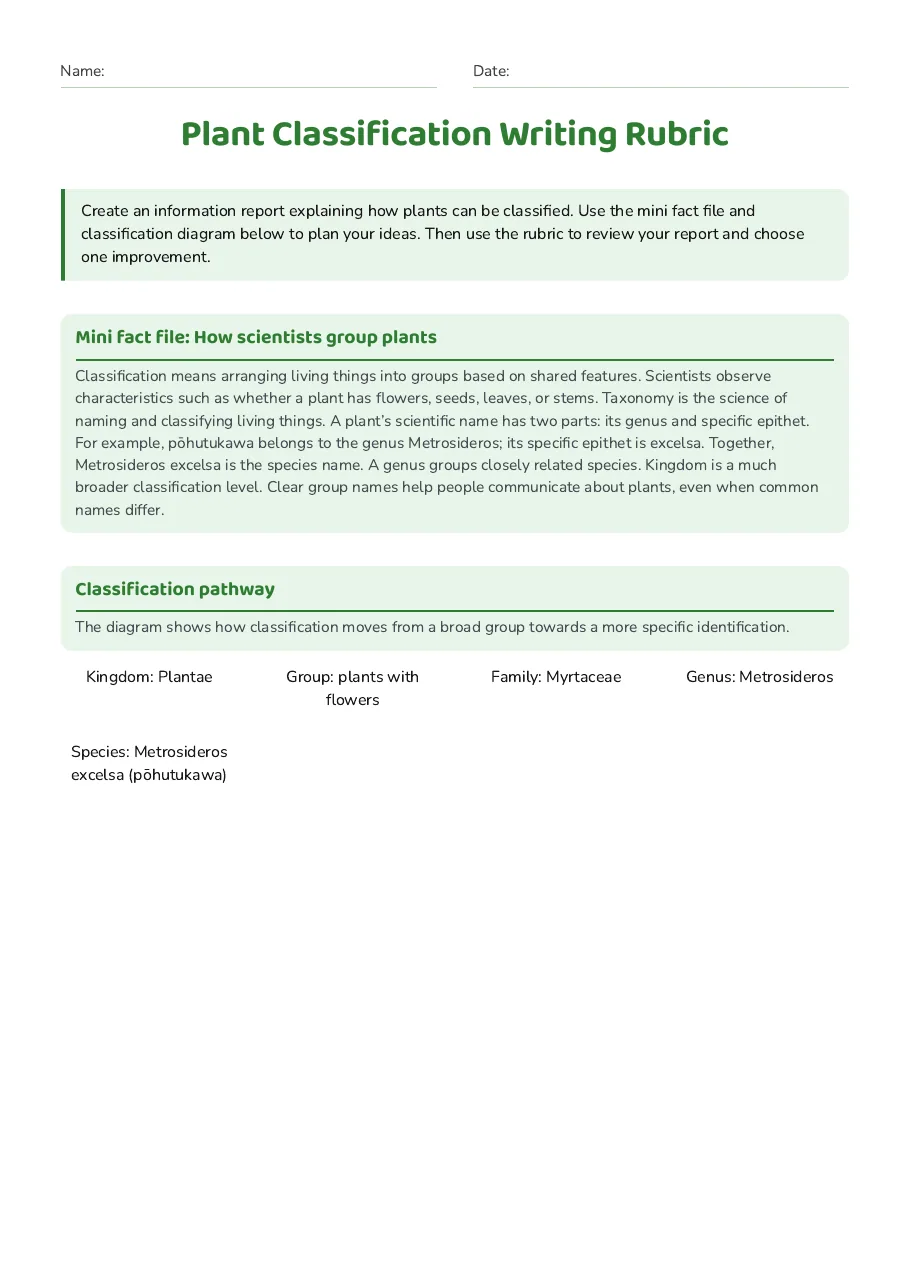
Plant Classification Writing Rubric
Mini fact file: How scientists group plants
Classification means arranging living things into groups based on shared features. Scientists observe characteristics such as whether a plant has flowers, seeds, leaves, or stems. Taxonomy is the science of naming and classifying living things. A plant’s scientific name has two parts: its genus and specific epithet. For example, pōhutukawa belongs to the genus Metrosideros; its specific epithet is excelsa. Together, Metrosideros excelsa is the species name. A genus groups closely related species. Kingdom is a much broader classification level. Clear group names help people communicate about plants, even when common names differ.
Classification pathway
The diagram shows how classification moves from a broad group towards a more specific identification.
Kingdom: Plantae
Group: plants with flowers
Family: Myrtaceae
Genus: Metrosideros
Species: Metrosideros excelsa (pōhutukawa)
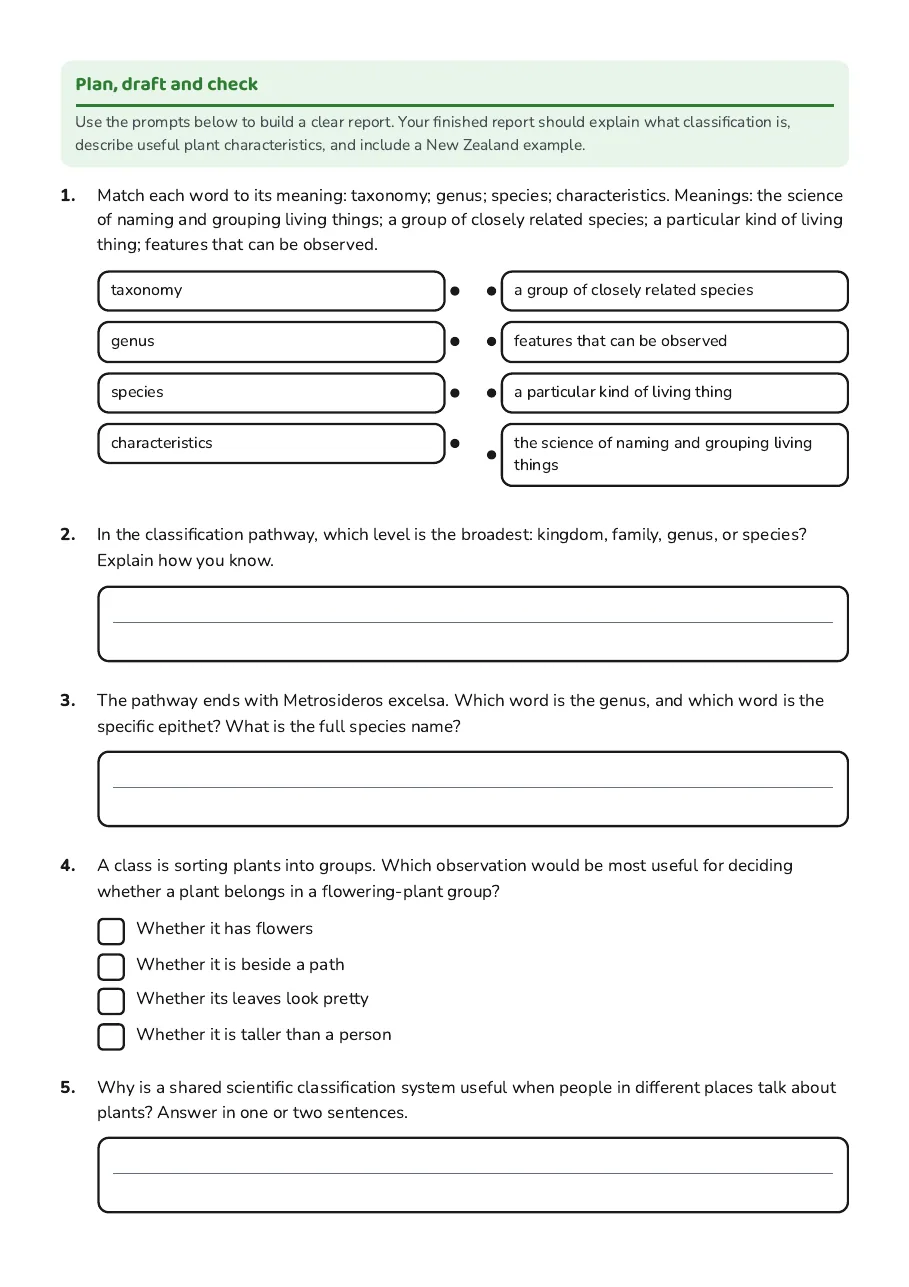
Plan, draft and check
Use the prompts below to build a clear report. Your finished report should explain what classification is, describe useful plant characteristics, and include a New Zealand example.
- taxonomy
- genus
- species
- characteristics
- a group of closely related species
- features that can be observed
- a particular kind of living thing
- the science of naming and grouping living things
- Whether it has flowers
- Whether it is beside a path
- Whether its leaves look pretty
- Whether it is taller than a person
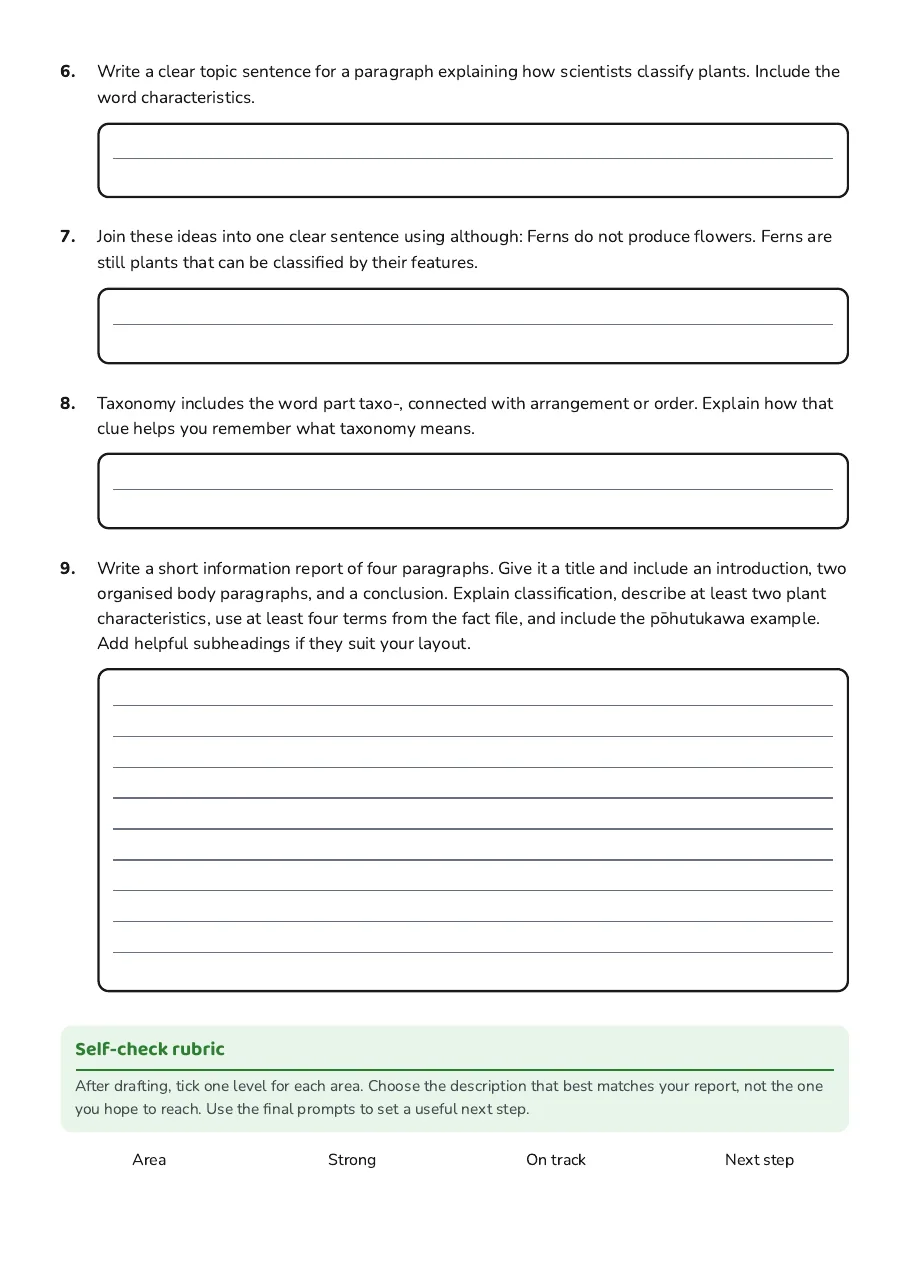
Self-check rubric
After drafting, tick one level for each area. Choose the description that best matches your report, not the one you hope to reach. Use the final prompts to set a useful next step.
Area
Strong
On track
Next step
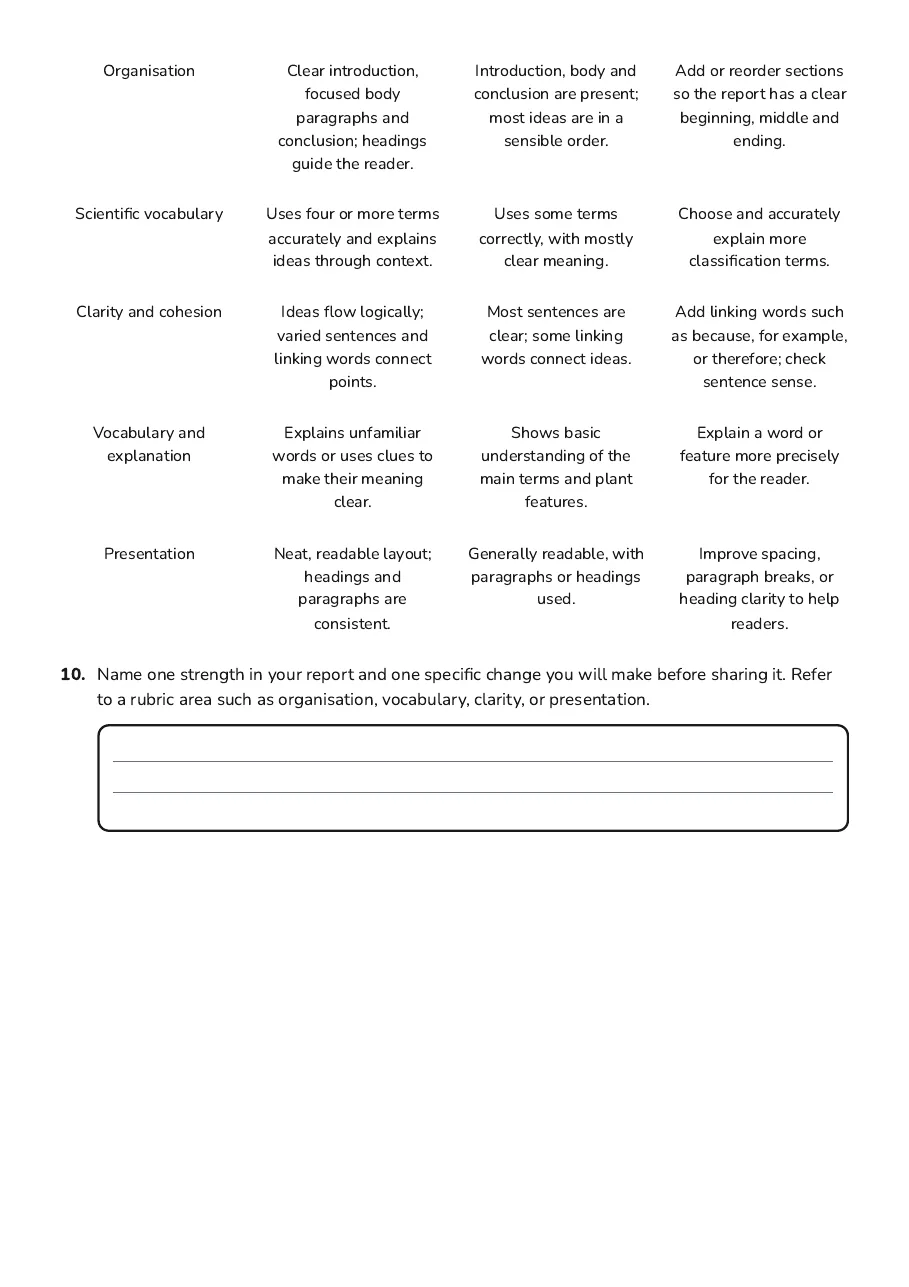
Organisation
Clear introduction, focused body paragraphs and conclusion; headings guide the reader.
Introduction, body and conclusion are present; most ideas are in a sensible order.
Add or reorder sections so the report has a clear beginning, middle and ending.
Scientific vocabulary
Uses four or more terms accurately and explains ideas through context.
Uses some terms correctly, with mostly clear meaning.
Choose and accurately explain more classification terms.
Clarity and cohesion
Ideas flow logically; varied sentences and linking words connect points.
Most sentences are clear; some linking words connect ideas.
Add linking words such as because, for example, or therefore; check sentence sense.
Vocabulary and explanation
Explains unfamiliar words or uses clues to make their meaning clear.
Shows basic understanding of the main terms and plant features.
Explain a word or feature more precisely for the reader.
Presentation
Neat, readable layout; headings and paragraphs are consistent.
Generally readable, with paragraphs or headings used.
Improve spacing, paragraph breaks, or heading clarity to help readers.
4 printable pages
Page 1
Page 2
Page 3
Page 4
About This Worksheet
Free in Kuraplan
Sign up free, grab the PDF, and customize it for your class.
Print-Ready
Formatted for standard paper. Clean layout, easy to read.
AI-Generated
Created with Kuraplan's AI, designed for real classroom use.
For Teachers & Parents
Use in classrooms, for homework, tutoring, or homeschool.
Need a custom version of this worksheet?
Kuraplan's AI generates custom worksheets in seconds — differentiated for every learner, aligned to your curriculum.
Generate Custom Worksheets — FreeMore English Worksheets
Paragraphing with Adverbial Starters
Free
SCAR Narrative Writing Guide
Free
Year 12 Writing Scaffolds
Free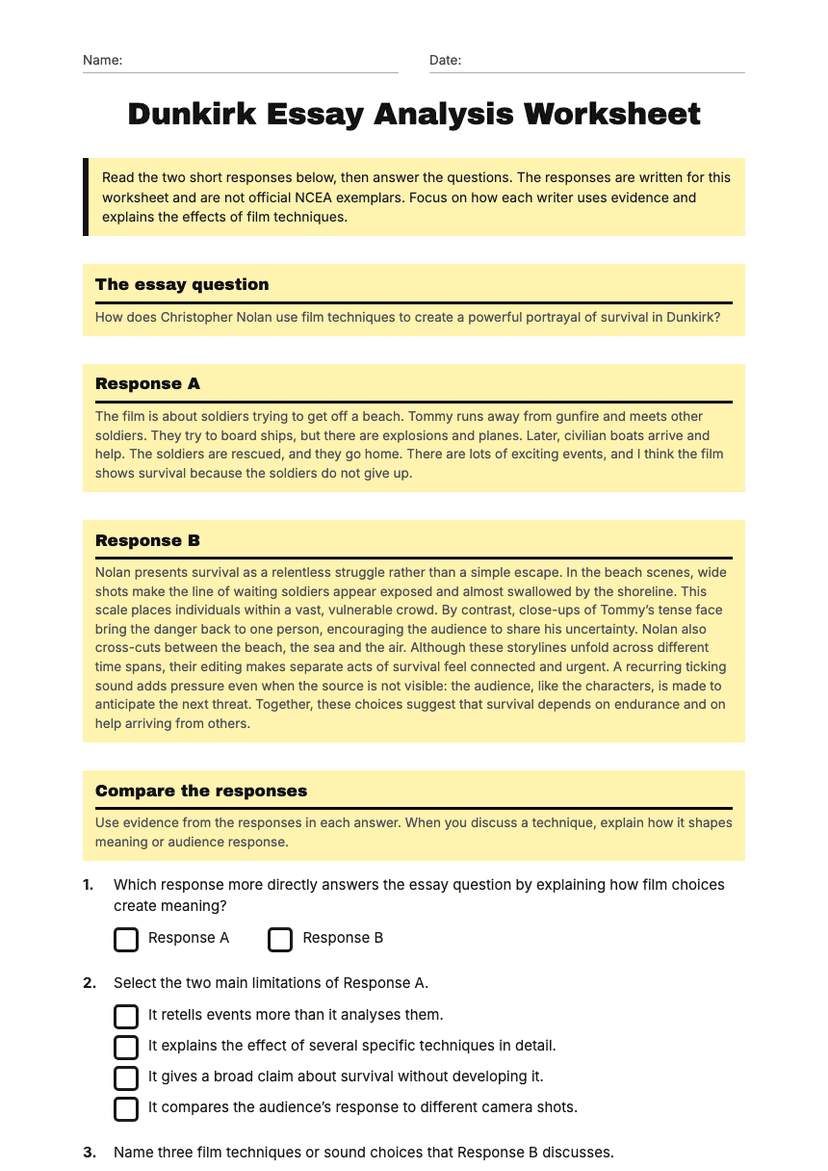
Dunkirk Essay Analysis Worksheet
Free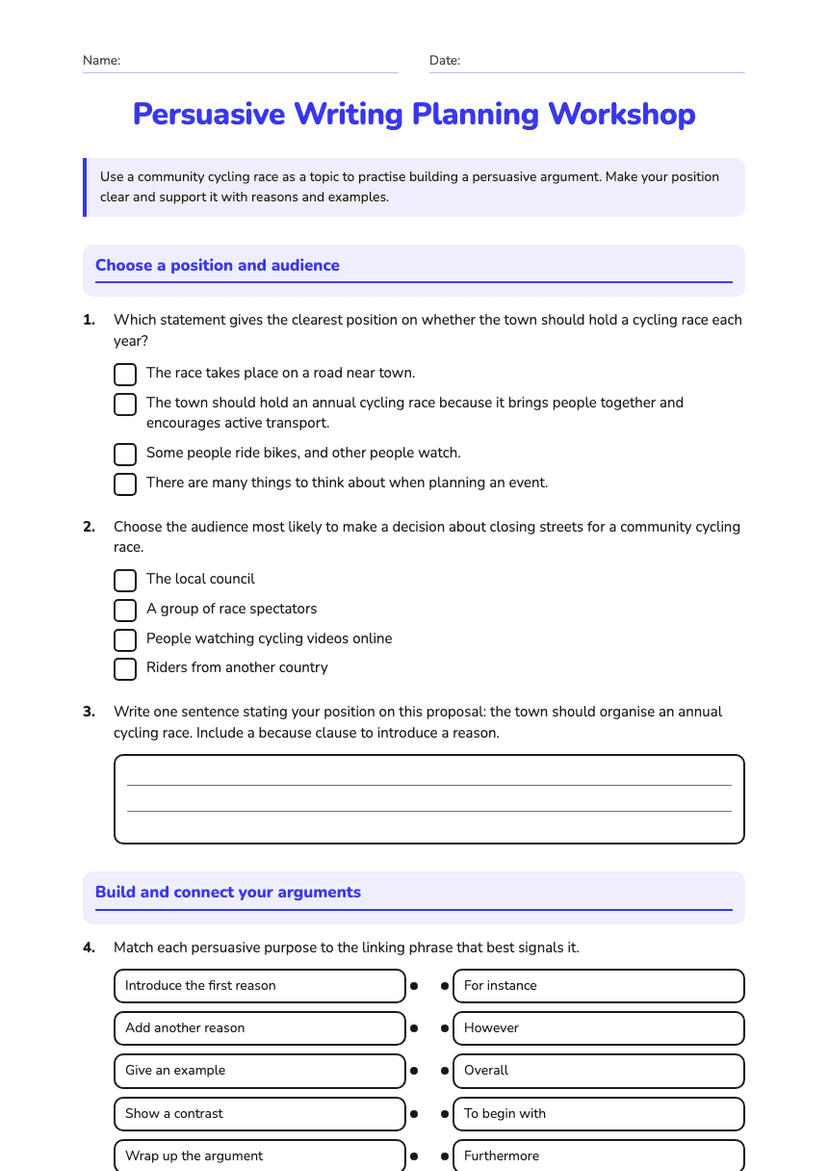
Persuasive Writing Planning Workshop
Free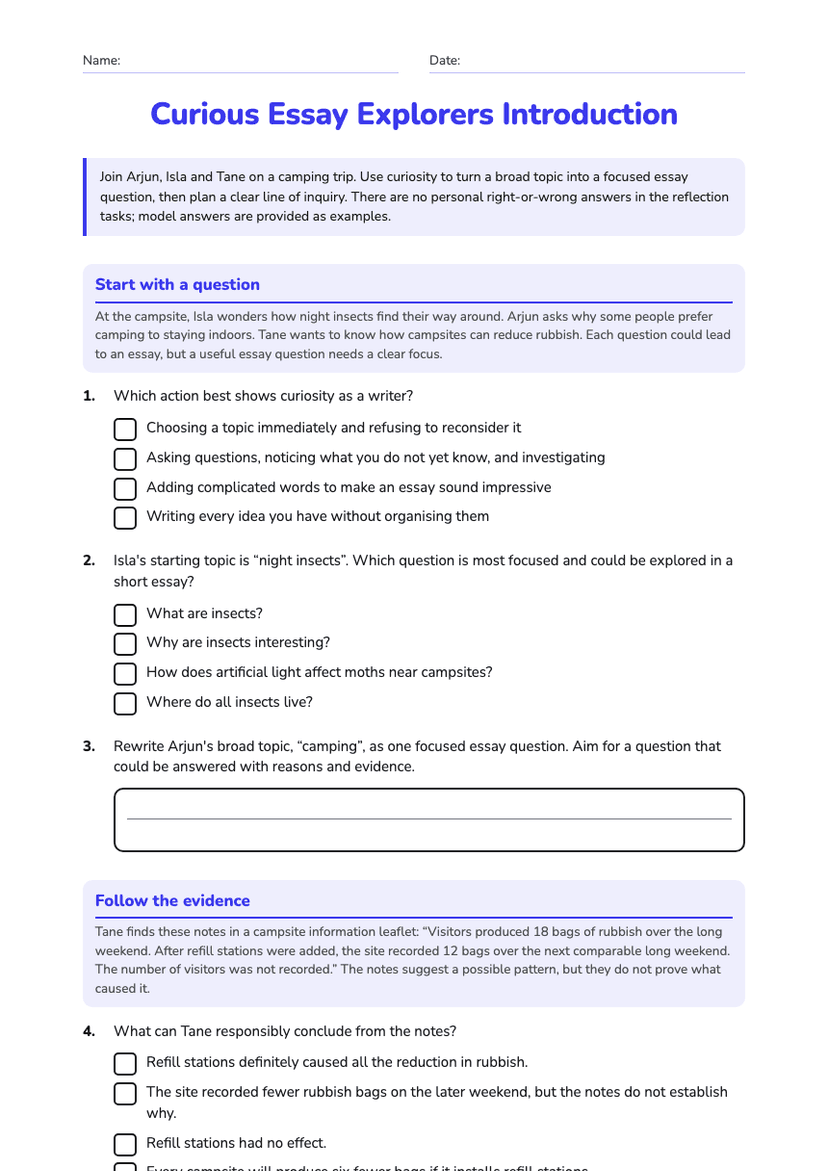
Curious Essay Explorers Introduction
Free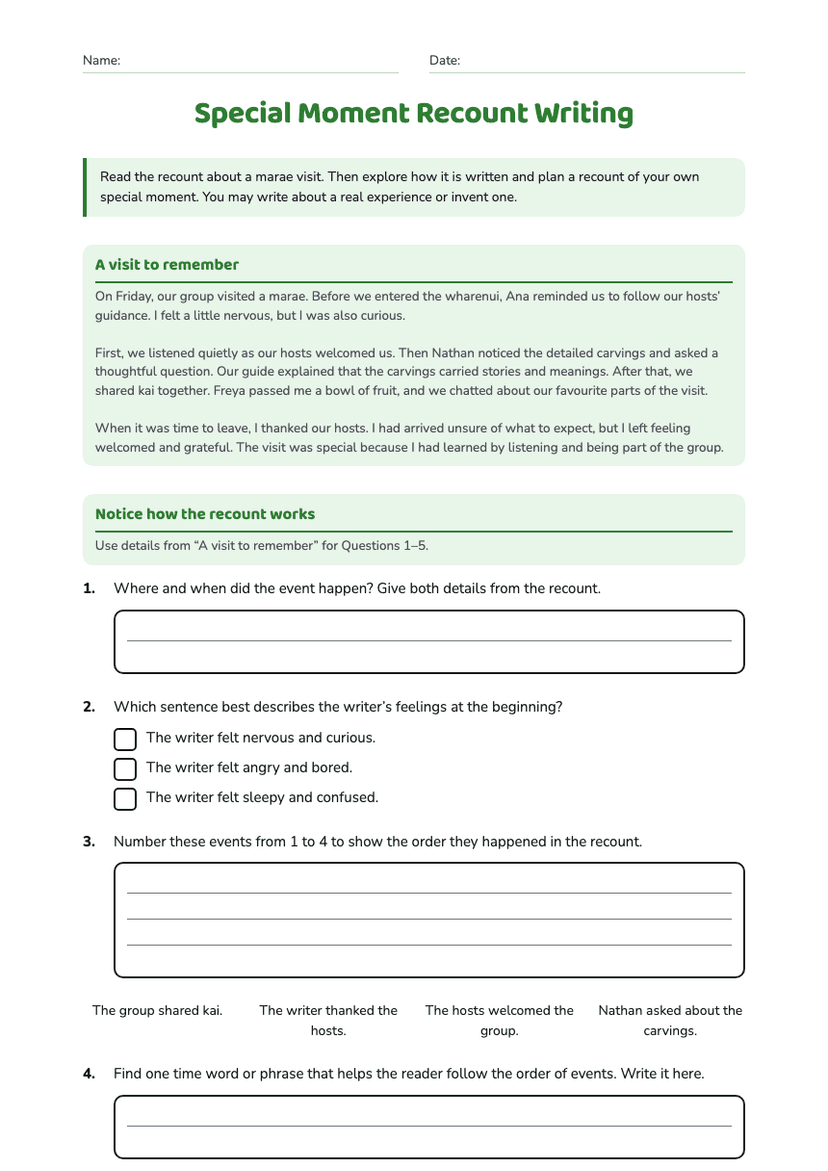
Special Moment Recount Writing
Free