Te Reo MāoriFreePrintable

Pseudo Passive Whānau Worksheet

A free te reo māori worksheet ready for your classroom. Open in Kuraplan to grab the print-ready PDF, customize it for your students, or generate a fresh version in seconds.
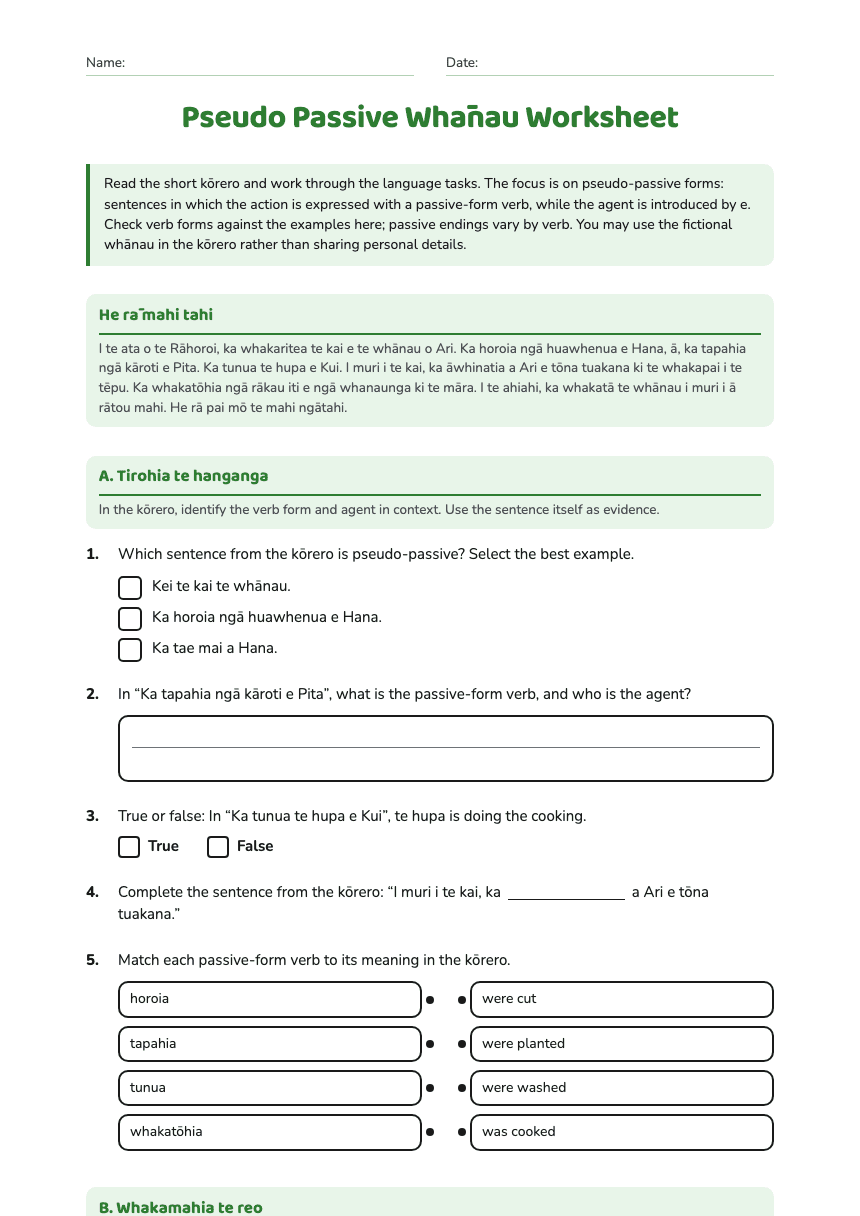
Pseudo Passive Whānau Worksheet worksheet preview
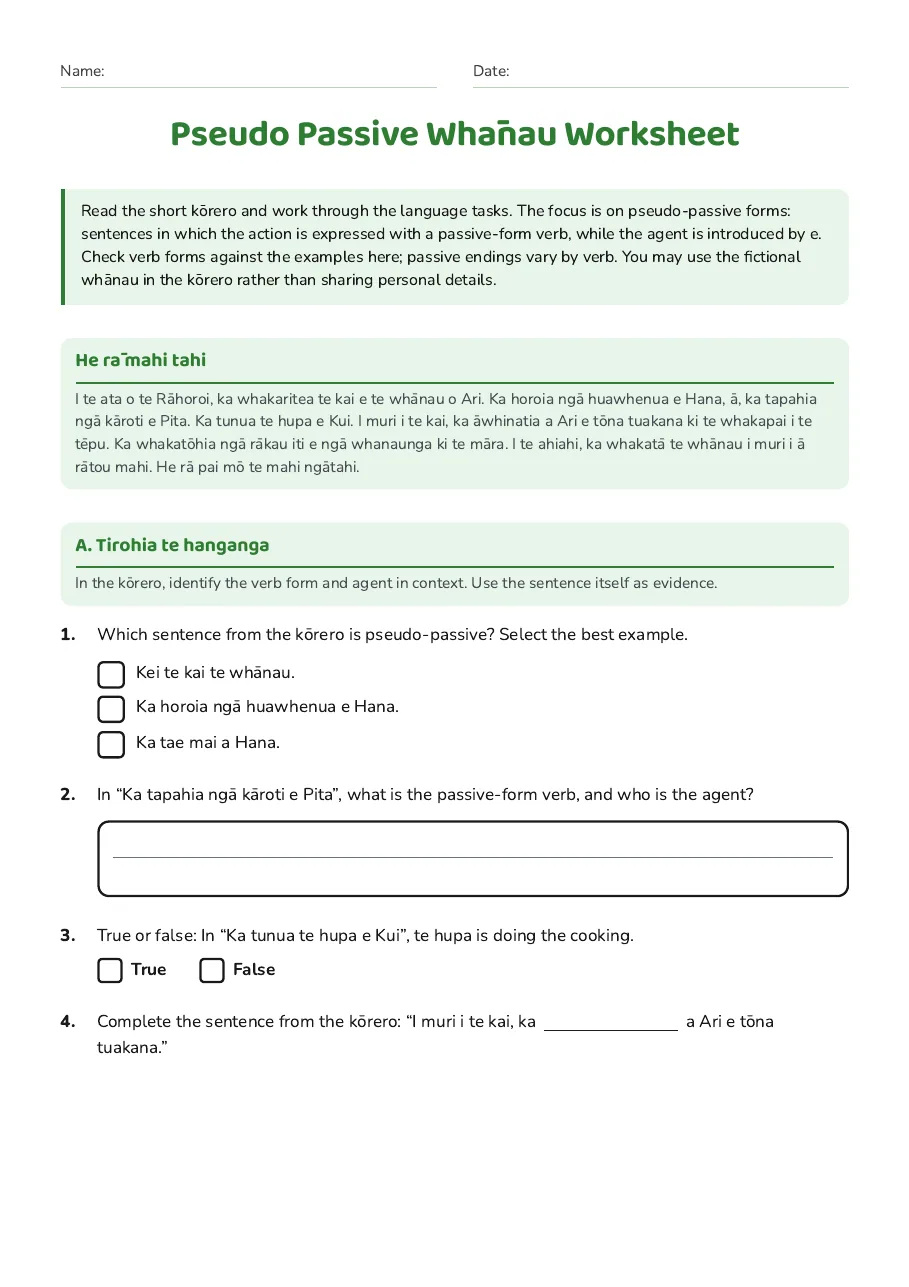
Name:Date:

Pseudo Passive Whānau Worksheet

Read the short kōrero and work through the language tasks. The focus is on pseudo-passive forms: sentences in which the action is expressed with a passive-form verb, while the agent is introduced by e. Check verb forms against the examples here; passive endings vary by verb. You may use the fictional whānau in the kōrero rather than sharing personal details.

He rā mahi tahi

I te ata o te Rāhoroi, ka whakaritea te kai e te whānau o Ari. Ka horoia ngā huawhenua e Hana, ā, ka tapahia ngā kāroti e Pita. Ka tunua te hupa e Kui. I muri i te kai, ka āwhinatia a Ari e tōna tuakana ki te whakapai i te tēpu. Ka whakatōhia ngā rākau iti e ngā whanaunga ki te māra. I te ahiahi, ka whakatā te whānau i muri i ā rātou mahi. He rā pai mō te mahi ngātahi.

A. Tirohia te hanganga

In the kōrero, identify the verb form and agent in context. Use the sentence itself as evidence.

1.Which sentence from the kōrero is pseudo-passive? Select the best example.
  • Kei te kai te whānau.
  • Ka horoia ngā huawhenua e Hana.
  • Ka tae mai a Hana.
2.In “Ka tapahia ngā kāroti e Pita”, what is the passive-form verb, and who is the agent?
3.True or false: In “Ka tunua te hupa e Kui”, te hupa is doing the cooking.
TrueFalse
4.Complete the sentence from the kōrero: “I muri i te kai, ka a Ari e tōna tuakana.”
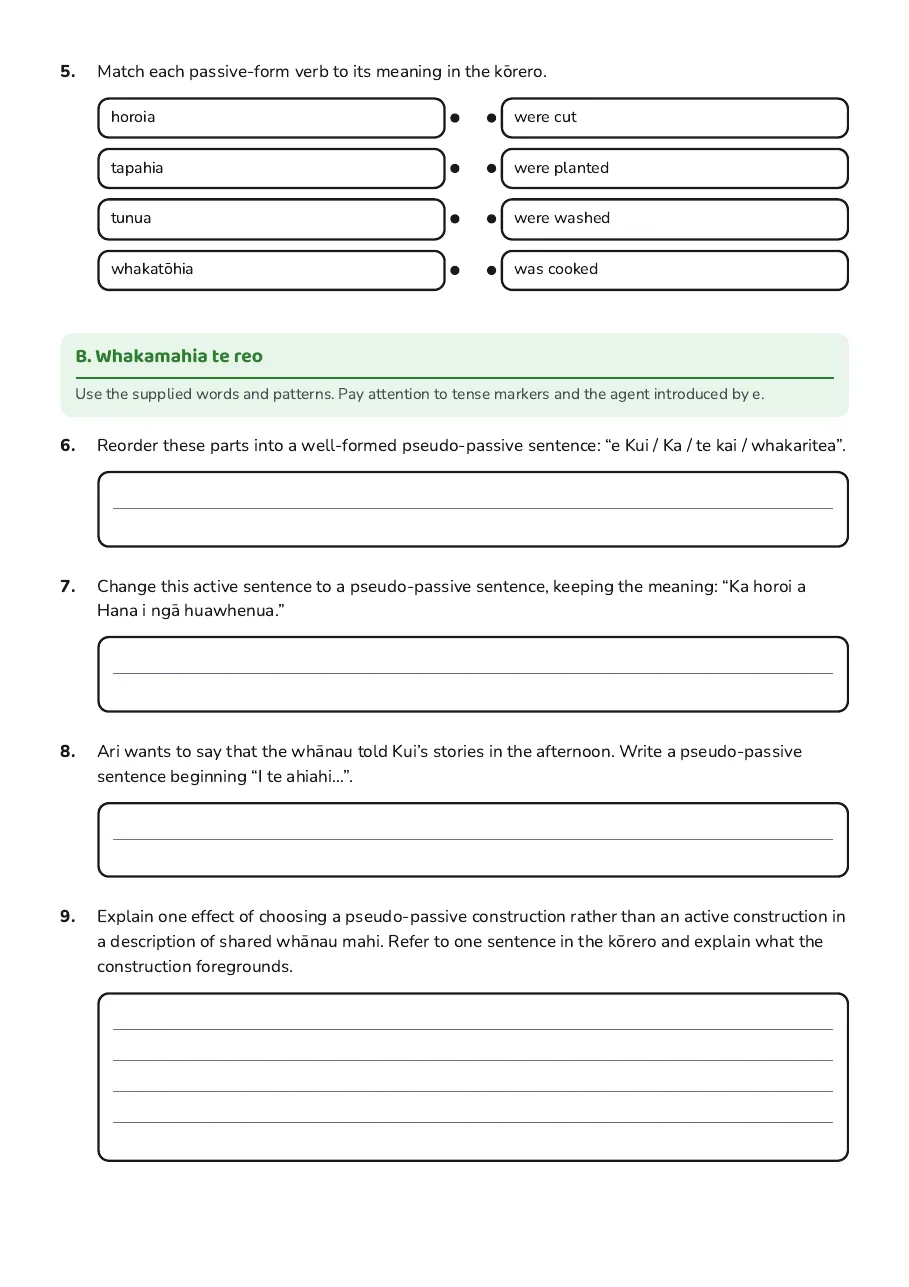
5.Match each passive-form verb to its meaning in the kōrero.
  • horoia
  • tapahia
  • tunua
  • whakatōhia
  • were cut
  • were planted
  • were washed
  • was cooked

B. Whakamahia te reo

Use the supplied words and patterns. Pay attention to tense markers and the agent introduced by e.

6.Reorder these parts into a well-formed pseudo-passive sentence: “e Kui / Ka / te kai / whakaritea”.
7.Change this active sentence to a pseudo-passive sentence, keeping the meaning: “Ka horoi a Hana i ngā huawhenua.”
8.Ari wants to say that the whānau told Kui’s stories in the afternoon. Write a pseudo-passive sentence beginning “I te ahiahi…”.
9.Explain one effect of choosing a pseudo-passive construction rather than an active construction in a description of shared whānau mahi. Refer to one sentence in the kōrero and explain what the construction foregrounds.
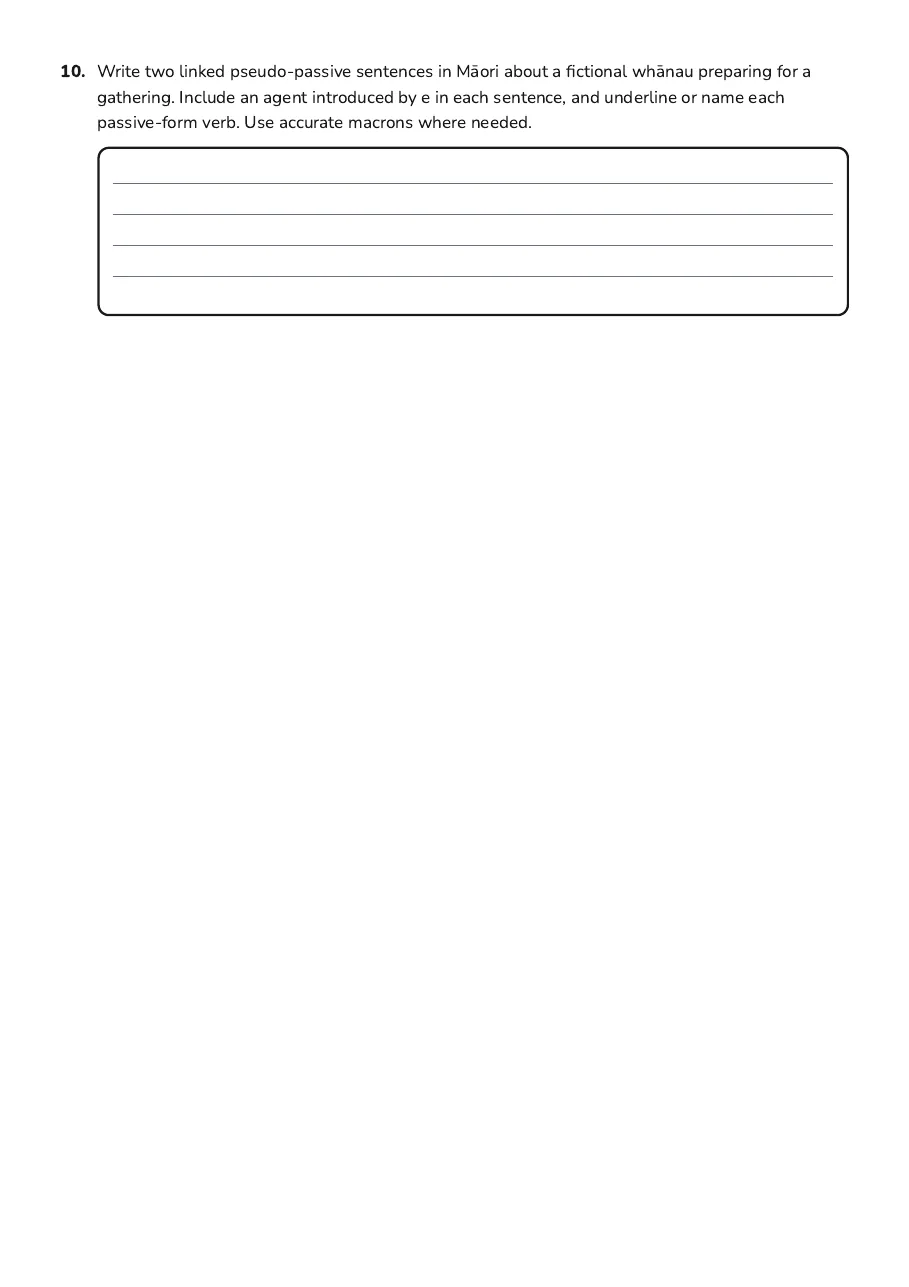
10.Write two linked pseudo-passive sentences in Māori about a fictional whānau preparing for a gathering. Include an agent introduced by e in each sentence, and underline or name each passive-form verb. Use accurate macrons where needed.

3 printable pages

  • Pseudo Passive Whānau Worksheet, page 1 of 3: He rā mahi tahi, A. Tirohia te hanganga

    Page 1

  • Pseudo Passive Whānau Worksheet, page 2 of 3: B. Whakamahia te reo

    Page 2

  • Pseudo Passive Whānau Worksheet, page 3 of 3: 10. Write two linked pseudo-passive sentences in Mā ori about a fictional whā nau…

    Page 3

About This Worksheet

Free in Kuraplan

Sign up free, grab the PDF, and customize it for your class.

Print-Ready

Formatted for standard paper. Clean layout, easy to read.

AI-Generated

Created with Kuraplan's AI, designed for real classroom use.

For Teachers & Parents

Use in classrooms, for homework, tutoring, or homeschool.

Need a custom version of this worksheet?

Kuraplan's AI generates custom worksheets in seconds — differentiated for every learner, aligned to your curriculum.

Generate Custom Worksheets — Free
No credit card Curriculum-aligned Under 60 seconds

Explore more free resources