Rocks: Weathering and Erosion
A free science worksheet ready for your classroom. Open in Kuraplan to grab the print-ready PDF, customize it for your students, or generate a fresh version in seconds.
Rocks: Weathering and Erosion
🪨 Understanding Weathering and Erosion
Key Concepts: Weathering is the breakdown of rocks in place, while erosion involves the movement of weathered material. Three main types of weathering occur: mechanical (physical breaking), chemical (chemical changes), and biological (caused by living things). Different rocks weather at different rates depending on their composition and structure.
🔄 Matching Weathering Processes
Instructions: Match each example to the correct type of weathering by drawing lines between them.
Word bank: erosion, mechanical, chemical, rates, composition
Different rocks weather at different _________ because of their mineral _________. _________ weathering involves physical breaking, while _________ weathering involves chemical changes. After weathering occurs, _________ can transport the broken material away.
🔍 Analysis and Application
✅ Answer Sheet
1. Definition of weathering: The breakdown of rocks in their original location.
2. Agents of weathering: Water, wind, plant roots, temperature changes, and acids. All five choices should be ticked.
Matching activity:
3. Fill in the blanks: Different rocks weather at different rates because of their mineral composition. Mechanical weathering involves physical breaking, while chemical weathering involves chemical changes. After weathering occurs, erosion can transport the broken material away.
4. Model answer: Granite is generally harder and more resistant than limestone. Limestone reacts more readily with weak acids in rainwater, so New Zealand’s wet climate can dissolve and weather it more quickly. Granite may still weather, but usually at a slower rate.
5. Model answer: Marble is made mostly of calcite, which can dissolve when exposed to acidic rainwater. Chemical weathering therefore rounds its edges and fades the lettering. Granite contains harder, more resistant minerals and is less affected by acidic water, so the granite headstones show much less weathering.
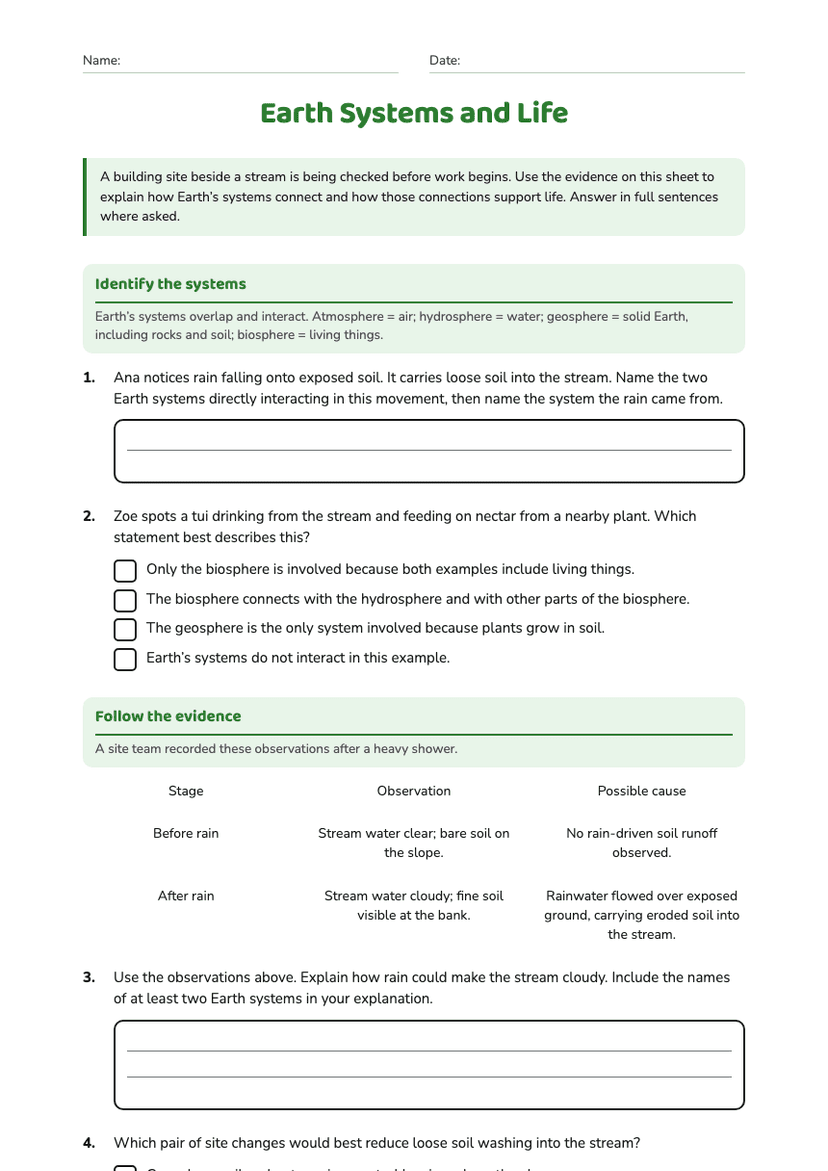
6. Model answer: Weathering breaks rock into smaller mineral particles. These particles mix with decayed plants and animals, called organic matter or humus. The mixture, along with air and water, forms soil. Organic matter adds nutrients and helps soil hold water.
7. Acceptable responses:
- Waitomo Caves: Slightly acidic groundwater dissolved limestone, creating caves, passages, and underground features. Erosion carried away dissolved and loosened material.
- Pancake Rocks: Waves and rain eroded layers of limestone, while weaker layers wore away more quickly, forming the distinctive stacked shapes and blowholes.
- Canterbury Plains: Rivers transported and deposited weathered rock and sediment from the Southern Alps, gradually building the broad alluvial plains.
Other well-supported examples should also be accepted if they accurately explain the roles of weathering and erosion.
About This Worksheet
Free in Kuraplan
Sign up free, grab the PDF, and customize it for your class.
Print-Ready
Formatted for standard paper. Clean layout, easy to read.
AI-Generated
Created with Kuraplan's AI, designed for real classroom use.
For Teachers & Parents
Use in classrooms, for homework, tutoring, or homeschool.
Need a custom version of this worksheet?
Kuraplan's AI generates custom worksheets in seconds — differentiated for every learner, aligned to your curriculum.
Generate Custom Worksheets — Free