EnglishFreePrintable

Run-On Sentence Surgery

A free english worksheet ready for your classroom. Open in Kuraplan to grab the print-ready PDF, customize it for your students, or generate a fresh version in seconds.
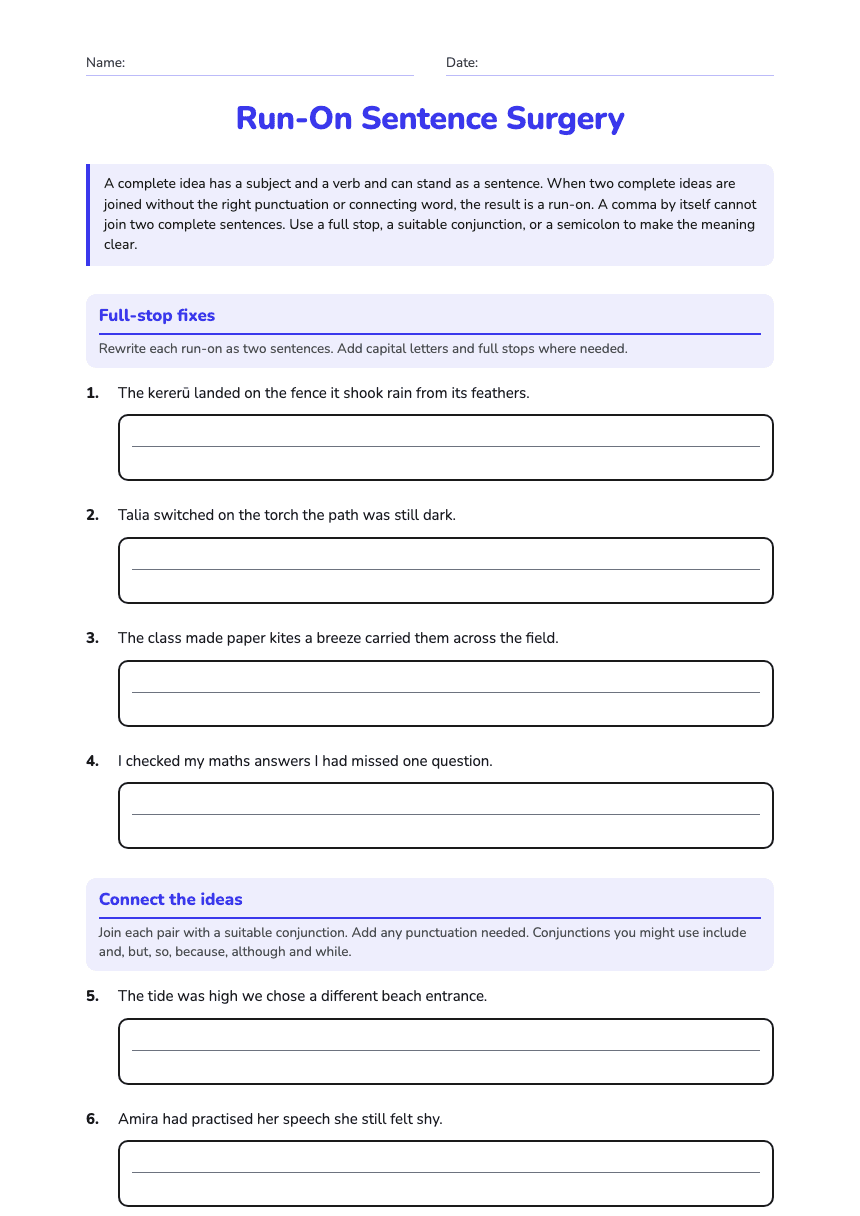
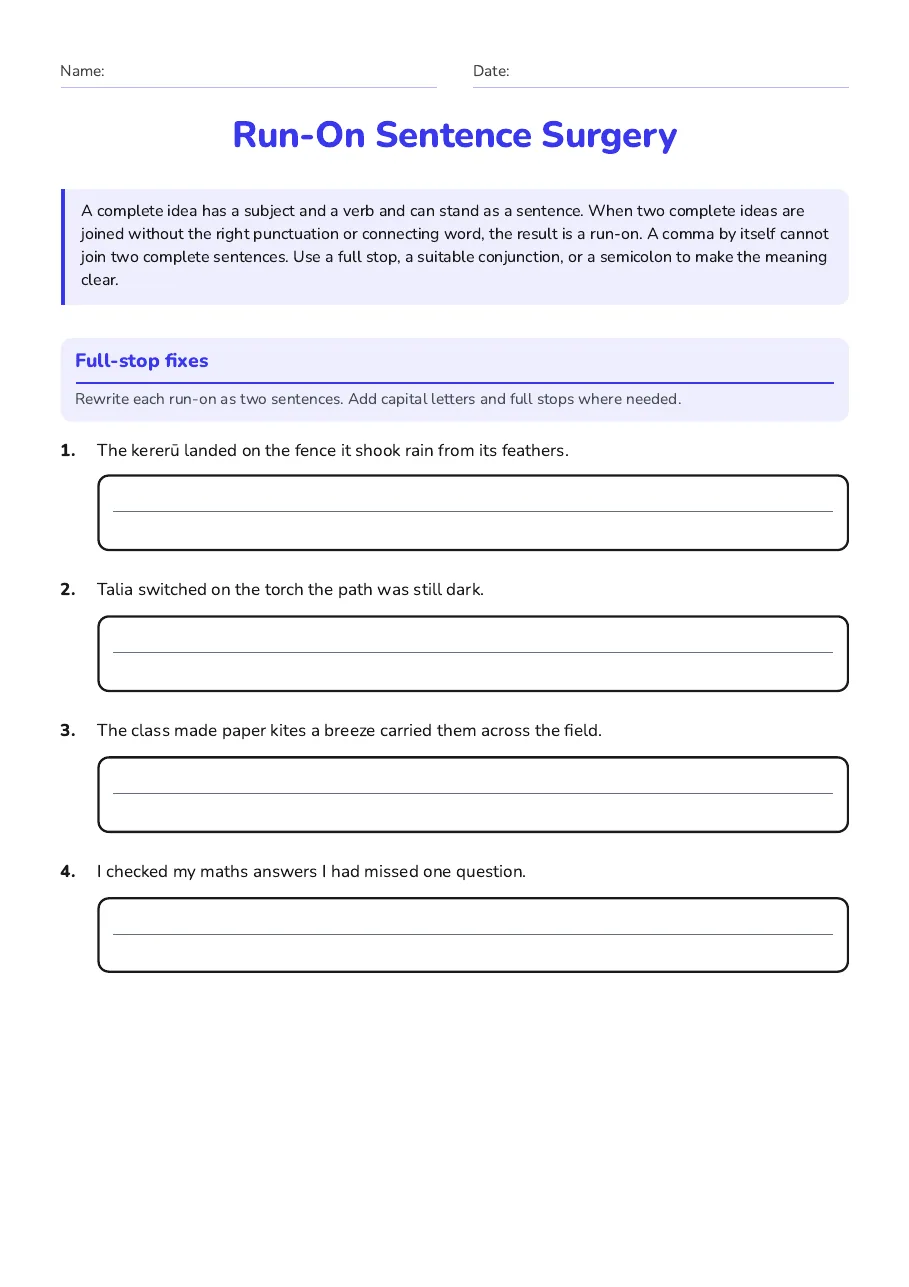
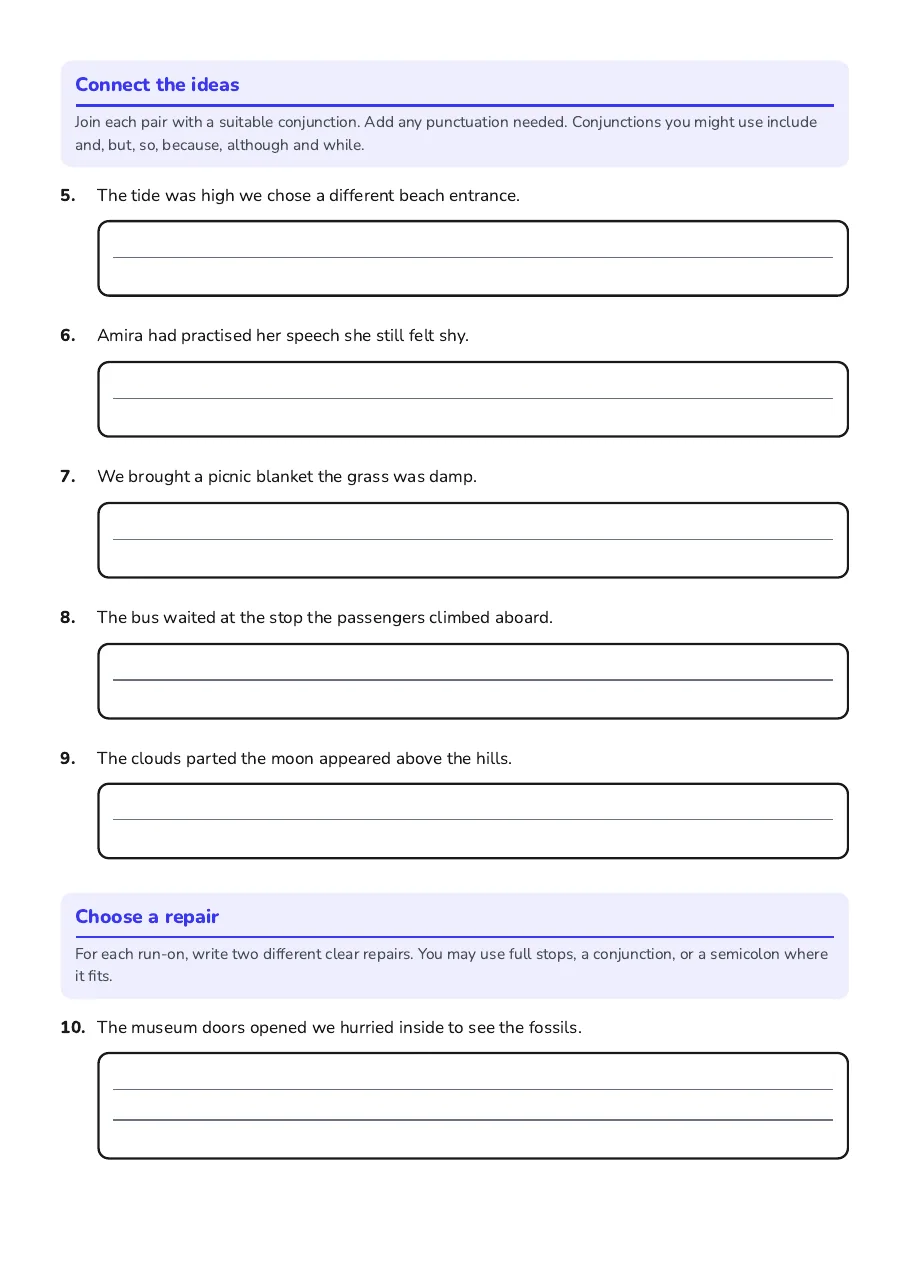
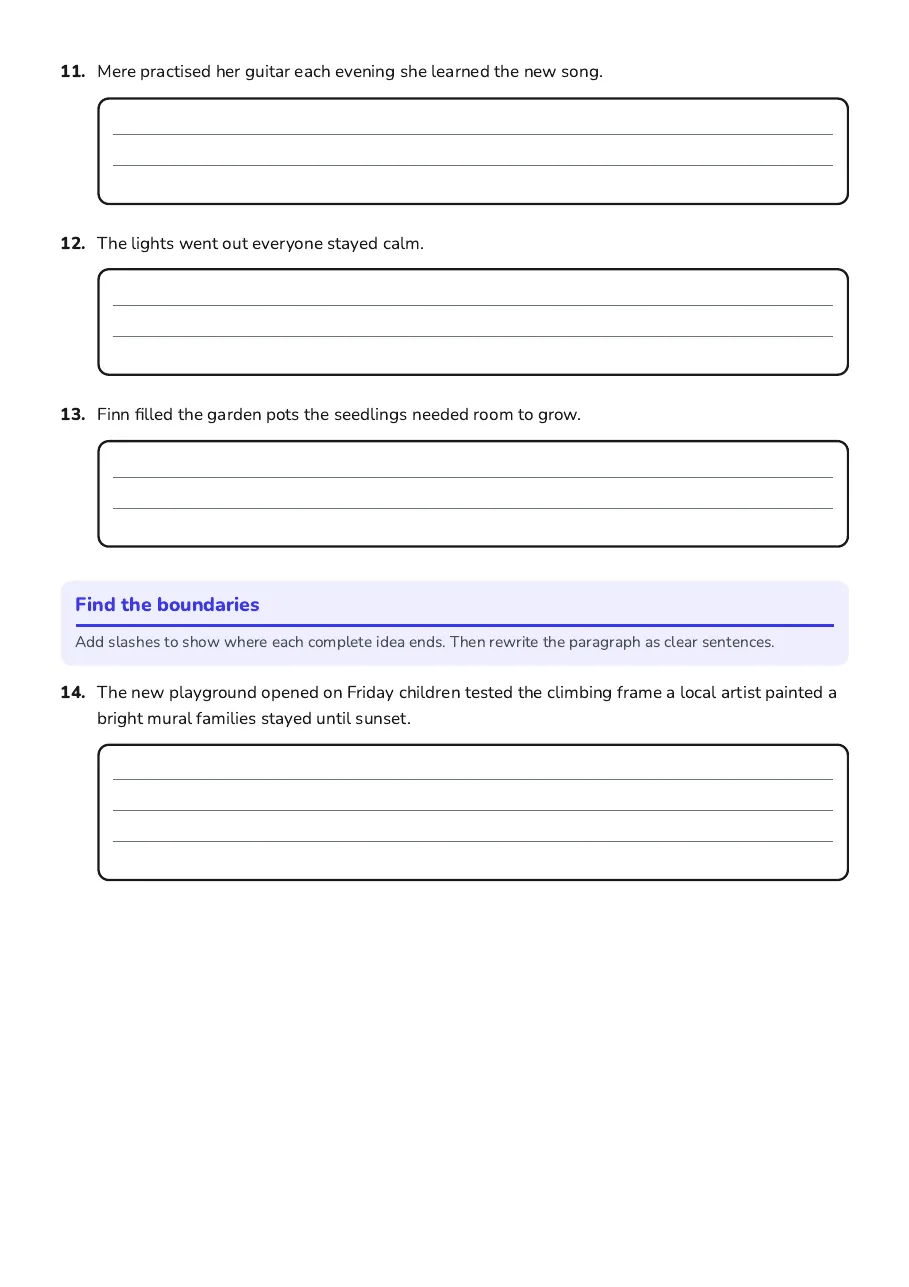
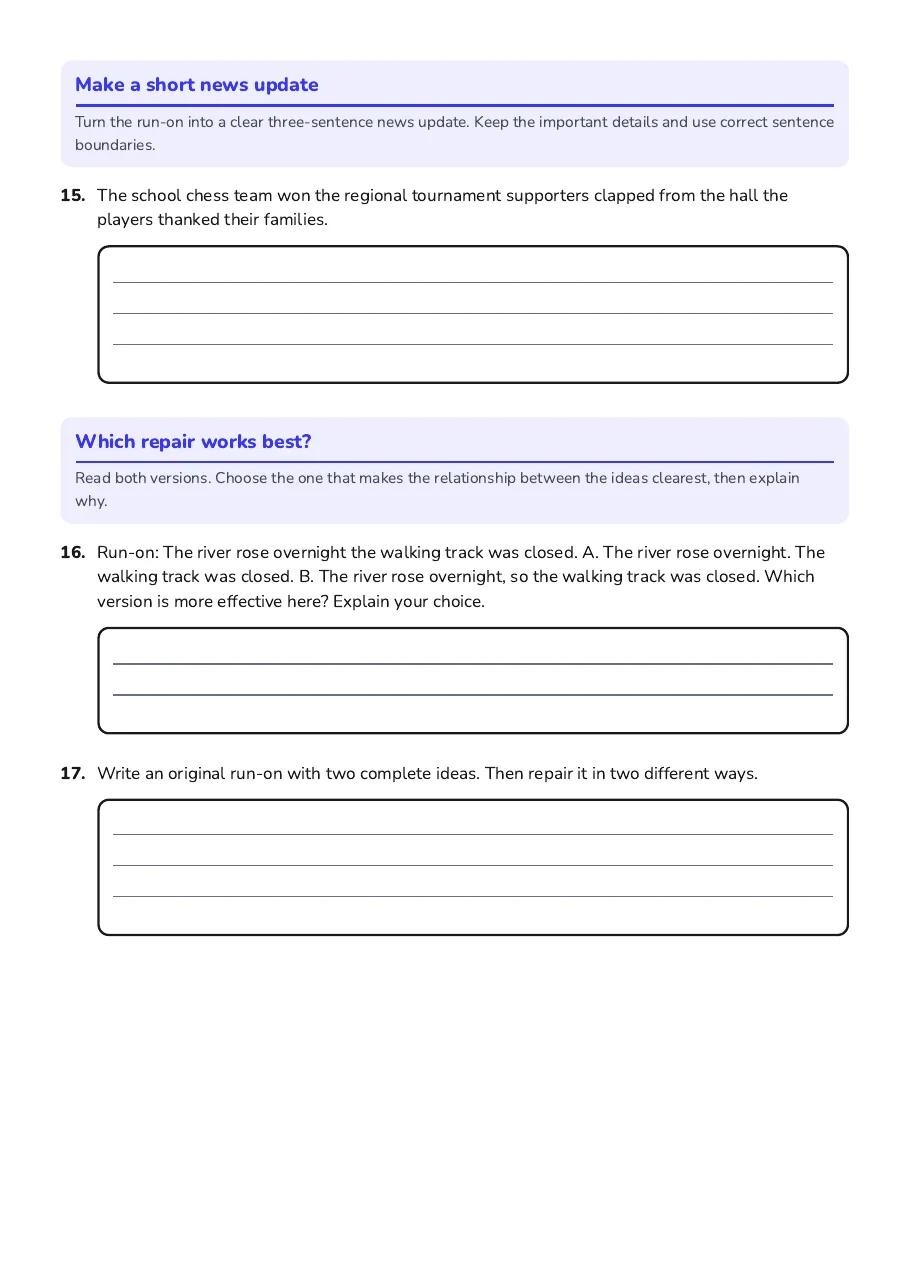
Run-On Sentence Surgery worksheet preview

Sentence Switch Stations: Run-on Sentence Surgery

Worksheet illustration

WALT and Success Criteria

WALT: We are learning to identify and repair run-on sentences.

A run-on sentence joins two or more complete ideas without suitable punctuation or a connecting word. Each complete idea has a subject and a verb and can stand alone.

Example: Mia packed her bag she forgot her lunch.

Two sentences: Mia packed her bag. She forgot her lunch.

Conjunction: Mia packed her bag, but she forgot her lunch.

Semicolon: Mia packed her bag; she forgot her lunch.

Important: A comma alone does not correctly join two complete sentences. This is called a comma splice.

Before you begin, check each box:

I can identify complete ideas.

I can locate where one sentence ends.

I can repair a run-on using full stops, conjunctions or semicolons.

I can read my writing aloud and check its clarity.

Station 1: Punctuation Pit Stop

Rewrite each run-on as two clear sentences. Remember capital letters and full stops.

1. The taniwha crossed the river it vanished into the mist.
2. Ruby opened the window fresh air filled the room.
3. The kapa haka group practised after school everyone improved.
4. I finished my science model it needed one more label.

Station 2: Conjunction Challenge

Word bank: and   but   so   because   although   while

Choose a suitable conjunction. Add punctuation and rewrite each sentence clearly.

5. The rain started we moved the football game indoors.
6. Hana wanted to join the choir she was nervous.
7. We packed extra water the walk was longer than expected.
8. The teacher read the instructions we began the experiment.
9. The sun came out the puddles slowly dried.

Station 3: Sentence Surgery

Repair each run-on in two different ways. Try a full stop, a conjunction or a semicolon where it makes sense.

10. The library was quiet I found a book about volcanoes.
11. Our team trained hard we were ready for the final.
12. The bell rang the students packed away their books.
13. Kiri planted the seedlings they needed plenty of sunlight.

Station 4: Read-Aloud Detectives

Read this paragraph aloud. Mark each pause or sentence boundary with a slash. Then rewrite it as clear sentences.

The school garden opened today students planted herbs the principal thanked the volunteers everyone enjoyed the afternoon.

Station 5: Newsroom Rewrite

Turn this run-on report into a clear three-sentence news update. Say each sentence aloud before writing.

The Year 6 team won the netball final the crowd cheered loudly the players thanked their coach.

Station 6: Author’s Choice

Compare the two repairs. Tick the clearer or more effective version, then explain your choice.

Run-on: The wind grew stronger the boats returned to shore.

A. The wind grew stronger. The boats returned to shore.

B. The wind grew stronger, so the boats returned to shore.

14. I chose version ____ because...
15. Write one original run-on sentence. Then repair it in two different ways.

Support Box

Sentence frames: “I can hear ____ complete ideas.” “The sentence boundary is after ____.” “I chose ____ because ____.”

Use two colours: highlight the first complete idea in one colour and the second complete idea in another. Read aloud and pause where the ideas change.

Extension Box

Explain how a full stop, semicolon and conjunction can change the meaning, emphasis or rhythm of a sentence. You could also create a run-on that shows a character speaking quickly or breathlessly, then explain why it is effective.

Exit Ticket

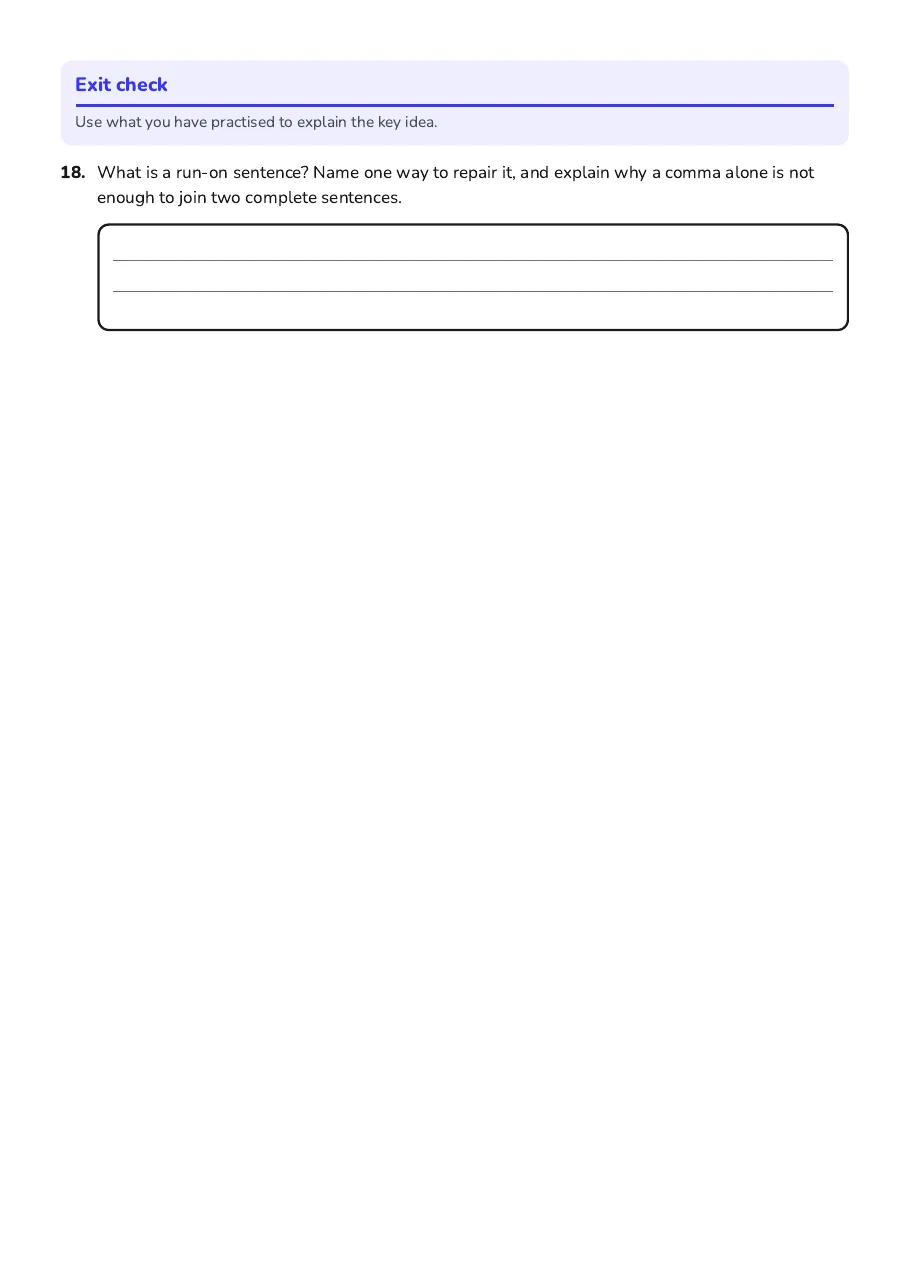
16. Define a run-on sentence and name one repair strategy.

Learning support: Rehearse answers with a partner, use colour-coded sentence halves, draw the ideas first, or dictate your answer using speech-to-text. Your teacher may model pronunciation and pauses.

Teacher Answer Key

Note: Answers may vary if the repair is grammatical, clear and keeps the original meaning. Accept suitable conjunctions and sensible sentence boundaries.

Station 1

1. The taniwha crossed the river. It vanished into the mist.

2. Ruby opened the window. Fresh air filled the room.

3. The kapa haka group practised after school. Everyone improved.

4. I finished my science model. It needed one more label.

Station 2: Possible answers

5. The rain started, so we moved the football game indoors.

6. Hana wanted to join the choir, but she was nervous.

7. We packed extra water because the walk was longer than expected.

8. While the teacher read the instructions, we began the experiment. Also accept: The teacher read the instructions, and we began the experiment.

9. The sun came out, and the puddles slowly dried. Also accept: The sun came out, so the puddles slowly dried.

Station 3: Possible answers

10. The library was quiet. I found a book about volcanoes. / The library was quiet; I found a book about volcanoes.

11. Our team trained hard, so we were ready for the final. / Our team trained hard. We were ready for the final.

12. The bell rang. The students packed away their books. / The bell rang, and the students packed away their books.

13. Kiri planted the seedlings. They needed plenty of sunlight. / Kiri planted the seedlings; they needed plenty of sunlight.

Station 4

Possible boundaries: The school garden opened today / students planted herbs / the principal thanked the volunteers / everyone enjoyed the afternoon.

Possible rewrite: The school garden opened today. Students planted herbs. The principal thanked the volunteers. Everyone enjoyed the afternoon.

Station 5

Answers will vary. A suitable answer is: The Year 6 team won the netball final. The crowd cheered loudly. The players thanked their coach.

Station 6

14. Version B is usually clearer because “so” shows that the stronger wind caused the boats to return. Version A is also correct if the writer wants a sharper pause.

15. Answers will vary. Check that the original has two complete ideas and that both repairs are grammatical and clear.

Exit Ticket

16. A run-on sentence incorrectly joins two or more complete ideas. Repair strategies include using a full stop, a suitable conjunction or a semicolon. A comma alone is not enough.

About This Worksheet

Free in Kuraplan

Sign up free, grab the PDF, and customize it for your class.

Print-Ready

Formatted for standard paper. Clean layout, easy to read.

AI-Generated

Created with Kuraplan's AI, designed for real classroom use.

For Teachers & Parents

Use in classrooms, for homework, tutoring, or homeschool.

Need a custom version of this worksheet?

Kuraplan's AI generates custom worksheets in seconds — differentiated for every learner, aligned to your curriculum.

Generate Custom Worksheets — Free
No credit card Curriculum-aligned Under 60 seconds