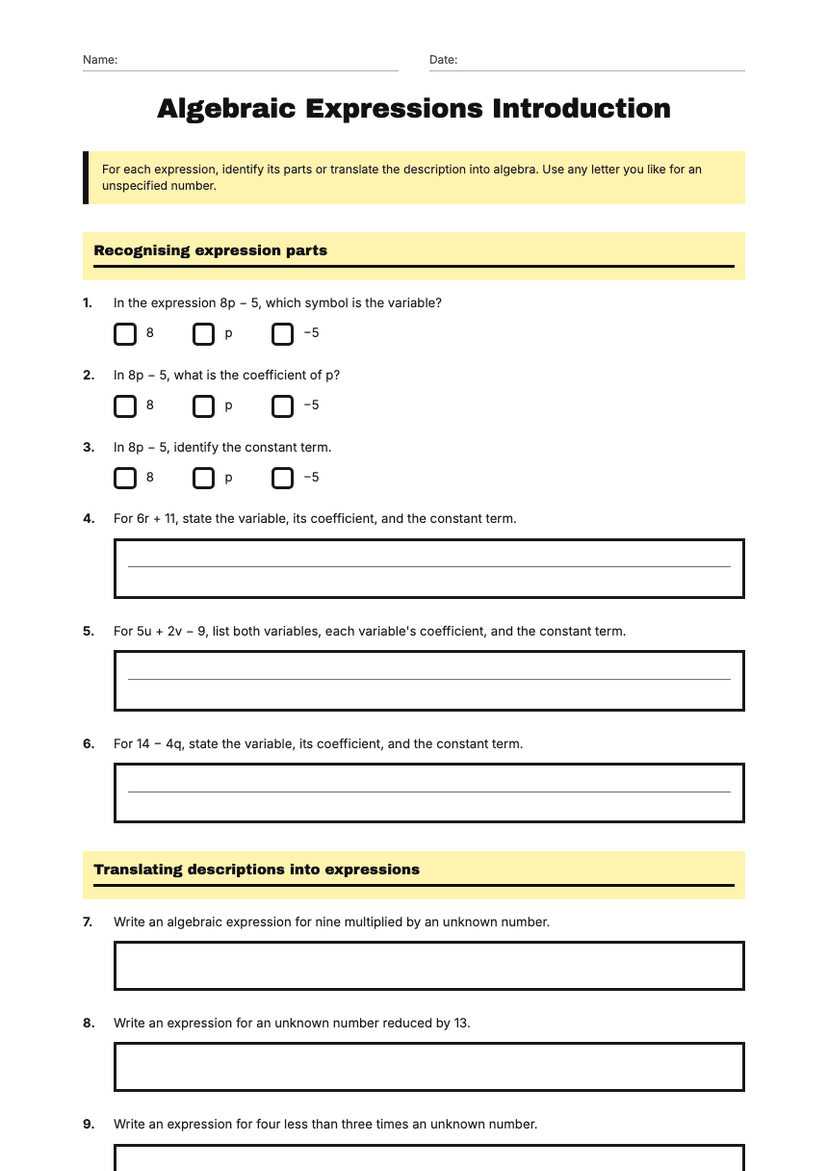
Sequence Classification: Differences & Ratios
A free maths worksheet ready for your classroom. Open in Kuraplan to grab the print-ready PDF, customize it for your students, or generate a fresh version in seconds.
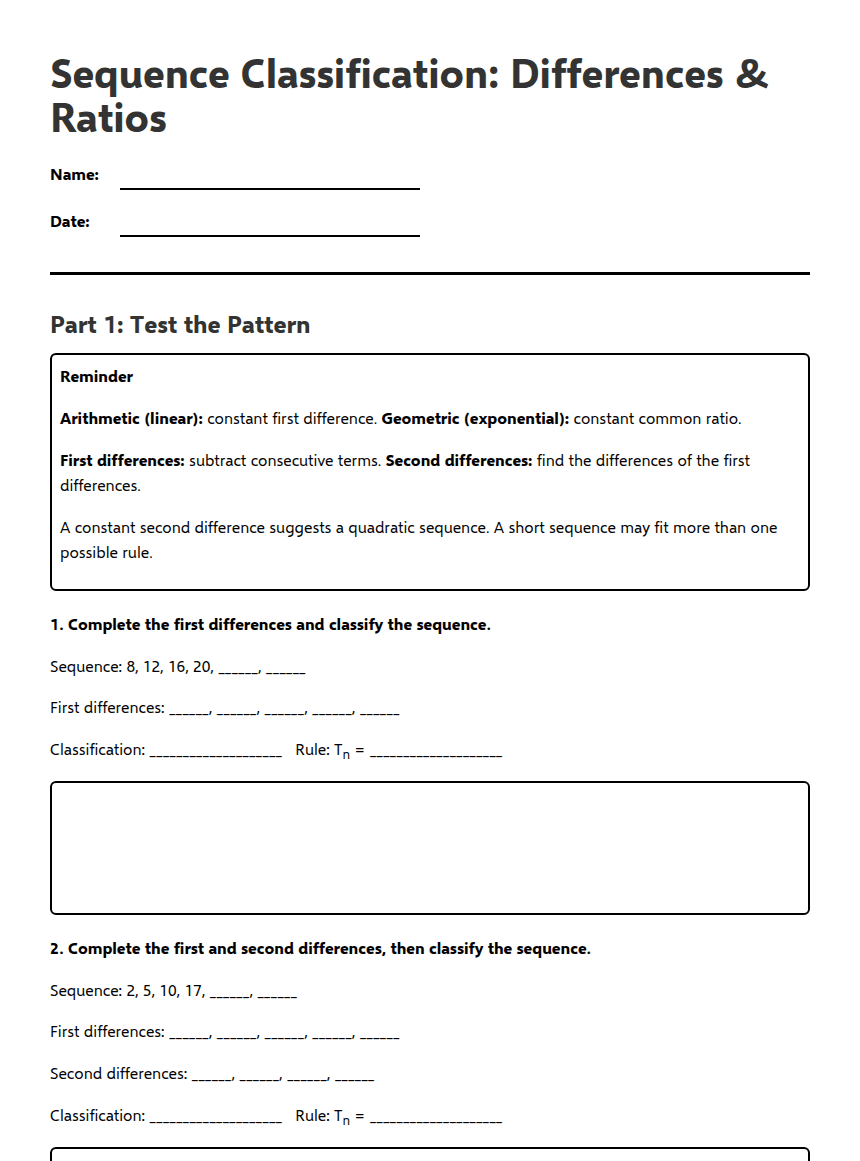
Sequence Classification: Differences & Ratios
Part 1: Test the Pattern
Arithmetic (linear): constant first difference. Geometric (exponential): constant common ratio.
First differences: subtract consecutive terms. Second differences: find the differences of the first differences.
A constant second difference suggests a quadratic sequence. A short sequence may fit more than one possible rule.
Sequence: 8, 12, 16, 20, ______, ______
First differences: ______, ______, ______, ______, ______
Classification: ____________________ Rule: Tn = ____________________
Sequence: 2, 5, 10, 17, ______, ______
First differences: ______, ______, ______, ______, ______
Second differences: ______, ______, ______, ______
Classification: ____________________ Rule: Tn = ____________________
Sequence: 81, 27, 9, 3, ______, ______
Common ratios: ______, ______, ______, ______, ______
Classification: ____________________ Rule: Tn = ____________________
Sequence: 1.5, 0.75, 0.375, ______, ______, ______
Common ratio: ____________________ Classification: ____________________
Part 2: Classify and Justify
For each sequence, calculate the most useful evidence. Write linear, quadratic, exponential, or not enough information. Then complete the sentence.
Useful test and results: __________________________________________________________
It is ____________________ because __________________________________________________.
First differences: ____________________ Second differences: ____________________
It is ____________________ because __________________________________________________.
Common ratio: ____________________ It is ____________________ because _______________.
Rule: Tn = ____________________
First difference: ____________________ It is ____________________ because _____________.
First differences: ____________________ Second differences: ____________________
It is ____________________ because __________________________________________________.
Part 3: Challenges, Self-Check and Answer Key
Self-check
☐ I can calculate first differences accurately.
☐ I can calculate second differences when first differences are not constant.
☐ I can test for a constant ratio, including fractions, decimals and negative values.
☐ I can classify a sequence and justify my decision using mathematical vocabulary.
☐ I can check an nth-term rule by substituting n = 1 and other positions.
☐ I understand that a short sequence may not have one unique rule.
Answer Key
1. Terms: 24, 28. First differences: +4 throughout. Linear; Tn = 4n + 4.
2. Terms: 26, 37. First differences: 3, 5, 7, 9, 11. Second differences: +2 throughout. Quadratic; Tn = n2 + 1.
3. Terms: 1, 1/3. Ratios: 1/3 throughout. Exponential; Tn = 81(1/3)n-1.
4. Terms: 0.1875, 0.09375, 0.046875. Ratio: 0.5. Exponential.
5. Terms: 21, 25. First difference +4. Linear; possible rule Tn = 4n + 1.
6. Terms: 25, 36. First differences: 3, 5, 7, 9. Second difference: +2. Quadratic; Tn = n2.
7. Terms: 80, 160. Ratio 2. Exponential; Tn = 5(2n-1).
8. Terms: 8, 5. First difference −3. Linear.
9. Terms: 31, 43. First differences: 4, 6, 8, 10, 12. Second difference: +2. Quadratic; a possible rule is Tn = n2 + n + 1.
10. One possible answer: the next term could be 10 under a constant-difference rule, but another rule could produce a different term. More terms or a stated rule would help.
11. Missing term: 14. First difference is +4; a possible rule is Tn = 4n + 2.
12. A possible rule is Tn = (n + 1)2. It gives 4 when n = 1 and 25 when n = 4.
About This Worksheet
Free in Kuraplan
Sign up free, grab the PDF, and customize it for your class.
Print-Ready
Formatted for standard paper. Clean layout, easy to read.
AI-Generated
Created with Kuraplan's AI, designed for real classroom use.
For Teachers & Parents
Use in classrooms, for homework, tutoring, or homeschool.
Need a custom version of this worksheet?
Kuraplan's AI generates custom worksheets in seconds — differentiated for every learner, aligned to your curriculum.
Generate Custom Worksheets — FreeMore Maths Worksheets
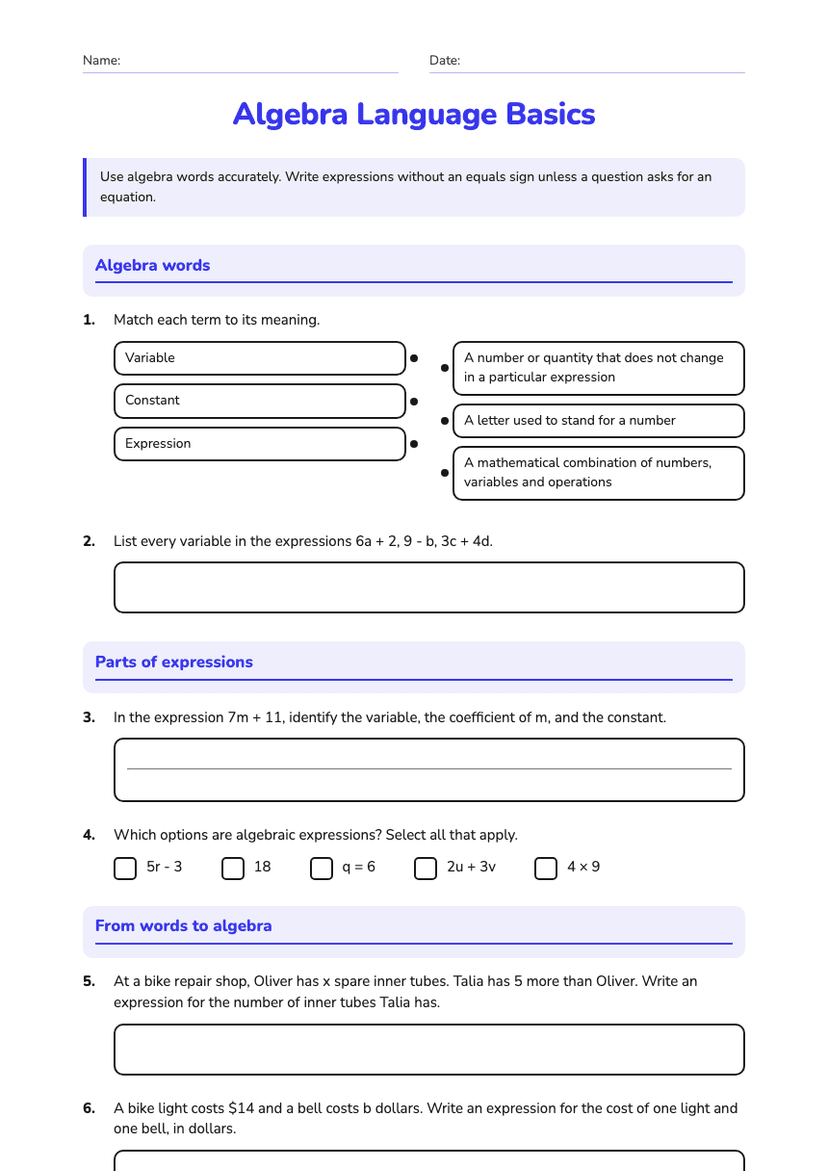
Algebra Language Basics
Free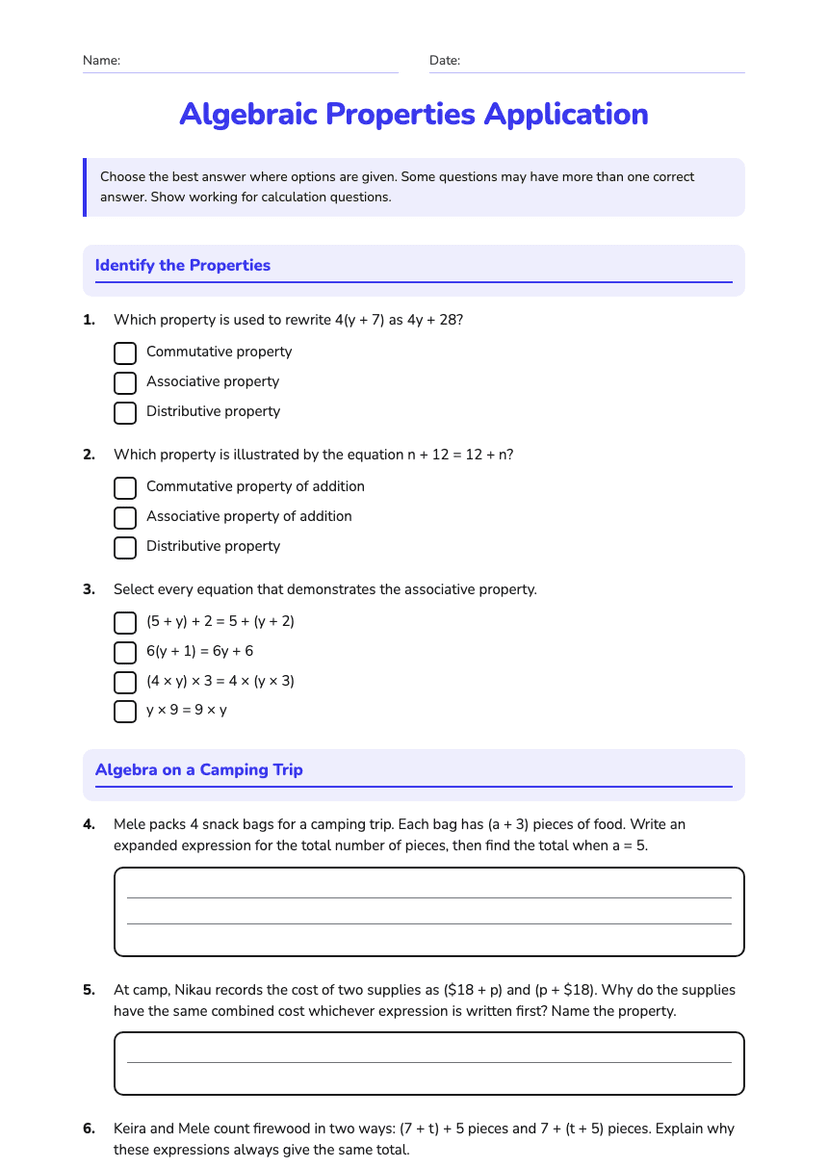
Algebraic Properties Application
Free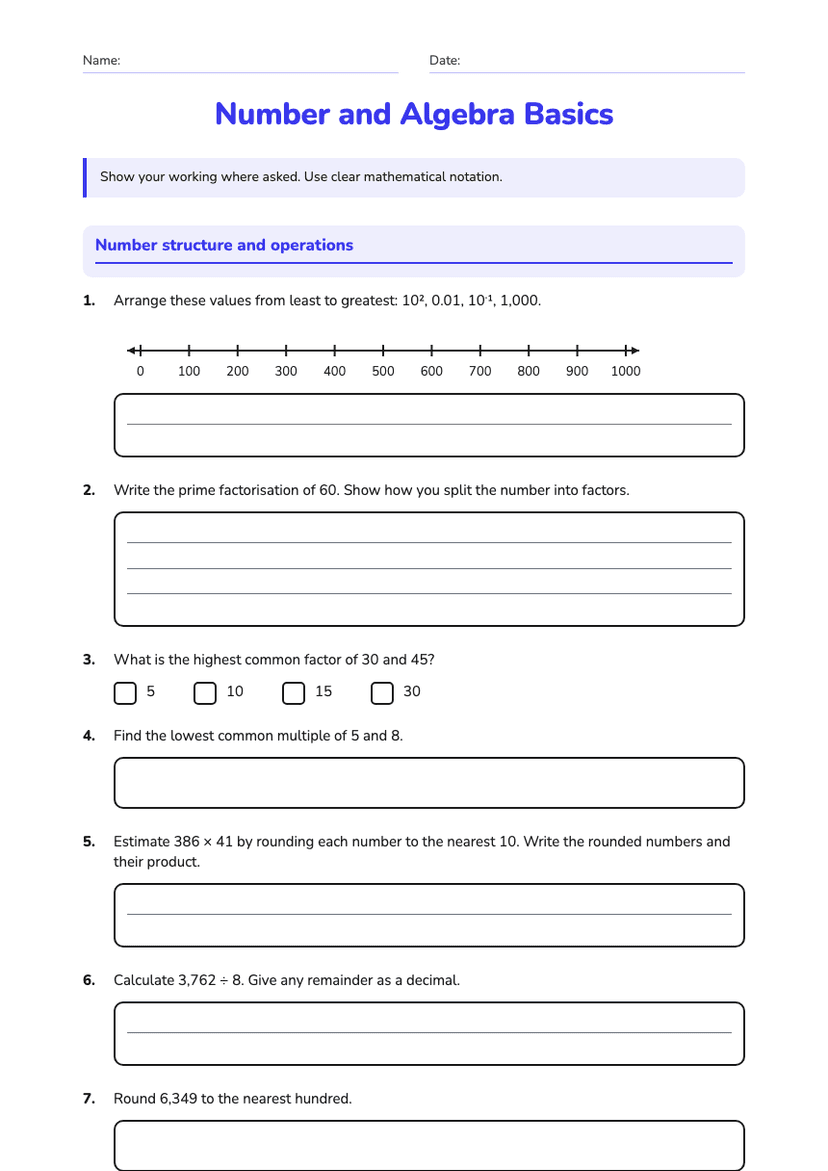
Number and Algebra Basics
Free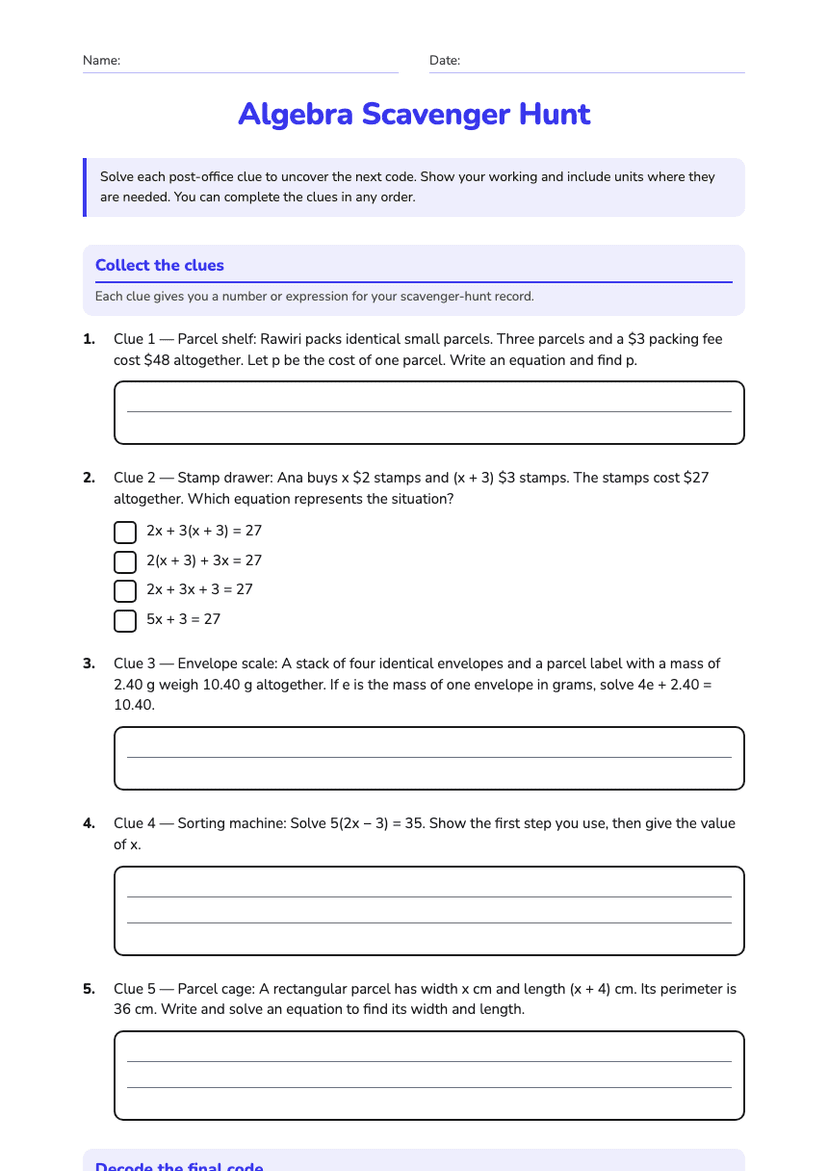
Algebra Scavenger Hunt
Free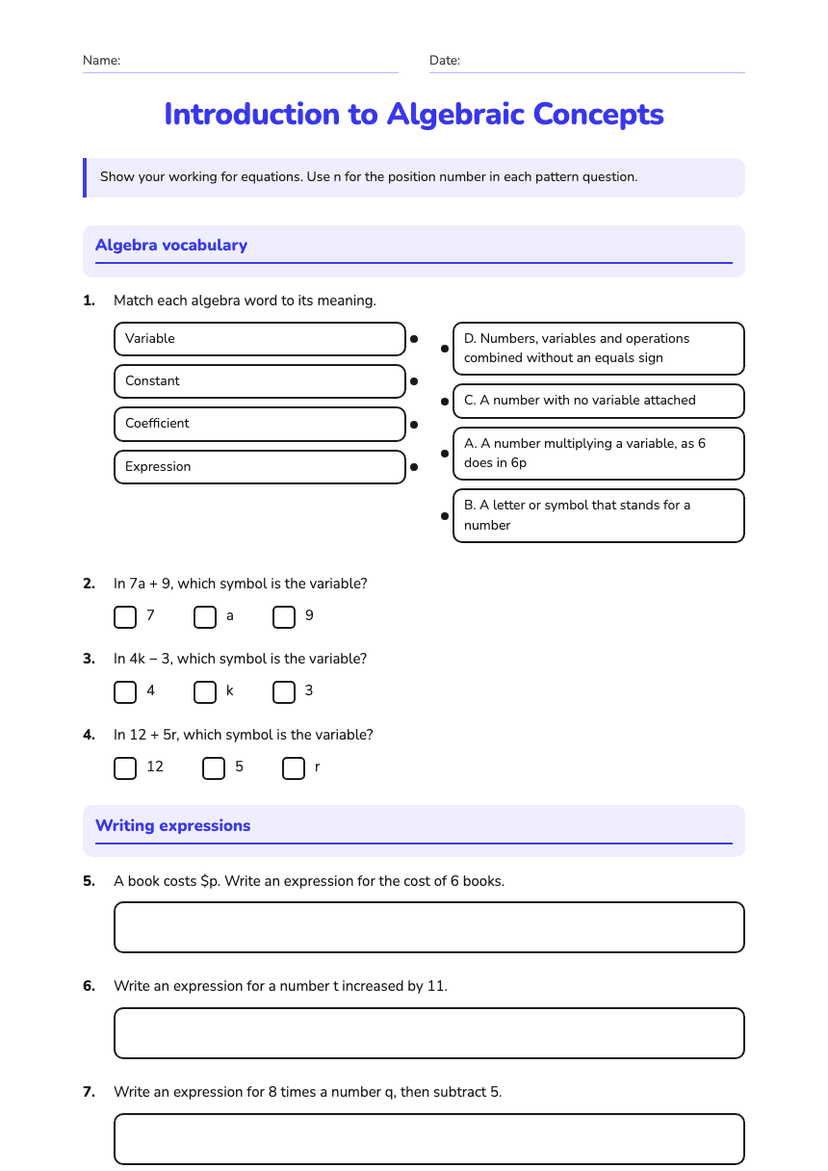
Introduction to Algebraic Concepts
Free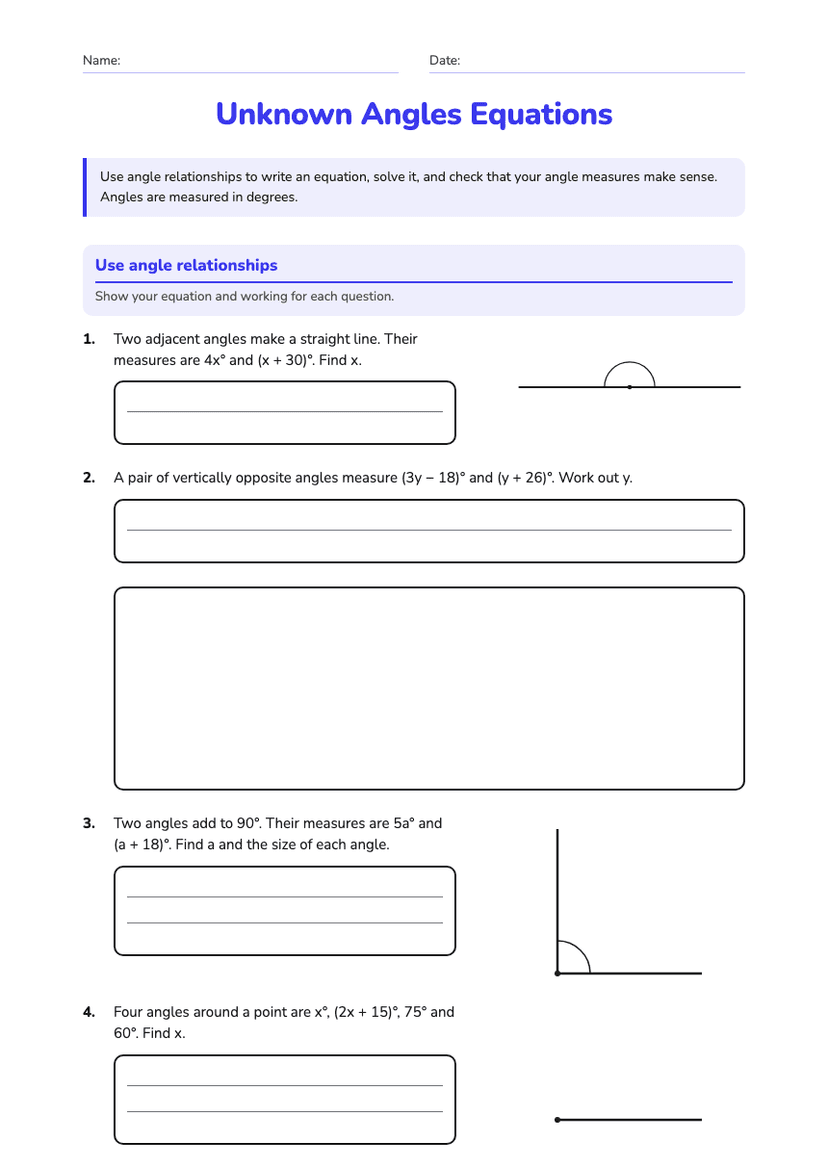
Unknown Angles Equations
Free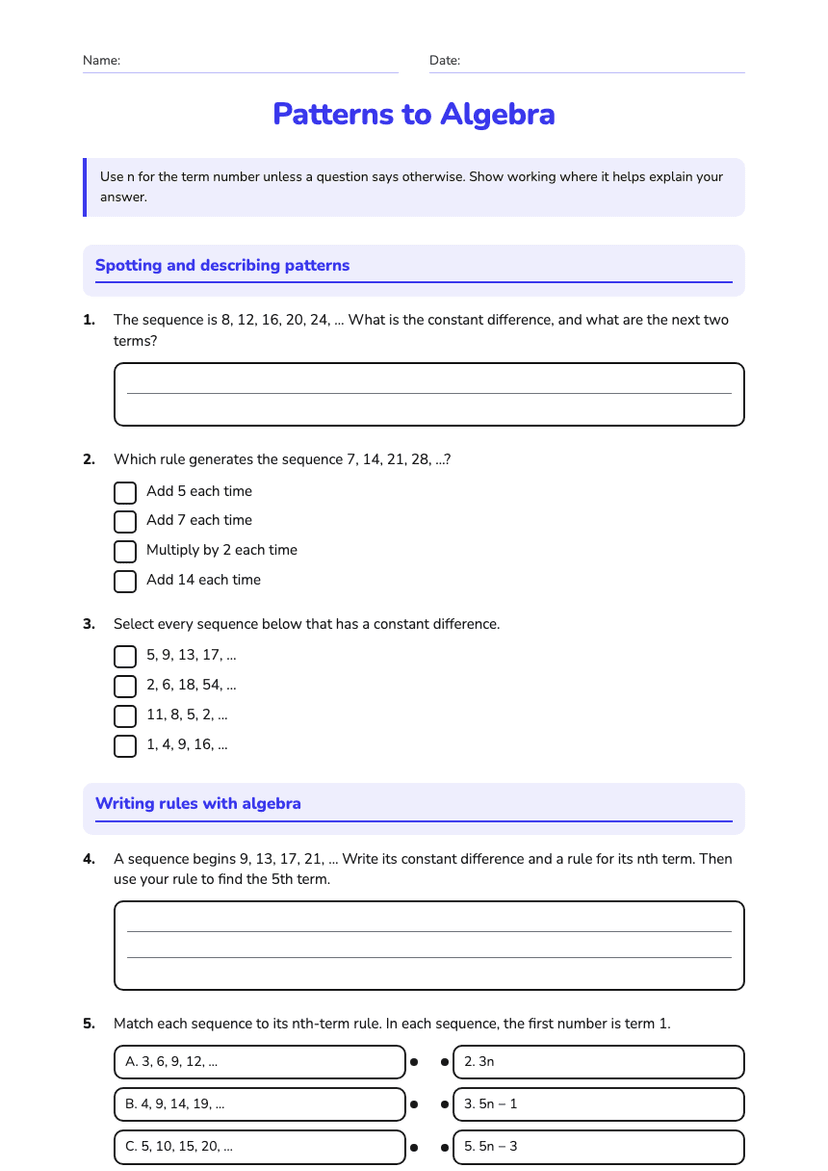
Patterns to Algebra
Free