ArtFreePrintable

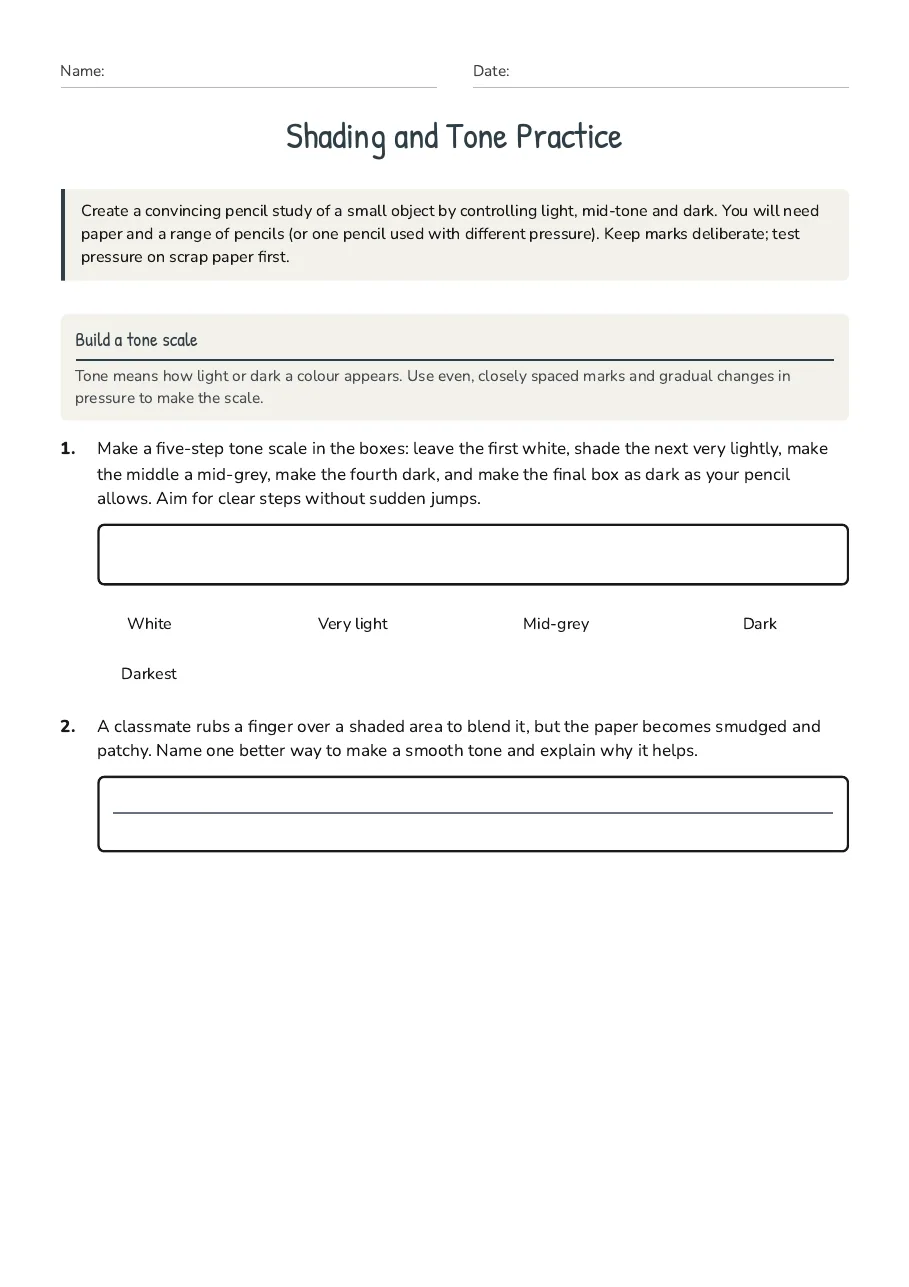
Shading and Tone Practice

A free art worksheet ready for your classroom. Open in Kuraplan to grab the print-ready PDF, customize it for your students, or generate a fresh version in seconds.
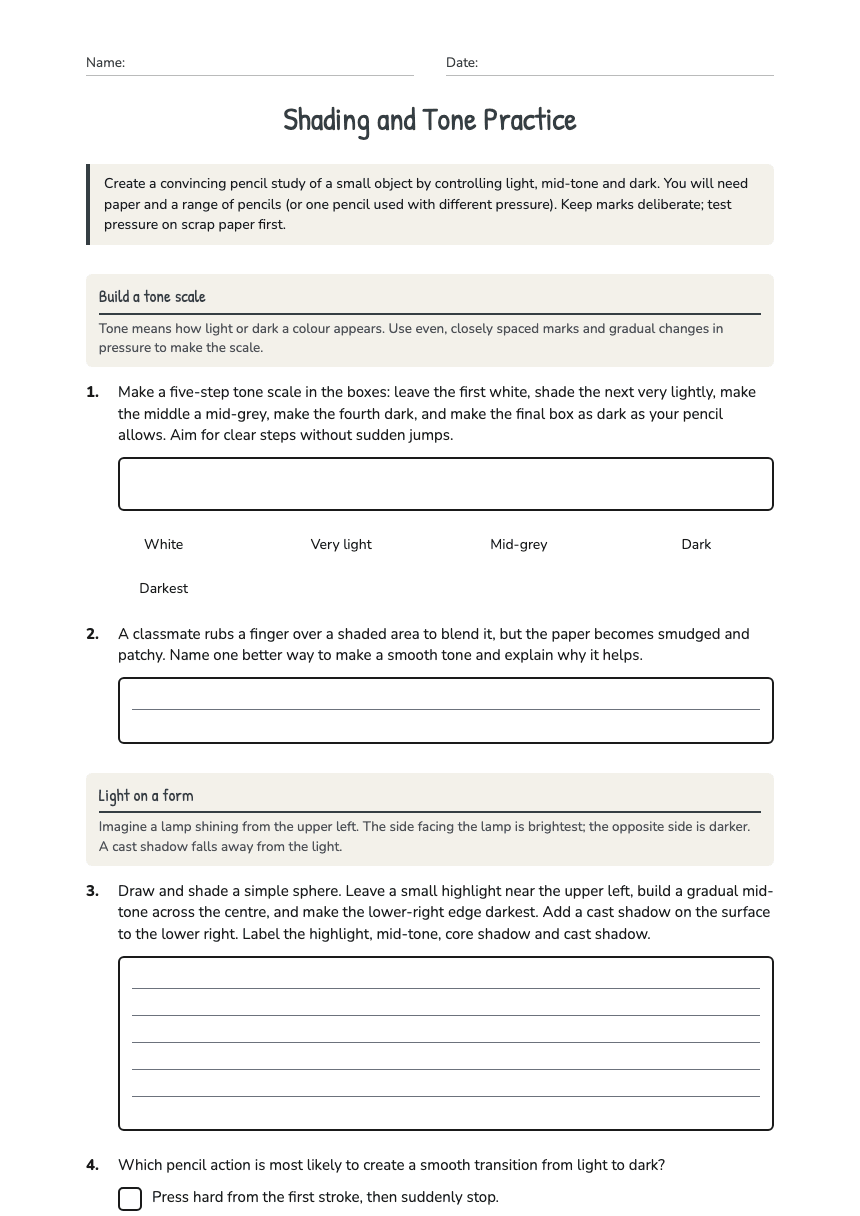
Shading and Tone Practice worksheet preview
Name:Date:

Shading and Tone Practice

Create a convincing pencil study of a small object by controlling light, mid-tone and dark. You will need paper and a range of pencils (or one pencil used with different pressure). Keep marks deliberate; test pressure on scrap paper first.

Build a tone scale

Tone means how light or dark a colour appears. Use even, closely spaced marks and gradual changes in pressure to make the scale.

1.Make a five-step tone scale in the boxes: leave the first white, shade the next very lightly, make the middle a mid-grey, make the fourth dark, and make the final box as dark as your pencil allows. Aim for clear steps without sudden jumps.

White

Very light

Mid-grey

Dark

Darkest

2.A classmate rubs a finger over a shaded area to blend it, but the paper becomes smudged and patchy. Name one better way to make a smooth tone and explain why it helps.

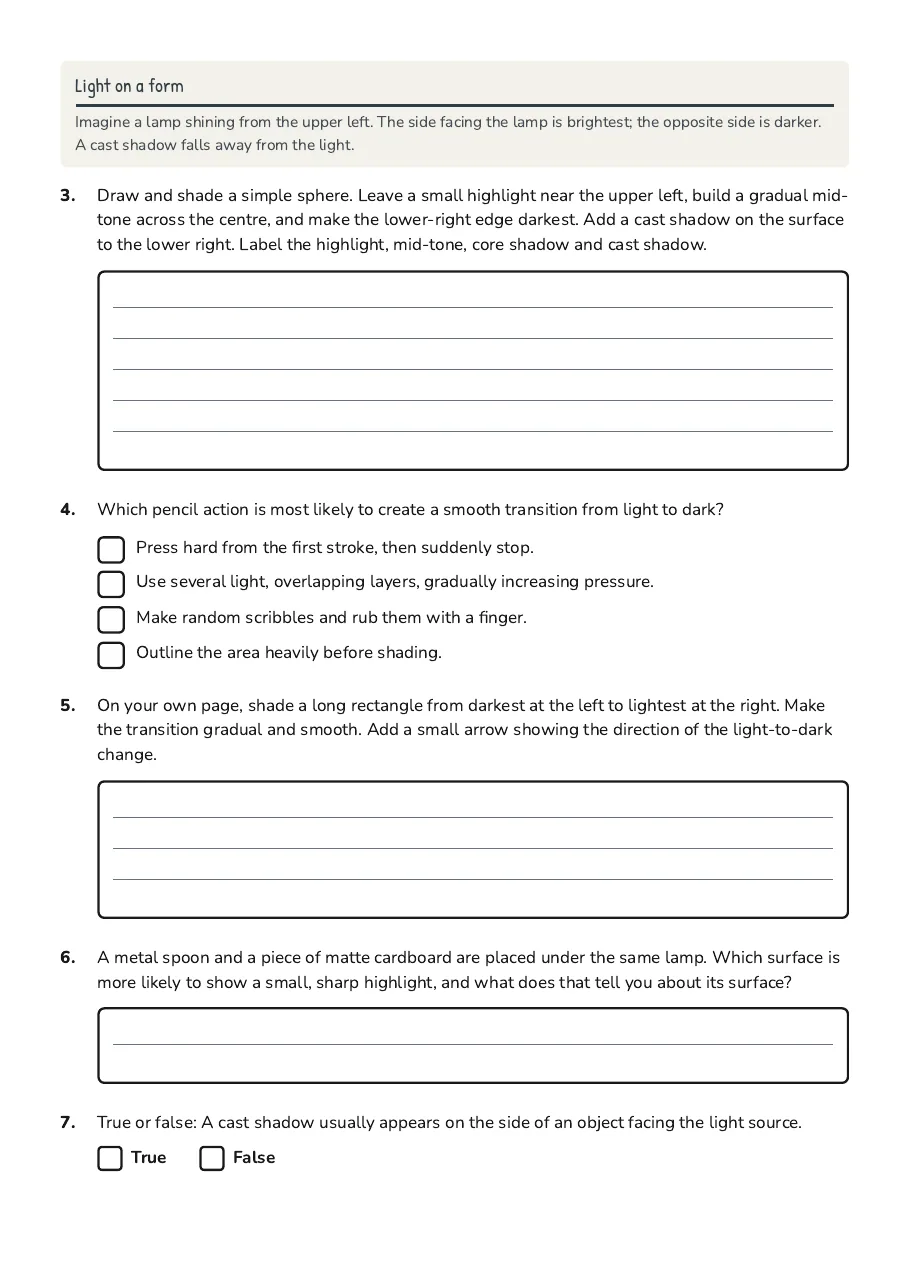
Light on a form

Imagine a lamp shining from the upper left. The side facing the lamp is brightest; the opposite side is darker. A cast shadow falls away from the light.

3.Draw and shade a simple sphere. Leave a small highlight near the upper left, build a gradual mid-tone across the centre, and make the lower-right edge darkest. Add a cast shadow on the surface to the lower right. Label the highlight, mid-tone, core shadow and cast shadow.
4.Which pencil action is most likely to create a smooth transition from light to dark?
  • Press hard from the first stroke, then suddenly stop.
  • Use several light, overlapping layers, gradually increasing pressure.
  • Make random scribbles and rub them with a finger.
  • Outline the area heavily before shading.
5.On your own page, shade a long rectangle from darkest at the left to lightest at the right. Make the transition gradual and smooth. Add a small arrow showing the direction of the light-to-dark change.
6.A metal spoon and a piece of matte cardboard are placed under the same lamp. Which surface is more likely to show a small, sharp highlight, and what does that tell you about its surface?
7.True or false: A cast shadow usually appears on the side of an object facing the light source.
TrueFalse
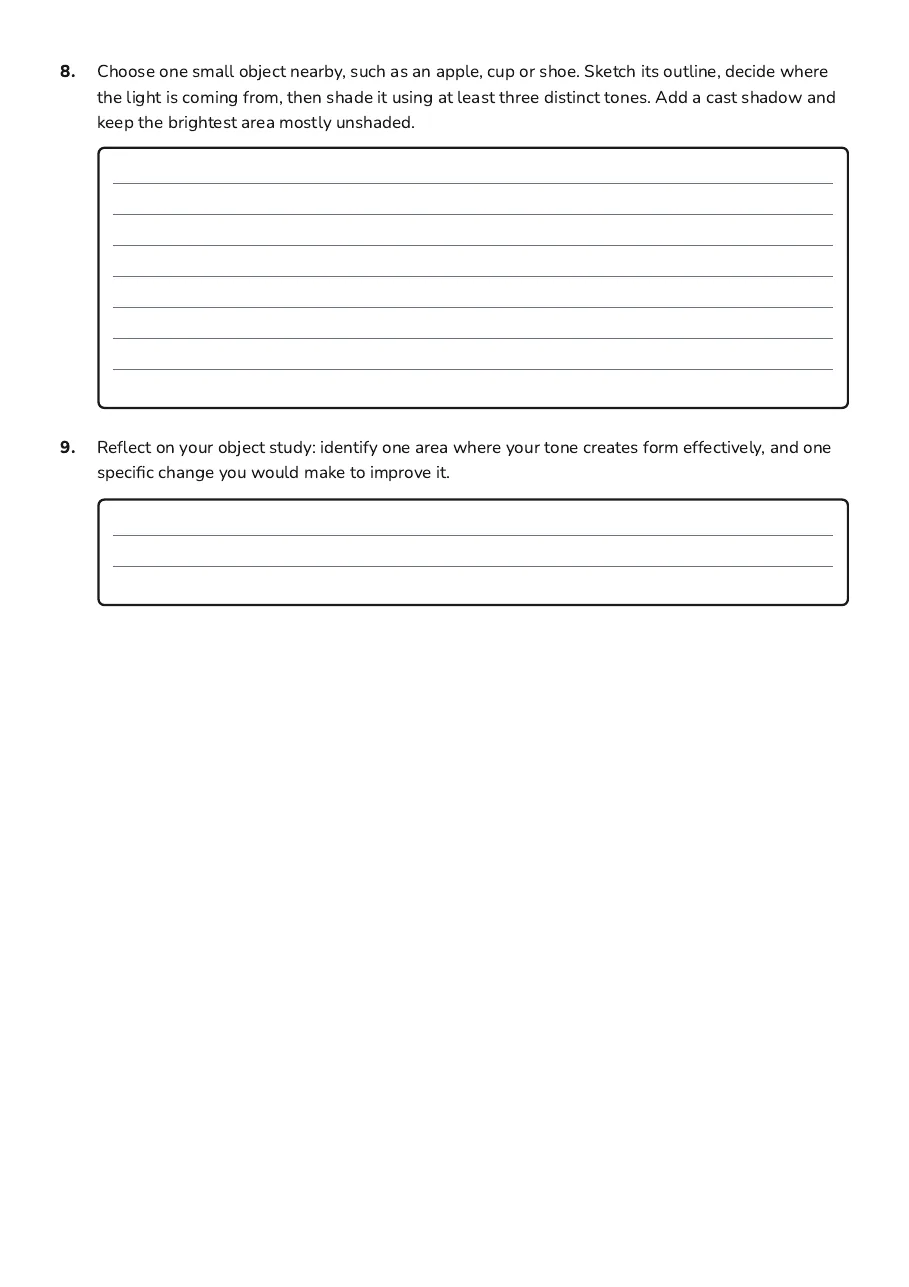
8.Choose one small object nearby, such as an apple, cup or shoe. Sketch its outline, decide where the light is coming from, then shade it using at least three distinct tones. Add a cast shadow and keep the brightest area mostly unshaded.
9.Reflect on your object study: identify one area where your tone creates form effectively, and one specific change you would make to improve it.

3 printable pages

  • Shading and Tone Practice, page 1 of 3: Build a tone scale

    Page 1

  • Shading and Tone Practice, page 2 of 3: Light on a form

    Page 2

  • Shading and Tone Practice, page 3 of 3: 8. Choose one small object nearby, such as an apple, cup or shoe. Sketch its outline,…

    Page 3

About This Worksheet

Free in Kuraplan

Sign up free, grab the PDF, and customize it for your class.

Print-Ready

Formatted for standard paper. Clean layout, easy to read.

AI-Generated

Created with Kuraplan's AI, designed for real classroom use.

For Teachers & Parents

Use in classrooms, for homework, tutoring, or homeschool.

Need a custom version of this worksheet?

Kuraplan's AI generates custom worksheets in seconds — differentiated for every learner, aligned to your curriculum.

Generate Custom Worksheets — Free
No credit card Curriculum-aligned Under 60 seconds