ScienceFreePrintable

Space Forces Simulation Experiment

A free science worksheet ready for your classroom. Open in Kuraplan to grab the print-ready PDF, customize it for your students, or generate a fresh version in seconds.
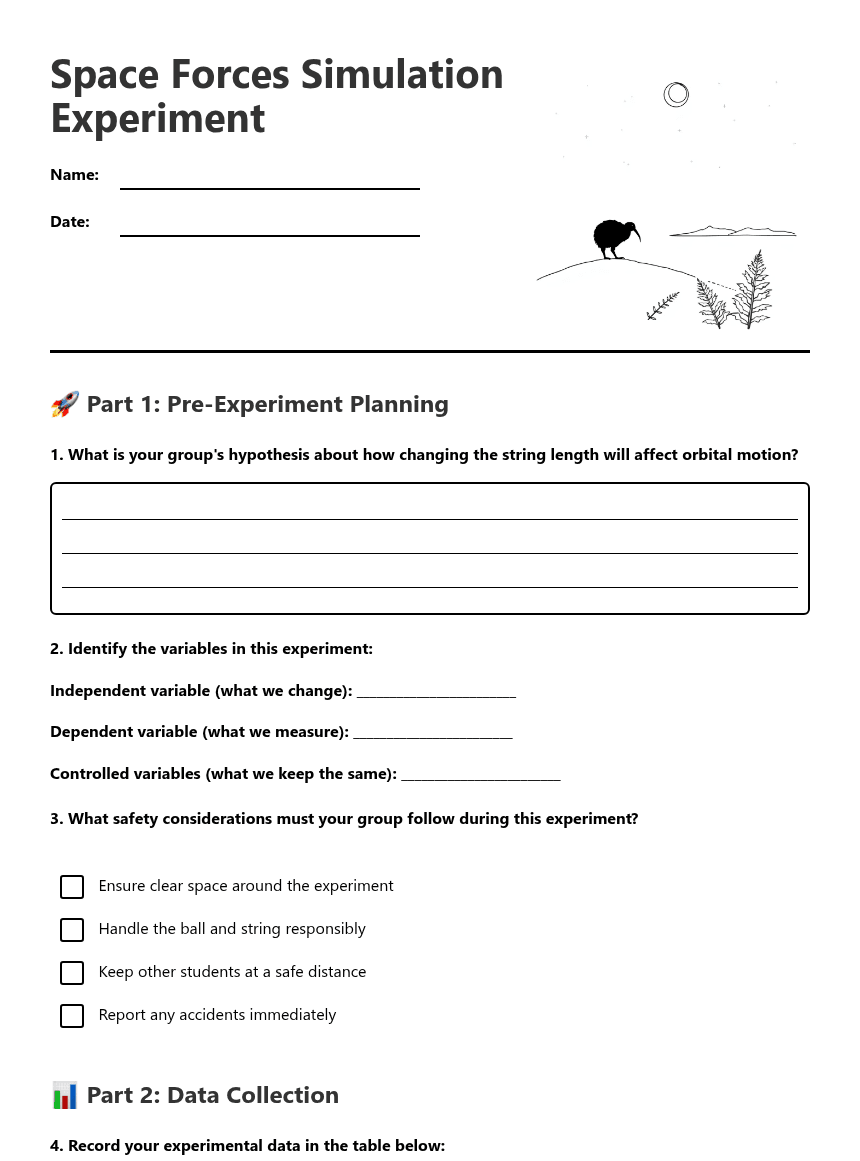
Space Forces Simulation Experiment worksheet preview
Space Forces Simulation Experiment

Space Forces Simulation Experiment

Space satellite orbiting Earth

🚀 Part 1: Pre-Experiment Planning

1. What is your group's hypothesis about how changing the string length will affect orbital motion?
2. Identify the variables in this experiment:

Independent variable (what we change): ________________________

Dependent variable (what we measure): ________________________

Controlled variables (what we keep the same): ________________________

3. What safety considerations must your group follow during this experiment?

Ensure clear space around the experiment

Handle the ball and string responsibly

Keep other students at a safe distance

Report any accidents immediately

📊 Part 2: Data Collection

4. Record your experimental data in the table below:

Trial 1 - String Length: _____ cm

Time for 5 complete orbits: _____ seconds

Average time per orbit: _____ seconds

Observations: _________________________________


Trial 2 - String Length: _____ cm

Time for 5 complete orbits: _____ seconds

Average time per orbit: _____ seconds

Observations: _________________________________


Trial 3 - String Length: _____ cm

Time for 5 complete orbits: _____ seconds

Average time per orbit: _____ seconds

Observations: _________________________________

5. What patterns do you notice in your data?

🔬 Part 3: Analysis and Conclusions

6. Based on your results, what is the relationship between string length and orbital speed?

Longer string = faster orbital speed

Longer string = slower orbital speed

String length has no effect on orbital speed

The relationship is unclear from our data

7. How does this experiment relate to real satellites orbiting Earth?
8. What forces are acting on the ball during the experiment?

Centripetal force (string tension pulling inward)

Gravitational force (weight of ball)

Centrifugal force (ball's tendency to move outward)

Air resistance

🌟 Part 4: Real-World Connections

9. Match the space exploration concepts with their descriptions:
1. Geostationary orbit
2. Low Earth orbit
3. Escape velocity
4. Orbital decay
A. Satellite gradually loses altitude
B. Speed needed to leave Earth's gravity
C. Orbit that stays above same Earth location
D. Close orbit around Earth (160-2000 km)
10. How did Māori navigators use celestial bodies for exploration? Research and explain one example:

🎯 Part 5: Evaluation and Reflection

11. Was your original hypothesis supported by the experimental evidence?

Yes, completely supported

Partially supported

No, not supported

Inconclusive due to experimental limitations

12. What improvements could be made to this experiment to get more accurate results?
13. Draw a diagram showing the forces acting on a satellite in orbit around Earth:
14. Explain how this experiment helps us understand the challenges of space exploration:
15. Rate your group's collaboration during this experiment:

Excellent - everyone contributed equally

Good - most members participated well

Fair - some members did most of the work

Poor - collaboration was difficult

About This Worksheet

Free in Kuraplan

Sign up free, grab the PDF, and customize it for your class.

Print-Ready

Formatted for standard paper. Clean layout, easy to read.

AI-Generated

Created with Kuraplan's AI, designed for real classroom use.

For Teachers & Parents

Use in classrooms, for homework, tutoring, or homeschool.

Need a custom version of this worksheet?

Kuraplan's AI generates custom worksheets in seconds — differentiated for every learner, aligned to your curriculum.

Generate Custom Worksheets — Free
No credit card Curriculum-aligned Under 60 seconds