Space Junk Impact
A free science worksheet ready for your classroom. Open in Kuraplan to grab the print-ready PDF, customize it for your students, or generate a fresh version in seconds.
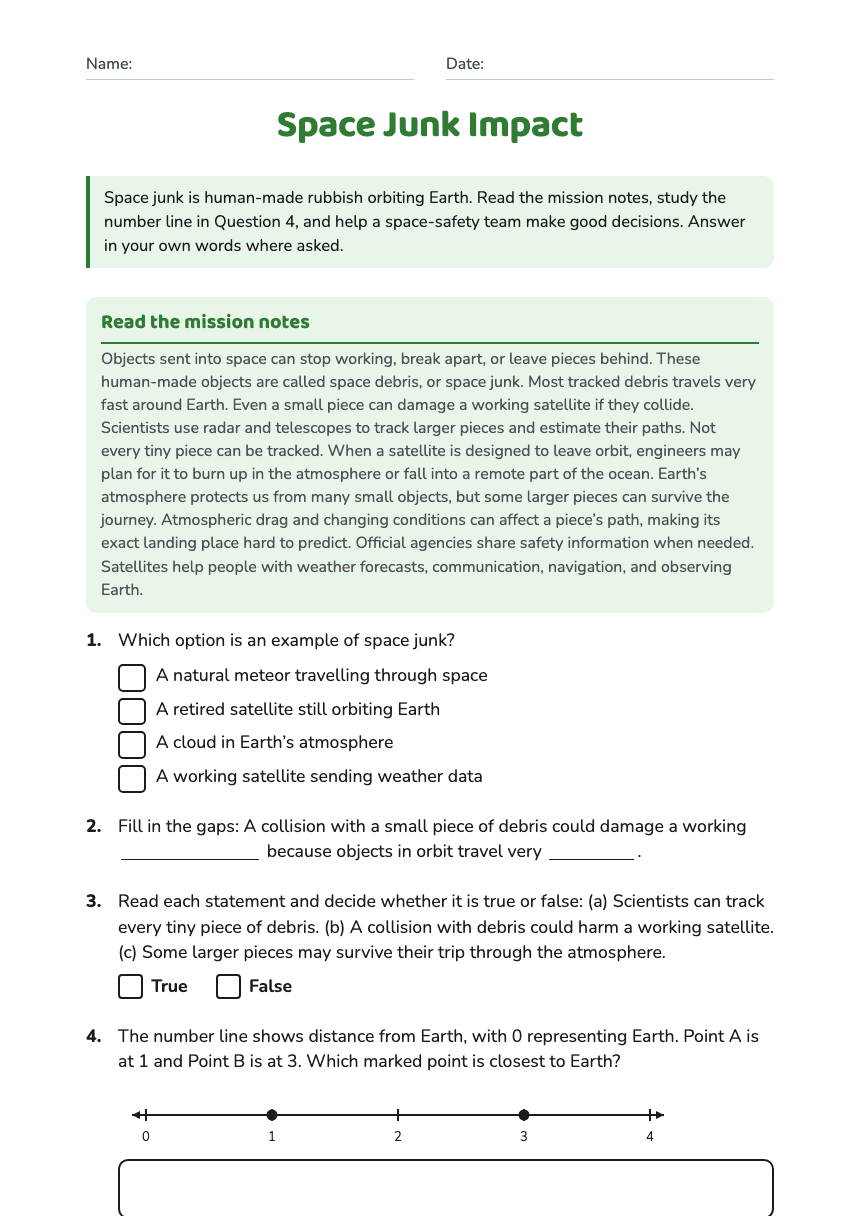
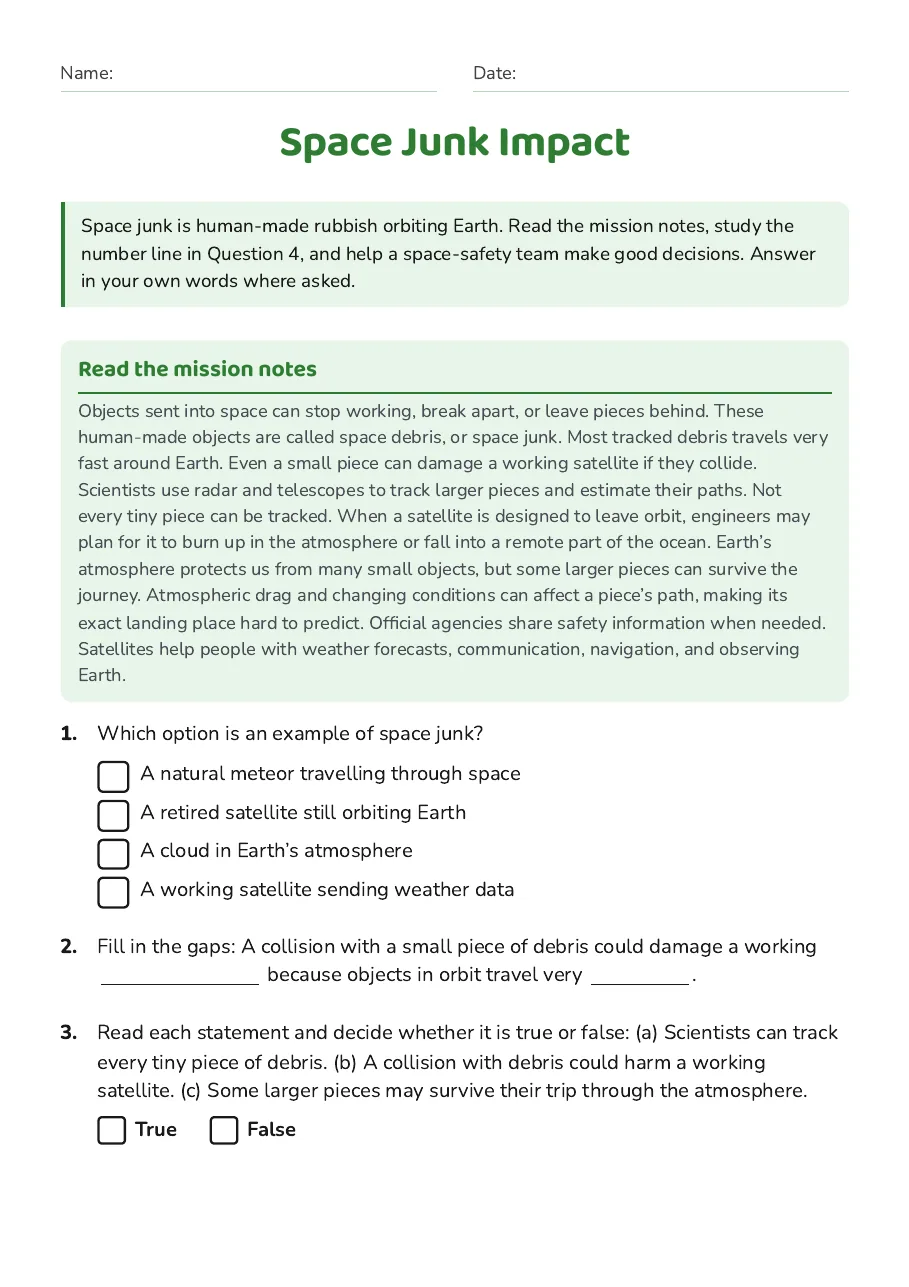
Space Junk Impact
Read the mission notes
Objects sent into space can stop working, break apart, or leave pieces behind. These human-made objects are called space debris, or space junk. Most tracked debris travels very fast around Earth. Even a small piece can damage a working satellite if they collide. Scientists use radar and telescopes to track larger pieces and estimate their paths. Not every tiny piece can be tracked. When a satellite is designed to leave orbit, engineers may plan for it to burn up in the atmosphere or fall into a remote part of the ocean. Earth’s atmosphere protects us from many small objects, but some larger pieces can survive the journey. Atmospheric drag and changing conditions can affect a piece’s path, making its exact landing place hard to predict. Official agencies share safety information when needed. Satellites help people with weather forecasts, communication, navigation, and observing Earth.
- A natural meteor travelling through space
- A retired satellite still orbiting Earth
- A cloud in Earth’s atmosphere
- A working satellite sending weather data
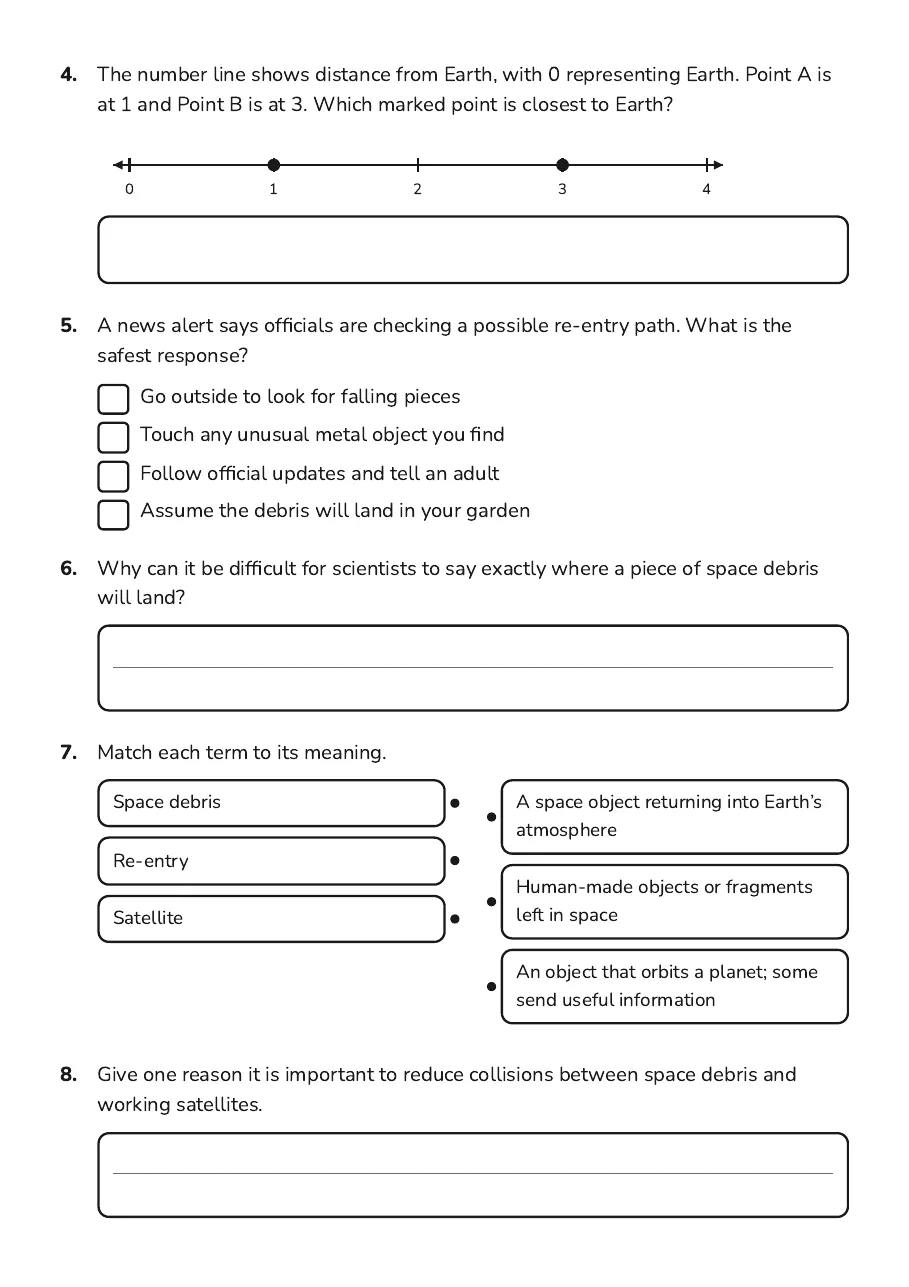
- Go outside to look for falling pieces
- Touch any unusual metal object you find
- Follow official updates and tell an adult
- Assume the debris will land in your garden
- Space debris
- Re-entry
- Satellite
- A space object returning into Earth’s atmosphere
- Human-made objects or fragments left in space
- An object that orbits a planet; some send useful information
3 printable pages
Page 1
Page 2
Page 3
About This Worksheet
Free in Kuraplan
Sign up free, grab the PDF, and customize it for your class.
Print-Ready
Formatted for standard paper. Clean layout, easy to read.
AI-Generated
Created with Kuraplan's AI, designed for real classroom use.
For Teachers & Parents
Use in classrooms, for homework, tutoring, or homeschool.
Need a custom version of this worksheet?
Kuraplan's AI generates custom worksheets in seconds — differentiated for every learner, aligned to your curriculum.
Generate Custom Worksheets — Free