Te Marae Introduction Worksheet
A free te reo māori worksheet ready for your classroom. Open in Kuraplan to grab the print-ready PDF, customize it for your students, or generate a fresh version in seconds.
Te Marae Introduction Worksheet
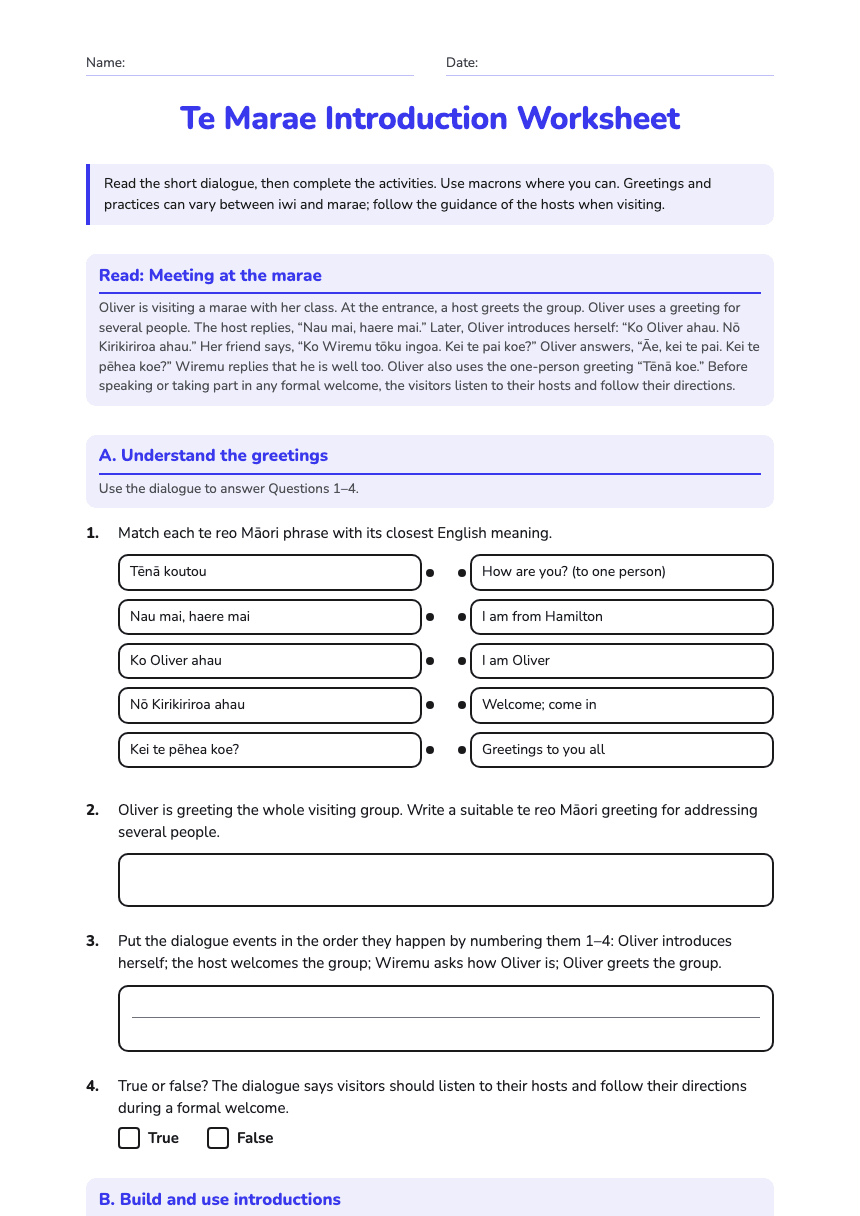
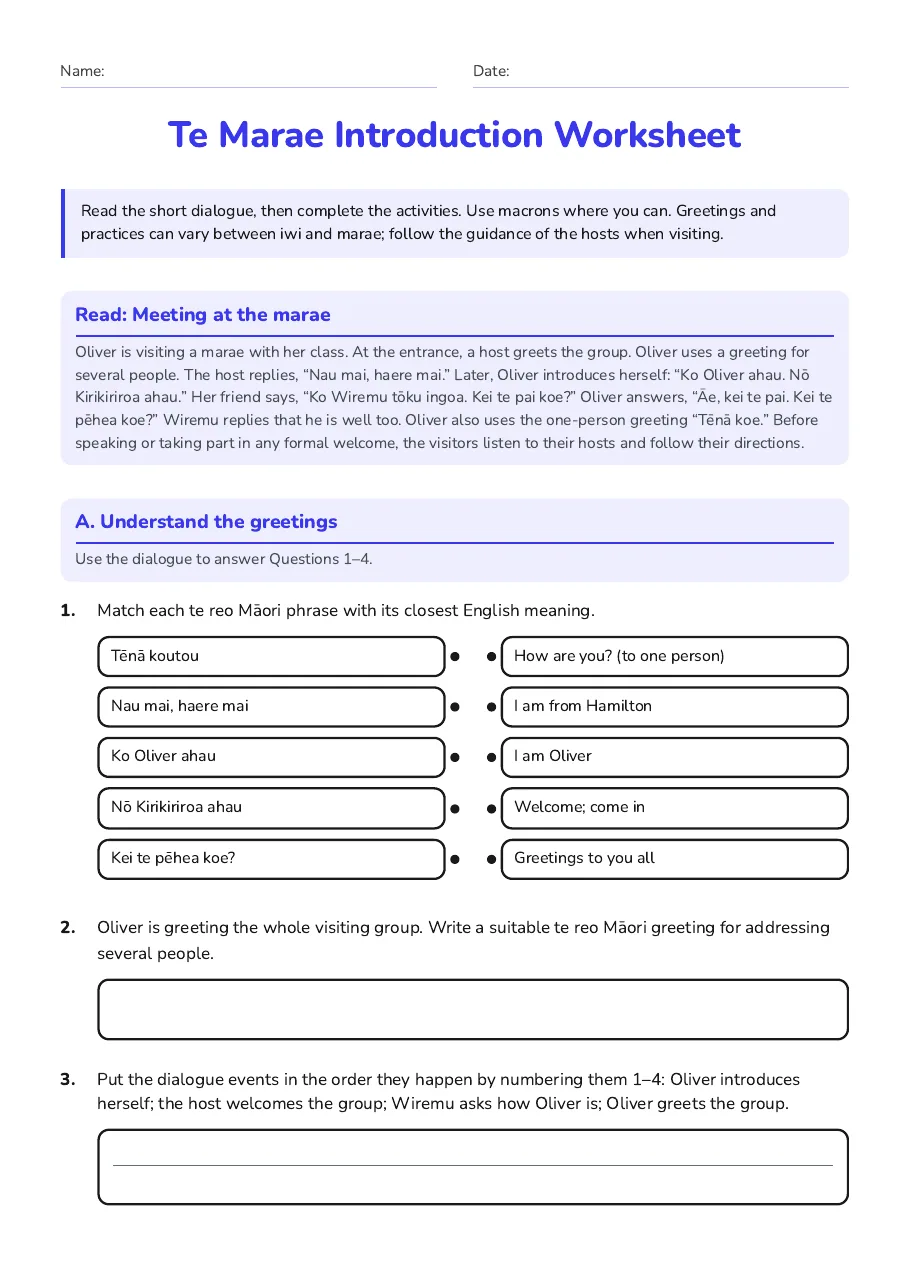
Read: Meeting at the marae
Oliver is visiting a marae with her class. At the entrance, a host greets the group. Oliver uses a greeting for several people. The host replies, “Nau mai, haere mai.” Later, Oliver introduces herself: “Ko Oliver ahau. Nō Kirikiriroa ahau.” Her friend says, “Ko Wiremu tōku ingoa. Kei te pai koe?” Oliver answers, “Āe, kei te pai. Kei te pēhea koe?” Wiremu replies that he is well too. Oliver also uses the one-person greeting “Tēnā koe.” Before speaking or taking part in any formal welcome, the visitors listen to their hosts and follow their directions.
A. Understand the greetings
Use the dialogue to answer Questions 1–4.
- Tēnā koutou
- Nau mai, haere mai
- Ko Oliver ahau
- Nō Kirikiriroa ahau
- Kei te pēhea koe?
- How are you? (to one person)
- I am from Hamilton
- I am Oliver
- Welcome; come in
- Greetings to you all
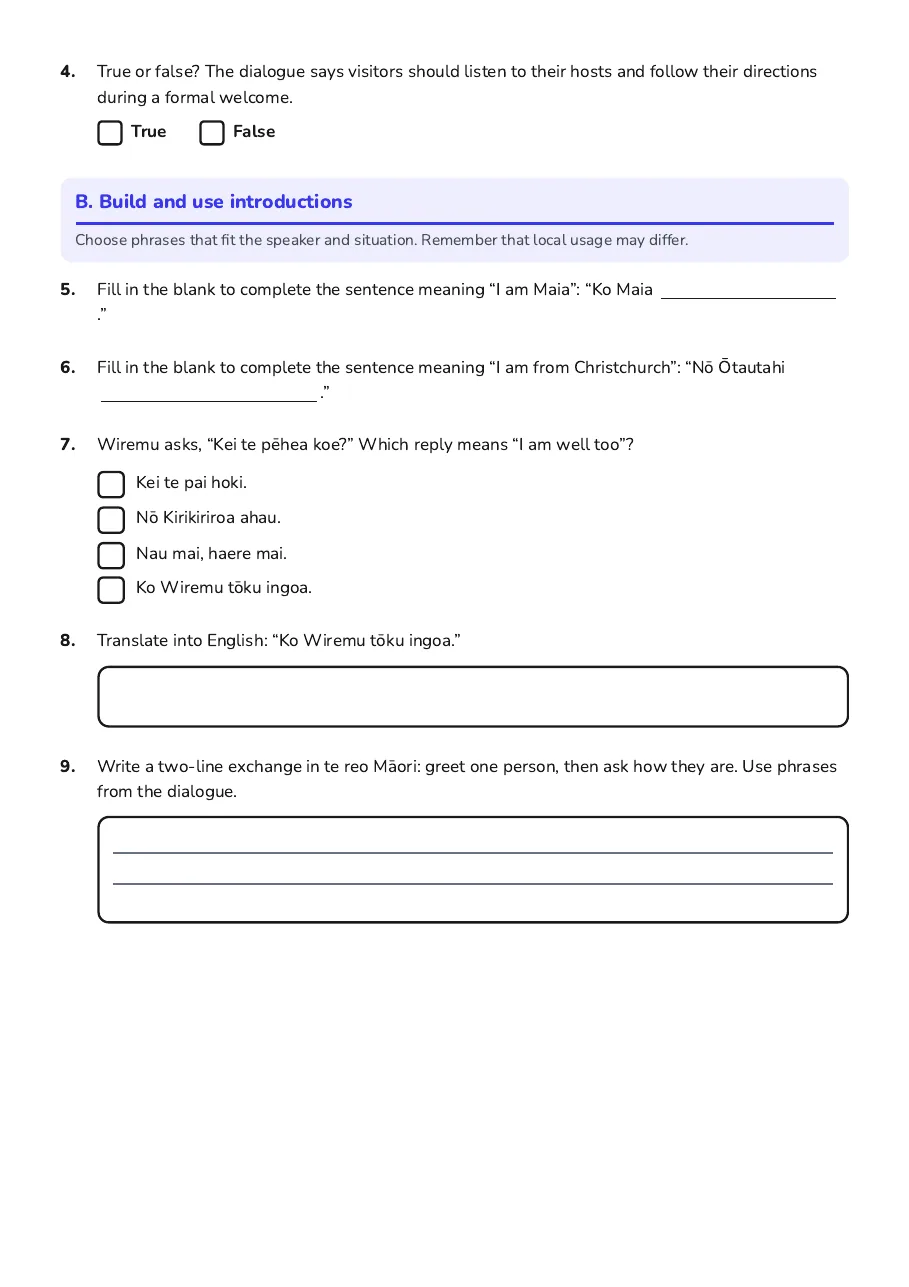
B. Build and use introductions
Choose phrases that fit the speaker and situation. Remember that local usage may differ.
- Kei te pai hoki.
- Nō Kirikiriroa ahau.
- Nau mai, haere mai.
- Ko Wiremu tōku ingoa.
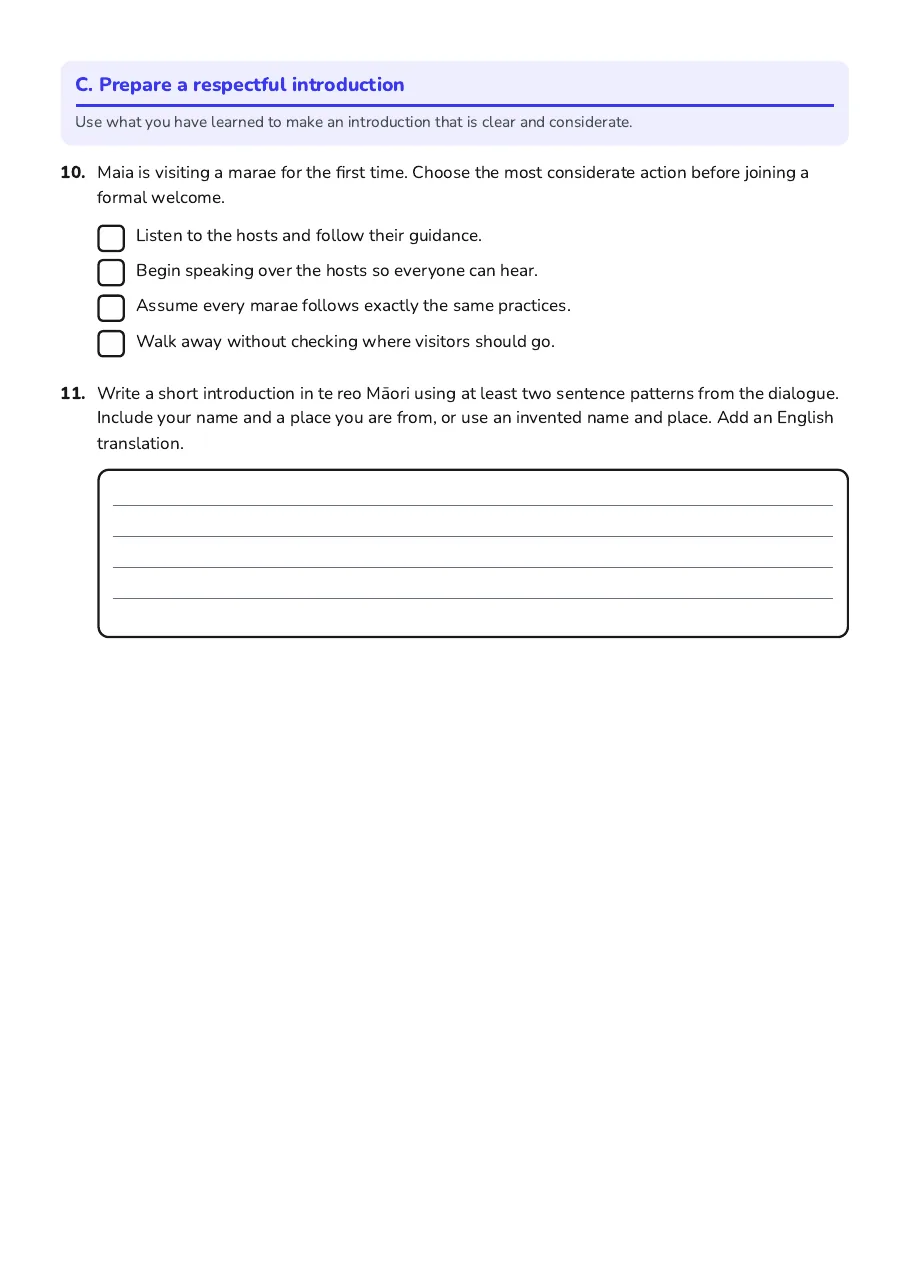
C. Prepare a respectful introduction
Use what you have learned to make an introduction that is clear and considerate.
- Listen to the hosts and follow their guidance.
- Begin speaking over the hosts so everyone can hear.
- Assume every marae follows exactly the same practices.
- Walk away without checking where visitors should go.
3 printable pages
Page 1
Page 2
Page 3
About This Worksheet
Free in Kuraplan
Sign up free, grab the PDF, and customize it for your class.
Print-Ready
Formatted for standard paper. Clean layout, easy to read.
AI-Generated
Created with Kuraplan's AI, designed for real classroom use.
For Teachers & Parents
Use in classrooms, for homework, tutoring, or homeschool.
Need a custom version of this worksheet?
Kuraplan's AI generates custom worksheets in seconds — differentiated for every learner, aligned to your curriculum.
Generate Custom Worksheets — FreeMore Te Reo Māori Worksheets
Mihi Whakatau Leadership Practice
Free
Te Reo Māori Introductions
Free
Te Reo Māori Introductions
Free
Matariki Introduction Worksheet
Free
Māori Time Concepts Introduction
Free
Māori Greetings Introduction
Free
Te Ao Māori Greetings
Free