Exploring the Haka
A free te reo māori worksheet ready for your classroom. Open in Kuraplan to grab the print-ready PDF, customize it for your students, or generate a fresh version in seconds.
Exploring the Haka
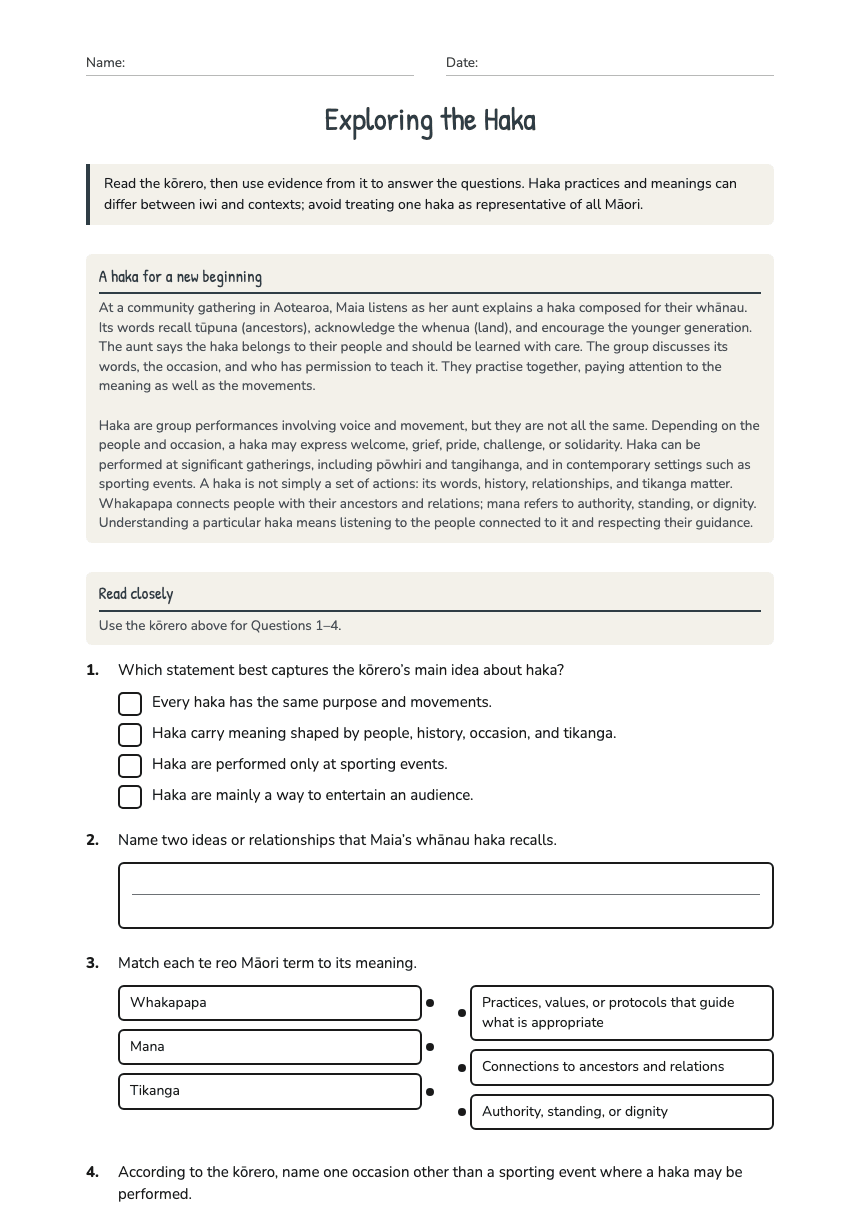
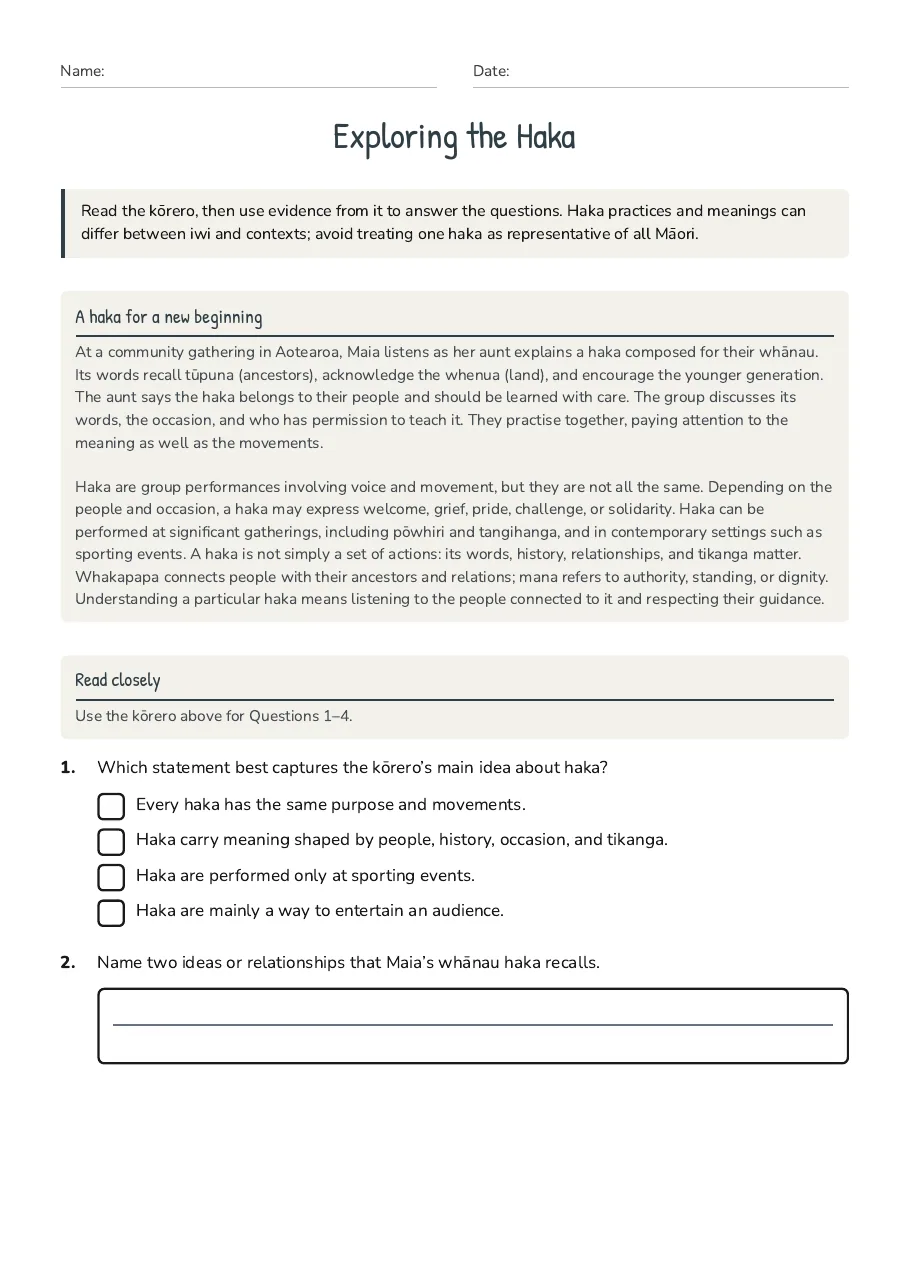
A haka for a new beginning
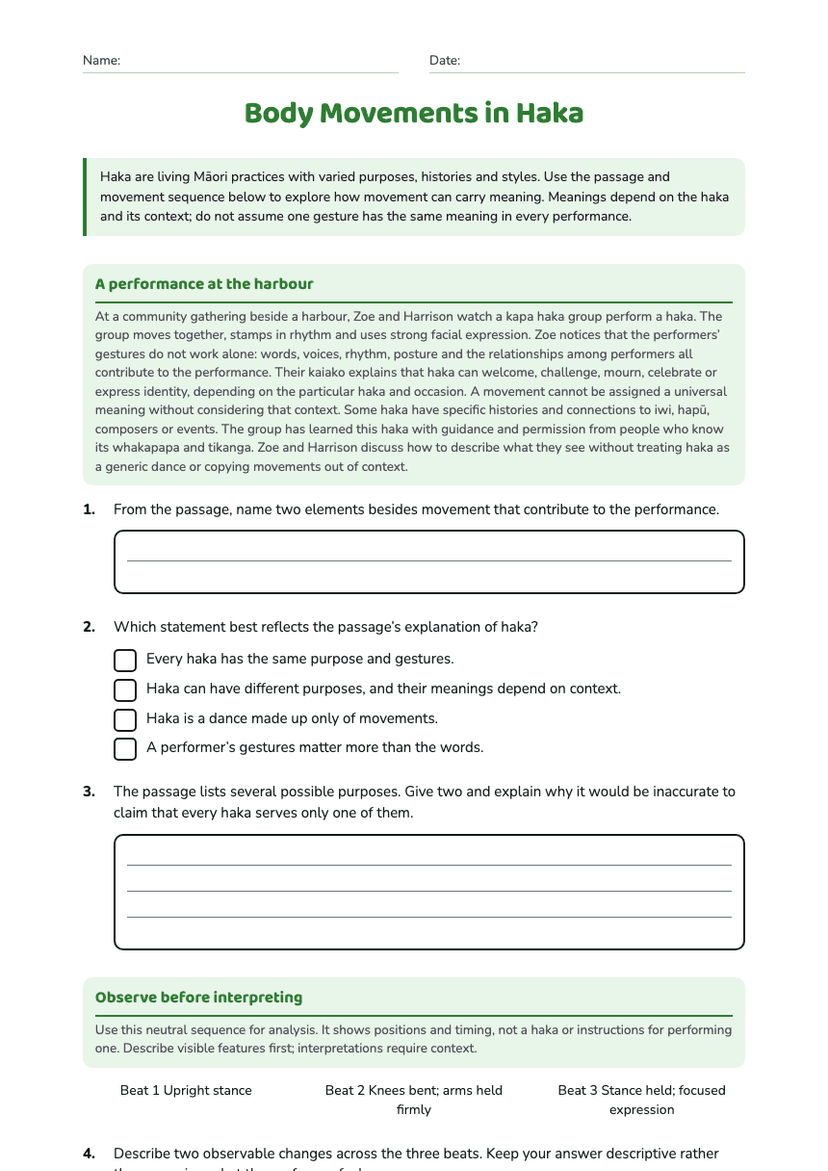
At a community gathering in Aotearoa, Maia listens as her aunt explains a haka composed for their whānau. Its words recall tūpuna (ancestors), acknowledge the whenua (land), and encourage the younger generation. The aunt says the haka belongs to their people and should be learned with care. The group discusses its words, the occasion, and who has permission to teach it. They practise together, paying attention to the meaning as well as the movements. Haka are group performances involving voice and movement, but they are not all the same. Depending on the people and occasion, a haka may express welcome, grief, pride, challenge, or solidarity. Haka can be performed at significant gatherings, including pōwhiri and tangihanga, and in contemporary settings such as sporting events. A haka is not simply a set of actions: its words, history, relationships, and tikanga matter. Whakapapa connects people with their ancestors and relations; mana refers to authority, standing, or dignity. Understanding a particular haka means listening to the people connected to it and respecting their guidance.
Read closely
Use the kōrero above for Questions 1–4.
- Every haka has the same purpose and movements.
- Haka carry meaning shaped by people, history, occasion, and tikanga.
- Haka are performed only at sporting events.
- Haka are mainly a way to entertain an audience.
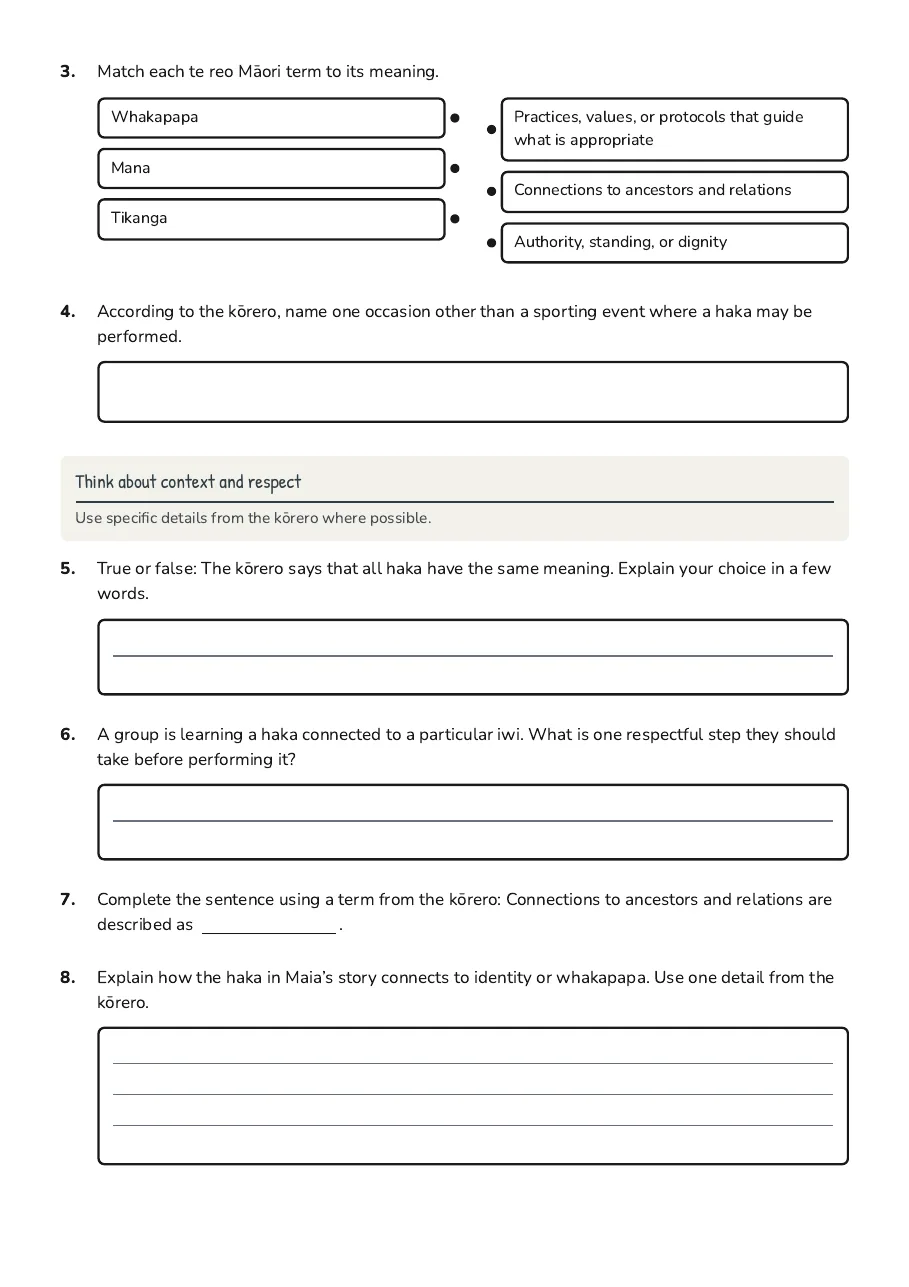
- Whakapapa
- Mana
- Tikanga
- Practices, values, or protocols that guide what is appropriate
- Connections to ancestors and relations
- Authority, standing, or dignity
Think about context and respect
Use specific details from the kōrero where possible.
3 printable pages
Page 1
Page 2
Page 3
About This Worksheet
Free in Kuraplan
Sign up free, grab the PDF, and customize it for your class.
Print-Ready
Formatted for standard paper. Clean layout, easy to read.
AI-Generated
Created with Kuraplan's AI, designed for real classroom use.
For Teachers & Parents
Use in classrooms, for homework, tutoring, or homeschool.
Need a custom version of this worksheet?
Kuraplan's AI generates custom worksheets in seconds — differentiated for every learner, aligned to your curriculum.
Generate Custom Worksheets — Free