Tracking Space Junk
A free science worksheet ready for your classroom. Open in Kuraplan to grab the print-ready PDF, customize it for your students, or generate a fresh version in seconds.
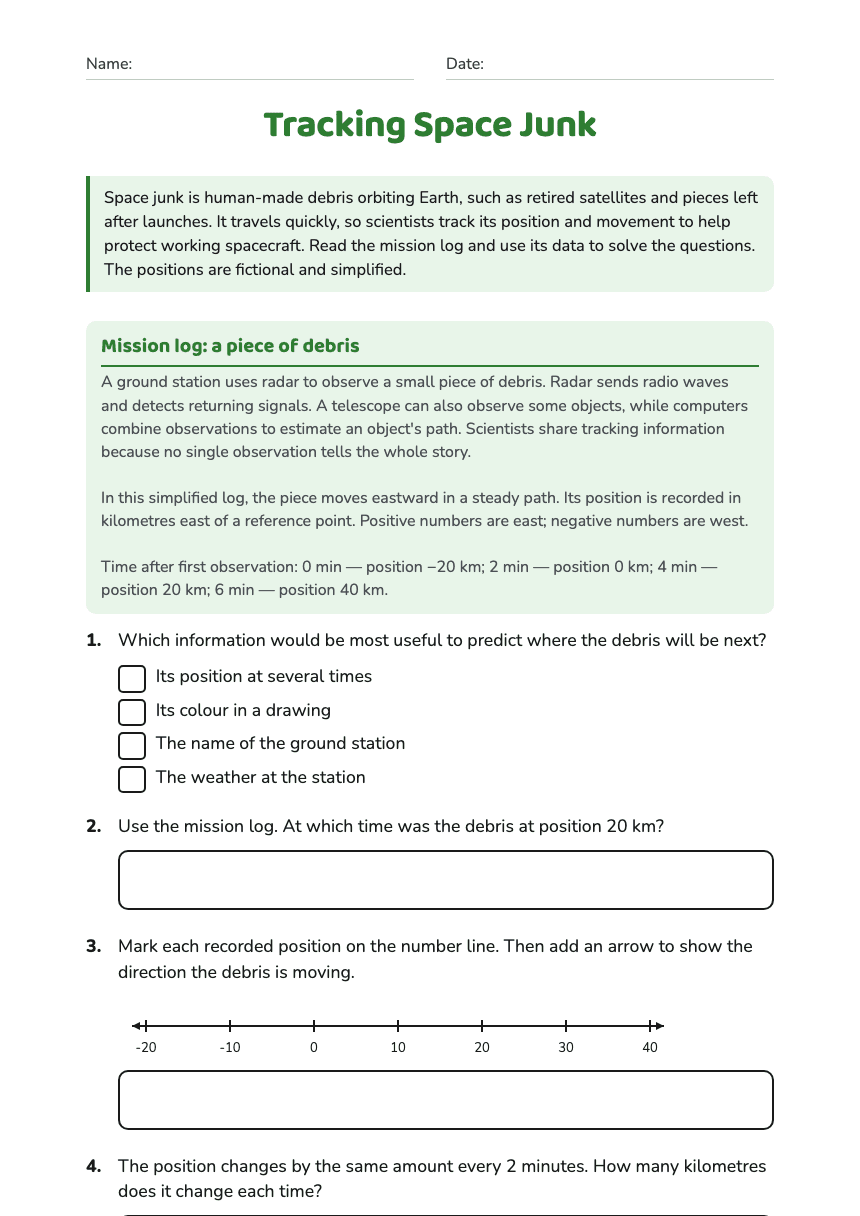
Tracking Space Junk
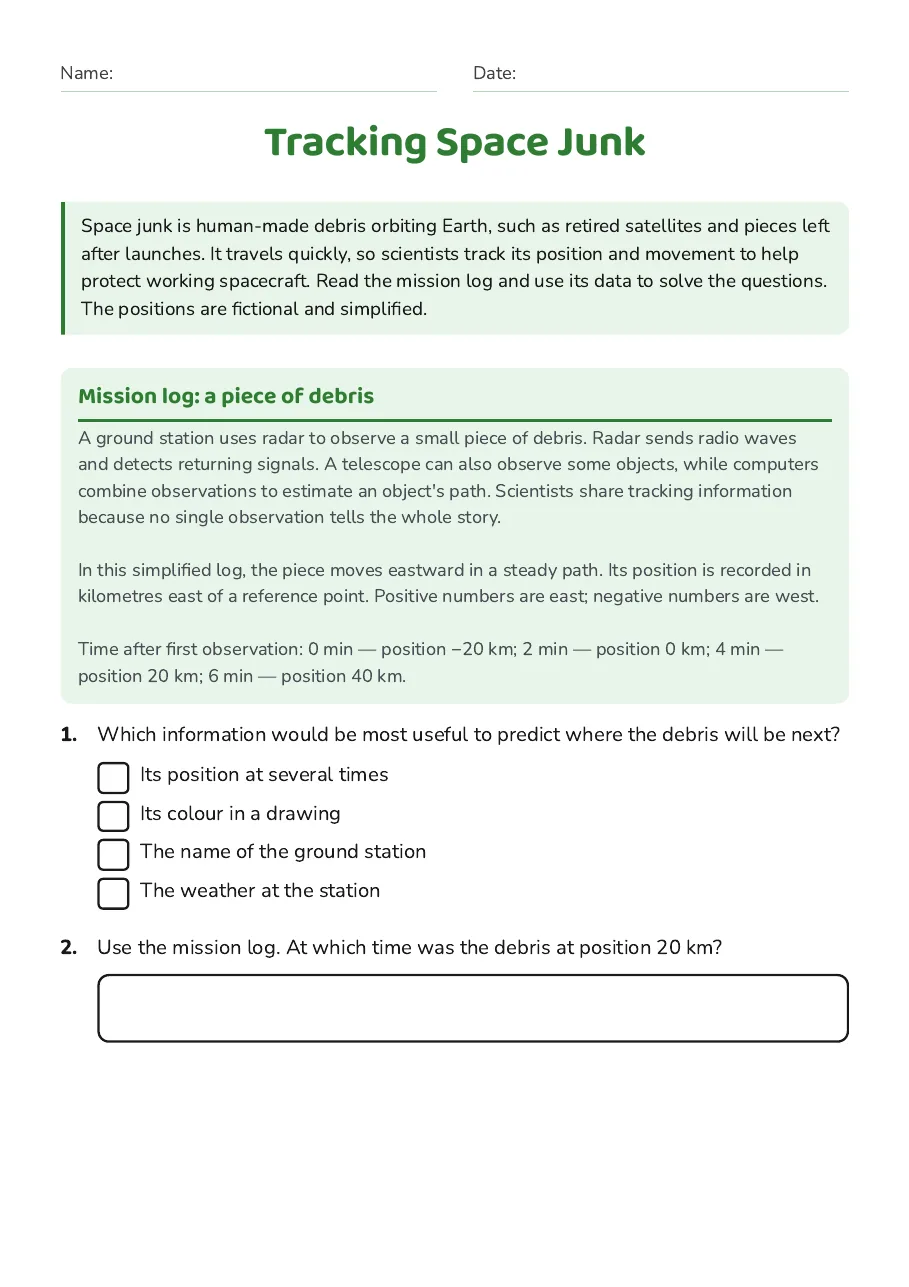
Mission log: a piece of debris
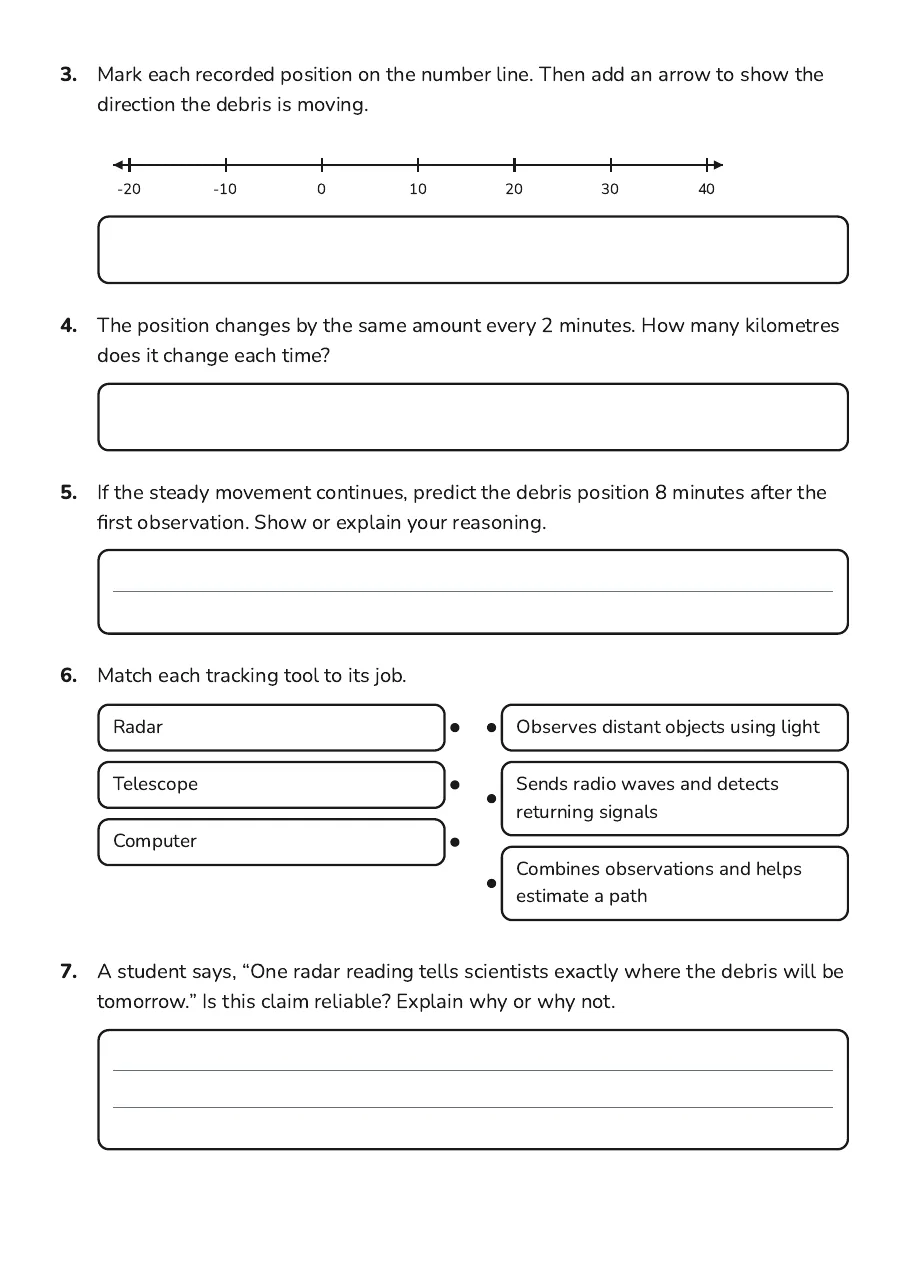
A ground station uses radar to observe a small piece of debris. Radar sends radio waves and detects returning signals. A telescope can also observe some objects, while computers combine observations to estimate an object's path. Scientists share tracking information because no single observation tells the whole story. In this simplified log, the piece moves eastward in a steady path. Its position is recorded in kilometres east of a reference point. Positive numbers are east; negative numbers are west. Time after first observation: 0 min — position −20 km; 2 min — position 0 km; 4 min — position 20 km; 6 min — position 40 km.
- Its position at several times
- Its colour in a drawing
- The name of the ground station
- The weather at the station
- Radar
- Telescope
- Computer
- Observes distant objects using light
- Sends radio waves and detects returning signals
- Combines observations and helps estimate a path
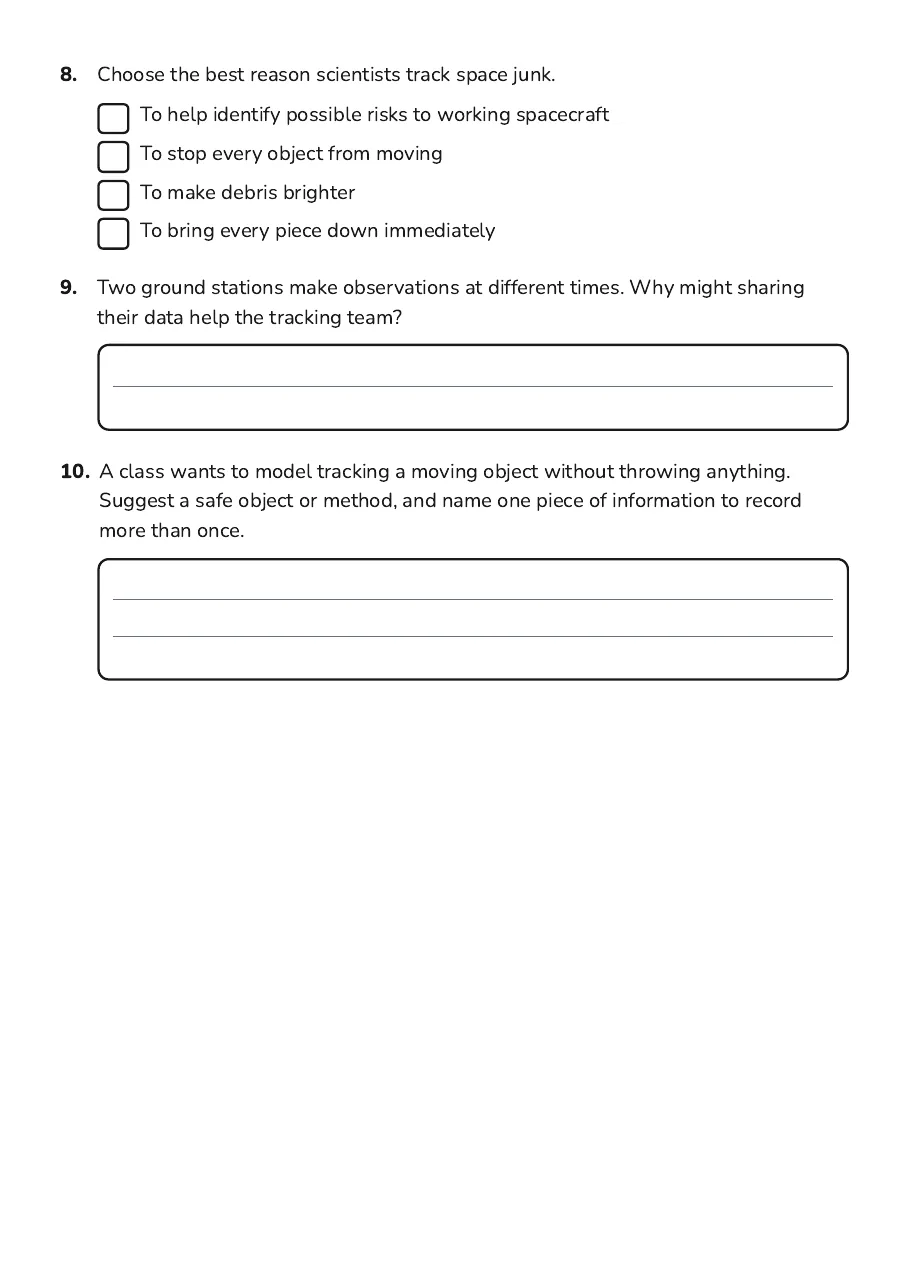
- To help identify possible risks to working spacecraft
- To stop every object from moving
- To make debris brighter
- To bring every piece down immediately
3 printable pages
Page 1
Page 2
Page 3
About This Worksheet
Free in Kuraplan
Sign up free, grab the PDF, and customize it for your class.
Print-Ready
Formatted for standard paper. Clean layout, easy to read.
AI-Generated
Created with Kuraplan's AI, designed for real classroom use.
For Teachers & Parents
Use in classrooms, for homework, tutoring, or homeschool.
Need a custom version of this worksheet?
Kuraplan's AI generates custom worksheets in seconds — differentiated for every learner, aligned to your curriculum.
Generate Custom Worksheets — Free