ScienceFreePrintable

Understanding Atoms

A free science worksheet ready for your classroom. Open in Kuraplan to grab the print-ready PDF, customize it for your students, or generate a fresh version in seconds.

Understanding Atoms worksheet preview
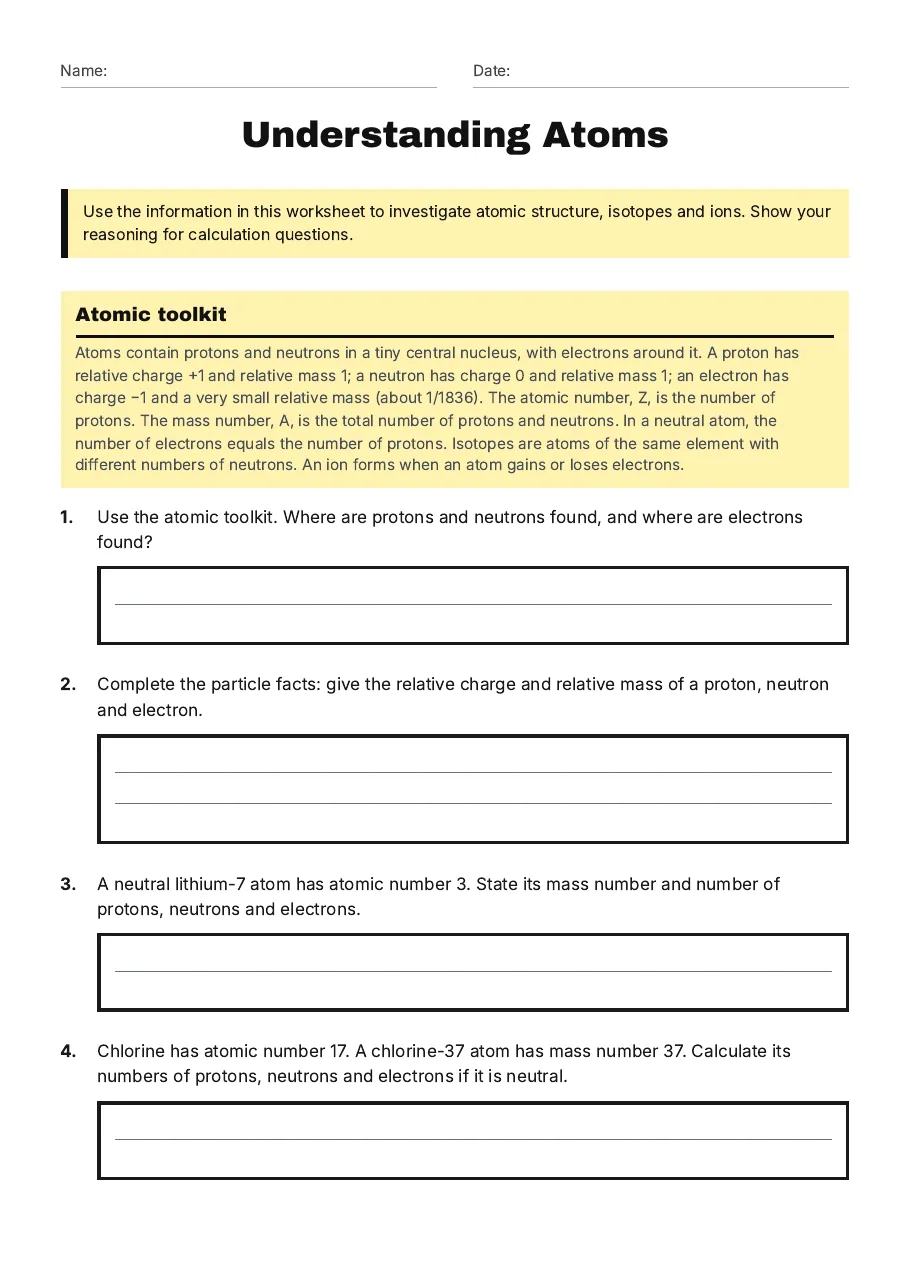
Name:Date:

Understanding Atoms

Use the information in this worksheet to investigate atomic structure, isotopes and ions. Show your reasoning for calculation questions.

Atomic toolkit

Atoms contain protons and neutrons in a tiny central nucleus, with electrons around it. A proton has relative charge +1 and relative mass 1; a neutron has charge 0 and relative mass 1; an electron has charge −1 and a very small relative mass (about 1/1836). The atomic number, Z, is the number of protons. The mass number, A, is the total number of protons and neutrons. In a neutral atom, the number of electrons equals the number of protons. Isotopes are atoms of the same element with different numbers of neutrons. An ion forms when an atom gains or loses electrons.

1.Use the atomic toolkit. Where are protons and neutrons found, and where are electrons found?
2.Complete the particle facts: give the relative charge and relative mass of a proton, neutron and electron.
3.A neutral lithium-7 atom has atomic number 3. State its mass number and number of protons, neutrons and electrons.
4.Chlorine has atomic number 17. A chlorine-37 atom has mass number 37. Calculate its numbers of protons, neutrons and electrons if it is neutral.
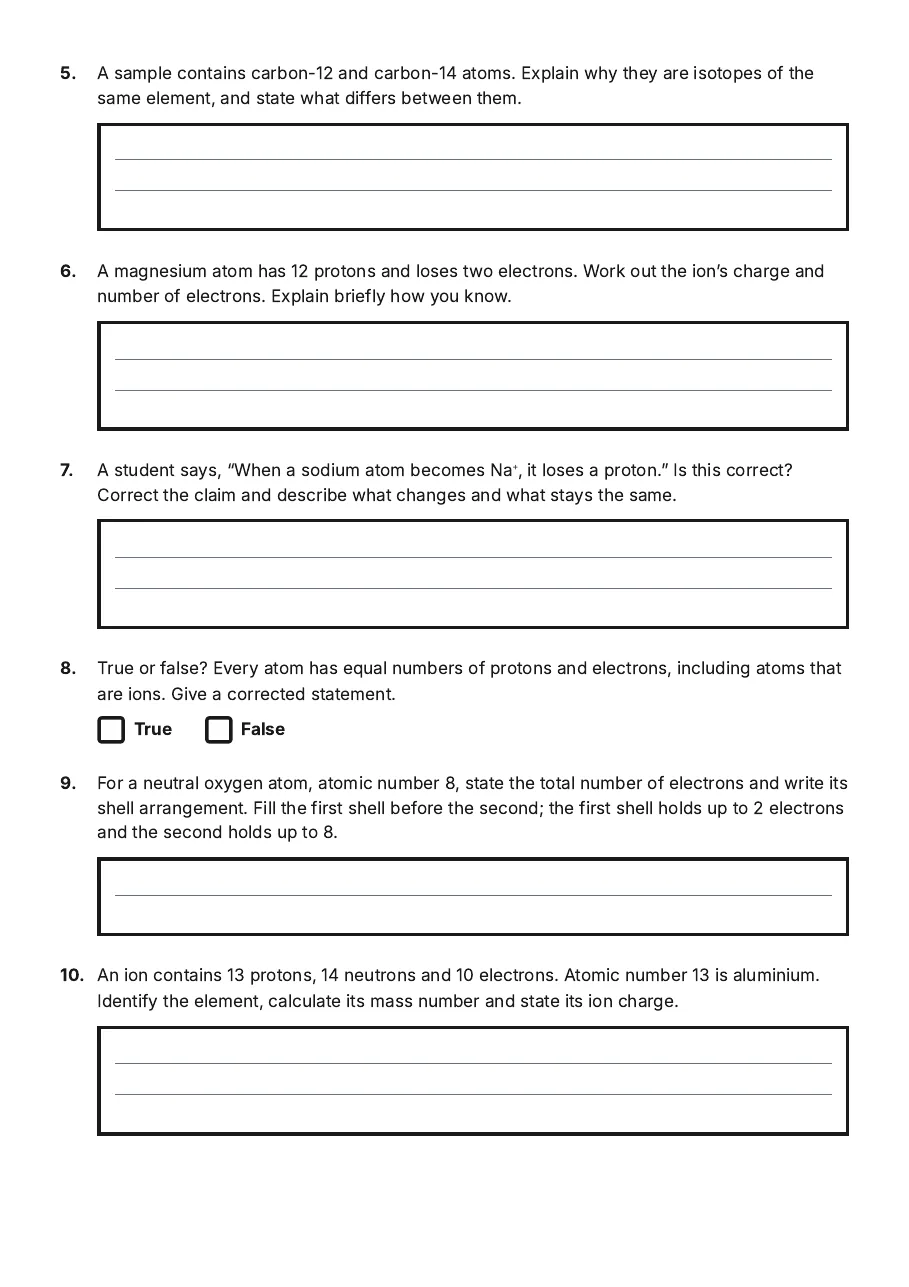
5.A sample contains carbon-12 and carbon-14 atoms. Explain why they are isotopes of the same element, and state what differs between them.
6.A magnesium atom has 12 protons and loses two electrons. Work out the ion’s charge and number of electrons. Explain briefly how you know.
7.A student says, “When a sodium atom becomes Na⁺, it loses a proton.” Is this correct? Correct the claim and describe what changes and what stays the same.
8.True or false? Every atom has equal numbers of protons and electrons, including atoms that are ions. Give a corrected statement.
TrueFalse
9.For a neutral oxygen atom, atomic number 8, state the total number of electrons and write its shell arrangement. Fill the first shell before the second; the first shell holds up to 2 electrons and the second holds up to 8.
10.An ion contains 13 protons, 14 neutrons and 10 electrons. Atomic number 13 is aluminium. Identify the element, calculate its mass number and state its ion charge.

2 printable pages

  • Understanding Atoms, page 1 of 2: Atomic toolkit

    Page 1

  • Understanding Atoms, page 2 of 2: 5. A sample contains carbon-12 and carbon-14 atoms. Explain why they are isotopes of the

    Page 2

About This Worksheet

Free in Kuraplan

Sign up free, grab the PDF, and customize it for your class.

Print-Ready

Formatted for standard paper. Clean layout, easy to read.

AI-Generated

Created with Kuraplan's AI, designed for real classroom use.

For Teachers & Parents

Use in classrooms, for homework, tutoring, or homeschool.

Need a custom version of this worksheet?

Kuraplan's AI generates custom worksheets in seconds — differentiated for every learner, aligned to your curriculum.

Generate Custom Worksheets — Free
No credit card Curriculum-aligned Under 60 seconds