Understanding Human Rights
A free social sciences worksheet ready for your classroom. Open in Kuraplan to grab the print-ready PDF, customize it for your students, or generate a fresh version in seconds.
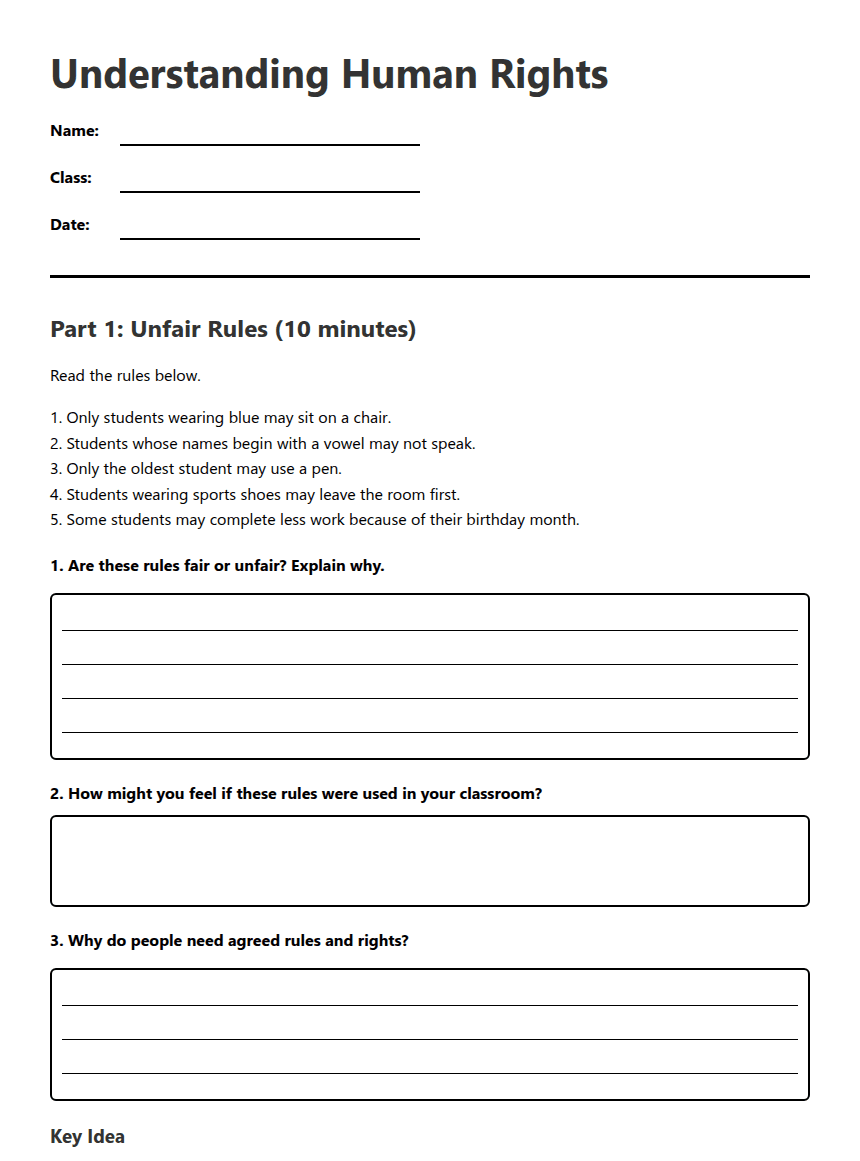
Understanding Human Rights
Part 1: Unfair Rules (10 minutes)
Read the rules below.
1. Only students wearing blue may sit on a chair.
2. Students whose names begin with a vowel may not speak.
3. Only the oldest student may use a pen.
4. Students wearing sports shoes may leave the room first.
5. Some students may complete less work because of their birthday month.
Key Idea
Human rights are basic freedoms and protections that every person should have. They help make sure people are treated fairly, safely and with dignity.
Part 2: The Three Kete of Rights (15 minutes)
Human rights can be grouped into three simple kete:
Kete 1: Identity and Fairness — rights to be treated equally, to have a name, to follow beliefs.
Kete 2: Safety and Freedom — rights to feel safe, be free from violence, speak your opinion.
Kete 3: Community and Wellbeing — rights to education, food, healthcare, culture and rest.
Part 3 & Part 4: Rights in Our Place + Reflection (35 minutes)
Choose one human right and connect it to a local issue.
Kaitiakitanga and Human Rights
Reflection (10 minutes)
Exit Ticket
Extension Challenge (optional)
Self-Assessment
Tick the box that best describes your work.
I explained what a human right is.
Not Yet Nearly There AchievedI identified important human rights.
Not Yet Nearly There AchievedI connected a right to a local issue.
Not Yet Nearly There AchievedI explained how kaitiakitanga protects people and places.
Not Yet Nearly There AchievedI completed the reflection and exit ticket.
Not Yet Nearly There AchievedAbout This Worksheet
Free in Kuraplan
Sign up free, grab the PDF, and customize it for your class.
Print-Ready
Formatted for standard paper. Clean layout, easy to read.
AI-Generated
Created with Kuraplan's AI, designed for real classroom use.
For Teachers & Parents
Use in classrooms, for homework, tutoring, or homeschool.
Need a custom version of this worksheet?
Kuraplan's AI generates custom worksheets in seconds — differentiated for every learner, aligned to your curriculum.
Generate Custom Worksheets — FreeMore Social Sciences Worksheets
Government Systems Comparison Chart
Free
Government Types and Methods
Free
Government Market Intervention Vocabulary Clues
Free
Government Concepts Overview
Free
Understanding Government Systems
Free
Government Systems Comparison
Free
Growing Communities Worksheet
Free