EnglishFreePrintable

Writing Rubric Years 0-8

A free english worksheet ready for your classroom. Open in Kuraplan to grab the print-ready PDF, customize it for your students, or generate a fresh version in seconds.
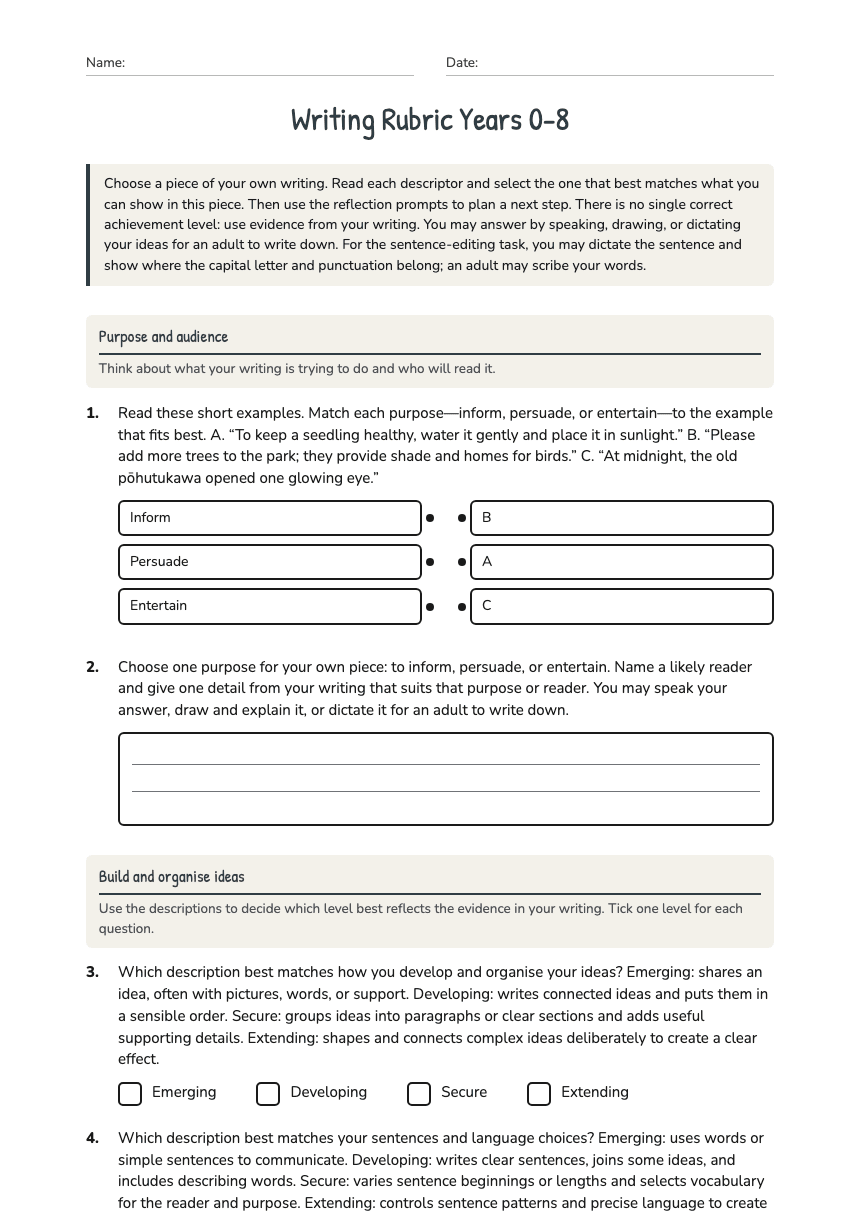
Writing Rubric Years 0-8 worksheet preview
Name:Date:

Writing Rubric Years 0-8

Choose a piece of your own writing. Read each descriptor and select the one that best matches what you can show in this piece. Then use the reflection prompts to plan a next step. There is no single correct achievement level: use evidence from your writing. You may answer by speaking, drawing, or dictating your ideas for an adult to write down. For the sentence-editing task, you may dictate the sentence and show where the capital letter and punctuation belong; an adult may scribe your words.

Purpose and audience

Think about what your writing is trying to do and who will read it.

1.Read these short examples. Match each purpose—inform, persuade, or entertain—to the example that fits best. A. “To keep a seedling healthy, water it gently and place it in sunlight.” B. “Please add more trees to the park; they provide shade and homes for birds.” C. “At midnight, the old pōhutukawa opened one glowing eye.”
  • Inform
  • Persuade
  • Entertain
  • B
  • A
  • C
2.Choose one purpose for your own piece: to inform, persuade, or entertain. Name a likely reader and give one detail from your writing that suits that purpose or reader. You may speak your answer, draw and explain it, or dictate it for an adult to write down.

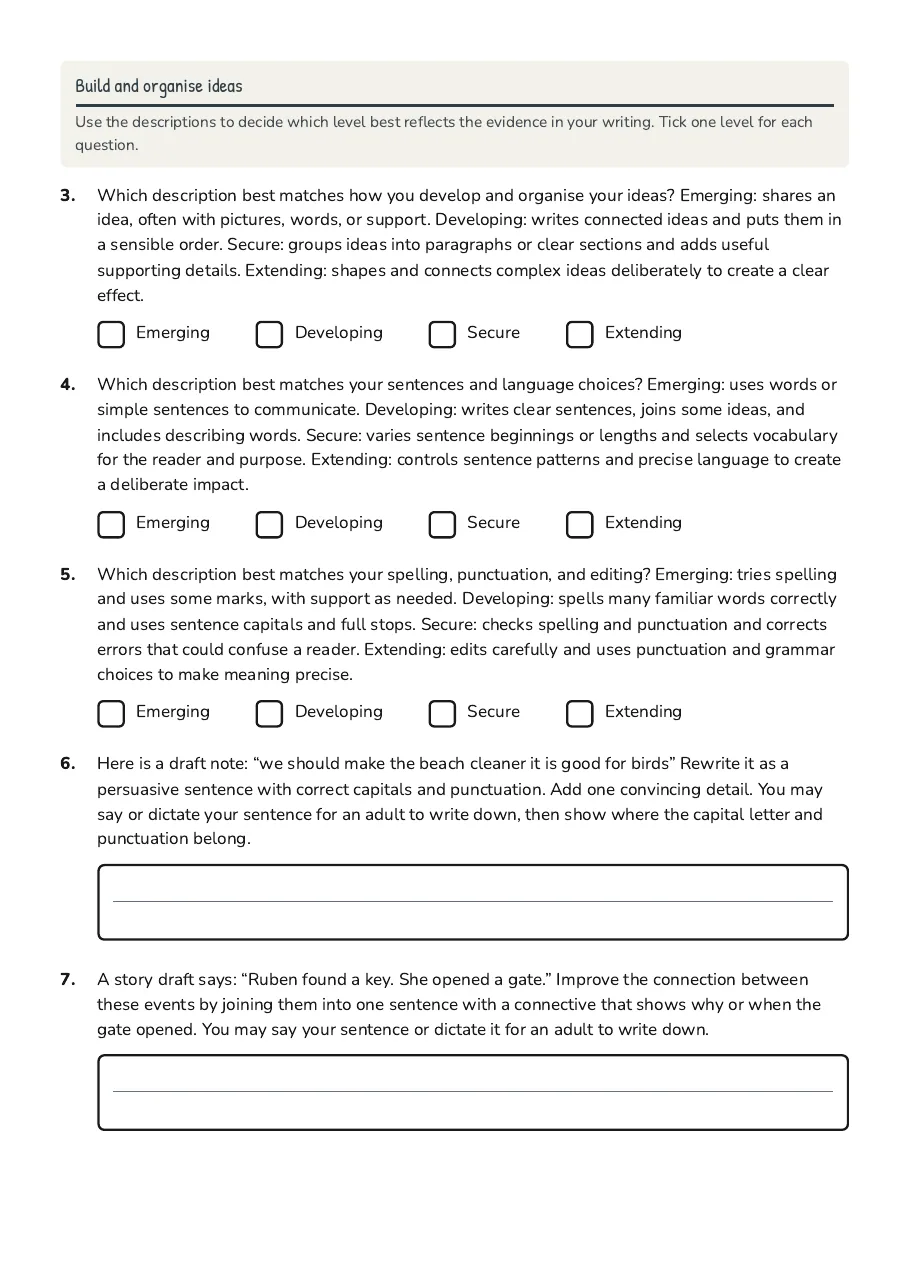
Build and organise ideas

Use the descriptions to decide which level best reflects the evidence in your writing. Tick one level for each question.

3.Which description best matches how you develop and organise your ideas? Emerging: shares an idea, often with pictures, words, or support. Developing: writes connected ideas and puts them in a sensible order. Secure: groups ideas into paragraphs or clear sections and adds useful supporting details. Extending: shapes and connects complex ideas deliberately to create a clear effect.
  • Emerging
  • Developing
  • Secure
  • Extending
4.Which description best matches your sentences and language choices? Emerging: uses words or simple sentences to communicate. Developing: writes clear sentences, joins some ideas, and includes describing words. Secure: varies sentence beginnings or lengths and selects vocabulary for the reader and purpose. Extending: controls sentence patterns and precise language to create a deliberate impact.
  • Emerging
  • Developing
  • Secure
  • Extending
5.Which description best matches your spelling, punctuation, and editing? Emerging: tries spelling and uses some marks, with support as needed. Developing: spells many familiar words correctly and uses sentence capitals and full stops. Secure: checks spelling and punctuation and corrects errors that could confuse a reader. Extending: edits carefully and uses punctuation and grammar choices to make meaning precise.
  • Emerging
  • Developing
  • Secure
  • Extending
6.Here is a draft note: “we should make the beach cleaner it is good for birds” Rewrite it as a persuasive sentence with correct capitals and punctuation. Add one convincing detail. You may say or dictate your sentence for an adult to write down, then show where the capital letter and punctuation belong.
7.A story draft says: “Ruben found a key. She opened a gate.” Improve the connection between these events by joining them into one sentence with a connective that shows why or when the gate opened. You may say your sentence or dictate it for an adult to write down.

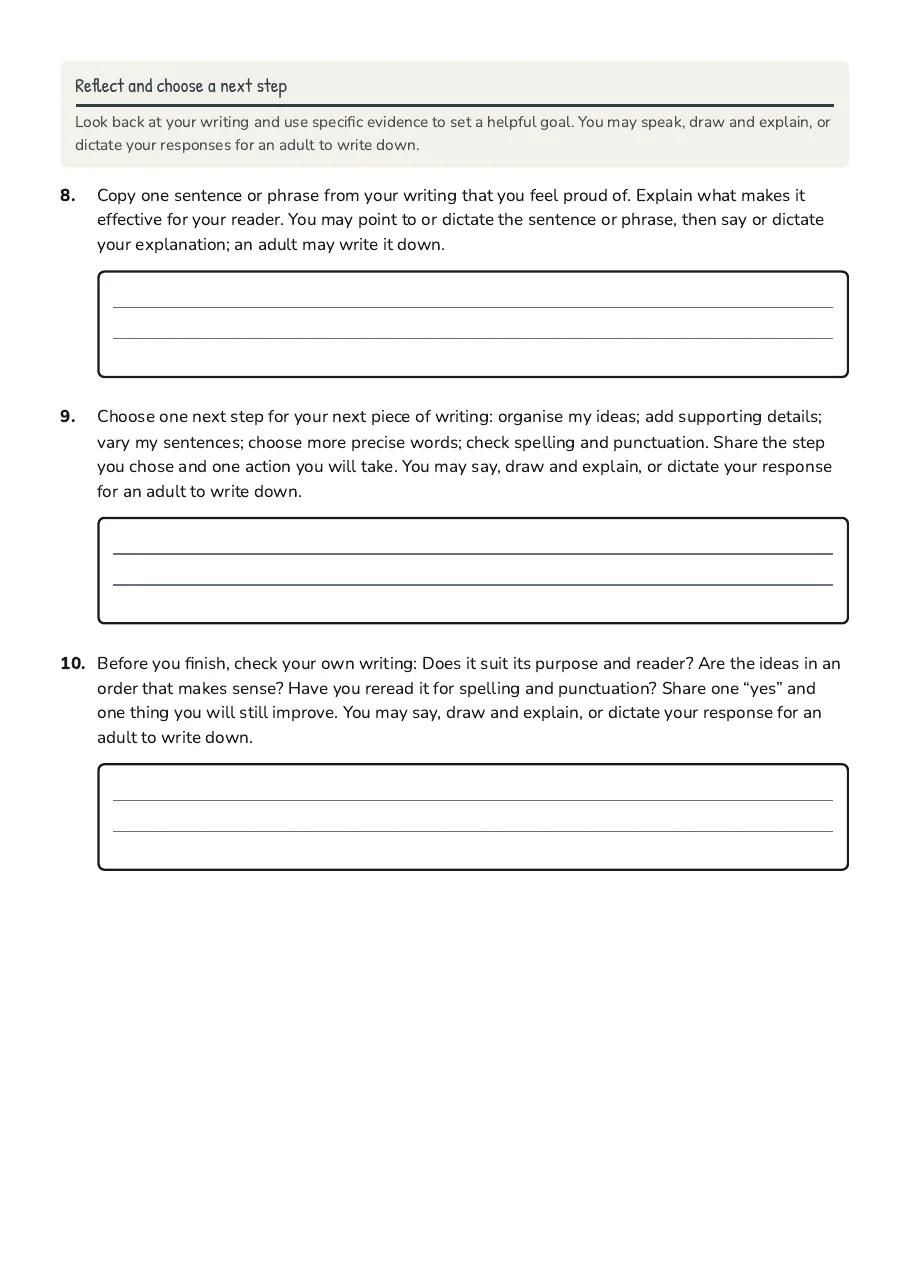
Reflect and choose a next step

Look back at your writing and use specific evidence to set a helpful goal. You may speak, draw and explain, or dictate your responses for an adult to write down.

8.Copy one sentence or phrase from your writing that you feel proud of. Explain what makes it effective for your reader. You may point to or dictate the sentence or phrase, then say or dictate your explanation; an adult may write it down.
9.Choose one next step for your next piece of writing: organise my ideas; add supporting details; vary my sentences; choose more precise words; check spelling and punctuation. Share the step you chose and one action you will take. You may say, draw and explain, or dictate your response for an adult to write down.
10.Before you finish, check your own writing: Does it suit its purpose and reader? Are the ideas in an order that makes sense? Have you reread it for spelling and punctuation? Share one “yes” and one thing you will still improve. You may say, draw and explain, or dictate your response for an adult to write down.

3 printable pages
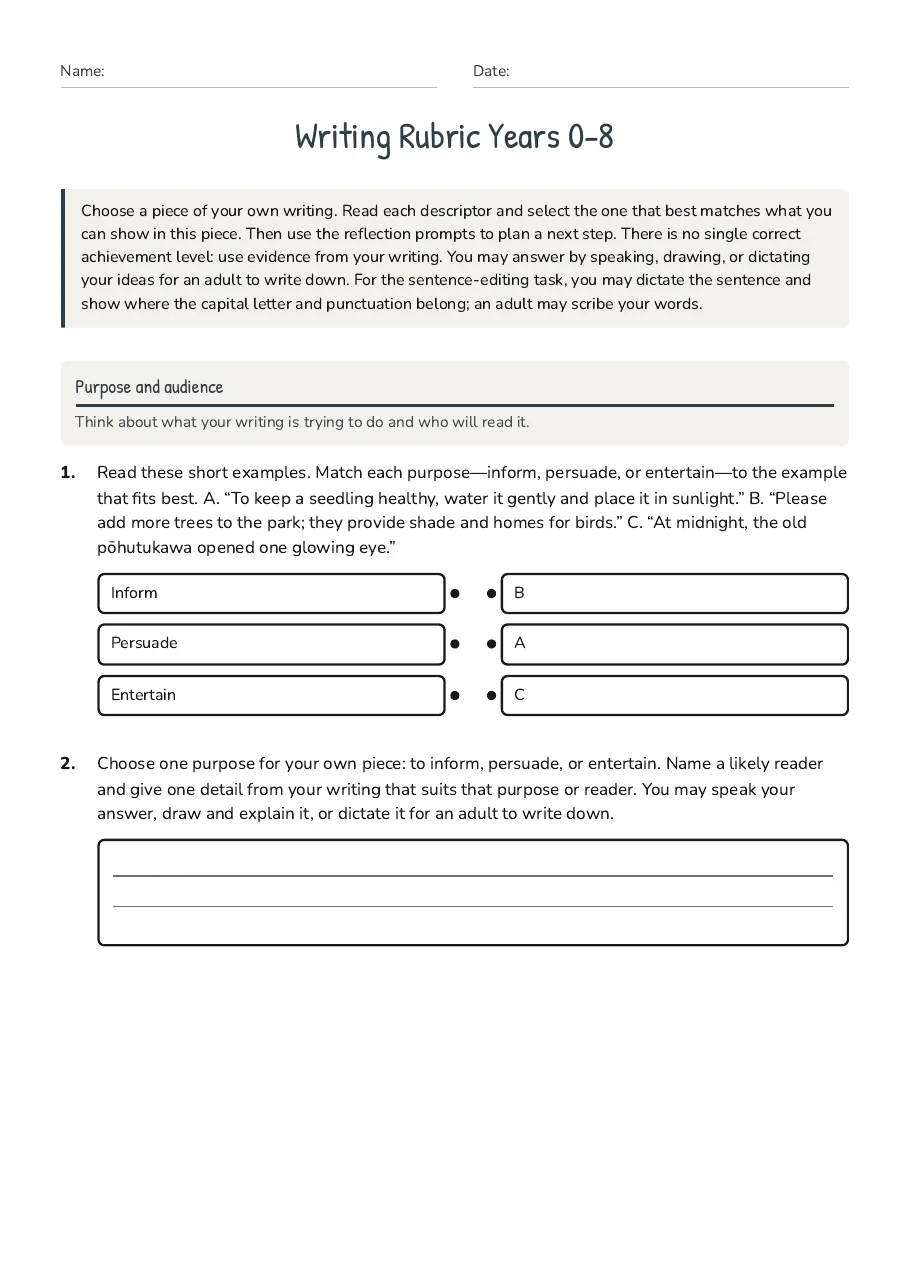
  • Writing Rubric Years 0-8, page 1 of 3: Purpose and audience

    Page 1

  • Writing Rubric Years 0-8, page 2 of 3: Build and organise ideas

    Page 2

  • Writing Rubric Years 0-8, page 3 of 3: Reflect and choose a next step

    Page 3

About This Worksheet

Free in Kuraplan

Sign up free, grab the PDF, and customize it for your class.

Print-Ready

Formatted for standard paper. Clean layout, easy to read.

AI-Generated

Created with Kuraplan's AI, designed for real classroom use.

For Teachers & Parents

Use in classrooms, for homework, tutoring, or homeschool.

Need a custom version of this worksheet?

Kuraplan's AI generates custom worksheets in seconds — differentiated for every learner, aligned to your curriculum.

Generate Custom Worksheets — Free
No credit card Curriculum-aligned Under 60 seconds