Year 10 Textual Analysis
A free english worksheet ready for your classroom. Open in Kuraplan to grab the print-ready PDF, customize it for your students, or generate a fresh version in seconds.
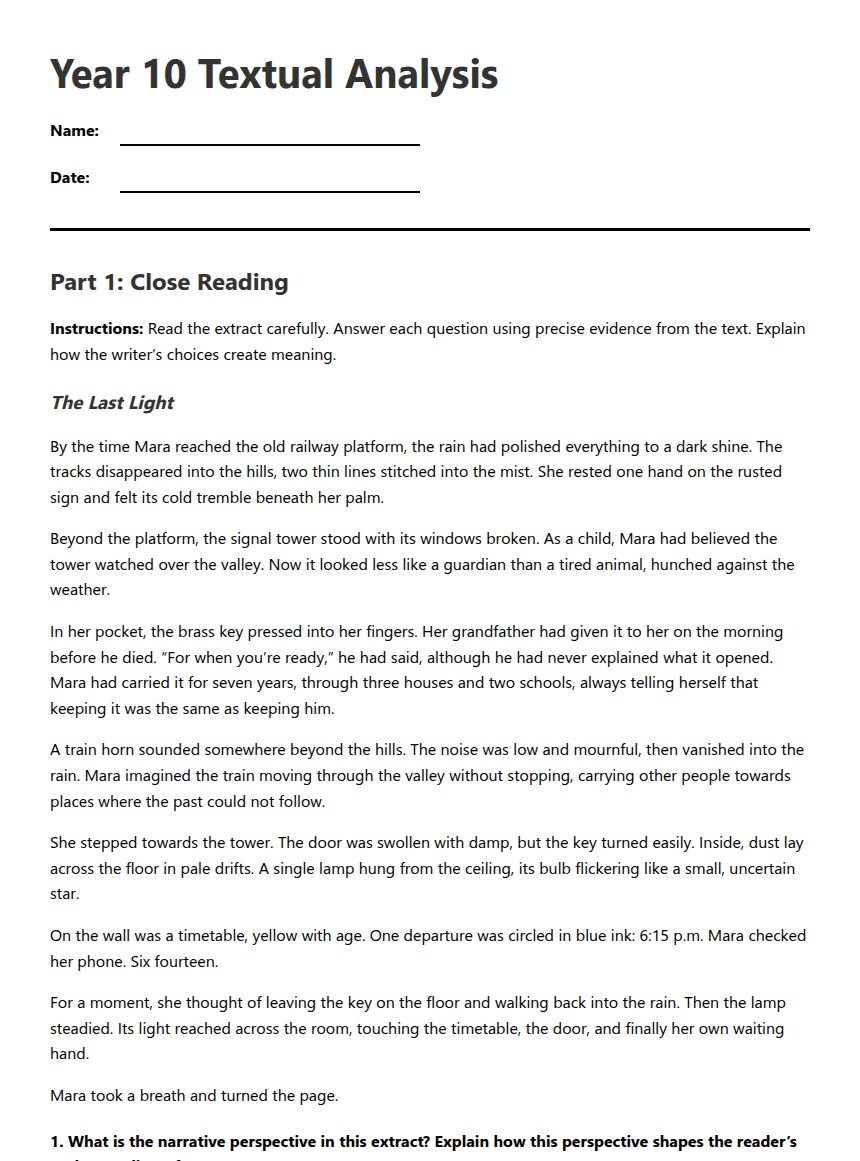
Year 10 Textual Analysis
Part 1: Close Reading
Instructions: Read the extract carefully. Answer each question using precise evidence from the text. Explain how the writer’s choices create meaning.
The Last Light
By the time Mara reached the old railway platform, the rain had polished everything to a dark shine. The tracks disappeared into the hills, two thin lines stitched into the mist. She rested one hand on the rusted sign and felt its cold tremble beneath her palm.
Beyond the platform, the signal tower stood with its windows broken. As a child, Mara had believed the tower watched over the valley. Now it looked less like a guardian than a tired animal, hunched against the weather.
In her pocket, the brass key pressed into her fingers. Her grandfather had given it to her on the morning before he died. “For when you’re ready,” he had said, although he had never explained what it opened. Mara had carried it for seven years, through three houses and two schools, always telling herself that keeping it was the same as keeping him.
A train horn sounded somewhere beyond the hills. The noise was low and mournful, then vanished into the rain. Mara imagined the train moving through the valley without stopping, carrying other people towards places where the past could not follow.
She stepped towards the tower. The door was swollen with damp, but the key turned easily. Inside, dust lay across the floor in pale drifts. A single lamp hung from the ceiling, its bulb flickering like a small, uncertain star.
On the wall was a timetable, yellow with age. One departure was circled in blue ink: 6:15 p.m. Mara checked her phone. Six fourteen.
For a moment, she thought of leaving the key on the floor and walking back into the rain. Then the lamp steadied. Its light reached across the room, touching the timetable, the door, and finally her own waiting hand.
Mara took a breath and turned the page.
Part 2: Language Features and Analytical Writing
Instructions: Complete the language-features table. Quote a word or phrase, then explain its effect on the reader or the development of an idea.
Find a comparison that is not introduced with “like” or “as”.
Find a sensory detail that helps you picture or feel the setting.
Comment on a sentence structure or sentence-length choice.
Choose one deliberate word and explain its connotations.
Describe the attitude or mood created by the language.
PEEL/SEEL Paragraph Scaffold
Question: How does the writer show that confronting the past can be the beginning of change?
Point/Statement: The writer shows that ________________________________________________
Evidence: This is shown when the text says, “__________________________________________”
Explain: The word/technique __________________ suggests ________________________________
Link: Therefore, the reader understands that ____________________________________________
Teacher Answer Guide and Self-Assessment
Indicative Responses
1. The extract uses third-person limited narration, closely following Mara’s thoughts and perceptions. This lets the reader understand her uncertainty while keeping some information, such as the key’s purpose, hidden.
2. Mara considers leaving the key behind, showing that she is hesitant to confront her grandfather’s memory. Carrying the key for seven years also suggests grief and emotional attachment.
3. The abandoned platform, mist and damaged tower reflect Mara’s isolation and uncertainty. The railway also suggests movement and the possibility of leaving the past behind.
4. The key may symbolise a family memory, responsibility or a choice Mara has avoided. The lamp may symbolise understanding or hope because its light steadies and reaches towards her hand as she chooses to continue.
5. Accept varied interpretations. Examples include “tracks... stitched into the mist” as metaphor; “rain had polished everything” as visual imagery; the short sentence “Six fourteen” creating urgency; “mournful” suggesting sadness; and the overall tone shifting from bleak and uncertain to cautiously hopeful.
6. “Turned” suggests a physical and emotional decision. Turning the page implies that Mara is ready to learn, remember or accept something rather than remain stuck in uncertainty.
7. Strong responses include a clear point, relevant quotations, explanation of language features, and a link to the idea of confronting the past and beginning change.
8. Answers may suggest a dark visual palette changing to warmer colours, a close-up of the lamp or key, a sound bridge using the train horn, or an interactive page-turning moment. The explanation should connect the choice to memory, uncertainty or hope.
Self-Assessment
Tick each statement when you can do it confidently.
I used quotations or precise references from the extract. I explained how language features create meaning. I discussed character, setting, perspective or symbolism. My analytical paragraph follows a PEEL/SEEL structure. I used accurate New Zealand English spelling and punctuation.One skill I will improve:
About This Worksheet
Free in Kuraplan
Sign up free, grab the PDF, and customize it for your class.
Print-Ready
Formatted for standard paper. Clean layout, easy to read.
AI-Generated
Created with Kuraplan's AI, designed for real classroom use.
For Teachers & Parents
Use in classrooms, for homework, tutoring, or homeschool.
Need a custom version of this worksheet?
Kuraplan's AI generates custom worksheets in seconds — differentiated for every learner, aligned to your curriculum.
Generate Custom Worksheets — Free