ScienceFreePrintable
Year 11 Chemistry Review
A free science worksheet ready for your classroom. Open in Kuraplan to grab the print-ready PDF, customize it for your students, or generate a fresh version in seconds.
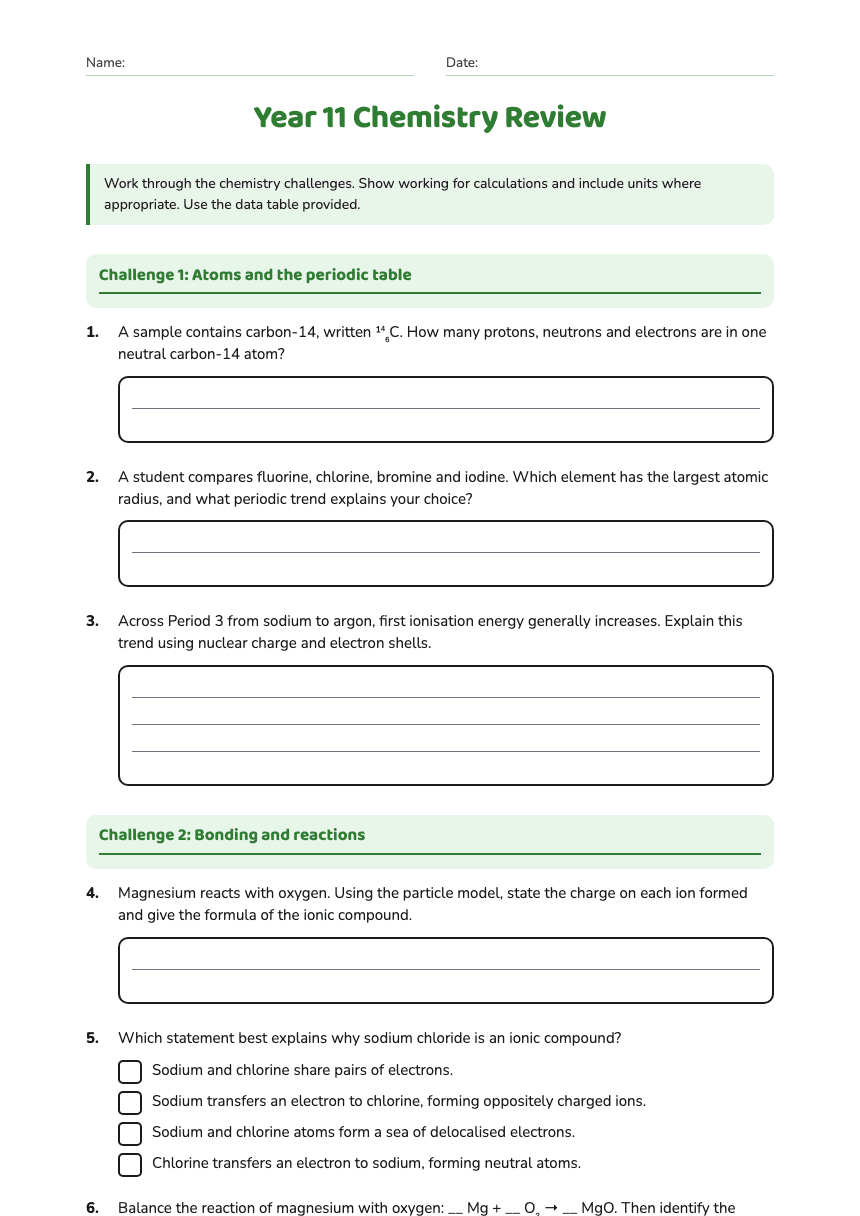
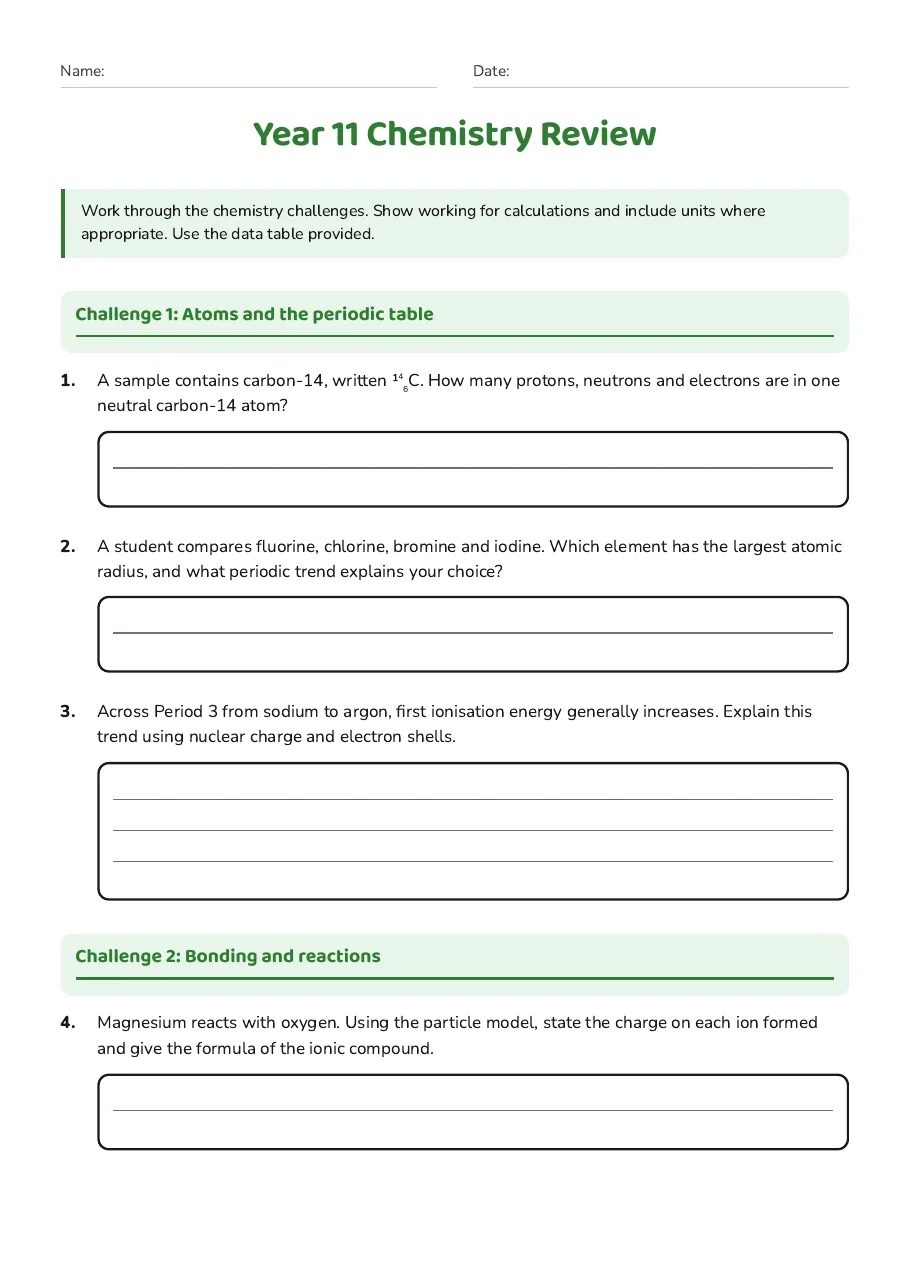
Name:Date:
Year 11 Chemistry Review
Work through the chemistry challenges. Show working for calculations and include units where appropriate. Use the data table provided.
Challenge 1: Atoms and the periodic table
1.A sample contains carbon-14, written ¹⁴₆C. How many protons, neutrons and electrons are in one neutral carbon-14 atom?
2.A student compares fluorine, chlorine, bromine and iodine. Which element has the largest atomic radius, and what periodic trend explains your choice?
3.Across Period 3 from sodium to argon, first ionisation energy generally increases. Explain this trend using nuclear charge and electron shells.
Challenge 2: Bonding and reactions
4.Magnesium reacts with oxygen. Using the particle model, state the charge on each ion formed and give the formula of the ionic compound.
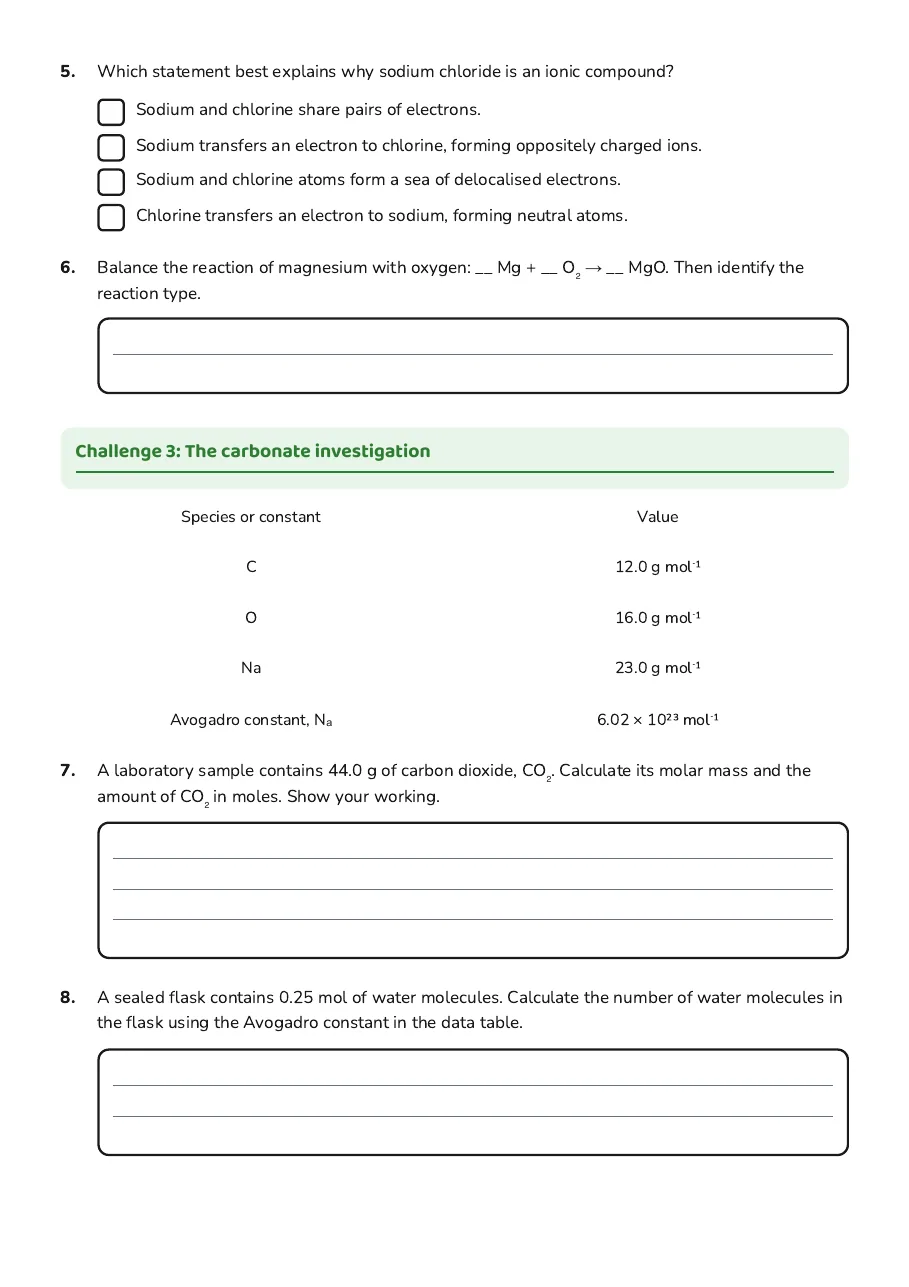
5.Which statement best explains why sodium chloride is an ionic compound?
- Sodium and chlorine share pairs of electrons.
- Sodium transfers an electron to chlorine, forming oppositely charged ions.
- Sodium and chlorine atoms form a sea of delocalised electrons.
- Chlorine transfers an electron to sodium, forming neutral atoms.
6.Balance the reaction of magnesium with oxygen: __ Mg + __ O₂ → __ MgO. Then identify the reaction type.
Challenge 3: The carbonate investigation
Species or constant
Value
C
12.0 g mol⁻¹
O
16.0 g mol⁻¹
Na
23.0 g mol⁻¹
Avogadro constant, Nₐ
6.02 × 10²³ mol⁻¹
7.A laboratory sample contains 44.0 g of carbon dioxide, CO₂. Calculate its molar mass and the amount of CO₂ in moles. Show your working.
8.A sealed flask contains 0.25 mol of water molecules. Calculate the number of water molecules in the flask using the Avogadro constant in the data table.
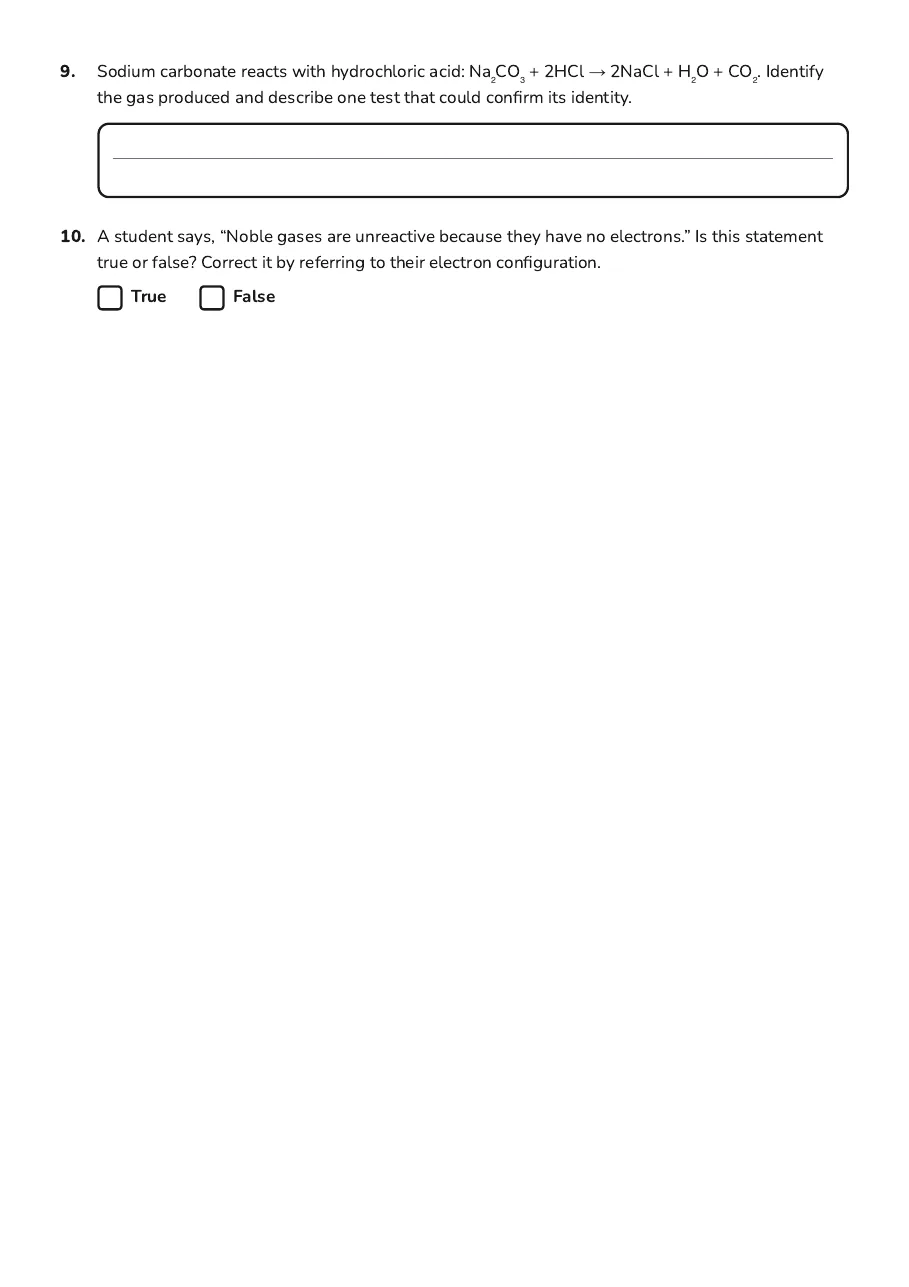
9.Sodium carbonate reacts with hydrochloric acid: Na₂CO₃ + 2HCl → 2NaCl + H₂O + CO₂. Identify the gas produced and describe one test that could confirm its identity.
10.A student says, “Noble gases are unreactive because they have no electrons.” Is this statement true or false? Correct it by referring to their electron configuration.
TrueFalse
3 printable pages
Page 1
Page 2
Page 3
About This Worksheet
Free in Kuraplan
Sign up free, grab the PDF, and customize it for your class.
Print-Ready
Formatted for standard paper. Clean layout, easy to read.
AI-Generated
Created with Kuraplan's AI, designed for real classroom use.
For Teachers & Parents
Use in classrooms, for homework, tutoring, or homeschool.
Need a custom version of this worksheet?
Kuraplan's AI generates custom worksheets in seconds — differentiated for every learner, aligned to your curriculum.
Generate Custom Worksheets — Free No credit card Curriculum-aligned Under 60 seconds
More Science Worksheets
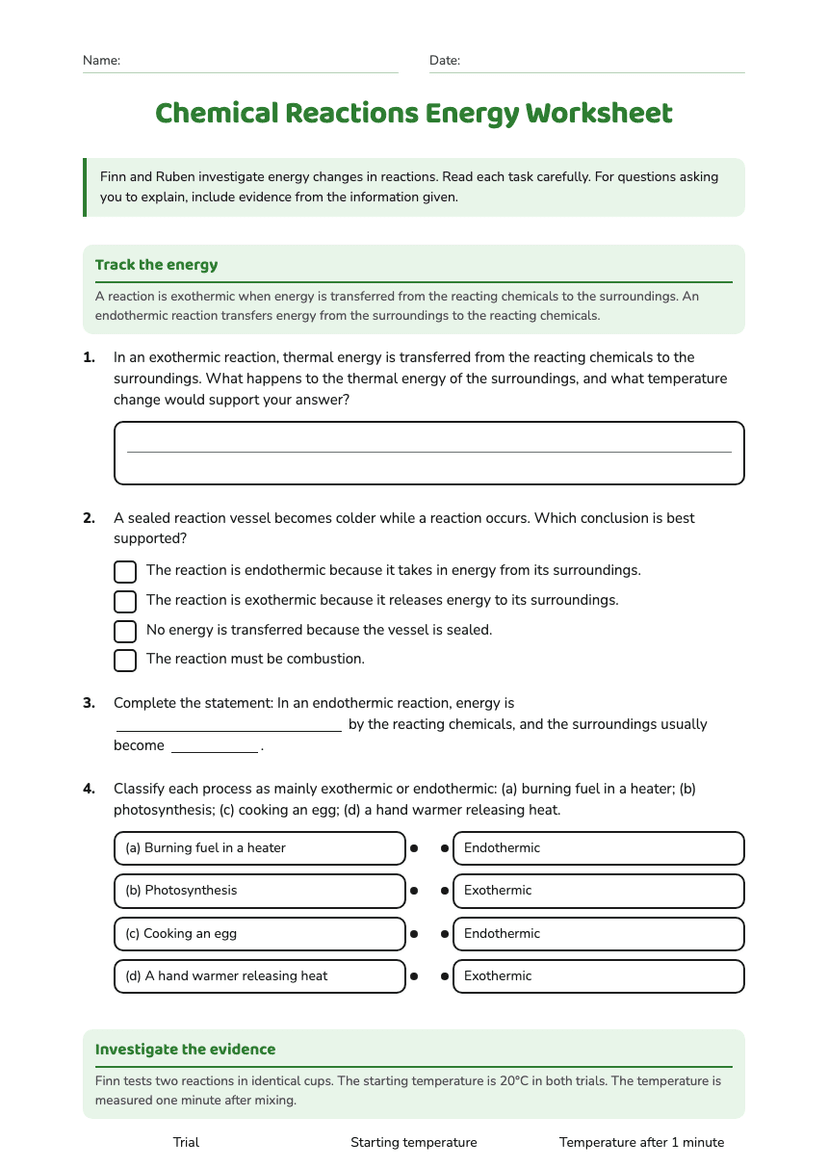
Chemical Reactions Energy Worksheet
Free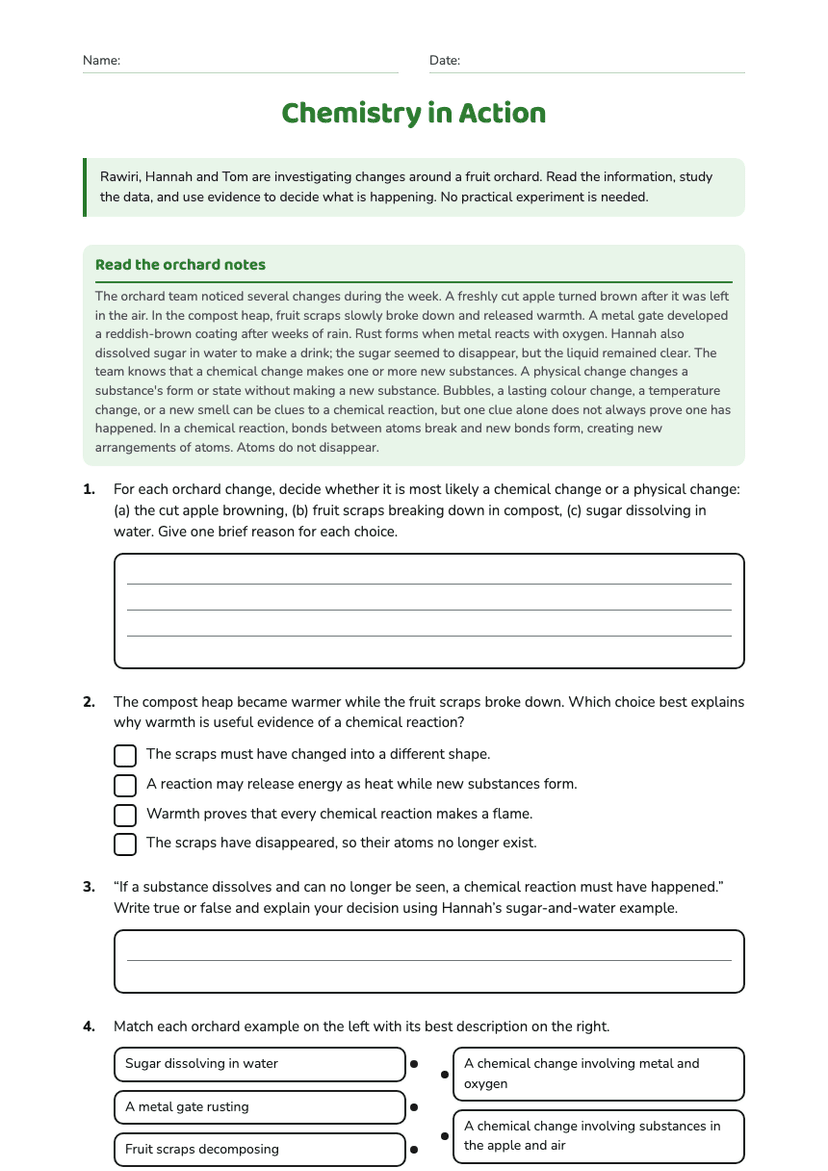
Year 7
Chemistry in Action
Free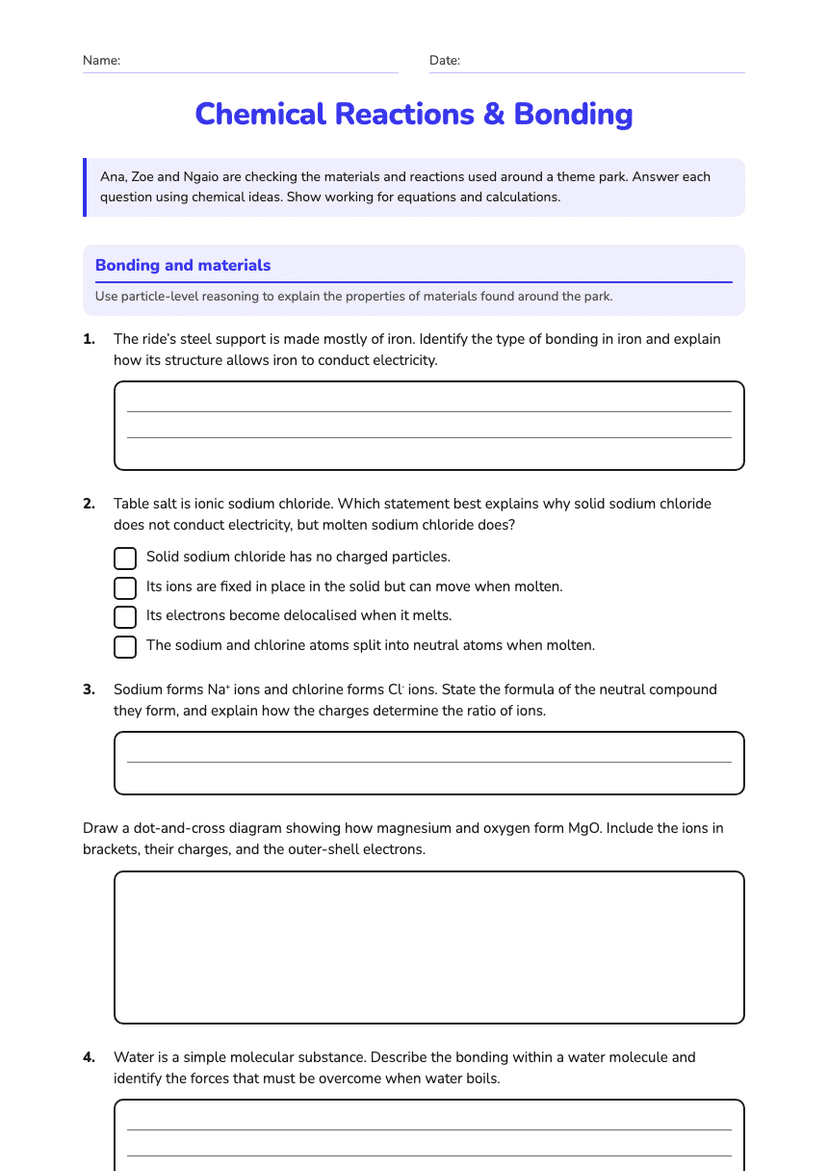
Year 11
Chemical Reactions & Bonding
Free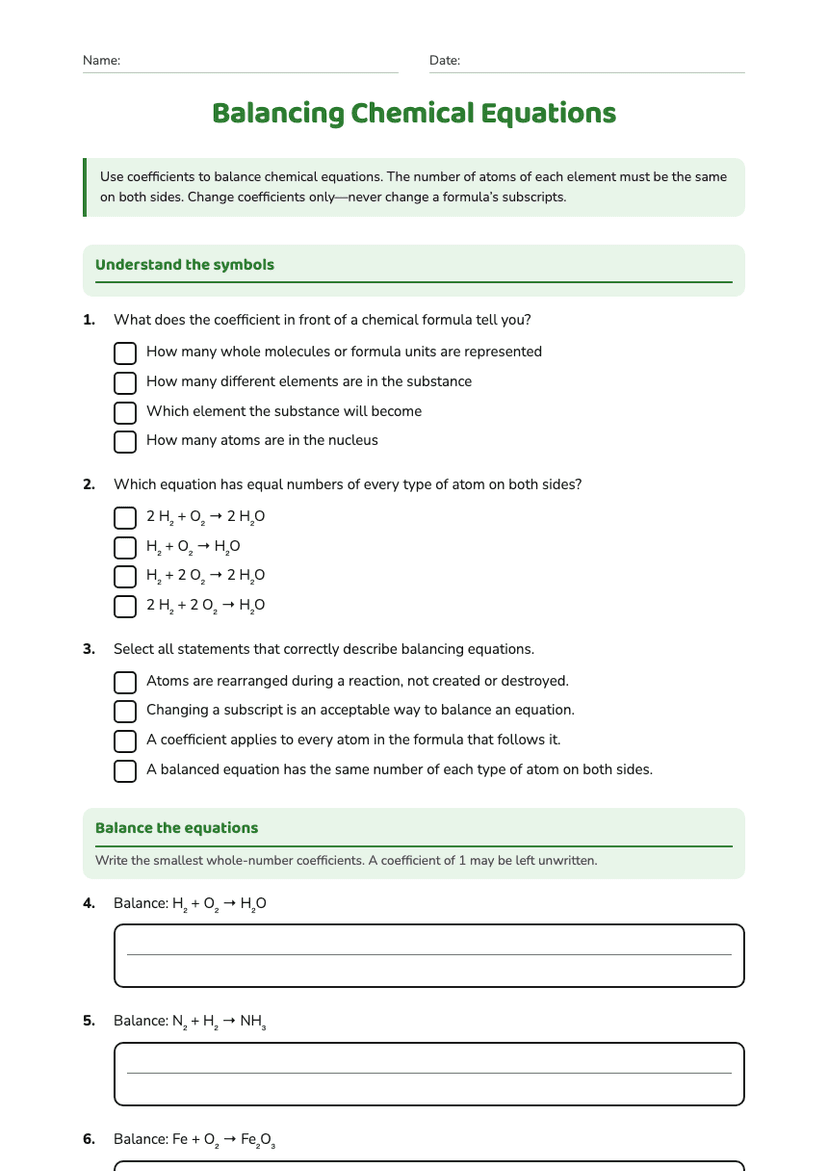
Year 7–8
Balancing Chemical Equations
Free
Year 2
Kitchen Chemistry Adventure
Free
Year 11
Chemical Reactions Introduction
Free
Year 9
Element Flashcards Worksheet
Free
Year 7–8