
Thursday afternoon, the last fractions test comes off the pile, and the marks are worse than the lessons deserved. The class could compare fractions on a number line by Friday. They'd done the strips, the card sort, the partner quiz. Then the test asked them to convert improper fractions, and half of them fell apart.
Nothing went wrong in the teaching. Something went wrong three weeks earlier, when the test came from a textbook chapter and the objectives were never written down at all.
A unit plan outline is the page that catches that before it costs you a week of reteaching. Not a longer lesson plan. Not the document you fill in for an observation. One page that shows the standards you're teaching, what students will be able to do, how you'll know they can, and where each lesson sits in that chain. Get the chain right and every lesson has a job. Get one link wrong and you find out at marking time, when the only fix left is the reteach.
The Parts of a Unit Plan Outline at a Glance
There's a folder on your laptop called Fractions. Inside it sit three documents that don't talk to each other: a list of activities you've collected over four years, a worksheet, and a test photocopied from a textbook. Everything you need is in there. Nothing in it tells you why Tuesday's lesson exists.
A unit plan outline puts those three documents on one page and puts them in an order that forces the hard decisions early. Fill it in the order below and you can't skip the question that matters.
The first half is about intent. Title and duration come first, because a three-week unit of twelve lessons is a different animal from a five-week one, and planning twelve lessons is very different from planning twenty-five. Then the big idea or essential question, the one students keep returning to. Then the standards, copied exactly from the curriculum document rather than paraphrased from memory, followed by learning objectives written with verbs you can watch a student do: compare, explain, solve, label.
The second half is where drafts go thin. The assessment plan needs short checks plus one end-of-unit task. The lesson sequence gets one line per lesson, each naming the objective it serves. Then resources, and finally differentiation, the supports and extensions for the students you already know will need them.
| Component | Question it answers | What to write | Example (Year 5 fractions) |
|---|---|---|---|
| Unit title and duration | How long and for whom? | Year level, number of weeks and lessons | Equivalent Fractions, Year 5, 3 weeks, 12 lessons |
| Big idea or essential question | Why does this matter? | One question students return to | Do two fractions name the same amount? |
| Standards | What must be taught? | Standard codes copied from the curriculum document | The curriculum code for equivalent fractions, copied exactly |
| Learning objectives | What should students do by the end? | Observable verbs such as compare, explain, solve | Students compare two fractions using a number line |
| Assessment plan | How will we know? | Short formative checks plus one summative task | Exit ticket each lesson; end-of-unit fraction task |
| Lesson sequence | In what order? | One line per lesson with its objective | Lesson 1 unit fractions; Lesson 4 equivalence on number lines |
| Resources | What do teachers and students need? | Materials, slides, worksheets, texts | Fraction strips, printed number lines |
| Differentiation | Who needs more or less support? | Supports, extensions and grouping | Sentence frames for EAL students; mixed-number extension tasks |
One test applies to the finished page: if any part is blank, the unit isn't ready to teach. A blank assessment field means you'll invent the test at the end and measure whatever you happened to teach. A blank differentiation field means you'll solve it live, in front of thirty students.
Planning time is finite, so the page has to earn its keep. Teachers received an average of 266 minutes of individual planning time per week, roughly 53 minutes a day, according to a 2024 survey of U.S. public schools published by the National Council on Teacher Quality. Lesson planning also accounted for 14% of teachers' working time in 2024 across participating systems, per the OECD's TALIS 2024 results. Fifty-three minutes a day disappears fast. An outline you reuse next year is the only planning work that compounds.
Why Planning Backward Produces Better Units
Almost every unit that goes sideways was planned in the same order: pick the activity you love, teach it well, then write a test that covers whatever happened.
Activity-first planning isn't laziness. It's what planning feels like on a Tuesday night when tomorrow's lesson needs to exist. The problem is that it puts the decision that matters least, which worksheet, ahead of the two that matter most: what students should learn, and how you'll know they learned it.
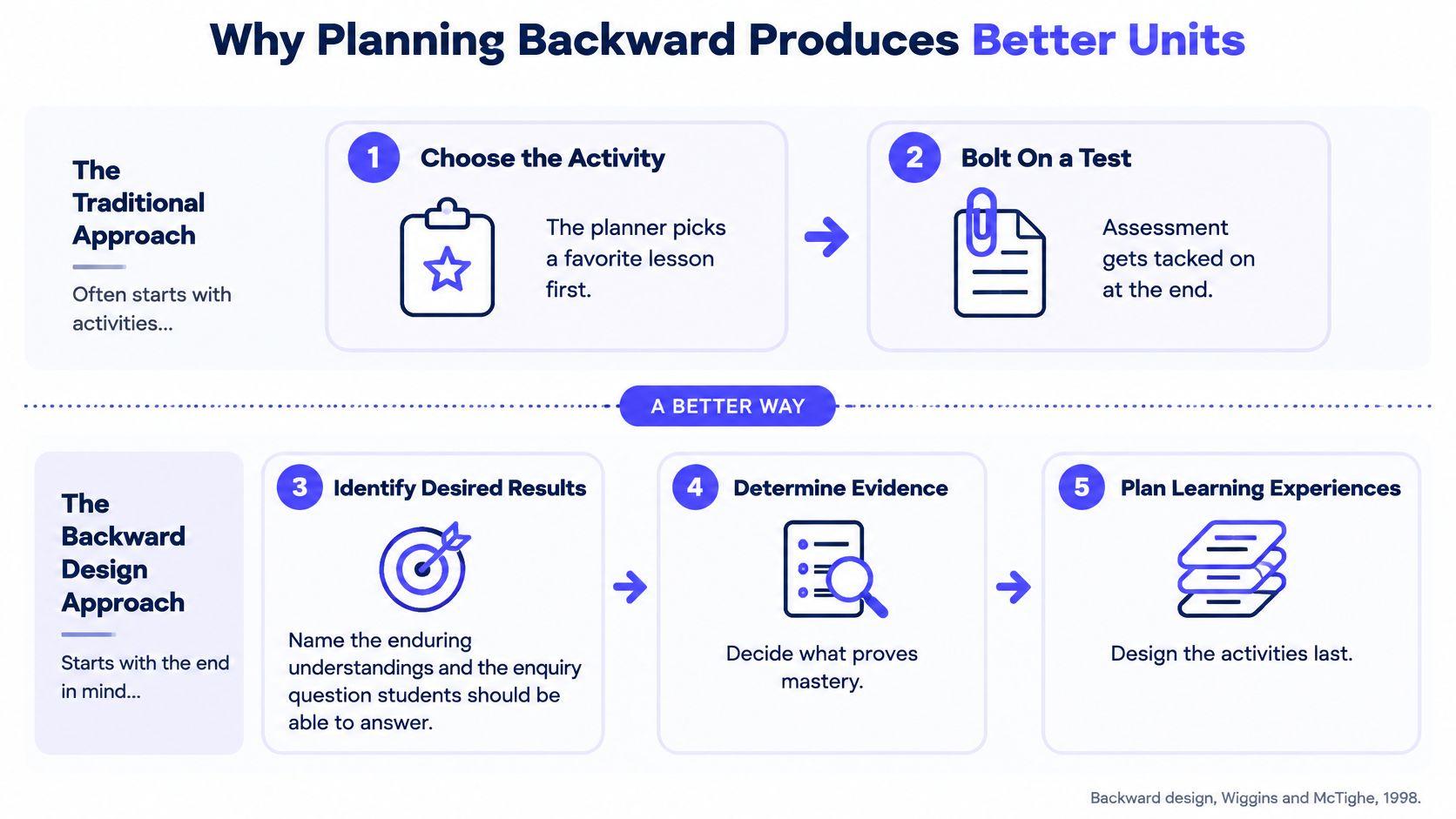
Backward design flips the order. As EBSCO's overview of Understanding by Design explains, Grant Wiggins and Jay McTighe introduced the framework in 1998, and it runs in three stages.
The three stages, in plain terms
- Identify the desired results. Name the enduring understandings, the ideas students should still hold months later, and the question that frames the unit.
- Determine acceptable evidence. Decide what would prove mastery: the assessment tasks, the performance criteria, the quality of a strong answer.
- Plan the learning experiences. Only now do you choose activities and sequence lessons, because you finally know what they have to lead to.
Think about a road trip. You don't pick a playlist and start driving. You choose the destination, work out how you'll know you've arrived, and then plan the route. Backward design is that order applied to a term's worth of lessons.
The same source notes this shifted curriculum planning away from activity-centered preparation toward outcome- and evidence-centered design, and that it scales from a single unit up to a whole course or program. That's reassuring if you've inherited a programme map you can't change. Start with the one unit you're teaching next month.
What it looks like on the page
The lessons come last even though they sit near the top of the page. A finished outline shows connected fields for standards, essential questions, learning objectives, assessments, lesson sequence, instructional resources and differentiation, all pulling in the same direction. The Massachusetts Department of Elementary and Secondary Education describes unit development in the same order: standards, understandings, knowledge and skills first, then evidence, then instruction.
The deletion test: cover your assessment with your hand. If the lessons underneath wouldn't change at all, your objectives are too vague to drive anything.
Here's where new planners get stuck. They write "students will understand equivalent fractions" and then can't build an assessment, because understanding isn't something you can watch. Rewrite it as "students explain why 2/4 and 1/2 sit at the same point on a number line" and both the lesson and the marking criteria appear almost by themselves. The objective is the hinge. Everything else swings on it.
Checking That Standards, Objectives and Assessments Line Up
The alignment failure that costs the most isn't a missing standard. It's a test that measures a different verb than the one you taught.
Say your objective reads "students explain why the denominator changes when adding fractions," and your test item says "define denominator." A student can clear that item with recall and fail the objective, or recall nothing and still explain beautifully. Either way, the mark tells you nothing you can act on.
A working outline behaves like a traceability system: every standard maps to a measurable outcome, a sequence of activities, formative checks, and a summative assessment. The IES guidance on performance assessments is explicit about the sequence: establish the assessment's purpose, list the standards, specify the associated outcomes, then check alignment among instruction, outcomes and assessment. It also recommends the assessment measure the same knowledge and skills the outcomes name, not merely related content, and that it cover every outcome without loading one area.
What one row of the trace holds
For each outcome, the outline should carry six things: the standard identifier, an observable performance verb, the evidence of mastery, the assessment method, the scoring criteria, and the lesson or lessons responsible for teaching it. If you can't fill all six, you've found the gap before your students do.
| Check | Passes when | Red flag |
|---|---|---|
| Every standard has an objective | Nothing is taught that no standard requires | A standard with no lesson or assessment |
| Every objective has evidence | The unit can show mastery of each goal | An objective tested only by a general quiz |
| Test matches the verb | The assessment asks for what the objective says | Objective says explain, but the test only asks for definitions |
| Every lesson serves an objective | Each lesson traces back to a goal | Activities with no objective attached |
Students hit the target more reliably when they can see it during practice, which is the argument for publishing learning intentions and success criteria at the start of a lesson rather than revealing the rubric on marking day. A tool such as Kuraplan keeps objectives, activities and rubrics in one unit plan, so a gap between them shows up as a blank field instead of a surprise in the data.
When the outline was drafted by AI
Generated content makes the alignment check more important, not less. Ipsos survey findings on teachers and AI report that 62% of U.S. K–12 teachers have used AI for work and 54% use it at least weekly for lesson planning or admin, while only 18% had received formal administrator guidance on AI use. At the same time, a 2024 NFER randomized trial across 68 English secondary schools found teachers using ChatGPT spent 56.2 minutes per week preparing lessons and resources against 81.5 minutes in the comparison group. Time saved is real. So is the risk of a standard code that doesn't exist in your document.
Three questions run against any outline, drafted by you or by a machine:
- Does every standard have at least one lesson?
- Does every objective have evidence attached to it?
- Does every lesson point back to an objective?
Three yeses and the unit holds together. Any no and you've found where the marking will hurt.
Sequencing Lessons into a Learning Progression
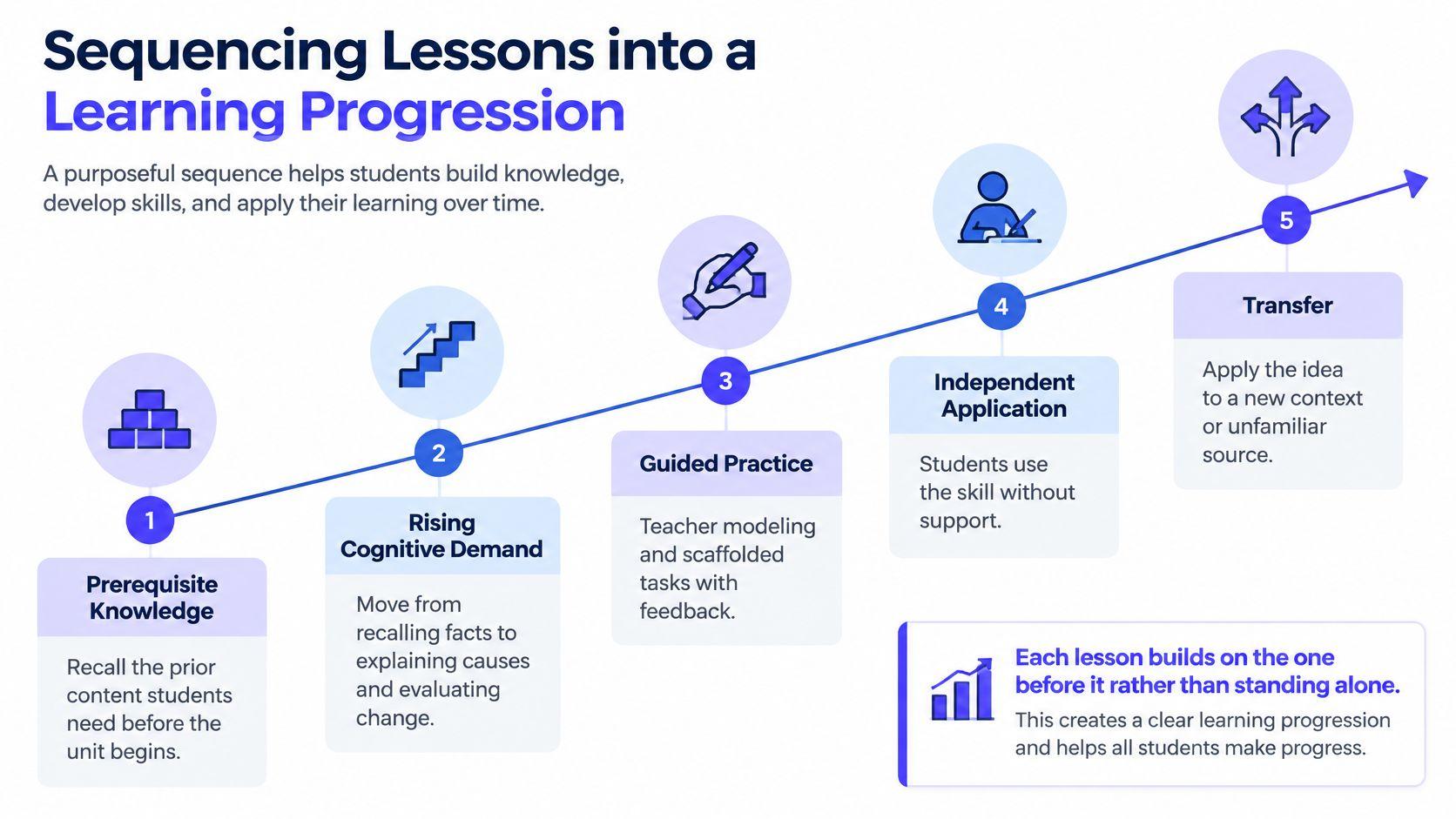
A unit is a staircase, not a stack. The test for a stack is simple: could you swap lesson 7 and lesson 3 without anyone noticing? If yes, you've written a list of activities, not a progression.
A real progression moves through prerequisite knowledge, rising cognitive demand, guided practice, independent application, reflection, and a final demonstration of mastery. The lessons are ordered by dependency. Lesson 7 can't happen before lesson 3 because it assumes what lesson 3 builds.
The progression matrix
The practical tool is a table with six columns: lesson objective, prerequisite or misconception, learning task, differentiation, formative evidence, decision rule. Each column keeps you honest about something different. The prerequisite column stops you teaching into a gap. The misconception column makes you name the wrong idea before you meet it in a hand. The decision rule column is the one people skip, and it's the one that turns the plan into something usable mid-lesson, for example reteaching when fewer than 80% of students demonstrate the target skill, as IES planning guidance describes. That same guidance calls for coherent sequencing, alignment to instructional goals, high-level cognitive activity and differentiation, with students told the unit and lesson goals explicitly and a cycle in which classwork, homework, quizzes and projects all feed back into teaching.
One skill, six moves
Take a single skill, say interpreting a bar graph. Here's the sequence I'd write on one line each:
- Introduce it with a concrete model. A real graph of something the class cares about, read aloud together.
- Practise together with teacher modelling. You think out loud through one question, then a second, then ask for the next step.
- Work in pairs on a shared prompt. Two students, one graph, one set of questions.
- Apply it independently to a new context. A graph they haven't seen, no prompts.
- Check the evidence and decide the next move. Exit ticket, sorted into secured, developing, not yet.
- Demonstrate mastery in a final task. The graph appears inside a longer problem.
Steps 2 to 4 are the gradual release of responsibility, and the reason the order matters is that step 4 fails if step 2 was skipped. Universal Design for Learning pushes the same logic upstream: anticipate barriers at the planning stage and offer multiple means of engagement, representation and action or expression, so the matrix flags who needs a different entry point before the lesson, not after the frustration.
A rubric handed out before the task is a map. The same rubric handed back with the marked work is a post-mortem.
That's why the IES recommends introducing rubrics before the final task. In the IES practice guide on using student achievement data, rubrics are named as a practical tool because they clarify what students are expected to learn and show strengths and weaknesses. Put the rubric on the desk in lesson 4 and students spend the next three lessons aiming at it.
Placing Checkpoints and Deciding What Happens Next
A single test at the end of a unit isn't assessment. It's an autopsy. By the time you have the results, the patient has left the building.
Formative assessment is a repeating loop, and the IES guidance on formative assessment sets out five parts: identify the focal objective or standard, deliver targeted instruction, assess student learning, analyse the results, and give targeted feedback or additional instruction. Then the loop runs again. The cycle continues until students reach the goal, which means reteaching, extra practice and regrouping are expected moves, not evidence that the unit failed.
Where the checks go
Put a short check after every three or four lessons, and name the reteach block that follows a weak result before you teach the sequence. A unit outline listing only topics and one final test has no feedback loop at all.
| Check result | Decision | Next lesson change |
|---|---|---|
| Well short of the target skill | Reteach | Small-group reteach with a new model before advancing |
| Close to the target with mixed errors | Practise | Partner task with a targeted worksheet |
| Same misconception across several students | Reteach the concept | Whole-class mini-lesson on the misconception |
| Consistent independent success | Extend | Challenge task or mixed-problem set |
Once a check shows a gap, the follow-up material has to exist by tomorrow, which is where worksheet generation earns its place. Kuraplan can produce a quick review task from the same objective, so the reteach group has something in hand at the start of the next lesson.
Write the decision rules first
Decisions made at 3pm on a Friday with a pile of exit tickets are not decisions. They're reactions. Write the rule while you're calm: fewer than half secured means whole-class reteach; half to four-fifths means a partner task and a regroup; four-fifths or more means move on and extend. Then a checkpoint takes ten minutes to process instead of an evening of guilt.
Differentiation is not three versions of every worksheet. It's a branching system, and the branching only works if the rules exist in advance. That matters more as more material gets generated: RAND-related findings on teachers' AI use identify instructional planning and preparation as the most common use at 76%, with creating assessments at 61%. Generated material still needs a human routing decision about who gets what.
Time the pair work, don't just suggest it
For primary-grade English learners, the IES recommendation is about 90 minutes per week in which pairs of students with different ability levels or English proficiency work together on an academic task in a structured way, per its practice guide on teaching English learners. That's a planning requirement, not a suggestion to encourage collaboration. Write the minutes, the pairing rule, the task and the language outcome into the outline, with assigned roles and sentence frames so the talk stays academic rather than drifting into social chat. If you want a wider set of quick check formats to plug into the loop, these formative assessment examples cover the practical range.
Protect a reteach slot in the timetable too. A schedule with every minute allocated to whole-class instruction has nowhere to put the reteach the evidence just demanded.
A Worked Example From a Five-Week History Unit

Year 9 history, five weeks, one enquiry question: How did factory work change daily life? Everything in the unit answers it, which is how Kuraplan history units are sequenced, with the assessments and the final project mapped in from week one rather than added at the end.
The standards ask for source analysis, comparison of interpretations, and a sustained written argument. Those become three objectives, and each one is observable:
- Students analyse a primary source, naming its origin, purpose and usefulness.
- Students compare two perspectives on factory conditions and explain the difference.
- Students write a supported evaluative paragraph that reaches a judgement.
Notice what's missing. No objective says "understand the Industrial Revolution," because you can't mark understanding. You can mark a source analysis, a comparison and a paragraph.
The assessment plan
Three checkpoints, spaced so each one produces information the next lesson uses. Week two brings a source analysis task on a child labour testimony. Week four brings a paired debate checkpoint, which is where you find out whether students can hold two perspectives in their heads at once. Week five is the final evaluative paragraph, marked against a rubric students have had since week one.
The lesson pattern you can copy
Every Kuraplan history lesson runs the same shape: an enquiry question, a primary source, a paired analysis task with sentence stems, and a final evaluative paragraph scaffold. Once the pattern is set, preparation for each lesson drops to choosing the source.
That repetition isn't lazy. It's how students stop spending cognitive energy working out what kind of lesson this is and start spending it on the source. For a feel of how a source-led enquiry runs with real classes, this walkthrough is worth the time.
The five weeks, one line at a time
- Week 1, context and wages. What factory work paid, what it replaced, and who took the jobs. Source: a wage table.
- Week 2, child labour and sources. Two testimonies, one from a factory commissioner, one from a worker. Source analysis checkpoint.
- Week 3, urban living. Housing, sanitation, and the argument that factories built the cities that sickened them. Source: a sanitary report.
- Week 4, the perspectives debate. Pairs argue the mill owner and the mill worker, then swap. Paired debate checkpoint.
- Week 5, the final paragraph. Draft, peer feedback against the rubric, rewrite, submit.
When the class moves faster than the plan
Say the week two source analysis comes back strong, with most students naming origin and purpose without prompting. The scaffolded source work in week three is now redundant, so you pull the debate forward into week three and use the recovered week for an extra source set on urban living instead.
The reverse works too. If the debate shows students can hold a perspective but can't compare two, the evaluative paragraph moves to week six and week five becomes comparison practice. The outline survives either way because the objectives and the assessment didn't change. Only the pacing did.
Final Check Before the First Lesson
The night before a unit starts is the last cheap moment to fix it. Once thirty students are in the room, every problem becomes a live problem.
Run six questions against your outline.
- Does every objective use an observable verb and carry at least one assessment? If not, you're teaching something you can't mark.
- Does every lesson name the objective it serves? A lesson that can't name one is a lesson you could delete, or move to a different unit.
- Does a checkpoint sit after every three or four lessons, each with a written decision rule? Checks without rules produce data nobody acts on.
- Does differentiation name supports for English learners, students with access needs, and the students who'll finish early? "Support as needed" is not a plan.
- Is the reteach block already in the timetable? If it isn't, it won't happen.
- Is the outline saved somewhere editable, so week one's evidence can change week three? A printed PDF can't adjust.
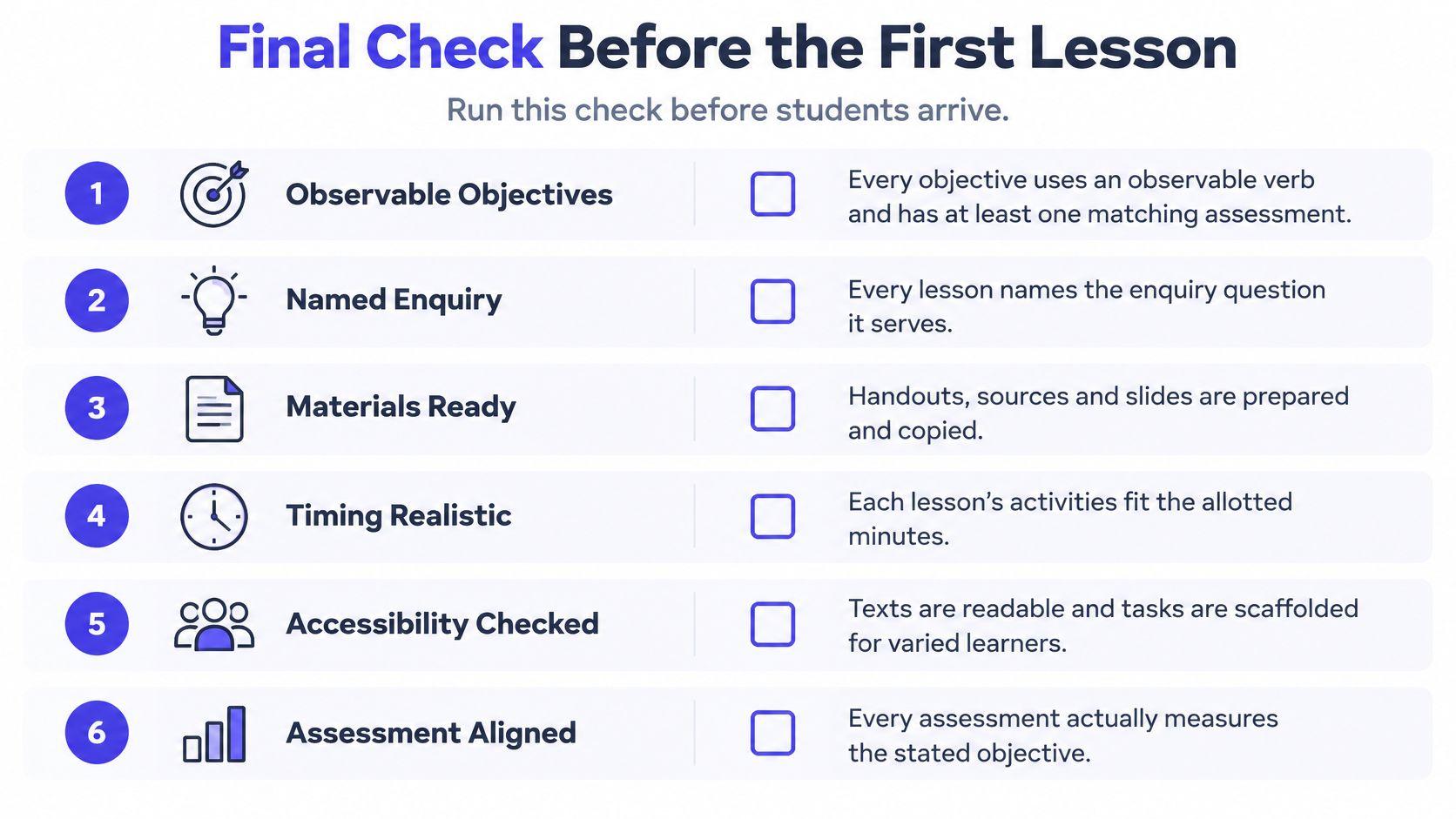
A no on any of these means the unit isn't ready, and the fix belongs to tonight rather than to the Friday when the first check reveals it. Work through the noes in order, starting with the objectives, because the other five depend on them.
This is the part of the job Kuraplan was built for. Its unit planner designs complete unit plans with interconnected lessons, every plan and worksheet is editable so you can adjust anything to your class and teaching style, while a KuraPlan Pro account at $9 USD per month includes the unit planner, the lesson planner, worksheet and slideshow generation, advanced curriculum alignment and the lesson plan library. Write the first version, teach lesson one, collect the evidence, then revise. The second version, built on what students showed you, is the one worth keeping for next year.
The chain only holds if every link is written down somewhere you can see it at a glance, and that's exactly the page Kuraplan's unit planner produces: standards, objectives, sequenced lessons and assessments in one editable plan, so a weak link shows up before the marking does. You can adjust every lesson and worksheet to your class, reuse the outline next term, and spend the planning minutes you've saved on the students in front of you. Start your first unit outline at Kuraplan.