EnglishFreePrintable

Author Purpose in Non-Fiction

A free english worksheet ready for your classroom. Open in Kuraplan to grab the print-ready PDF, customize it for your students, or generate a fresh version in seconds.
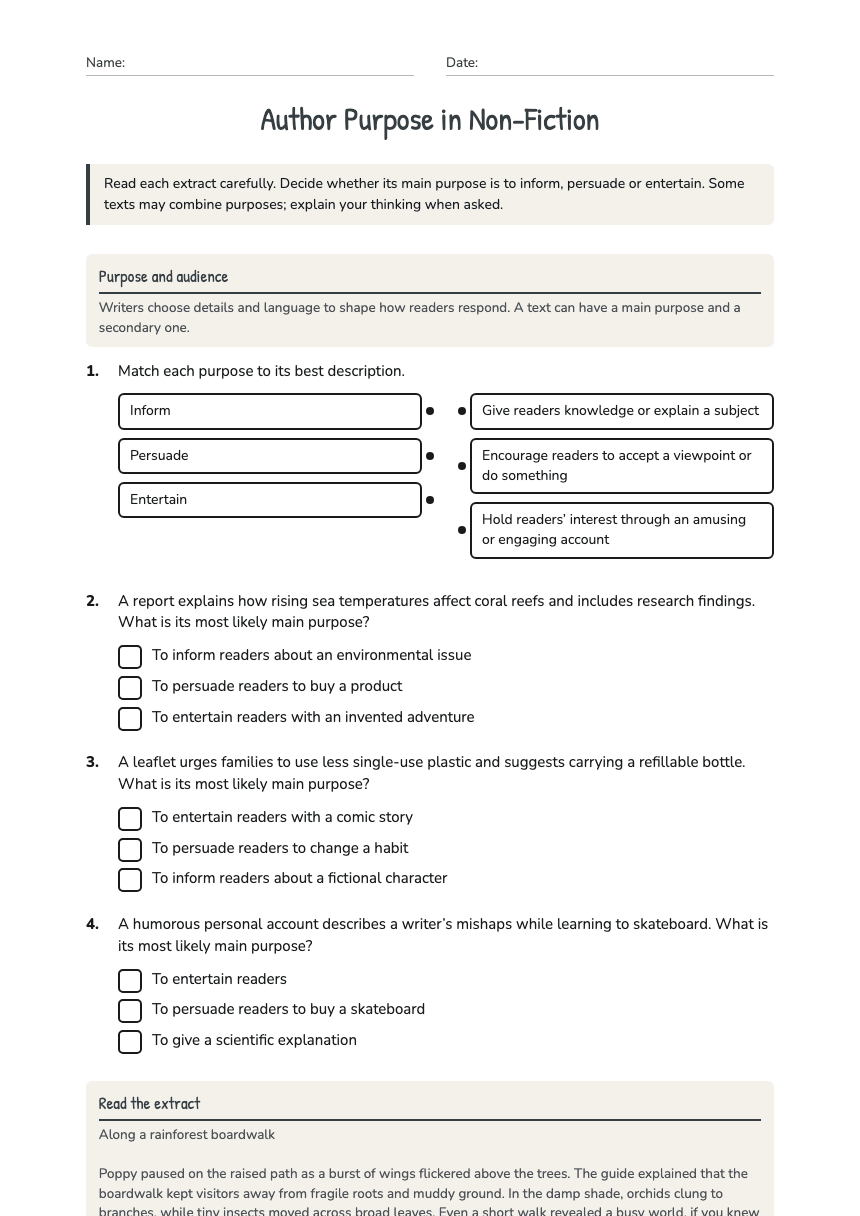
Author Purpose in Non-Fiction worksheet preview
Name:Date:

Author Purpose in Non-Fiction

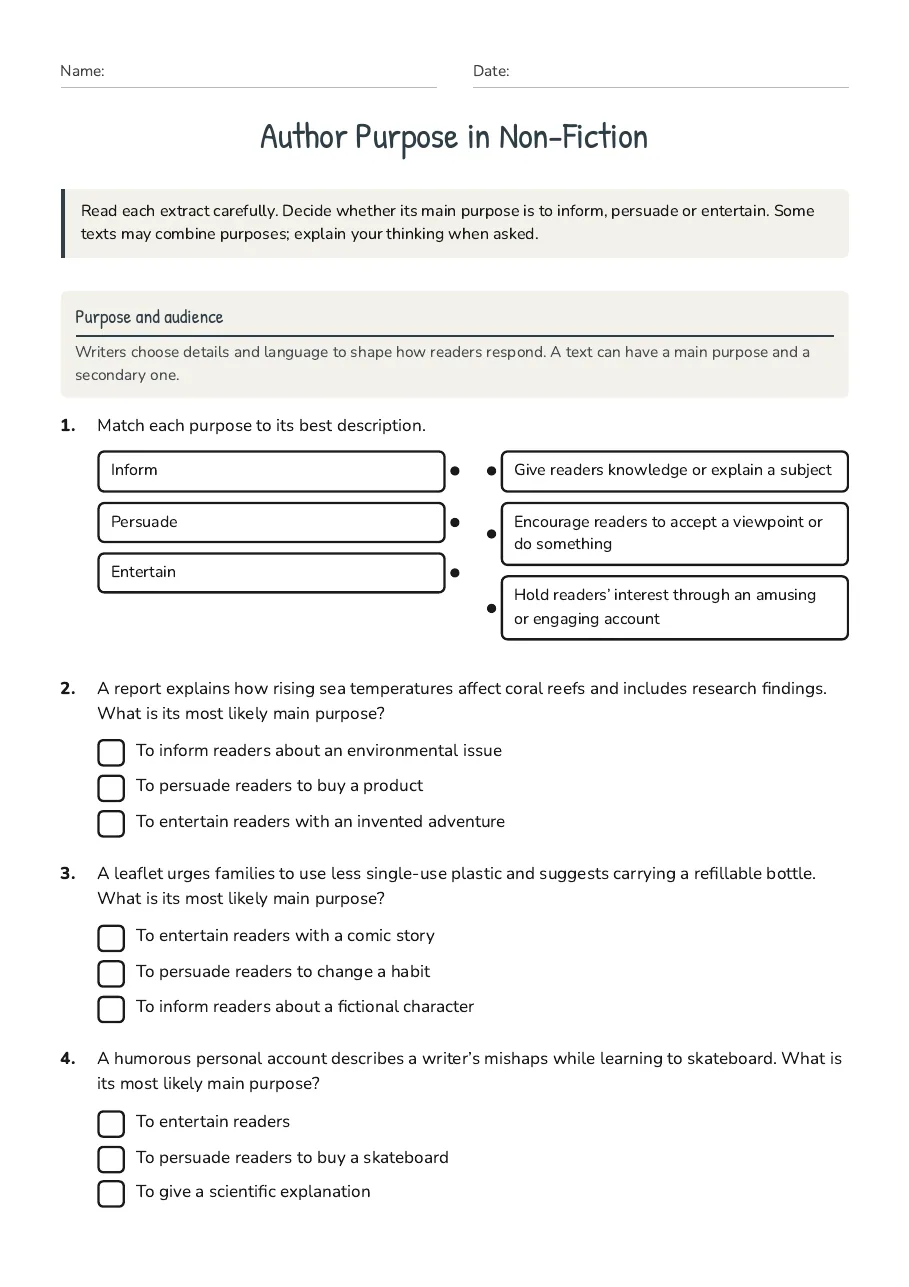
Read each extract carefully. Decide whether its main purpose is to inform, persuade or entertain. Some texts may combine purposes; explain your thinking when asked.

Purpose and audience

Writers choose details and language to shape how readers respond. A text can have a main purpose and a secondary one.

1.Match each purpose to its best description.
  • Inform
  • Persuade
  • Entertain
  • Give readers knowledge or explain a subject
  • Encourage readers to accept a viewpoint or do something
  • Hold readers’ interest through an amusing or engaging account
2.A report explains how rising sea temperatures affect coral reefs and includes research findings. What is its most likely main purpose?
  • To inform readers about an environmental issue
  • To persuade readers to buy a product
  • To entertain readers with an invented adventure
3.A leaflet urges families to use less single-use plastic and suggests carrying a refillable bottle. What is its most likely main purpose?
  • To entertain readers with a comic story
  • To persuade readers to change a habit
  • To inform readers about a fictional character
4.A humorous personal account describes a writer’s mishaps while learning to skateboard. What is its most likely main purpose?
  • To entertain readers
  • To persuade readers to buy a skateboard
  • To give a scientific explanation

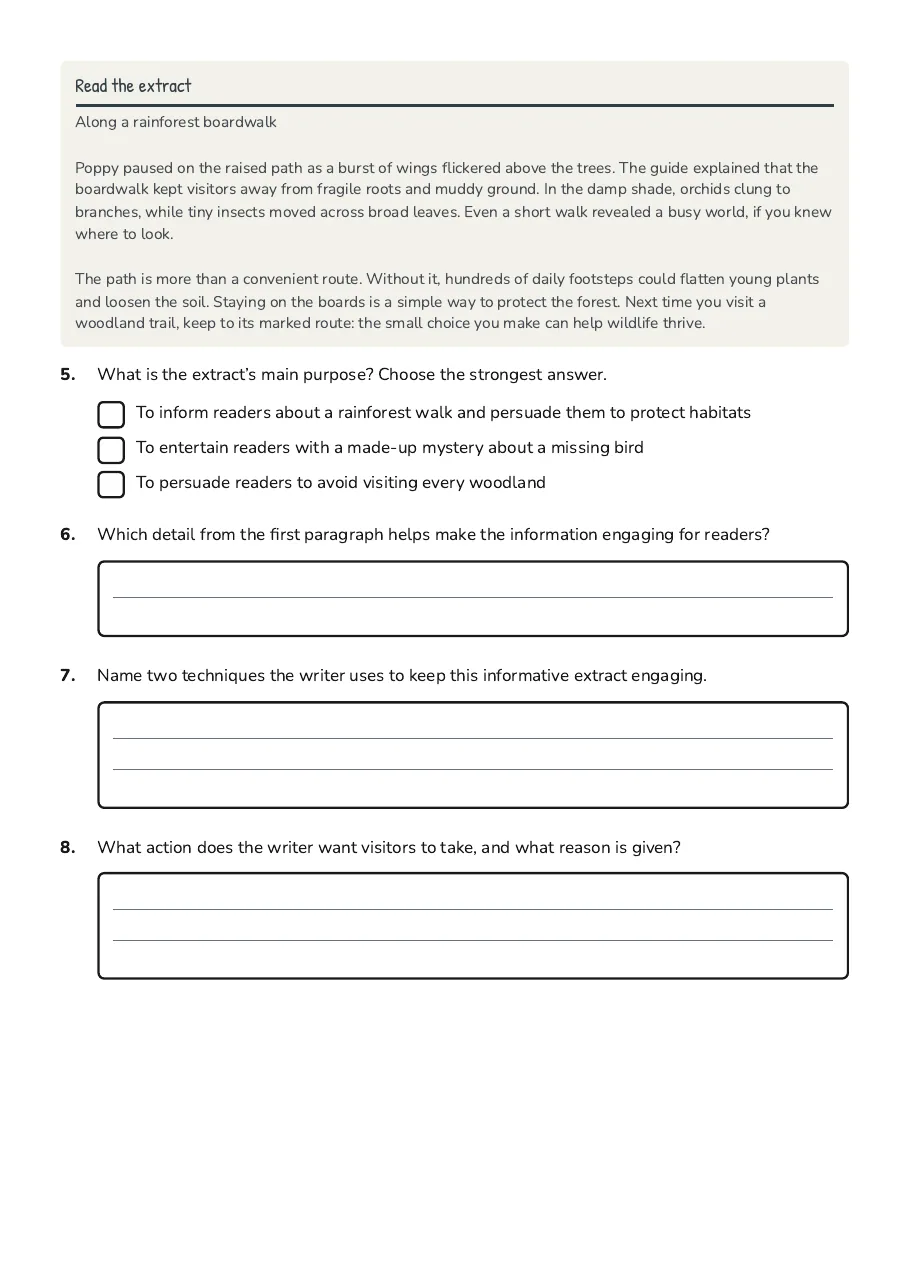
Read the extract

Along a rainforest boardwalk Poppy paused on the raised path as a burst of wings flickered above the trees. The guide explained that the boardwalk kept visitors away from fragile roots and muddy ground. In the damp shade, orchids clung to branches, while tiny insects moved across broad leaves. Even a short walk revealed a busy world, if you knew where to look. The path is more than a convenient route. Without it, hundreds of daily footsteps could flatten young plants and loosen the soil. Staying on the boards is a simple way to protect the forest. Next time you visit a woodland trail, keep to its marked route: the small choice you make can help wildlife thrive.

5.What is the extract’s main purpose? Choose the strongest answer.
  • To inform readers about a rainforest walk and persuade them to protect habitats
  • To entertain readers with a made-up mystery about a missing bird
  • To persuade readers to avoid visiting every woodland
6.Which detail from the first paragraph helps make the information engaging for readers?
7.Name two techniques the writer uses to keep this informative extract engaging.
8.What action does the writer want visitors to take, and what reason is given?

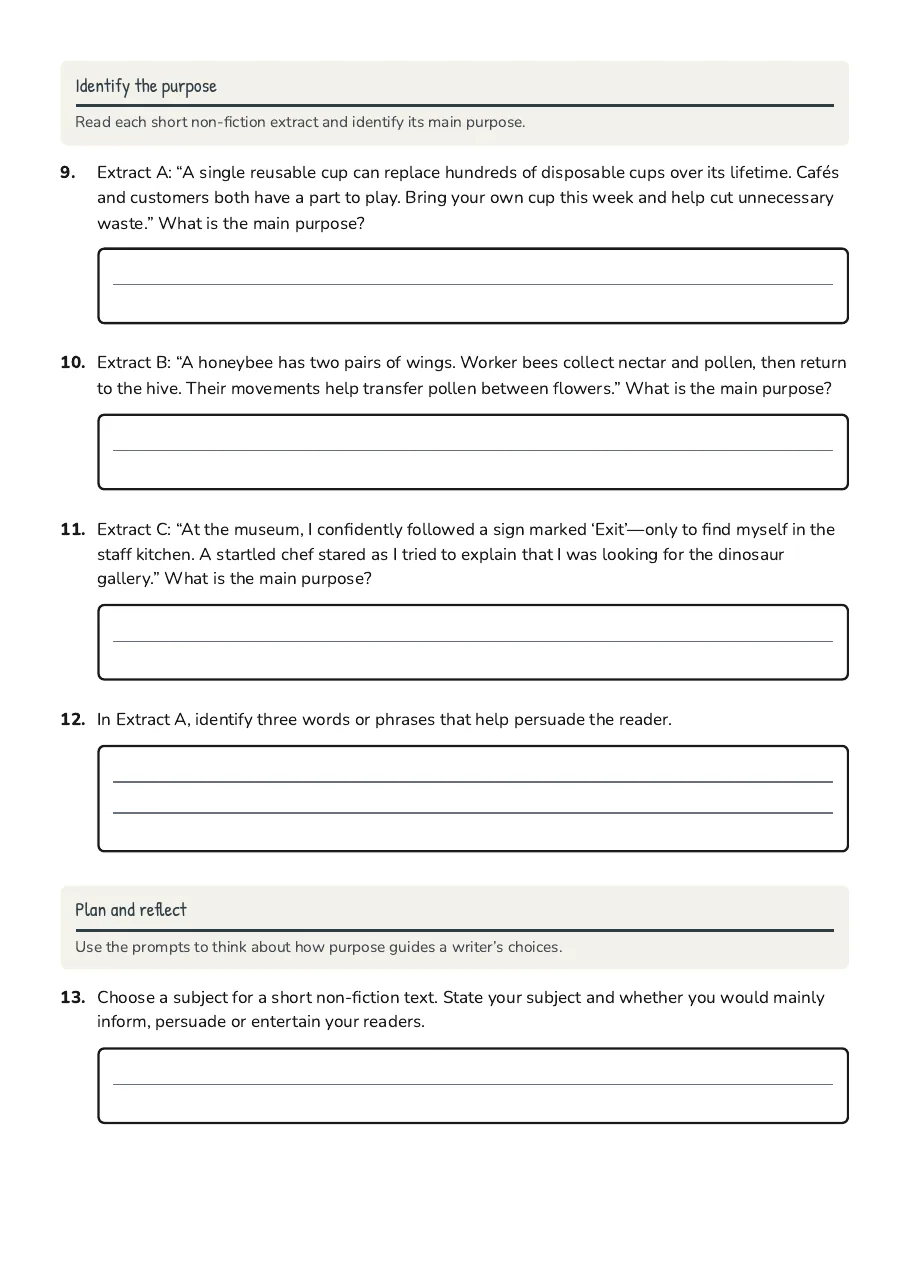
Identify the purpose

Read each short non-fiction extract and identify its main purpose.

9.Extract A: “A single reusable cup can replace hundreds of disposable cups over its lifetime. Cafés and customers both have a part to play. Bring your own cup this week and help cut unnecessary waste.” What is the main purpose?
10.Extract B: “A honeybee has two pairs of wings. Worker bees collect nectar and pollen, then return to the hive. Their movements help transfer pollen between flowers.” What is the main purpose?
11.Extract C: “At the museum, I confidently followed a sign marked ‘Exit’—only to find myself in the staff kitchen. A startled chef stared as I tried to explain that I was looking for the dinosaur gallery.” What is the main purpose?
12.In Extract A, identify three words or phrases that help persuade the reader.

Plan and reflect

Use the prompts to think about how purpose guides a writer’s choices.

13.Choose a subject for a short non-fiction text. State your subject and whether you would mainly inform, persuade or entertain your readers.
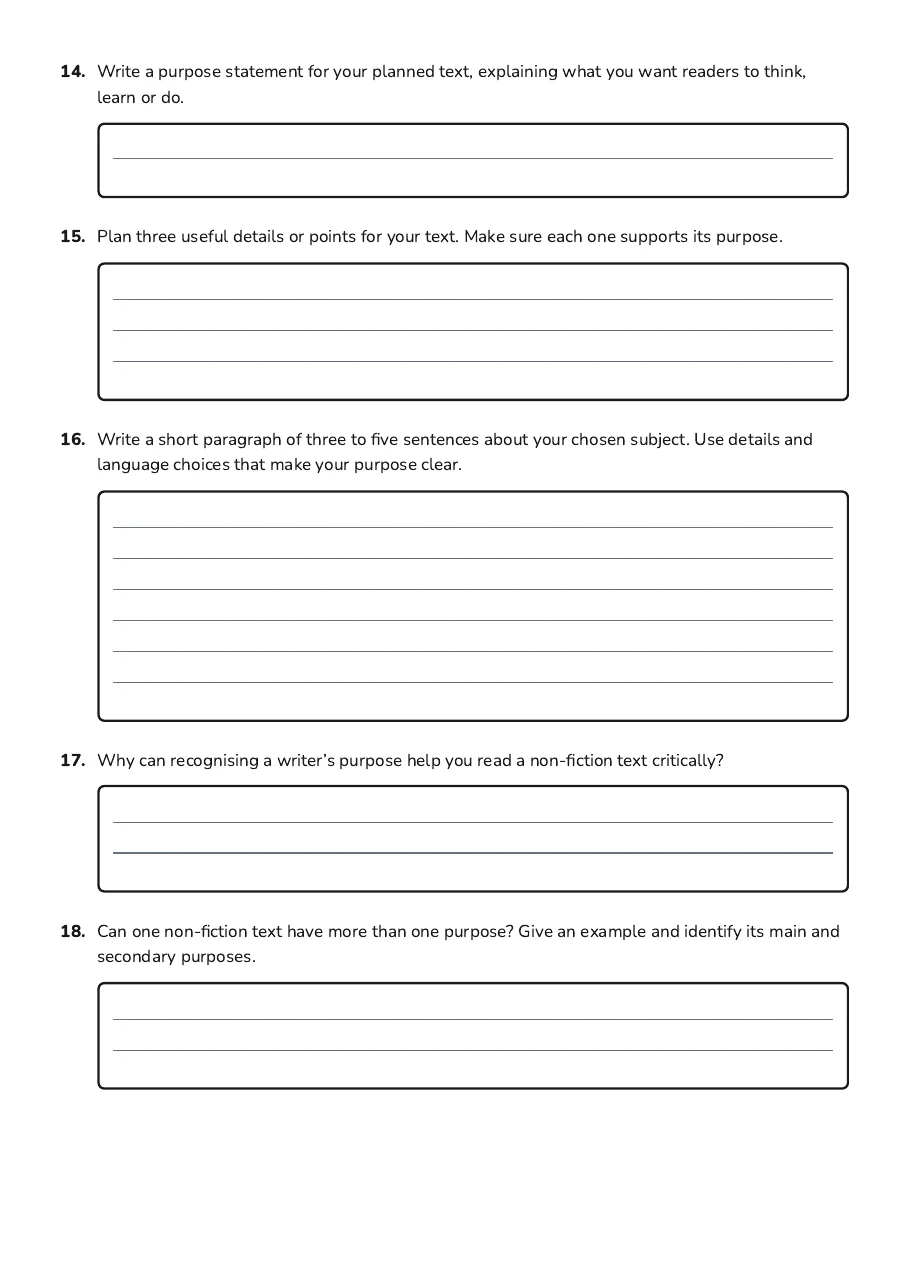
14.Write a purpose statement for your planned text, explaining what you want readers to think, learn or do.
15.Plan three useful details or points for your text. Make sure each one supports its purpose.
16.Write a short paragraph of three to five sentences about your chosen subject. Use details and language choices that make your purpose clear.
17.Why can recognising a writer’s purpose help you read a non-fiction text critically?
18.Can one non-fiction text have more than one purpose? Give an example and identify its main and secondary purposes.

4 printable pages

  • Author Purpose in Non-Fiction, page 1 of 4: Purpose and audience

    Page 1

  • Author Purpose in Non-Fiction, page 2 of 4: Read the extract

    Page 2

  • Author Purpose in Non-Fiction, page 3 of 4: Identify the purpose, Plan and reflect

    Page 3

  • Author Purpose in Non-Fiction, page 4 of 4: 14. Write a purpose statement for your planned text, explaining what you want readers to…

    Page 4

About This Worksheet

Free in Kuraplan

Sign up free, grab the PDF, and customize it for your class.

Print-Ready

Formatted for standard paper. Clean layout, easy to read.

AI-Generated

Created with Kuraplan's AI, designed for real classroom use.

For Teachers & Parents

Use in classrooms, for homework, tutoring, or homeschool.

Need a custom version of this worksheet?

Kuraplan's AI generates custom worksheets in seconds — differentiated for every learner, aligned to your curriculum.

Generate Custom Worksheets — Free
No credit card Curriculum-aligned Under 60 seconds