Braking Distance Decisions
A free science worksheet ready for your classroom. Open in Kuraplan to grab the print-ready PDF, customize it for your students, or generate a fresh version in seconds.
Braking Distance Decisions
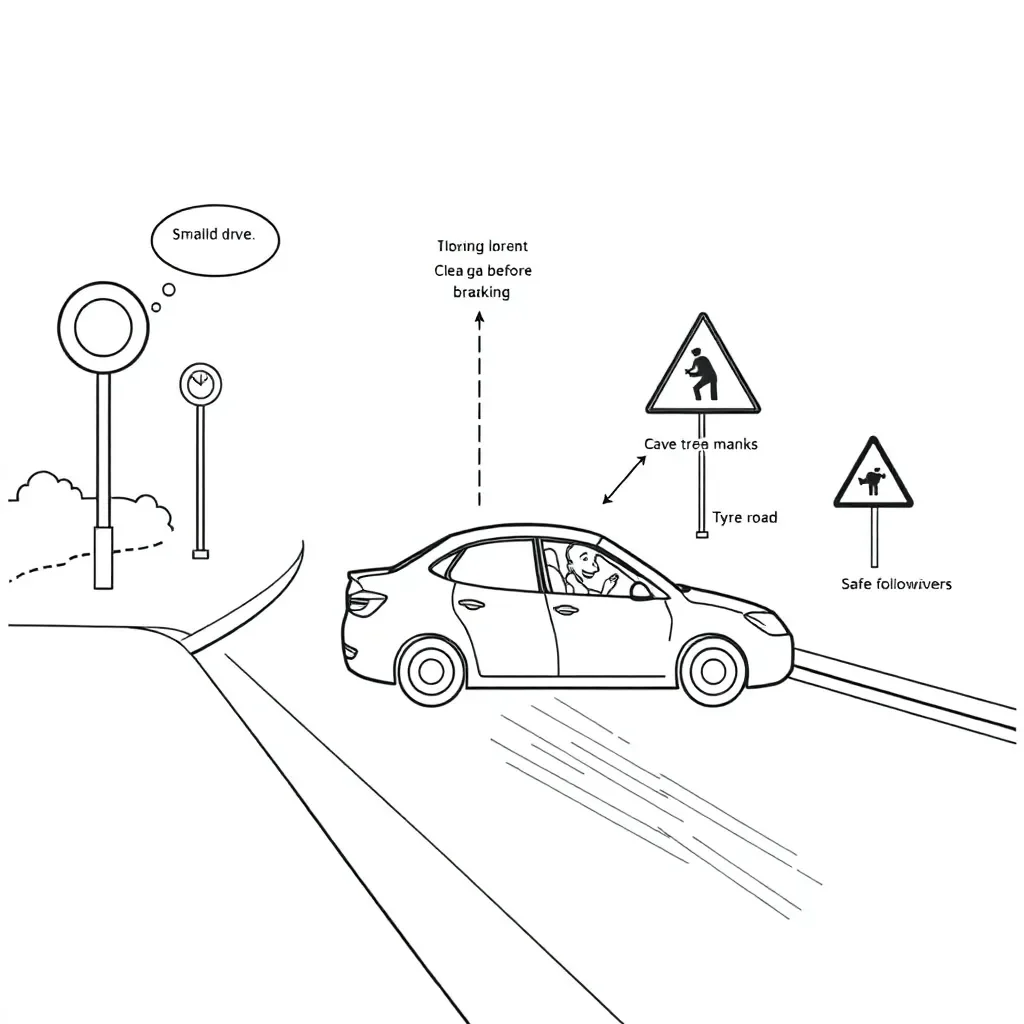
Part 1: Understand the science
Learning intentions: Explain how speed, reaction time and road conditions affect stopping distance; distinguish between thinking distance, braking distance and total stopping distance; use evidence to explain safer road decisions.
Success criteria: I can define the three distances, interpret data accurately, explain the effects of risk factors and justify a safe response.
Road-safety note: These are simplified examples for science education. They are not driving instructions and should not be used to encourage learners to drive.
Answers: A–____ B–____ C–____ D–____
Simplified example data: The figures below are illustrative averages, not universal exact values. Real stopping distances vary with the vehicle, driver, tyres, brakes, road surface, weather, gradient and load.
Speed (mph) Thinking distance (m) Braking distance (m) Total stopping distance (m)
20 6 6 12
30 9 14 23
40 12 24 36
50 15 38 53
60 18 55 73
Word bank: reaction time, speed, hazard, thinking distance, braking distance, total stopping distance, deceleration, friction, grip, wet road, safe gap, visibility.
Part 2: Make safe, evidence-based decisions
Sentence starters: “The safest response is…” “This reduces risk because…” “The data shows…” “Braking distance may increase when…”
One key fact I have learned:
One safety action that reduces risk:
My confidence rating: 1 2 3 4 5 Circle one.
Teacher answer key
1. Diagram: The correct order is starting point or hazard noticed, thinking distance, brakes applied, braking distance, final stopping point. Total stopping distance runs from the hazard being noticed to the vehicle stopping.
2. Matching: A–2, B–1, C–4, D–3.
3. Calculation: Thinking distance + braking distance = total stopping distance. At 40 mph: 12 m + 24 m = 36 m.
4. Indicative answers: Thinking distance increases as speed increases: 6 m at 20 mph to 18 m at 60 mph. Braking distance also increases, and it increases more rapidly: 6 m at 20 mph to 55 m at 60 mph. Total stopping distance increases as speed increases.
5. Calculation and interpretation: At 30 mph the total is 23 m. At 60 mph the total is 73 m. The difference is 73 − 23 = 50 m. The higher speed gives much less time and distance to respond, so the risk of collision is greater.
6. Wet road: Safest responses include reducing speed early, increasing the gap and avoiding sudden braking or steering. Water can reduce friction and grip, increasing braking distance. The queue means more stopping distance is needed.
7. Tired or distracted driver: The safest response is to stop the journey safely and remove the distraction, or regain full attention before continuing. Tiredness and distraction can increase reaction time, so thinking distance increases. The vehicle may travel further before braking begins.
8. Following too closely: The safest response is to increase the gap and reduce speed if necessary. A larger gap provides more time for reaction and more space for total stopping distance. If the vehicle ahead brakes suddenly, a small gap may not be enough.
9. Indicative response: Wet conditions can reduce friction and grip, which can increase braking distance and therefore total stopping distance. Tiredness can increase reaction time, so thinking distance increases. The simplified data shows total stopping distance rising from 23 m at 30 mph to 73 m at 60 mph. A safer response is to reduce speed, increase the gap and avoid driving when tired or distracted.
10. Exit ticket: Accept accurate key facts such as “total stopping distance equals thinking distance plus braking distance”. Suitable safety actions include reducing speed, increasing the gap, avoiding distractions or not travelling when tired. Confidence rating is the learner’s own assessment.
About This Worksheet
Free in Kuraplan
Sign up free, grab the PDF, and customize it for your class.
Print-Ready
Formatted for standard paper. Clean layout, easy to read.
AI-Generated
Created with Kuraplan's AI, designed for real classroom use.
For Teachers & Parents
Use in classrooms, for homework, tutoring, or homeschool.
Need a custom version of this worksheet?
Kuraplan's AI generates custom worksheets in seconds — differentiated for every learner, aligned to your curriculum.
Generate Custom Worksheets — Free