ScienceFreePrintable

Forces and Motion Calculations

A free science worksheet ready for your classroom. Open in Kuraplan to grab the print-ready PDF, customize it for your students, or generate a fresh version in seconds.
Forces and Motion Calculations worksheet preview
Name:Date:

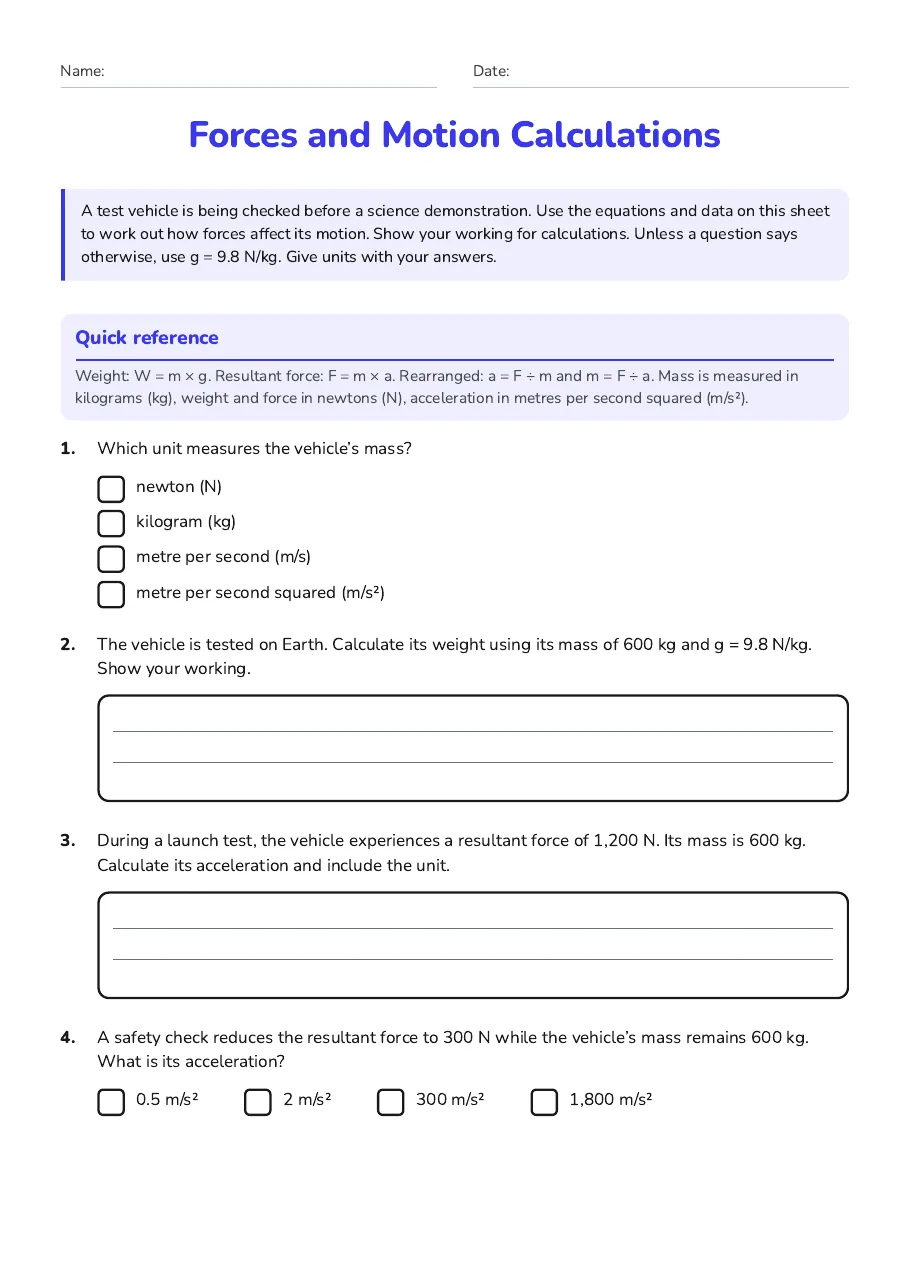
Forces and Motion Calculations

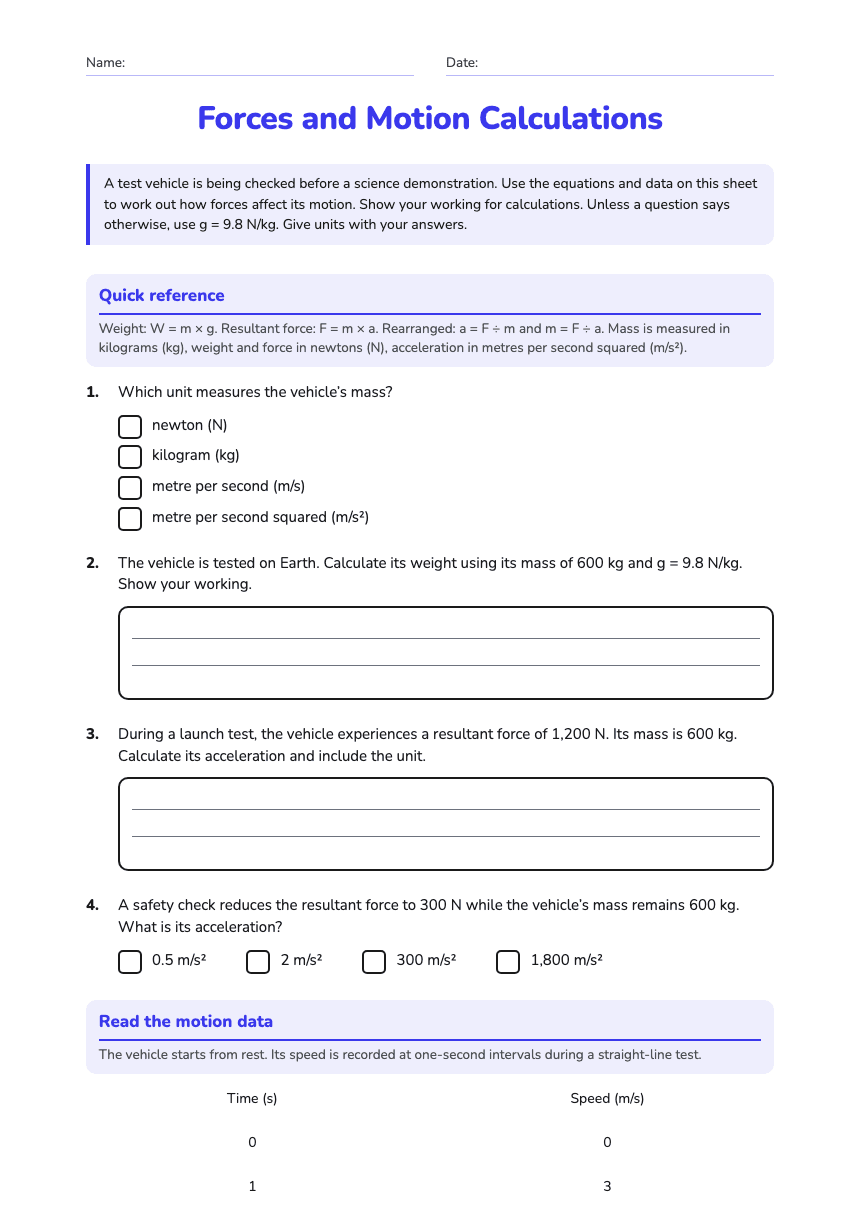
A test vehicle is being checked before a science demonstration. Use the equations and data on this sheet to work out how forces affect its motion. Show your working for calculations. Unless a question says otherwise, use g = 9.8 N/kg. Give units with your answers.

Quick reference

Weight: W = m × g. Resultant force: F = m × a. Rearranged: a = F ÷ m and m = F ÷ a. Mass is measured in kilograms (kg), weight and force in newtons (N), acceleration in metres per second squared (m/s²).

1.Which unit measures the vehicle’s mass?
  • newton (N)
  • kilogram (kg)
  • metre per second (m/s)
  • metre per second squared (m/s²)
2.The vehicle is tested on Earth. Calculate its weight using its mass of 600 kg and g = 9.8 N/kg. Show your working.
3.During a launch test, the vehicle experiences a resultant force of 1,200 N. Its mass is 600 kg. Calculate its acceleration and include the unit.
4.A safety check reduces the resultant force to 300 N while the vehicle’s mass remains 600 kg. What is its acceleration?
  • 0.5 m/s²
  • 2 m/s²
  • 300 m/s²
  • 1,800 m/s²

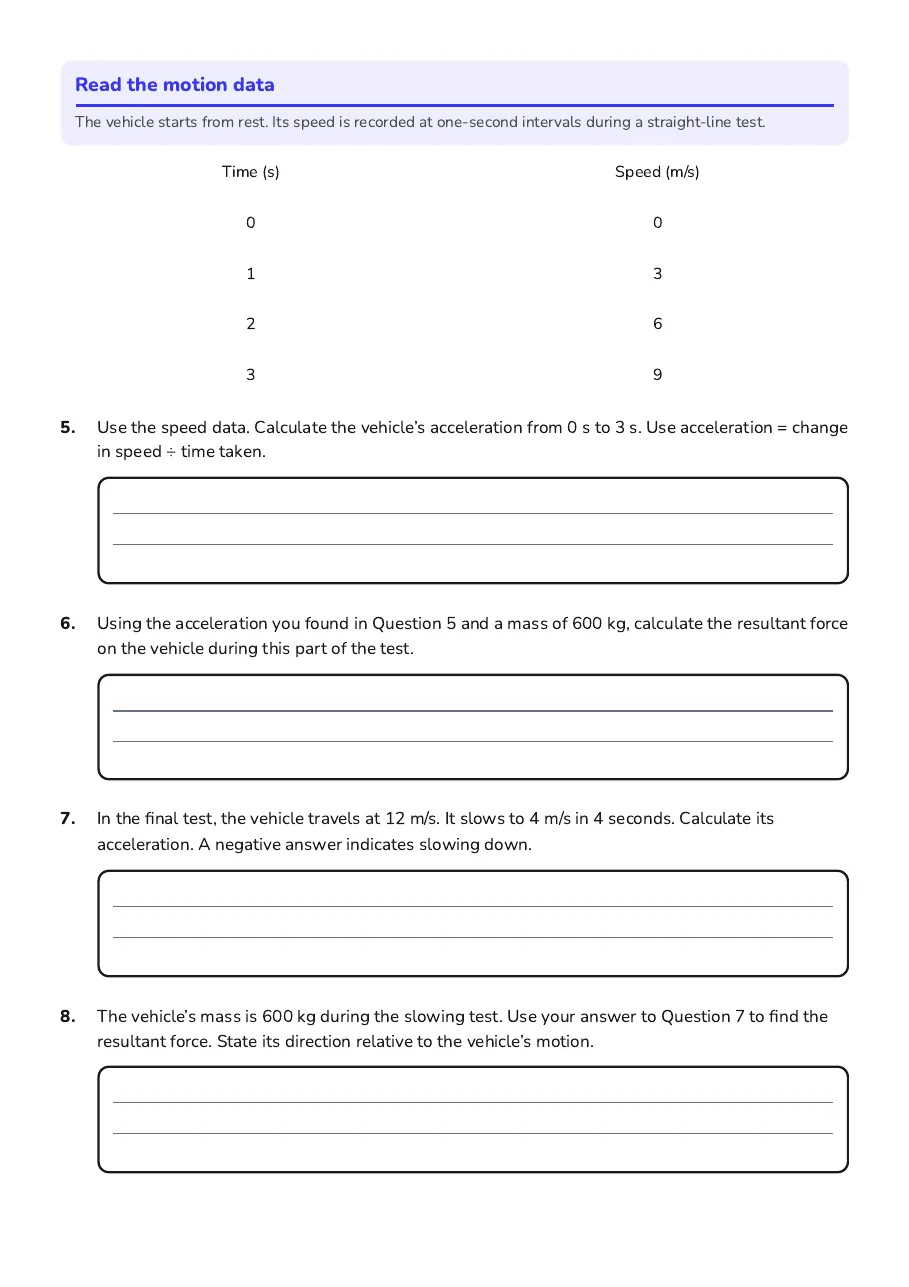
Read the motion data

The vehicle starts from rest. Its speed is recorded at one-second intervals during a straight-line test.

Time (s)

Speed (m/s)

0

0

1

3

2

6

3

9

5.Use the speed data. Calculate the vehicle’s acceleration from 0 s to 3 s. Use acceleration = change in speed ÷ time taken.
6.Using the acceleration you found in Question 5 and a mass of 600 kg, calculate the resultant force on the vehicle during this part of the test.
7.In the final test, the vehicle travels at 12 m/s. It slows to 4 m/s in 4 seconds. Calculate its acceleration. A negative answer indicates slowing down.
8.The vehicle’s mass is 600 kg during the slowing test. Use your answer to Question 7 to find the resultant force. State its direction relative to the vehicle’s motion.
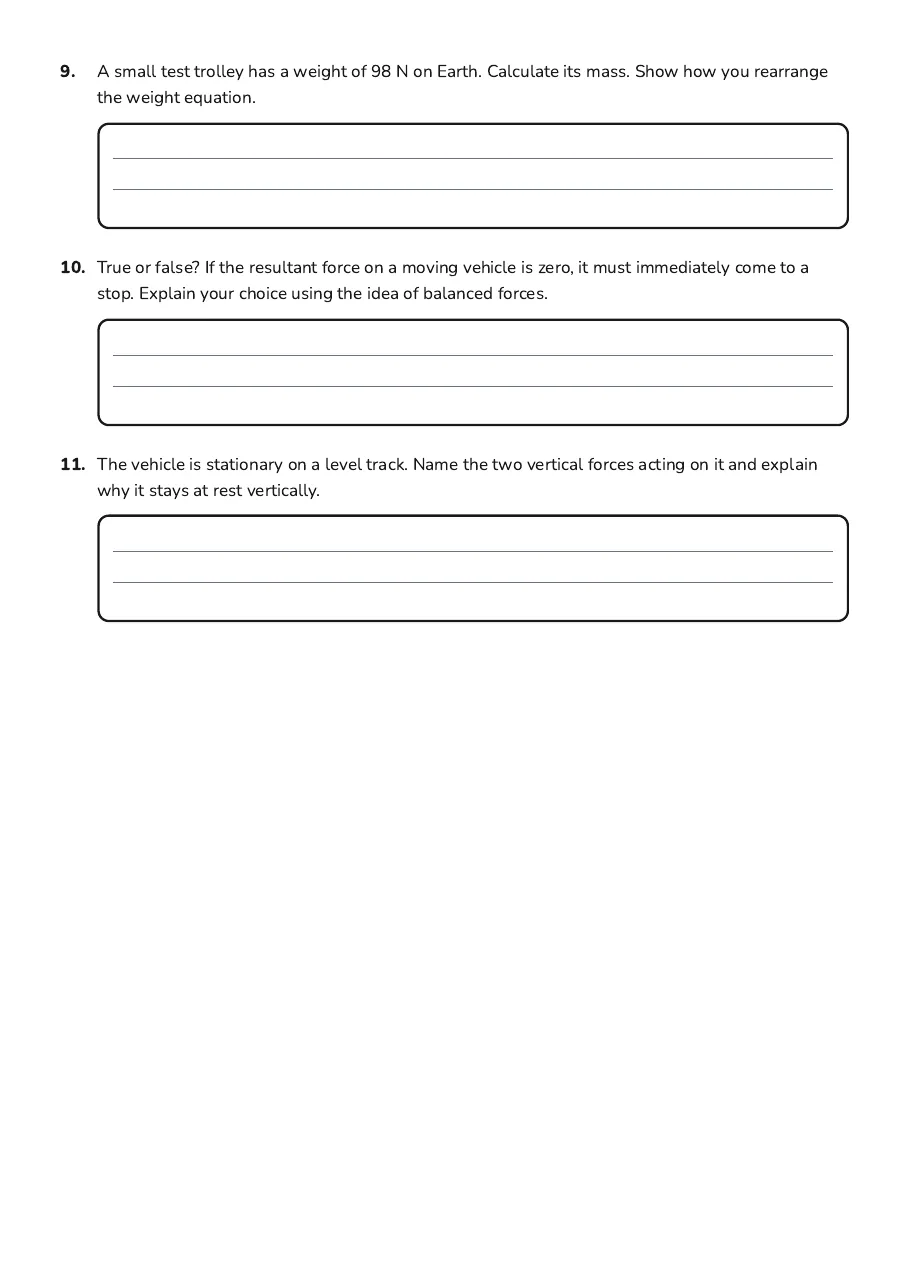
9.A small test trolley has a weight of 98 N on Earth. Calculate its mass. Show how you rearrange the weight equation.
10.True or false? If the resultant force on a moving vehicle is zero, it must immediately come to a stop. Explain your choice using the idea of balanced forces.
11.The vehicle is stationary on a level track. Name the two vertical forces acting on it and explain why it stays at rest vertically.

3 printable pages

  • Forces and Motion Calculations, page 1 of 3: Quick reference

    Page 1

  • Forces and Motion Calculations, page 2 of 3: Read the motion data

    Page 2

  • Forces and Motion Calculations, page 3 of 3: 9. A small test trolley has a weight of 98 N on Earth. Calculate its mass. Show how you…

    Page 3

About This Worksheet

Free in Kuraplan

Sign up free, grab the PDF, and customize it for your class.

Print-Ready

Formatted for standard paper. Clean layout, easy to read.

AI-Generated

Created with Kuraplan's AI, designed for real classroom use.

For Teachers & Parents

Use in classrooms, for homework, tutoring, or homeschool.

Need a custom version of this worksheet?

Kuraplan's AI generates custom worksheets in seconds — differentiated for every learner, aligned to your curriculum.

Generate Custom Worksheets — Free
No credit card Curriculum-aligned Under 60 seconds