Christmas Reading Skills Exam
A free english worksheet ready for your classroom. Open in Kuraplan to grab the print-ready PDF, customize it for your students, or generate a fresh version in seconds.
Christmas Reading Skills Exam

📖 Part 1: Reading Comprehension
Text A: Christmas Pudding Tradition
Dyslexia-friendly option: Ask your teacher for the audio version or larger font text.
Christmas pudding has been a British tradition for over 400 years. Originally called "plum pudding," it contains no plums but gets its name from the dried fruits used. Families traditionally make their pudding on "Stir-up Sunday" - the last Sunday before Advent begins. Each family member stirs the mixture clockwise and makes a secret wish. The pudding is then aged for several weeks, allowing the flavours to develop. On Christmas Day, the pudding is served flambéed with brandy, creating a spectacular blue flame that delights children and adults alike.
Text B: Boxing Day Origins
Boxing Day, celebrated on 26th December, has fascinating origins dating back to medieval times. Wealthy families would give their servants a day off and present them with gift boxes containing food, money, or leftover presents. Churches also opened their collection boxes for the poor on this day, distributing the contents to those in need. Today, Boxing Day is a bank holiday in the UK and many Commonwealth countries. It's become synonymous with football matches, shopping sales, and visiting extended family members who weren't seen on Christmas Day.
🎯 Part 2: Language Skills
Words: tinsel, reindeer, angel, pudding, mistletoe, crackers
1. _______________ 2. _______________ 3. _______________
4. _______________ 5. _______________ 6. _______________
Words to find: HOLLY, SNOW, GIFTS, CAROL, SANTA, BELLS
H O L L Y T R
S A N T A Q W
N B E L L S E
O P R T Y U R
W G I F T S T
C A R O L M Y
⭐ Success Criteria & Extension
To achieve Level 3, you should:
• Identify main ideas and supporting details from complex texts
• Make comparisons between different texts
• Use context clues to understand vocabulary
• Write clearly using appropriate formal language
Extension Activity: Research another Christmas tradition from a different country. Write a 150-word summary comparing it to British traditions, using the same formal style as the texts above.
About This Worksheet
Free in Kuraplan
Sign up free, grab the PDF, and customize it for your class.
Print-Ready
Formatted for standard paper. Clean layout, easy to read.
AI-Generated
Created with Kuraplan's AI, designed for real classroom use.
For Teachers & Parents
Use in classrooms, for homework, tutoring, or homeschool.
Need a custom version of this worksheet?
Kuraplan's AI generates custom worksheets in seconds — differentiated for every learner, aligned to your curriculum.
Generate Custom Worksheets — FreeMore English Worksheets
Willow Park Cricket
Free
Year 5 Reading Comprehension
Free
Year 5 Comprehension Worksheet
Free
Year 5 English Comprehension
Free
Inference Reading Skills Worksheet
Free
Inventive Solutions Through History
Free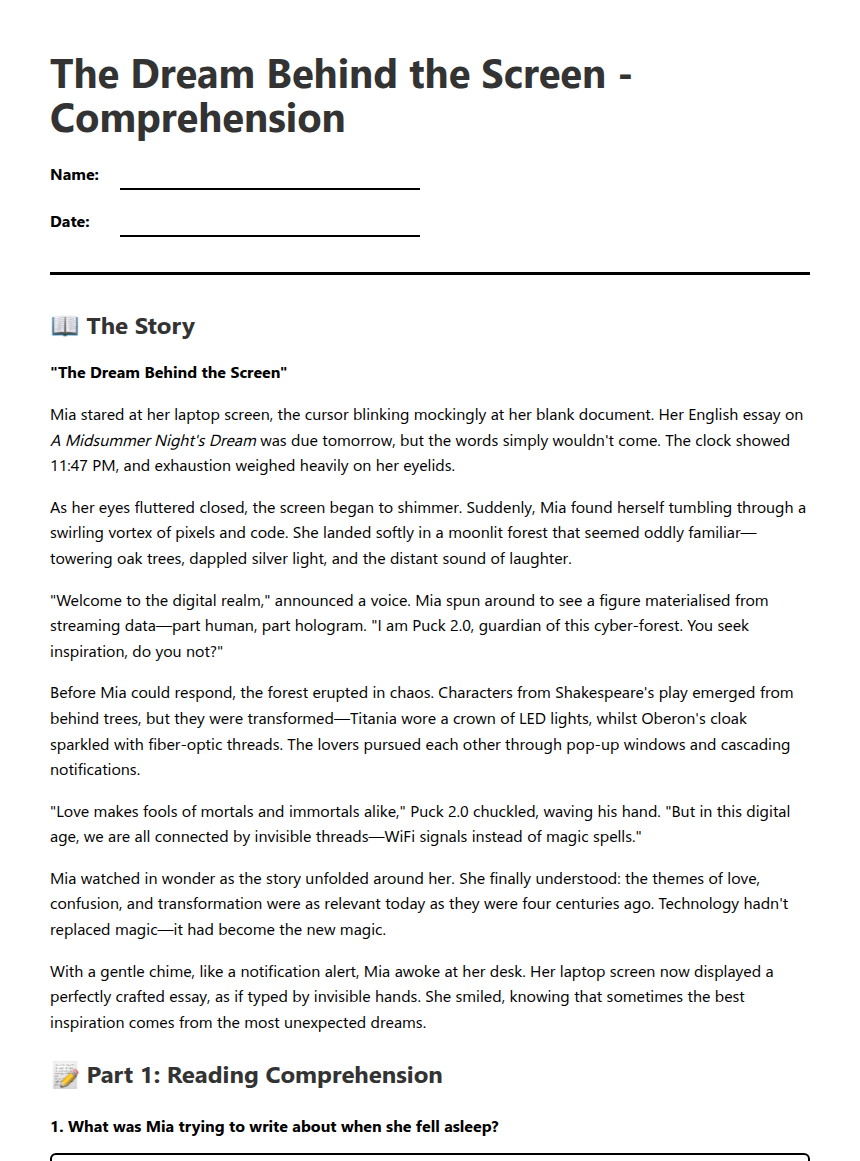
Dream Behind the Screen Comprehension
Free