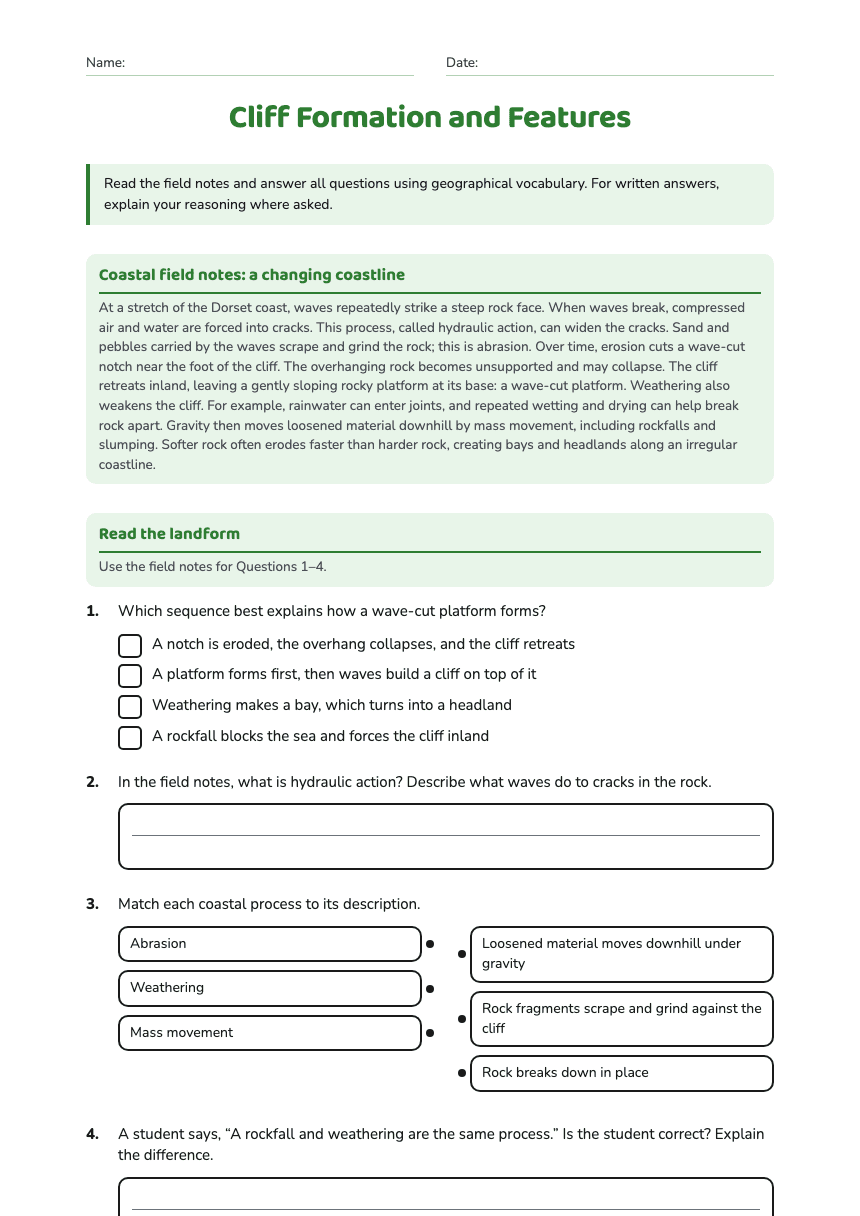
Cliff Formation and Features
A free geography worksheet ready for your classroom. Open in Kuraplan to grab the print-ready PDF, customize it for your students, or generate a fresh version in seconds.
Cliff Formation and Features
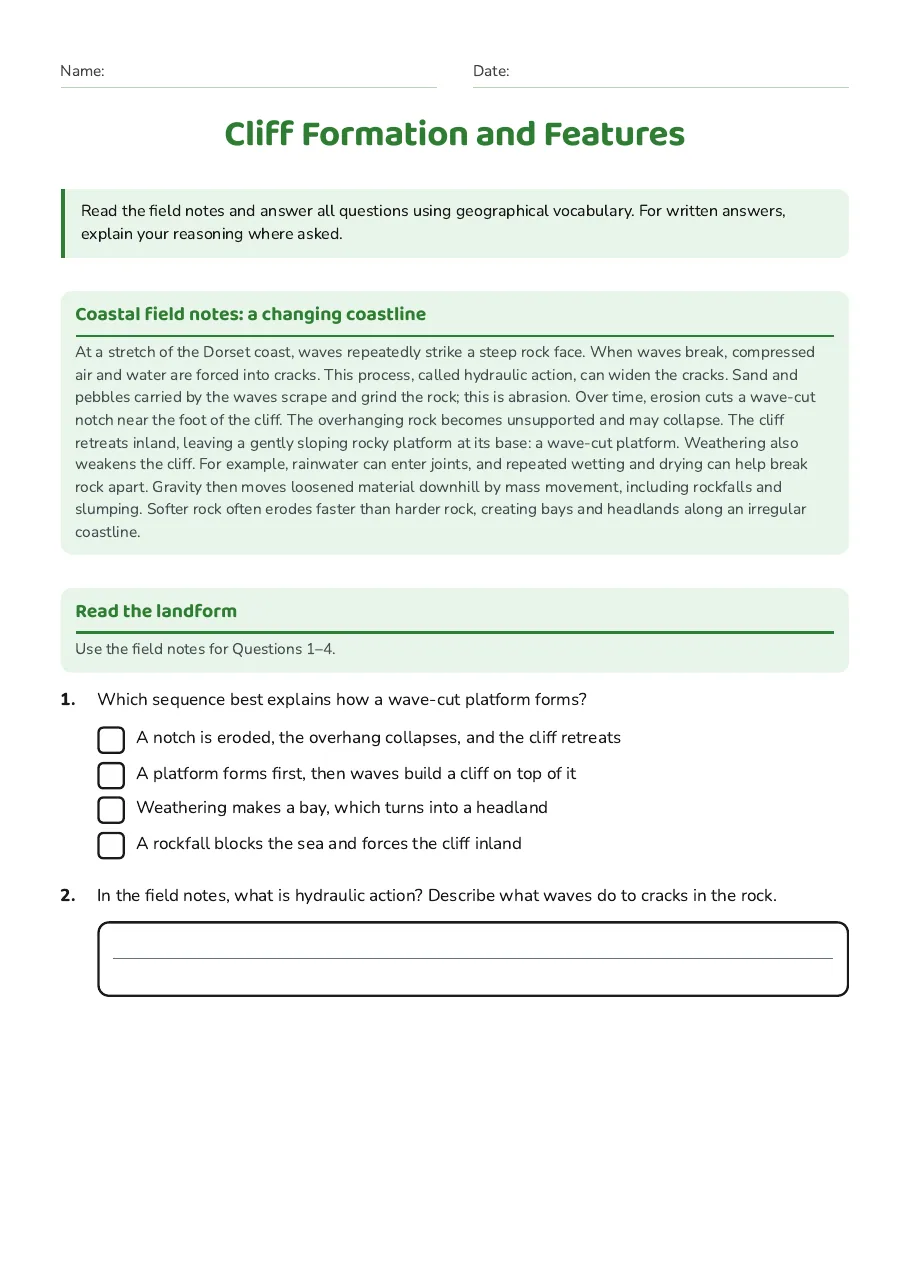
Coastal field notes: a changing coastline
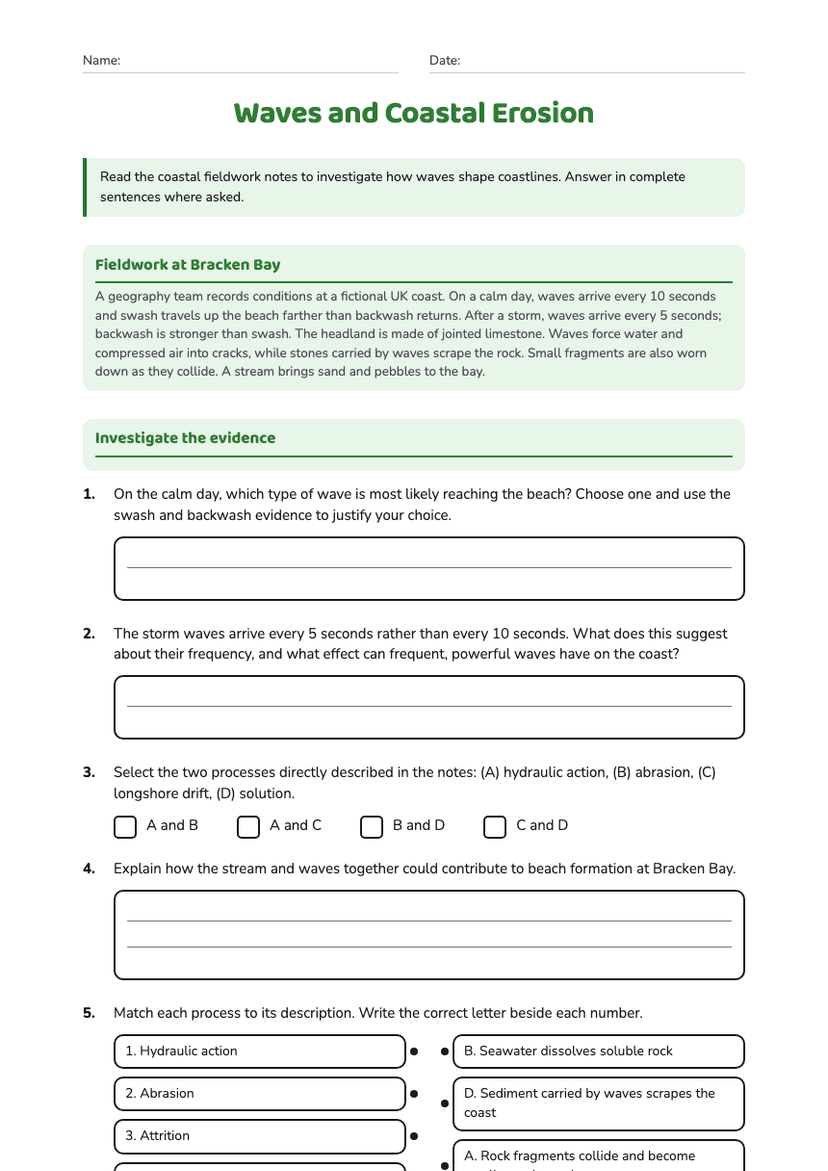
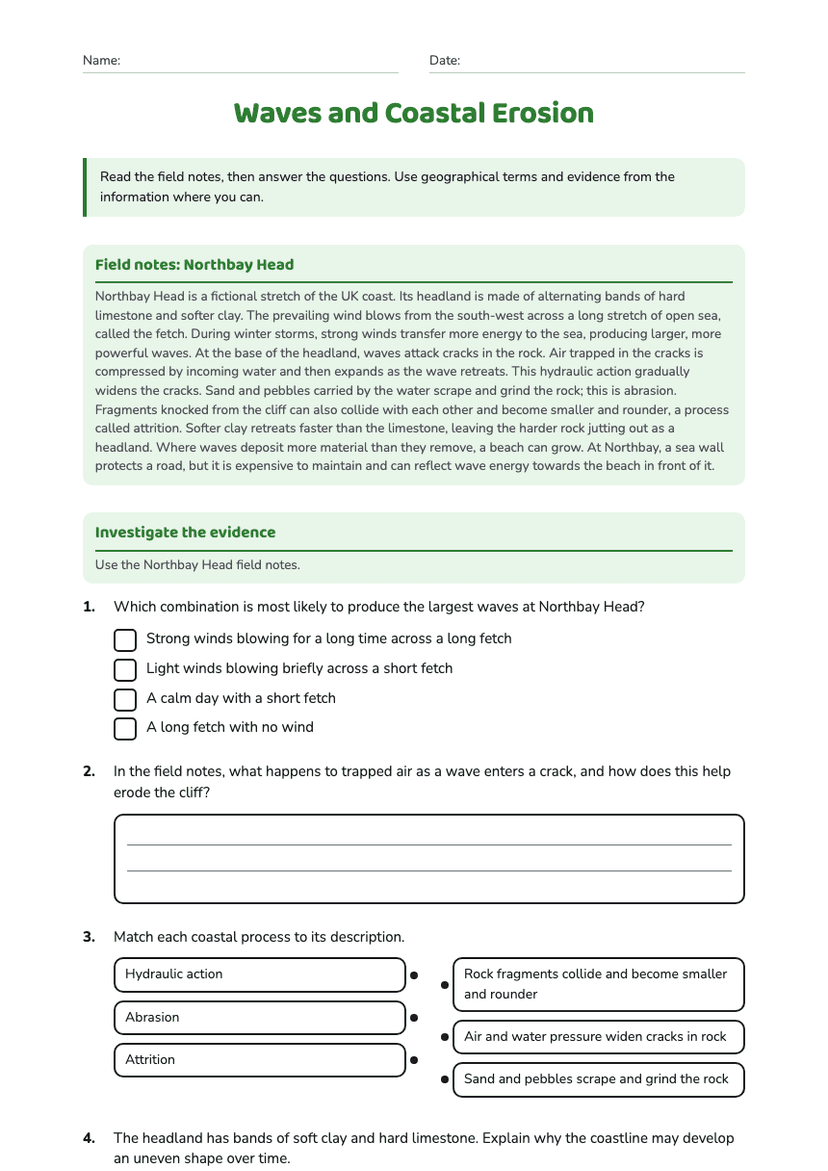
At a stretch of the Dorset coast, waves repeatedly strike a steep rock face. When waves break, compressed air and water are forced into cracks. This process, called hydraulic action, can widen the cracks. Sand and pebbles carried by the waves scrape and grind the rock; this is abrasion. Over time, erosion cuts a wave-cut notch near the foot of the cliff. The overhanging rock becomes unsupported and may collapse. The cliff retreats inland, leaving a gently sloping rocky platform at its base: a wave-cut platform. Weathering also weakens the cliff. For example, rainwater can enter joints, and repeated wetting and drying can help break rock apart. Gravity then moves loosened material downhill by mass movement, including rockfalls and slumping. Softer rock often erodes faster than harder rock, creating bays and headlands along an irregular coastline.
Read the landform
Use the field notes for Questions 1–4.
- A notch is eroded, the overhang collapses, and the cliff retreats
- A platform forms first, then waves build a cliff on top of it
- Weathering makes a bay, which turns into a headland
- A rockfall blocks the sea and forces the cliff inland
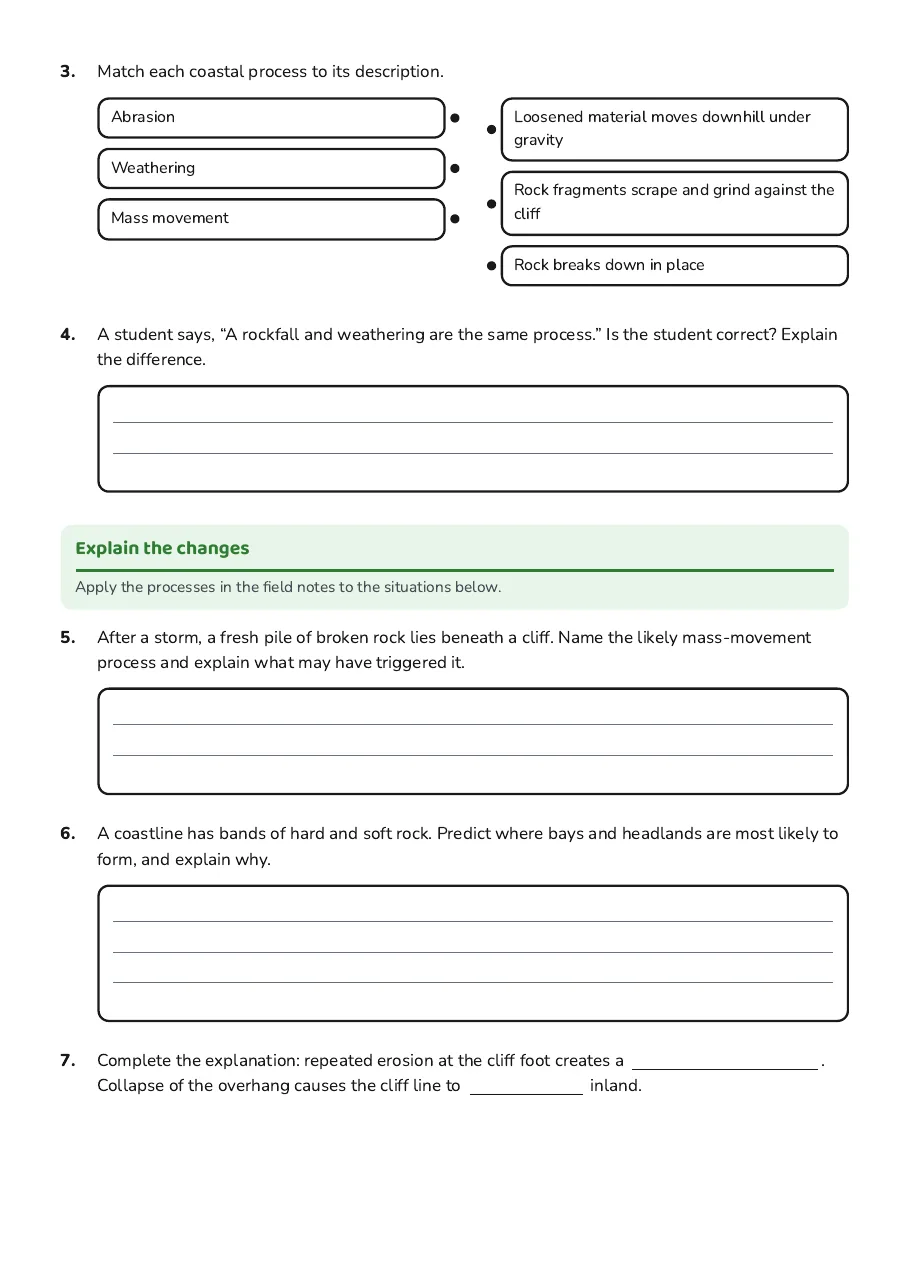
- Abrasion
- Weathering
- Mass movement
- Loosened material moves downhill under gravity
- Rock fragments scrape and grind against the cliff
- Rock breaks down in place
Explain the changes
Apply the processes in the field notes to the situations below.
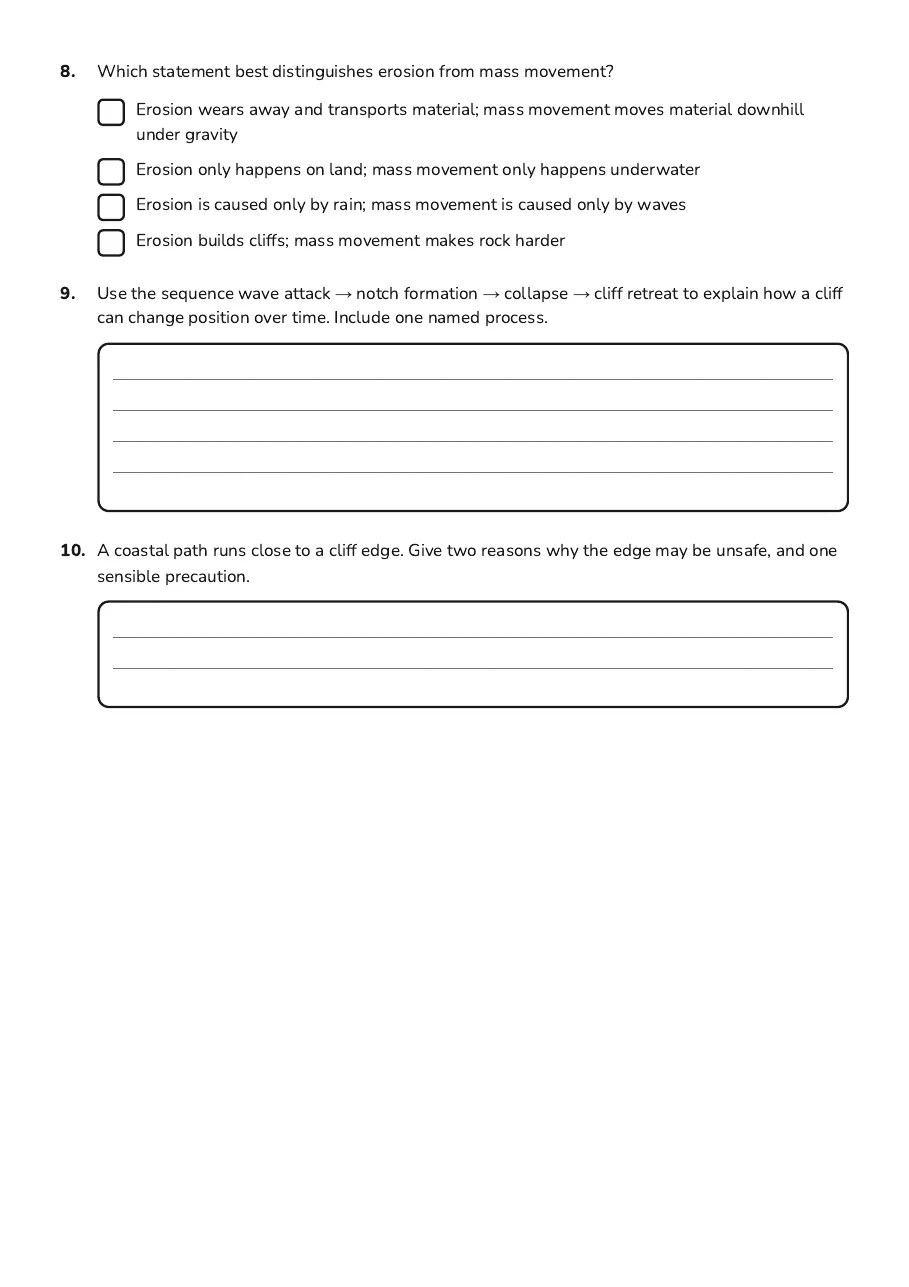
- Erosion wears away and transports material; mass movement moves material downhill under gravity
- Erosion only happens on land; mass movement only happens underwater
- Erosion is caused only by rain; mass movement is caused only by waves
- Erosion builds cliffs; mass movement makes rock harder
3 printable pages
Page 1
Page 2
Page 3
About This Worksheet
Free in Kuraplan
Sign up free, grab the PDF, and customize it for your class.
Print-Ready
Formatted for standard paper. Clean layout, easy to read.
AI-Generated
Created with Kuraplan's AI, designed for real classroom use.
For Teachers & Parents
Use in classrooms, for homework, tutoring, or homeschool.
Need a custom version of this worksheet?
Kuraplan's AI generates custom worksheets in seconds — differentiated for every learner, aligned to your curriculum.
Generate Custom Worksheets — Free