Coastal Deposition Basics
A free geography worksheet ready for your classroom. Open in Kuraplan to grab the print-ready PDF, customize it for your students, or generate a fresh version in seconds.
Coastal Deposition Basics
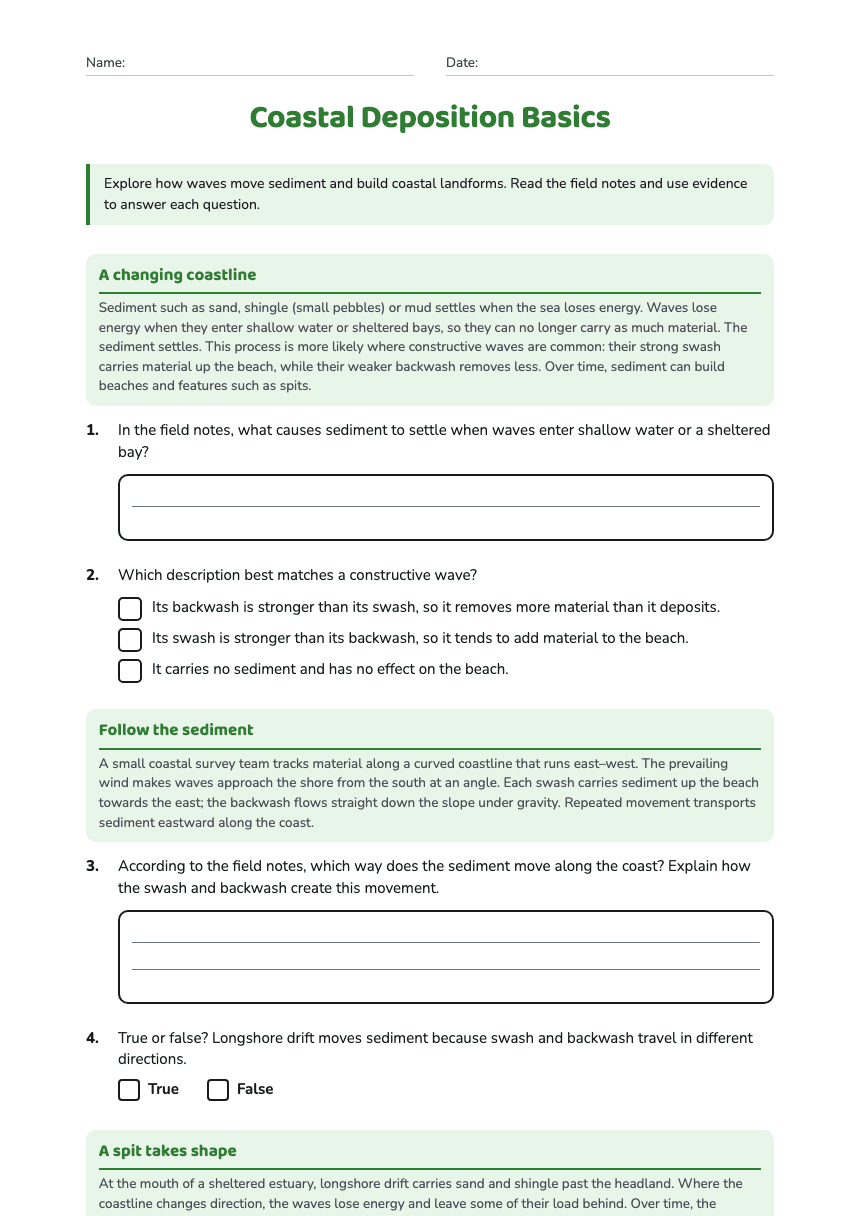
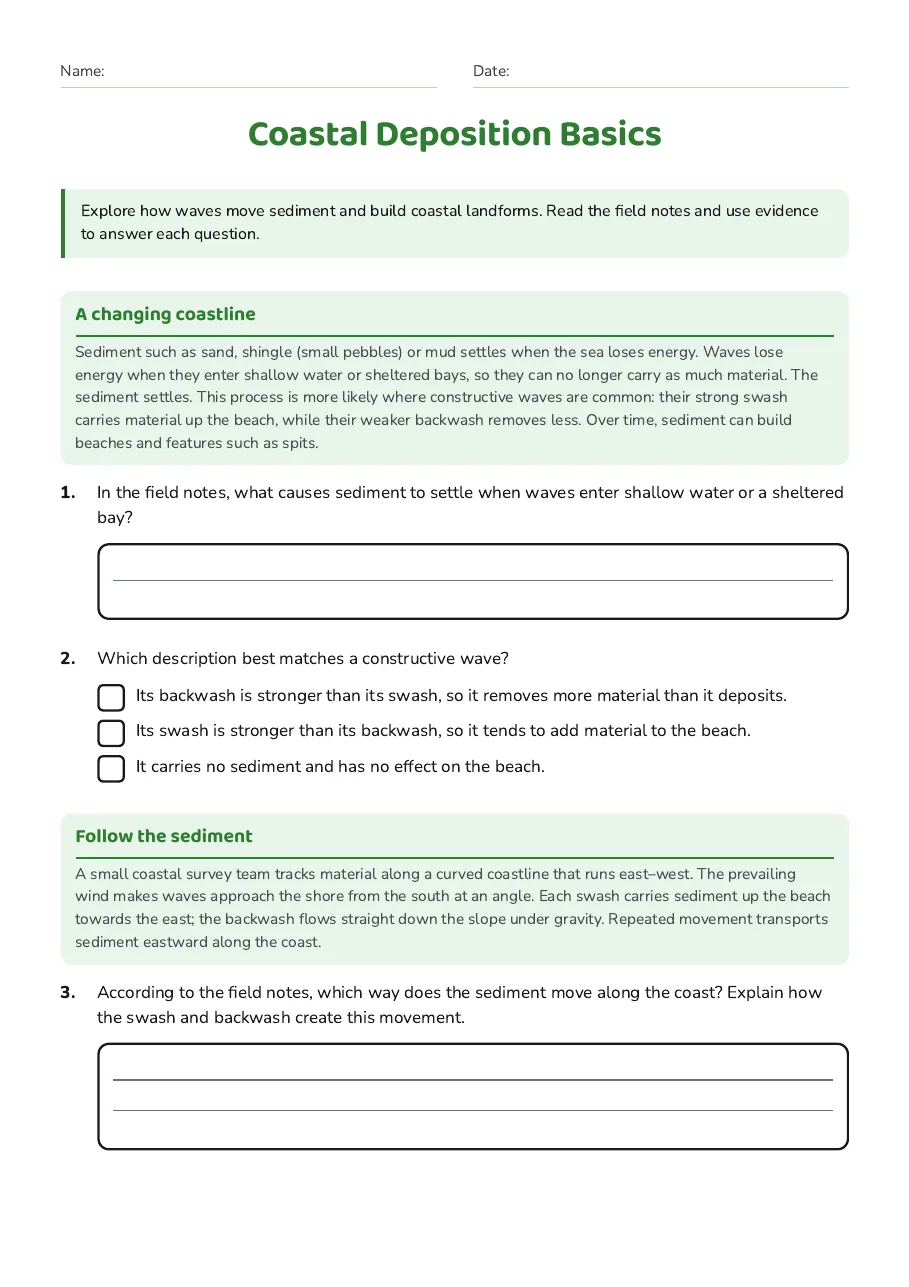
A changing coastline
Sediment such as sand, shingle (small pebbles) or mud settles when the sea loses energy. Waves lose energy when they enter shallow water or sheltered bays, so they can no longer carry as much material. The sediment settles. This process is more likely where constructive waves are common: their strong swash carries material up the beach, while their weaker backwash removes less. Over time, sediment can build beaches and features such as spits.
- Its backwash is stronger than its swash, so it removes more material than it deposits.
- Its swash is stronger than its backwash, so it tends to add material to the beach.
- It carries no sediment and has no effect on the beach.
Follow the sediment
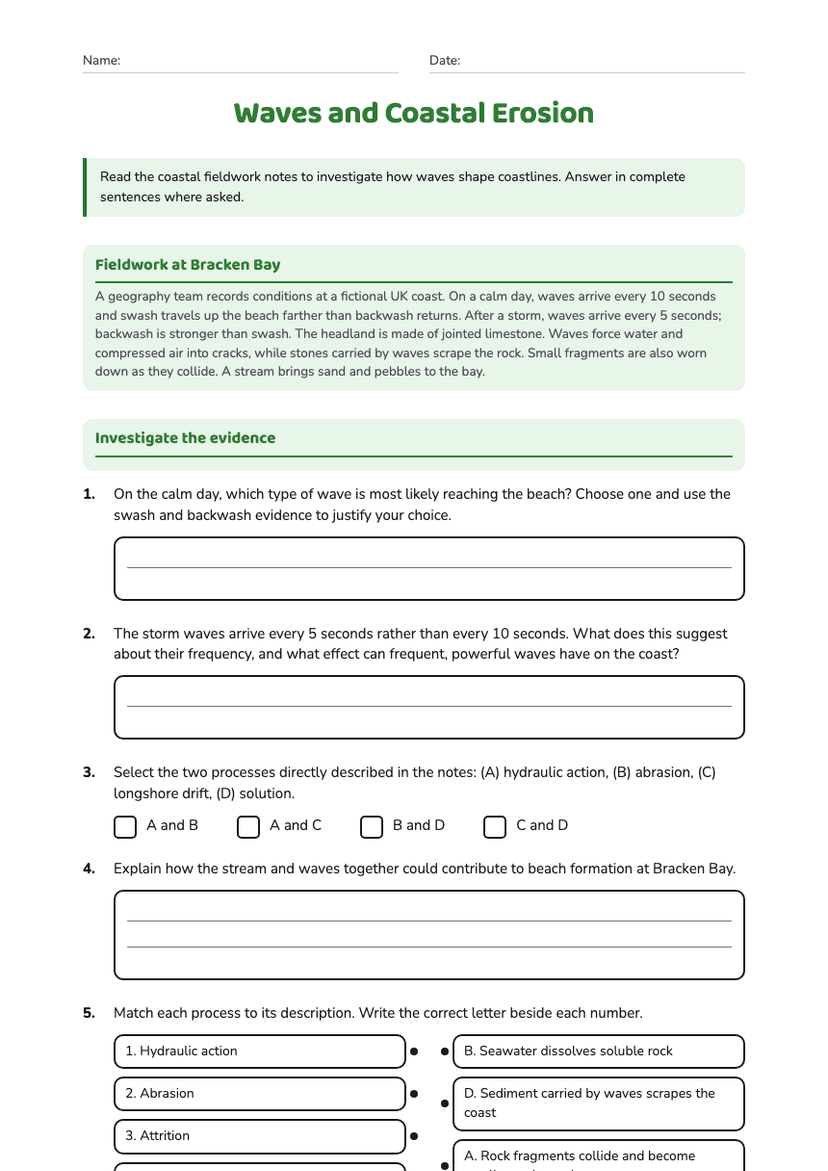
A small coastal survey team tracks material along a curved coastline that runs east–west. The prevailing wind makes waves approach the shore from the south at an angle. Each swash carries sediment up the beach towards the east; the backwash flows straight down the slope under gravity. Repeated movement transports sediment eastward along the coast.
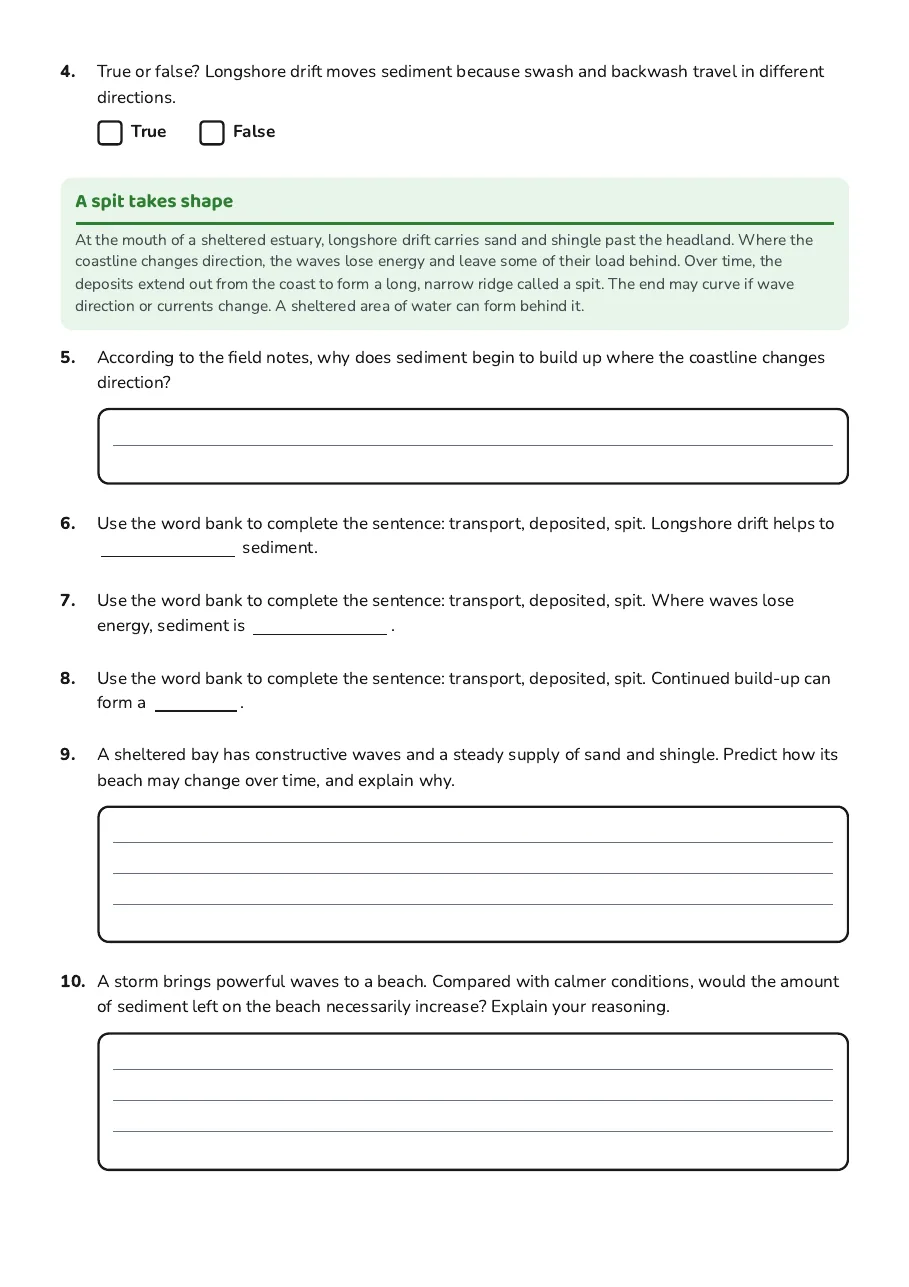
A spit takes shape
At the mouth of a sheltered estuary, longshore drift carries sand and shingle past the headland. Where the coastline changes direction, the waves lose energy and leave some of their load behind. Over time, the deposits extend out from the coast to form a long, narrow ridge called a spit. The end may curve if wave direction or currents change. A sheltered area of water can form behind it.
3 printable pages
Page 1
Page 2
Page 3
About This Worksheet
Free in Kuraplan
Sign up free, grab the PDF, and customize it for your class.
Print-Ready
Formatted for standard paper. Clean layout, easy to read.
AI-Generated
Created with Kuraplan's AI, designed for real classroom use.
For Teachers & Parents
Use in classrooms, for homework, tutoring, or homeschool.
Need a custom version of this worksheet?
Kuraplan's AI generates custom worksheets in seconds — differentiated for every learner, aligned to your curriculum.
Generate Custom Worksheets — Free