Plate Margins and Movement
A free geography worksheet ready for your classroom. Open in Kuraplan to grab the print-ready PDF, customize it for your students, or generate a fresh version in seconds.
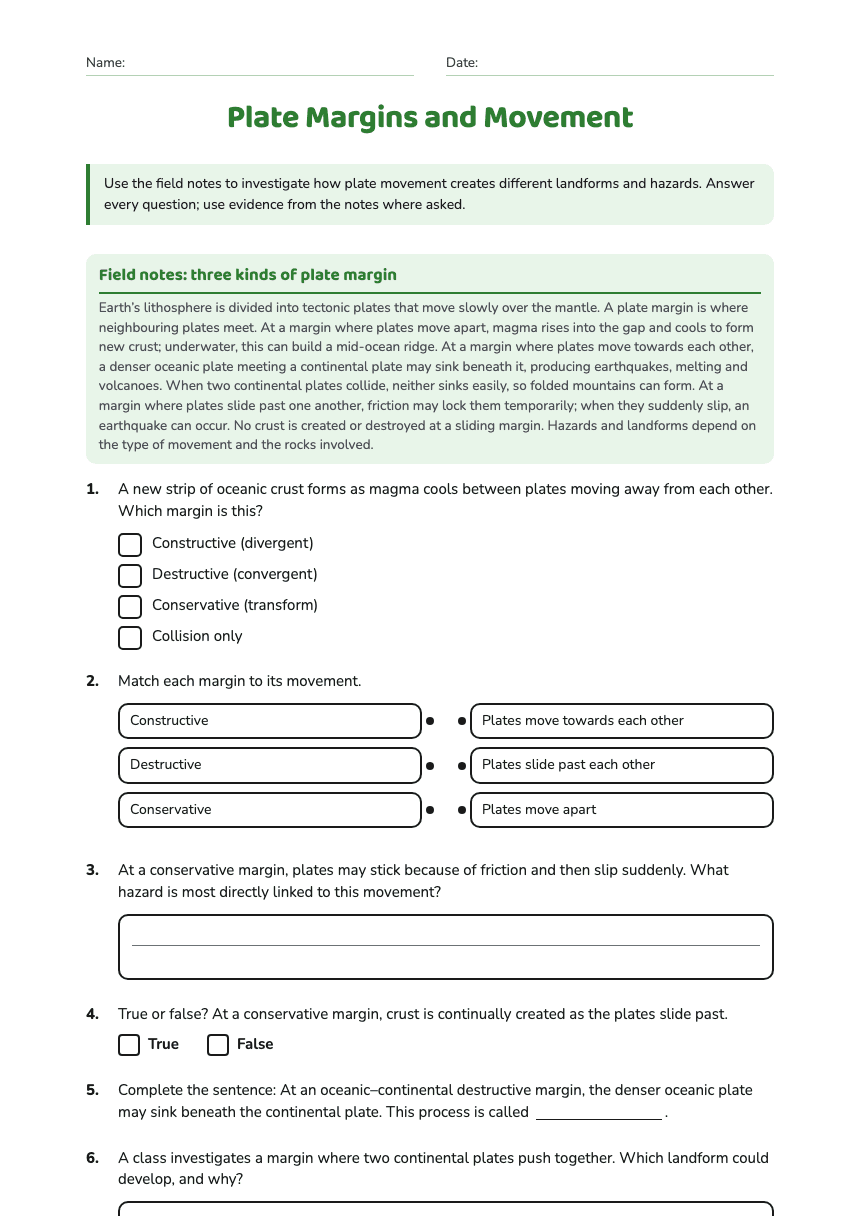
Plate Margins and Movement
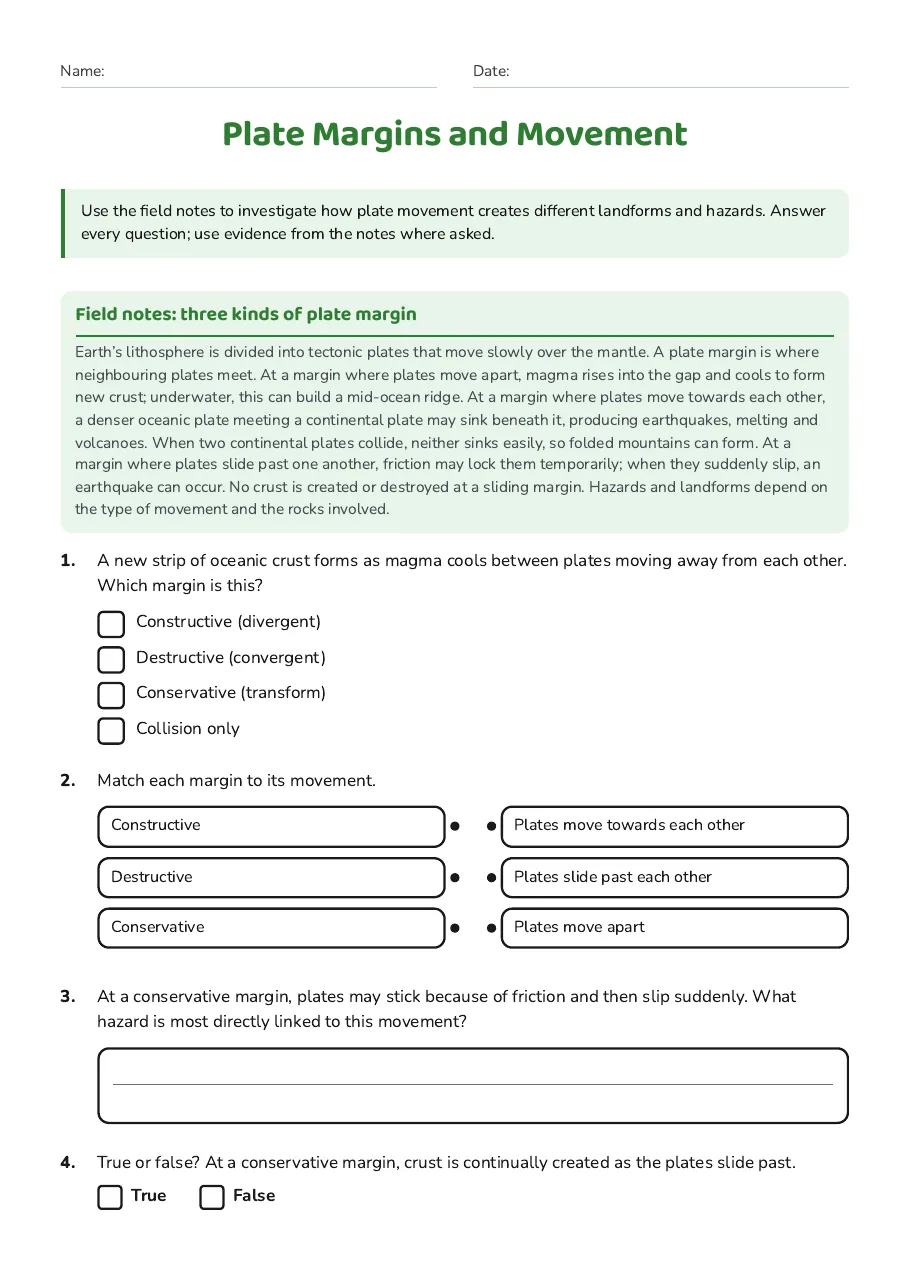
Field notes: three kinds of plate margin
Earth’s lithosphere is divided into tectonic plates that move slowly over the mantle. A plate margin is where neighbouring plates meet. At a margin where plates move apart, magma rises into the gap and cools to form new crust; underwater, this can build a mid-ocean ridge. At a margin where plates move towards each other, a denser oceanic plate meeting a continental plate may sink beneath it, producing earthquakes, melting and volcanoes. When two continental plates collide, neither sinks easily, so folded mountains can form. At a margin where plates slide past one another, friction may lock them temporarily; when they suddenly slip, an earthquake can occur. No crust is created or destroyed at a sliding margin. Hazards and landforms depend on the type of movement and the rocks involved.
- Constructive (divergent)
- Destructive (convergent)
- Conservative (transform)
- Collision only
- Constructive
- Destructive
- Conservative
- Plates move towards each other
- Plates slide past each other
- Plates move apart
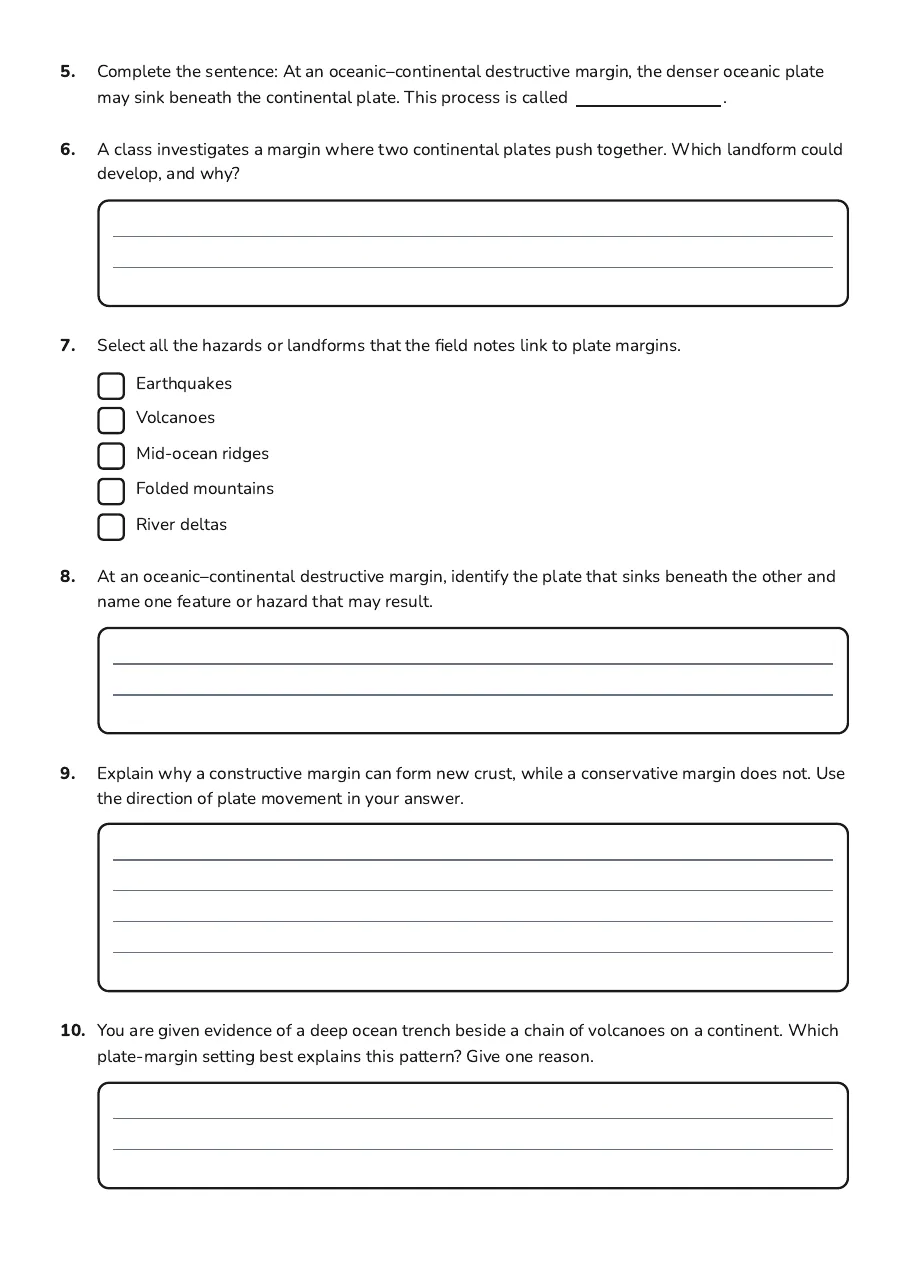
- Earthquakes
- Volcanoes
- Mid-ocean ridges
- Folded mountains
- River deltas
2 printable pages
Page 1
Page 2
About This Worksheet
Free in Kuraplan
Sign up free, grab the PDF, and customize it for your class.
Print-Ready
Formatted for standard paper. Clean layout, easy to read.
AI-Generated
Created with Kuraplan's AI, designed for real classroom use.
For Teachers & Parents
Use in classrooms, for homework, tutoring, or homeschool.
Need a custom version of this worksheet?
Kuraplan's AI generates custom worksheets in seconds — differentiated for every learner, aligned to your curriculum.
Generate Custom Worksheets — Free