Formal Sentence Mastery
A free english worksheet ready for your classroom. Open in Kuraplan to grab the print-ready PDF, customize it for your students, or generate a fresh version in seconds.
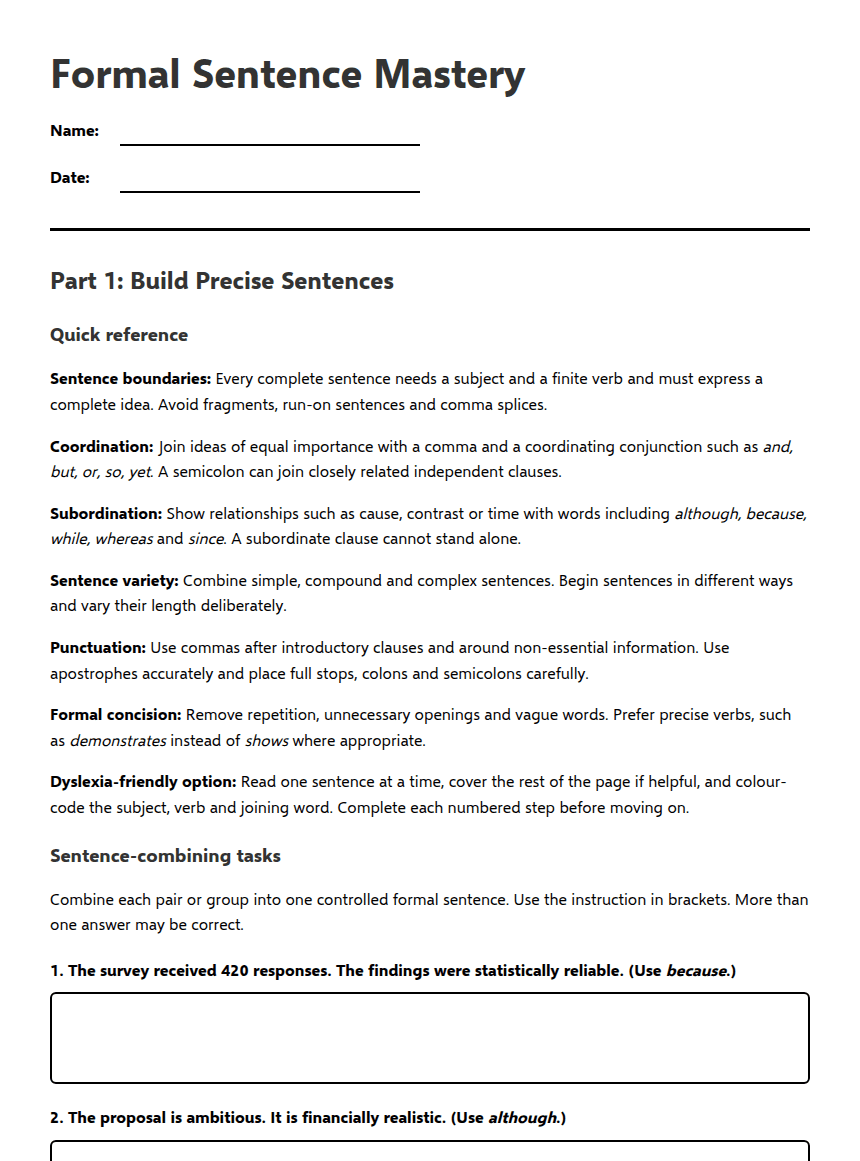
Formal Sentence Mastery
Part 1: Build Precise Sentences
Quick reference
Sentence boundaries: Every complete sentence needs a subject and a finite verb and must express a complete idea. Avoid fragments, run-on sentences and comma splices.
Coordination: Join ideas of equal importance with a comma and a coordinating conjunction such as and, but, or, so, yet. A semicolon can join closely related independent clauses.
Subordination: Show relationships such as cause, contrast or time with words including although, because, while, whereas and since. A subordinate clause cannot stand alone.
Sentence variety: Combine simple, compound and complex sentences. Begin sentences in different ways and vary their length deliberately.
Punctuation: Use commas after introductory clauses and around non-essential information. Use apostrophes accurately and place full stops, colons and semicolons carefully.
Formal concision: Remove repetition, unnecessary openings and vague words. Prefer precise verbs, such as demonstrates instead of shows where appropriate.
Dyslexia-friendly option: Read one sentence at a time, cover the rest of the page if helpful, and colour-code the subject, verb and joining word. Complete each numbered step before moving on.
Sentence-combining tasks
Combine each pair or group into one controlled formal sentence. Use the instruction in brackets. More than one answer may be correct.
Part 2: Correct and Refine
A. Correct the sentence
Rewrite each sentence. Identify the main problem mentally before editing: fragment, run-on, comma splice, faulty parallelism, unclear reference, misplaced modifier, agreement, punctuation or repetition.
B. Rewrite formally
Replace informal or vague wording with precise, appropriately formal language. Keep the original meaning.
Independent editing challenge
Edit this paragraph for sentence boundaries, punctuation, agreement, formality and concision. Optional extension: explain two of your changes.
The findings from the consultation was useful, however they were not conclusive. The report was written quickly it contains several repeated points and it does not clearly explain what action should be taken. Having considered the feedback, further research is recommended by the team.
Extension: Rewrite one sentence using a semicolon and another using a subordinate clause.
Part 3: Answer Key and Explanations
Note: Sentence-combining answers may vary. These are model answers; accept alternatives that preserve meaning and use accurate grammar and punctuation.
1. Because the survey received 420 responses, its findings were statistically reliable. The subordinate clause explains the reason.
2. Although the proposal is ambitious, it is financially realistic. The comma follows the introductory subordinate clause.
3. The report identifies a decline in attendance; it recommends additional evening sessions. A semicolon joins closely related independent clauses.
4. The committee, which met on Tuesday, approved the revised policy. The relative clause adds non-essential information.
5. Having reviewed the evidence, the researcher amended the conclusion. The participial phrase correctly refers to the researcher.
6. The placement not only provided valuable experience but also improved the applicant’s confidence. The paired structure is parallel.
7. Despite submitting the application after the deadline, the applicant explained the delay clearly. Despite is followed by a noun or -ing form.
8. The email contains several useful suggestions; however, its tone is unnecessarily informal. A semicolon precedes the linking adverb and a comma follows it.
9. The report was not available. The original is a fragment because because introduces an incomplete idea.
10. The interview ended, and the panel immediately compared its notes. The conjunction joins the two complete clauses.
11. Although the evidence is limited, the conclusion remains persuasive. The comma splice is replaced by subordination.
12. The role requires applicants to research thoroughly, write clearly and present confidently. The list uses parallel verb forms.
13. The department sent the students a revised timetable, which caused considerable confusion. The relative pronoun makes the reference clear.
14. Having reviewed the accounts, the treasurer amended the budget. The person reviewing the accounts must be the grammatical subject.
15. A range of solutions is discussed in the report. The head noun range is singular.
16. The report examines staff retention; it also evaluates recruitment costs. The comma splice is corrected with a semicolon.
17. The findings, which were published last week, demonstrate a significant change. The non-essential relative clause needs two commas.
18. The committee discussed the proposal and revised timetable before making a decision. Repetition is reduced without changing the meaning.
19. The results were unusual, and many participants did not respond. Vague and informal wording is replaced with precise vocabulary.
20. I am writing to enquire about employment opportunities at your organisation. The request is made in an appropriately formal way.
21. The manager investigated the problem and identified its cause. The phrasal verbs are replaced with precise verbs.
22. Thank you for your prompt response. This is concise and formal.
23. We need to resolve the issue before the meeting. Resolve is more precise than sort out.
24. The new system is effective because it streamlines the process. Informal intensifiers and vague wording are removed.
25. There are numerous reasons why the project was unsuccessful. The informal quantifier is replaced with a formal alternative.
26. I recommend substantial revisions to the report. The hesitant, repetitive structure is replaced with a direct recommendation.
Editing challenge model: The consultation findings were useful; however, they were not conclusive. The report was written quickly, contains several repeated points and does not clearly explain what action should be taken. Having considered the feedback, the team recommends further research.
Key changes: Findings requires the plural verb were; a semicolon and comma correctly punctuate however; the run-on sentence is repaired; repetition is reduced; and the misplaced modifier is corrected by making the team the subject of having considered.
About This Worksheet
Free in Kuraplan
Sign up free, grab the PDF, and customize it for your class.
Print-Ready
Formatted for standard paper. Clean layout, easy to read.
AI-Generated
Created with Kuraplan's AI, designed for real classroom use.
For Teachers & Parents
Use in classrooms, for homework, tutoring, or homeschool.
Need a custom version of this worksheet?
Kuraplan's AI generates custom worksheets in seconds — differentiated for every learner, aligned to your curriculum.
Generate Custom Worksheets — Free