Ice Cream History Comprehension
A free english worksheet ready for your classroom. Open in Kuraplan to grab the print-ready PDF, customize it for your students, or generate a fresh version in seconds.
Ice Cream History Comprehension
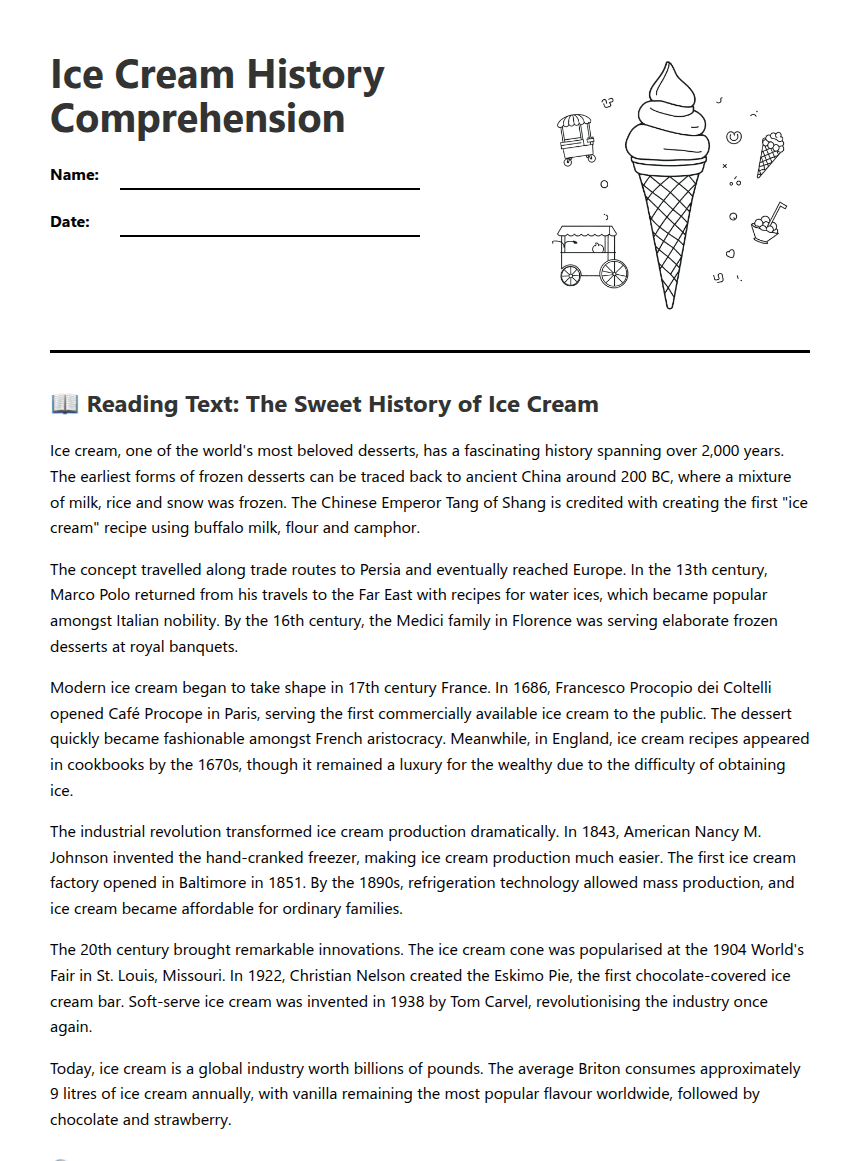
📖 Reading Text: The Sweet History of Ice Cream
Ice cream, one of the world's most beloved desserts, has a fascinating history spanning over 2,000 years. The earliest forms of frozen desserts can be traced back to ancient China around 200 BC, where a mixture of milk, rice and snow was frozen. The Chinese Emperor Tang of Shang is credited with creating the first "ice cream" recipe using buffalo milk, flour and camphor.
The concept travelled along trade routes to Persia and eventually reached Europe. In the 13th century, Marco Polo returned from his travels to the Far East with recipes for water ices, which became popular amongst Italian nobility. By the 16th century, the Medici family in Florence was serving elaborate frozen desserts at royal banquets.
Modern ice cream began to take shape in 17th century France. In 1686, Francesco Procopio dei Coltelli opened Café Procope in Paris, serving the first commercially available ice cream to the public. The dessert quickly became fashionable amongst French aristocracy. Meanwhile, in England, ice cream recipes appeared in cookbooks by the 1670s, though it remained a luxury for the wealthy due to the difficulty of obtaining ice.
The industrial revolution transformed ice cream production dramatically. In 1843, American Nancy M. Johnson invented the hand-cranked freezer, making ice cream production much easier. The first ice cream factory opened in Baltimore in 1851. By the 1890s, refrigeration technology allowed mass production, and ice cream became affordable for ordinary families.
The 20th century brought remarkable innovations. The ice cream cone was popularised at the 1904 World's Fair in St. Louis, Missouri. In 1922, Christian Nelson created the Eskimo Pie, the first chocolate-covered ice cream bar. Soft-serve ice cream was invented in 1938 by Tom Carvel, revolutionising the industry once again.
Today, ice cream is a global industry worth billions of pounds. The average Briton consumes approximately 9 litres of ice cream annually, with vanilla remaining the most popular flavour worldwide, followed by chocolate and strawberry.
🔍 Part 1: Retrieval Questions (1-8)
🔍 Part 2: Retrieval Questions (9-12)
About This Worksheet
Free in Kuraplan
Sign up free, grab the PDF, and customize it for your class.
Print-Ready
Formatted for standard paper. Clean layout, easy to read.
AI-Generated
Created with Kuraplan's AI, designed for real classroom use.
For Teachers & Parents
Use in classrooms, for homework, tutoring, or homeschool.
Need a custom version of this worksheet?
Kuraplan's AI generates custom worksheets in seconds — differentiated for every learner, aligned to your curriculum.
Generate Custom Worksheets — Free