Juliet's Character Development
A free english worksheet ready for your classroom. Open in Kuraplan to grab the print-ready PDF, customize it for your students, or generate a fresh version in seconds.
Juliet's Character Development
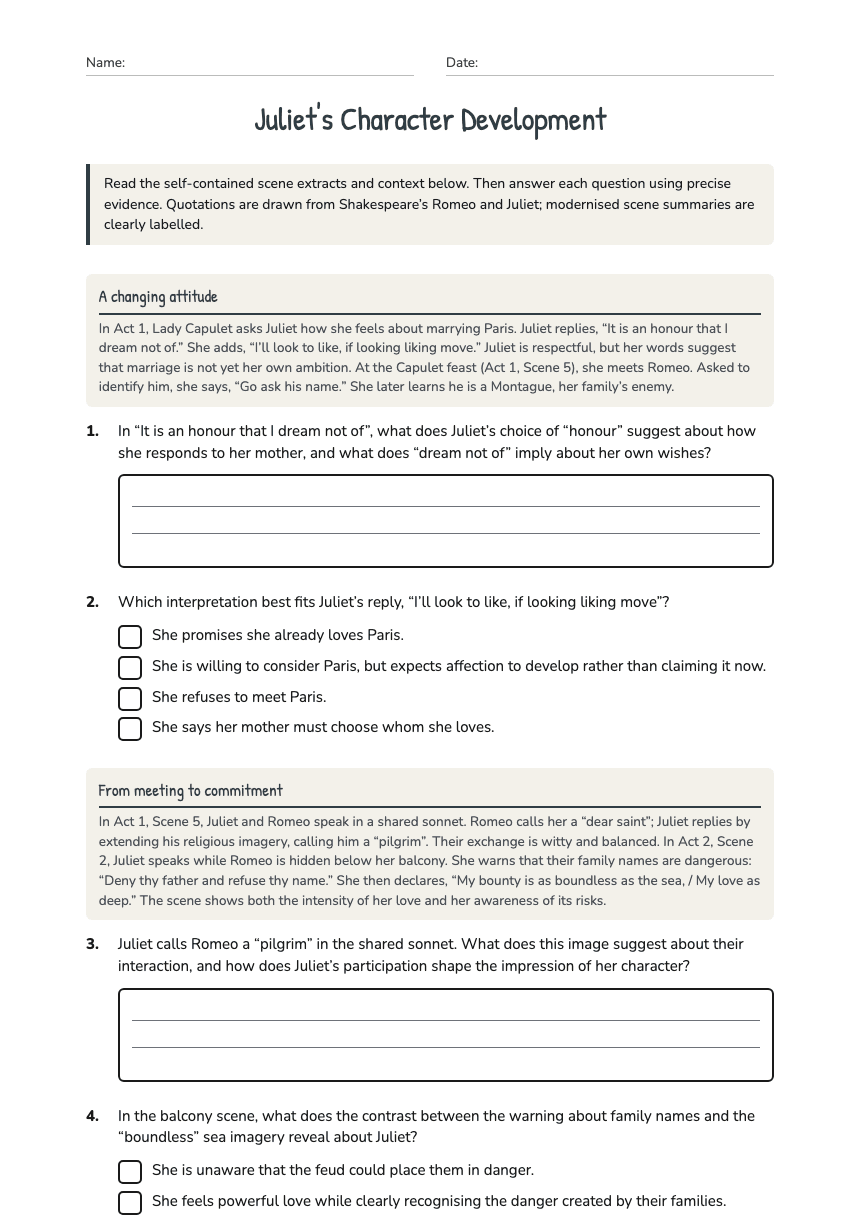
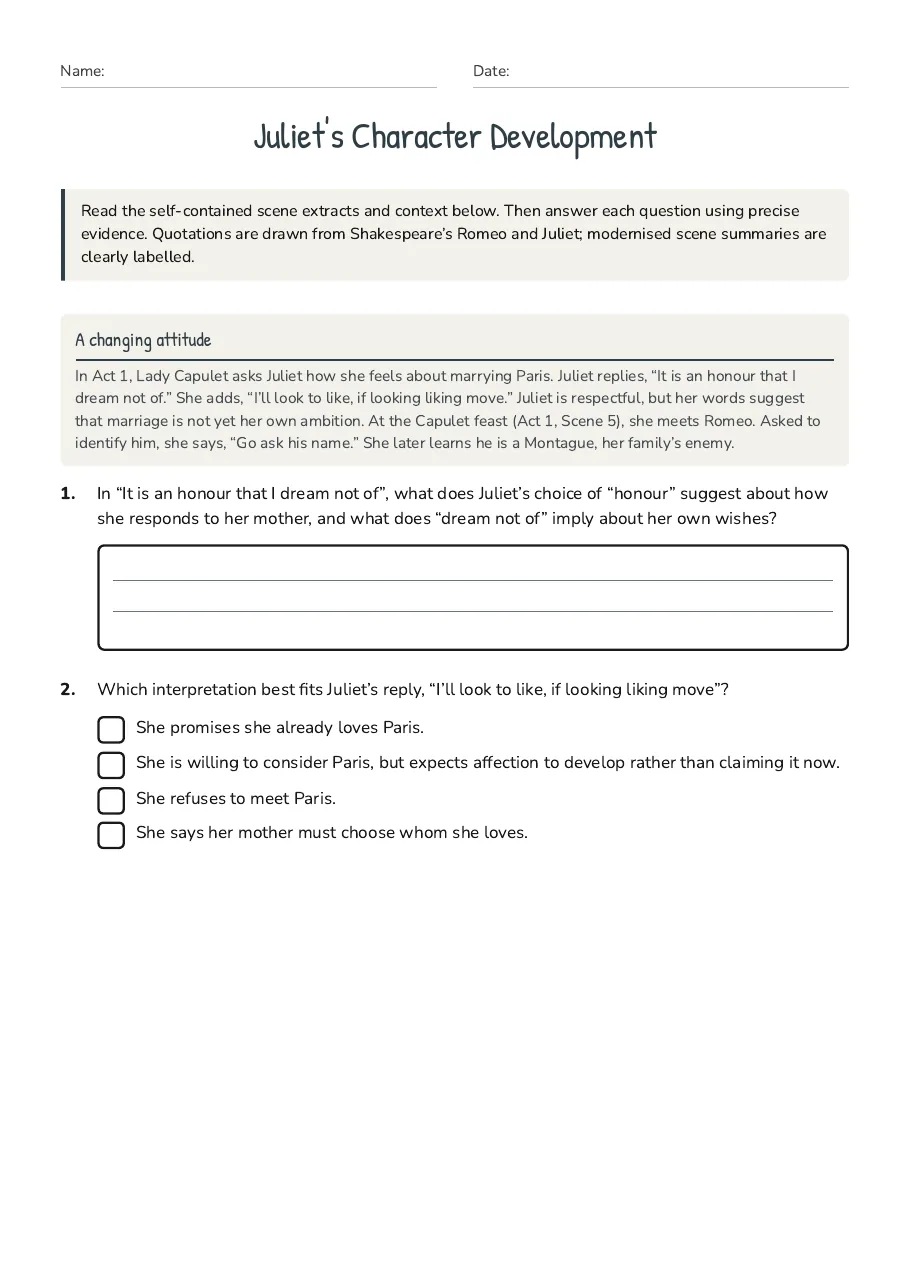
A changing attitude
In Act 1, Lady Capulet asks Juliet how she feels about marrying Paris. Juliet replies, “It is an honour that I dream not of.” She adds, “I’ll look to like, if looking liking move.” Juliet is respectful, but her words suggest that marriage is not yet her own ambition. At the Capulet feast (Act 1, Scene 5), she meets Romeo. Asked to identify him, she says, “Go ask his name.” She later learns he is a Montague, her family’s enemy.
- She promises she already loves Paris.
- She is willing to consider Paris, but expects affection to develop rather than claiming it now.
- She refuses to meet Paris.
- She says her mother must choose whom she loves.
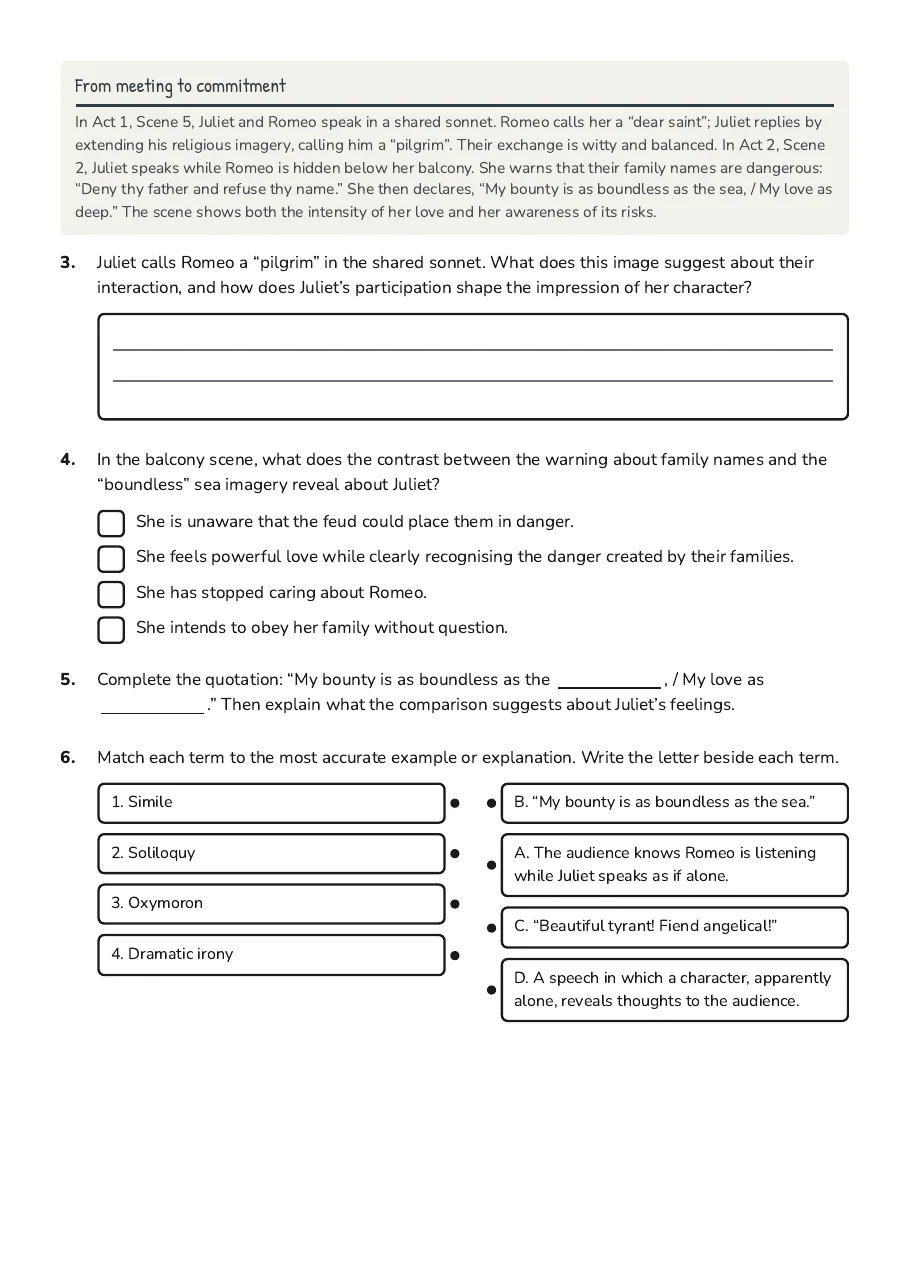
From meeting to commitment
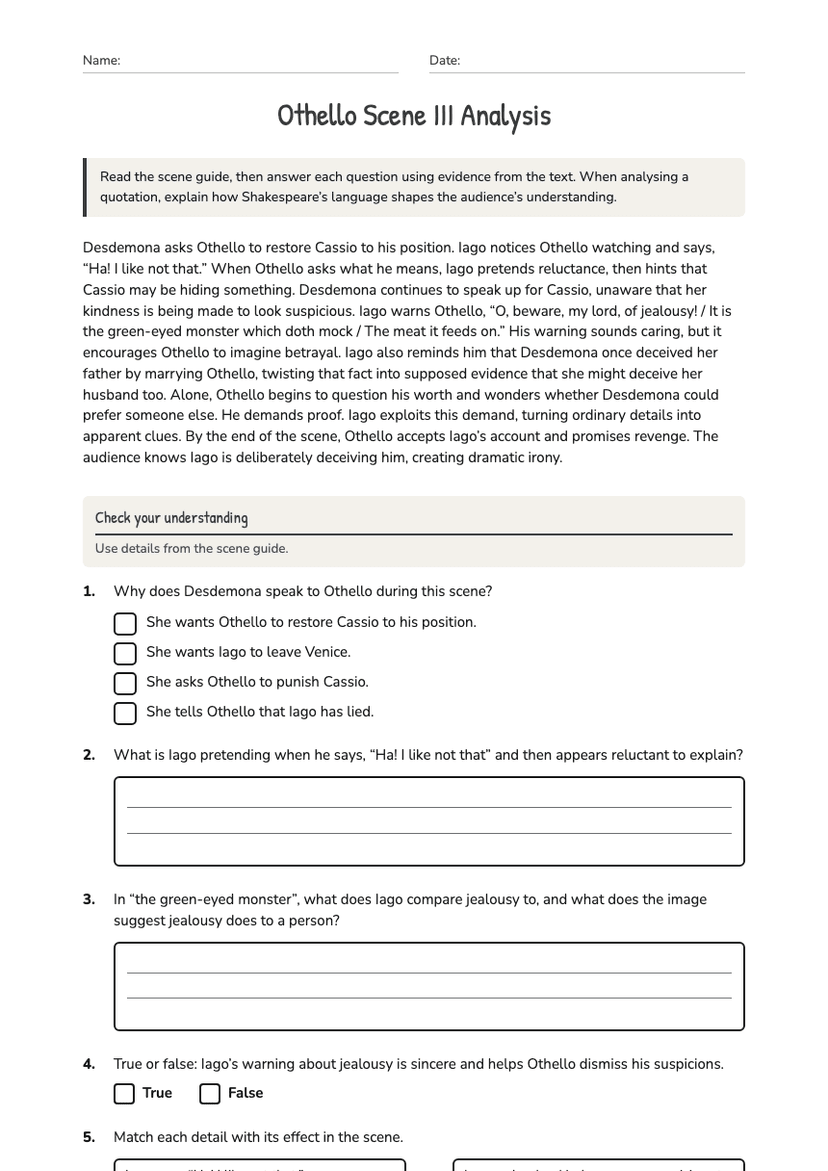
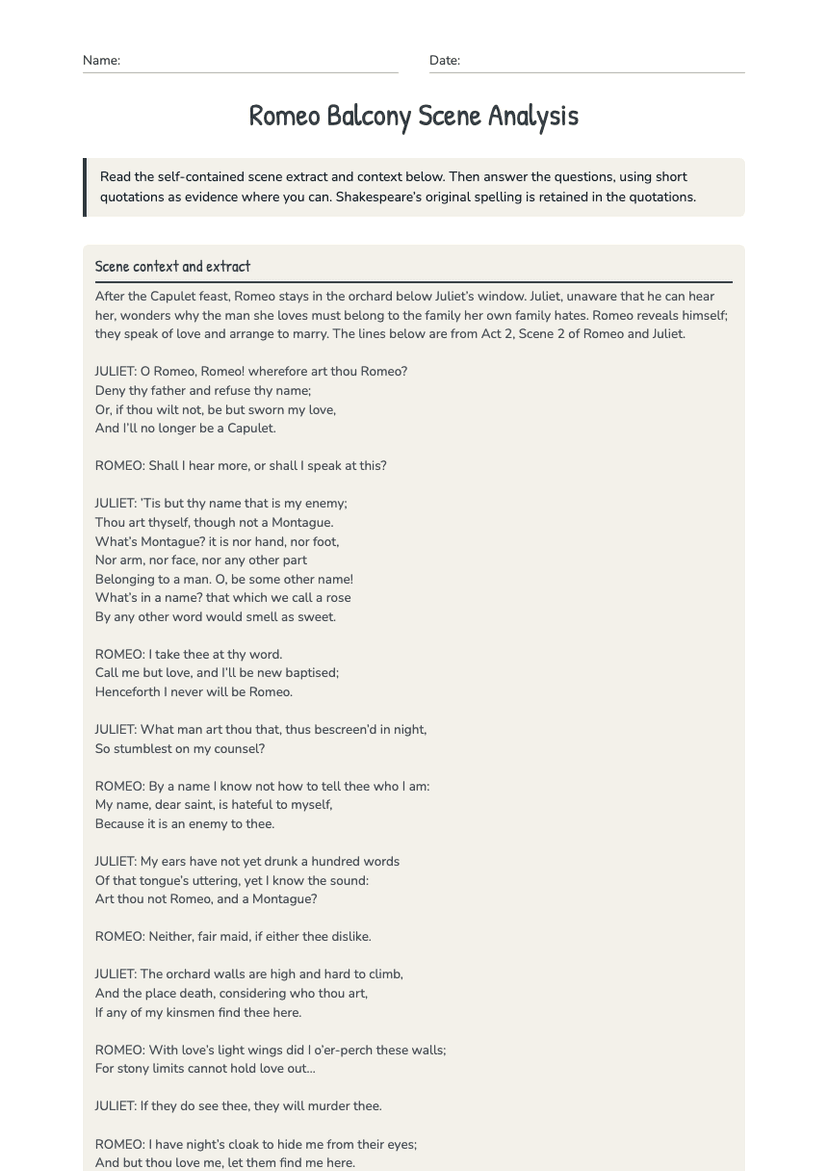
In Act 1, Scene 5, Juliet and Romeo speak in a shared sonnet. Romeo calls her a “dear saint”; Juliet replies by extending his religious imagery, calling him a “pilgrim”. Their exchange is witty and balanced. In Act 2, Scene 2, Juliet speaks while Romeo is hidden below her balcony. She warns that their family names are dangerous: “Deny thy father and refuse thy name.” She then declares, “My bounty is as boundless as the sea, / My love as deep.” The scene shows both the intensity of her love and her awareness of its risks.
- She is unaware that the feud could place them in danger.
- She feels powerful love while clearly recognising the danger created by their families.
- She has stopped caring about Romeo.
- She intends to obey her family without question.
- 1. Simile
- 2. Soliloquy
- 3. Oxymoron
- 4. Dramatic irony
- B. “My bounty is as boundless as the sea.”
- A. The audience knows Romeo is listening while Juliet speaks as if alone.
- C. “Beautiful tyrant! Fiend angelical!”
- D. A speech in which a character, apparently alone, reveals thoughts to the audience.
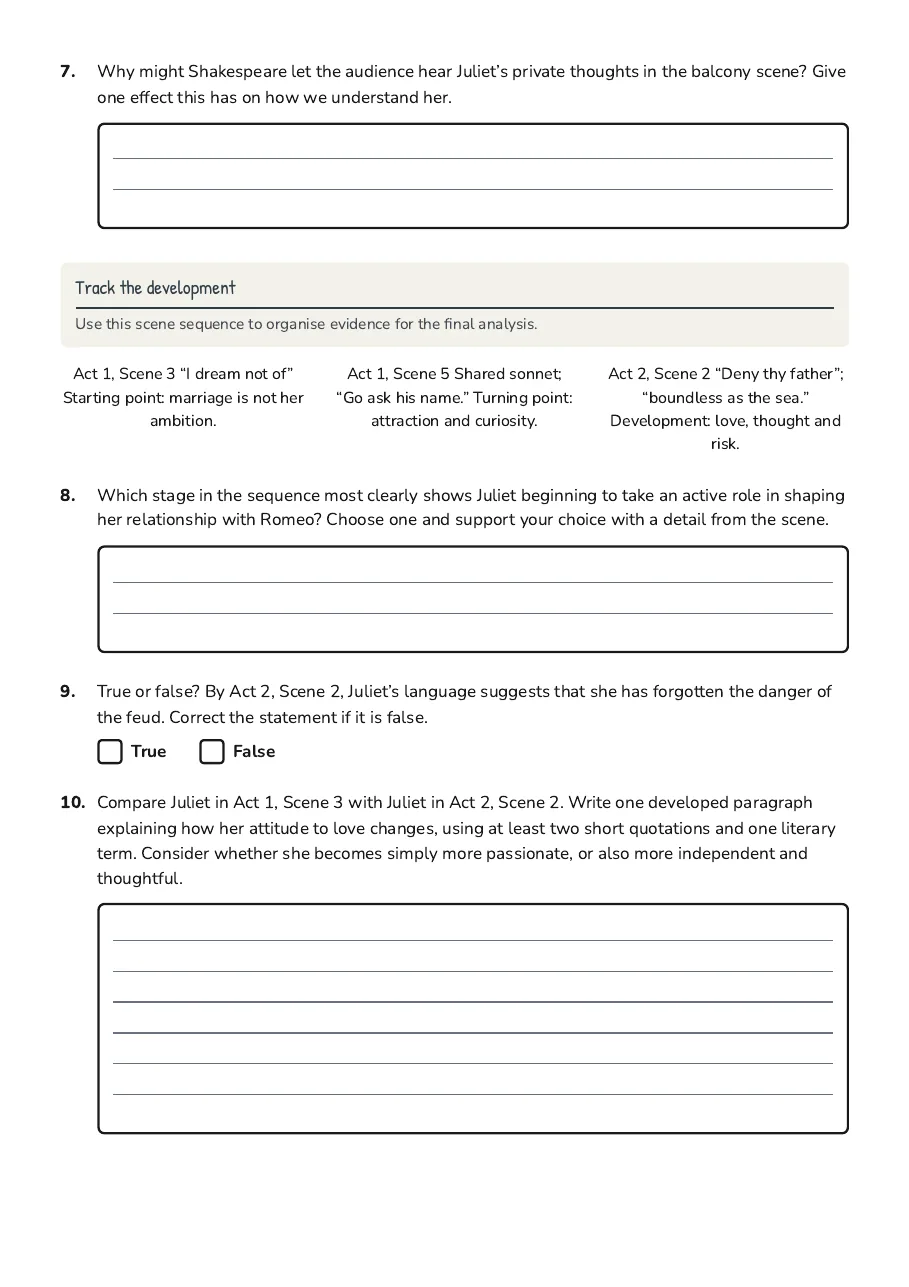
Track the development
Use this scene sequence to organise evidence for the final analysis.
Act 1, Scene 3 “I dream not of” Starting point: marriage is not her ambition.
Act 1, Scene 5 Shared sonnet; “Go ask his name.” Turning point: attraction and curiosity.
Act 2, Scene 2 “Deny thy father”; “boundless as the sea.” Development: love, thought and risk.
3 printable pages
Page 1
Page 2
Page 3
About This Worksheet
Free in Kuraplan
Sign up free, grab the PDF, and customize it for your class.
Print-Ready
Formatted for standard paper. Clean layout, easy to read.
AI-Generated
Created with Kuraplan's AI, designed for real classroom use.
For Teachers & Parents
Use in classrooms, for homework, tutoring, or homeschool.
Need a custom version of this worksheet?
Kuraplan's AI generates custom worksheets in seconds — differentiated for every learner, aligned to your curriculum.
Generate Custom Worksheets — Free